Real vs Fake Moldavite: Authentication Guide
Real vs fake moldavite identification starts with texture, color, inclusions, and origin clues. Rock Identifier helps compare a photo of green tektite-like material against visual mineral and glass references.


Drop a rock photo here or tap to upload
JPG, PNG, WebP, HEIC • Max 50 MB • 1 free scan per day

Analyzing your specimen…
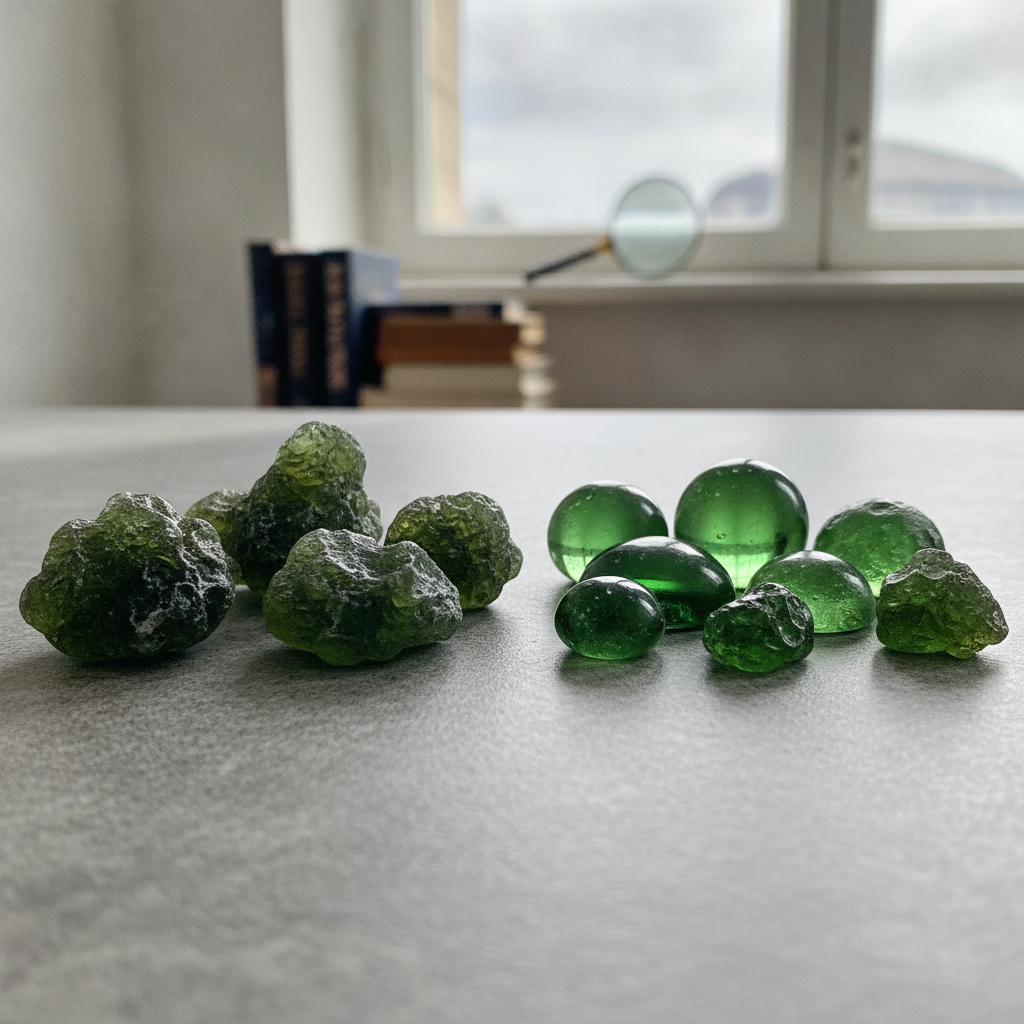
Quick answer: Real vs fake moldavite identification depends on texture, color, inclusions, origin, and seller context rather than one visual clue. Natural moldavite is a Czech tektite with irregular etched surfaces and internal stress features, while fake moldavite is often molded green glass with repeated patterns, rounded bubbles, or overly uniform color.
AI Rock ID can support real vs fake moldavite screening by comparing iPhone or iPad photos with visual references for tektites, glass, slag, and related lookalikes. RockIdentifier.io provides a web photo-upload option for checking green tektite-like specimens before deciding whether professional moldavite authentication is needed.
Quick summary
- Best for
- Collectors, online buyers, crystal shoppers, beginners, educators
- Works on
- Moldavite, green glass, tektites, slag, obsidian-like glass, rough specimens, jewelry pieces
- Accuracy
- Useful for first-pass visual screening, but not a certificate of authenticity
- Needs confirmation
- Yes
- Professional replacement
- No
- Platforms
- iPhone, iPad, Web
This guide is best for
- Collectors checking rough moldavite before buying or cataloging it
- Online shoppers comparing seller photos against common fake green glass clues
- Crystal buyers who want to understand surface texture, bubbles, and color variation
- People who inherited or received a green tektite-like stone and need a first-pass ID
- Teachers or students comparing tektites, impact glass, slag, and manufactured glass
- Jewelry buyers evaluating drilled, wrapped, polished, or faceted moldavite claims
Consider another approach if you
- Anyone needing a resale, insurance, or auction-grade authenticity certificate
- Buyers evaluating very expensive moldavite without provenance or lab testing
- Specimens hidden by metal settings, coatings, wax, resin, or heavy polishing
- People trying to prove geographic origin from a photo alone
- Legal, appraisal, or gemological decisions that require professional testing
Real moldavite is a natural green tektite from the Czech Republic, usually showing irregular pitting, flow textures, and internal stress features rather than perfect bubbles. Fake moldavite is commonly molded or bottle-green glass with repeated patterns, glossy rounded pits, and a color that looks too uniform. A photo-based lookup can help triage a specimen, but high-value pieces should be confirmed by a gemologist or trusted lab.
What Is Real vs Fake Moldavite?
Real vs fake moldavite is the process of separating natural moldavite, a silica-rich impact glass called a tektite, from imitation green glass sold as a gemstone. Genuine moldavite formed during the Ries impact event and is classically associated with southern Bohemia and Moravia in the Czech Republic. Its surface often shows etched pits, splashes, folds, and aerodynamic shapes rather than the soft, melted look of cheap molded glass.
A reliable check combines geology and gem handling: inspect the exterior texture, internal inclusions, color zoning, cutting style, weight, and seller documentation. For mineral context, <a href="https://www.mindat.org/min-2758.html">mindat.org</a> summarizes moldavite as a natural tektite rather than a conventional crystal. The app is best used as an early-screening tool before spending money or escalating to lab authentication.
How Real vs Fake Moldavite Authentication Works
Real vs fake moldavite authentication works by comparing visible diagnostic features against known tektite and glass behaviors. Natural moldavite typically has sharp, irregular sculpting; worm-like grooves; flow lines; and internal wisps or lechatelierite inclusions under magnification. Fake green glass often shows round gas bubbles, repeated mold marks, overly smooth pits, and a bright bottle-green color that lacks natural variation.
Photo identification looks for those surface and optical cues first, then weighs context such as claimed origin, size, price, and whether the specimen is rough, faceted, drilled, or set in jewelry. Rock Identifier uses image-based comparison to suggest likely matches and related materials. Photos are processed for identification rather than public posting, which makes the workflow practical for quick field or purchase checks.
How to Use a Real vs Fake Moldavite Photo ID
Photograph the specimen in daylight
Place the stone on a neutral background and use indirect natural light. Capture the whole piece, then take close-ups of pits, edges, drilled holes, and any visible internal features.
Avoid filters and colored lighting
Do not use flash, beauty filters, saturated backgrounds, or green-tinted light. Color accuracy matters because imitation glass often appears too uniform or too neon compared with natural moldavite.
Scan multiple angles
Submit several views through the photo-based lookup, including front, back, side profile, and magnified surface texture. A single glossy face can hide mold seams, repeated bubbles, or resin-filled damage.
Compare the suggested ID
Check whether the result aligns with moldavite, tektite, glass, obsidian, slag, or another amorphous material. Treat the result as a probability, not a certificate.
Escalate expensive pieces
For large, rare, faceted, or high-priced material, ask for provenance and consider gemological testing. The Rock Identifier iOS app page can help you start with free photo ID before paying for expert confirmation.
When to Use Real vs Fake Moldavite Checks (and When Not To)
Use it when
- Use it before buying rough moldavite online, especially when photos show very glossy surfaces or unusually low prices.
- Use it to compare a newly inherited or gifted green stone against tektite, glass, slag, and obsidian lookalikes.
- Use it when a seller claims Czech origin but provides no mine, locality, weight, or provenance details.
- Use it to document surface texture before a stone is wrapped, drilled, polished, or mounted in jewelry.
- Use it as a quick classroom or collection-screening method when teaching tektites, impact glass, and amorphous silica.
Skip it when
- Do not use photo ID alone to certify a high-value specimen for resale, insurance, or auction.
- Do not rely on photos if the stone is heavily polished, waxed, resin-coated, or hidden in a metal setting.
- Do not assume every green pitted object is moldavite; slag, bottle glass, and manufactured beads can be convincing.
- Do not use it as a substitute for refractive index, specific gravity, microscopy, or professional gem lab testing.
- Do not accept a real-looking texture if the seller history, price, and documentation are inconsistent.
Real vs Fake Moldavite vs Google Lens and Rock Scanner
| Feature | Rock Identifier | Google Lens | Rock Scanner |
|---|---|---|---|
| Primary purpose | Rock, mineral, crystal, and gemstone photo identification with geology-focused results | General visual search across the web, shopping, images, and similar-looking objects | Rock and crystal identification with app-based photo matching |
| Moldavite-specific usefulness | Good for comparing green tektite-like material with glass, obsidian, slag, and related lookalikes | Useful for finding visually similar listings, but may confuse authentic pieces with sales images of fakes | Useful for broad specimen lookup, though interpretation still depends on photo quality and reference depth |
| Authentication depth | Best for first-pass screening, feature comparison, and deciding whether lab testing is worth it | Best for web discovery, price comparison, and finding repeated seller photos | Best for quick ID suggestions and collection labeling |
| Risk with fake green glass | Can flag visual mismatch patterns, but cannot guarantee origin or certificate authenticity | May reinforce fakes because many online product photos are mislabeled as moldavite | May identify color and shape correctly while missing provenance or treatment issues |
| Best workflow role | Start with focused photo ID, then verify provenance and test valuable stones | Use after ID to search seller images, duplicate listings, and market context | Use as a second opinion when the specimen has clear, well-lit photos |
No consumer image tool can prove Czech origin from a photo alone. The strongest workflow is visual screening, seller-document review, magnified inspection, and lab confirmation for valuable specimens.
Real vs Fake Moldavite Use Cases
- Online marketplace screening: Use real vs fake moldavite checks before buying from auctions, social shops, or crystal livestreams. Watch for repeated shapes, identical pitting, stock photos, vague Czech-origin claims, and prices far below normal market value.
- Jewelry inspection: Faceted and wire-wrapped moldavite can hide diagnostic texture, so inspect exposed edges and internal features. If the stone is bright green, flawless, and perfectly clear, treat it cautiously until it is examined under magnification.
- Collection labeling: Collectors can separate probable moldavite from slag glass, manufactured beads, and unknown green stones before cataloging. Record weight, dimensions, photos, seller, locality claim, and any test results alongside the ID.
- Field and classroom education: Tektites are useful teaching examples because they connect impact geology, glass structure, weathering, and trade authentication. Comparing real and imitation samples trains students to see flow texture, bubbles, surface etching, and fracture behavior.
Real vs Fake Moldavite Limitations
- Treated stones can mislead visual checks when surfaces are waxed, oiled, resin-filled, acid-etched, or artificially abraded to imitate natural pitting.
- Polished specimens lose many exterior diagnostics; cabochons, beads, faceted stones, and jewelry inserts may require microscopy or gemological testing.
- Rare minerals and lookalikes such as green obsidian, slag, Libyan desert glass variants, synthetic glass, or unusual tektite fragments can overlap visually in photos.
- Photo quality strongly affects results; blur, flash glare, shadows, compression, and tinted lighting can hide bubbles, flow lines, chips, and mold seams.
- Value estimates cannot be made reliably from a single image because price depends on confirmed origin, weight, shape, damage, rarity, cutting, provenance, and market demand.
- A photo cannot prove Czech locality, chain of custody, export history, or whether a certificate is genuine.
- Very small chips and drilled fragments may not show enough diagnostic surface area for a confident visual distinction.
- Seller behavior matters; copied photos, inconsistent weights, and evasive provenance answers can be stronger warning signs than the image match itself.
Common mistakes
- Assuming every green pitted stone is moldavite instead of considering slag, bottle glass, or manufactured beads
- Treating one or two bubbles as automatic proof of a fake without checking the full texture and context
- Ignoring repeated mold marks because the surface still looks rough or etched
- Trusting a bright uniform bottle-green color without comparing natural color variation
- Believing a low price is harmless when large or unusually clean moldavite is being claimed
- Relying on a single front-facing photo instead of checking edges, back, holes, and side profile
- Using photo identification as a certificate for expensive faceted or jewelry-grade moldavite
Use Real vs Fake Moldavite Checks as a First Screening Step
A photo-based real vs fake moldavite check can help organize visual evidence such as texture, color, inclusions, and possible glass features. Expensive or resale-ready pieces should still be confirmed with provenance review and professional testing.
Related Articles
Frequently Asked Questions
Is my moldavite real?
It may be real if it shows irregular etched texture, non-repeating pits, natural flow features, and credible Czech provenance. If it has perfect bubbles, a molded shape, glossy rounded pits, or an unusually low price, treat it as suspect.
What does fake moldavite look like?
Fake moldavite often looks like bright bottle-green glass with smooth shine, round bubbles, repeated surface marks, or identical shapes across multiple pieces. Some fakes are acid-etched or tumbled to imitate natural texture, so magnification helps.
Can green glass pass as moldavite?
Yes, green glass is the most common moldavite imitation because color and translucency can look convincing in seller photos. Texture, inclusions, origin documentation, and price behavior usually separate it from genuine tektite.
Are bubbles always fake?
Round, isolated gas bubbles are a warning sign for manufactured glass, especially if they are common and uniform. Natural moldavite can have internal features, but they tend to look like wisps, flow structures, or irregular stress features rather than perfect bubbles.
Is faceted moldavite suspicious?
Faceted moldavite is not automatically fake, but cutting removes much of the natural surface texture used for visual authentication. For expensive faceted stones, request provenance and consider gemological testing.
Where does real moldavite come from?
Most recognized gem moldavite comes from Czech localities in Bohemia and Moravia. A seller should be able to provide a plausible locality claim, purchase history, and consistent details about weight and form.
Can a phone identify moldavite?
A phone can help screen moldavite by comparing color, surface texture, and overall form against known references. It cannot prove origin, value, or certificate authenticity without supporting evidence.
Why is moldavite so expensive?
Moldavite is limited by locality, supply, demand, specimen size, texture quality, and collector preference. Scarcity also creates a strong incentive for fake green glass, especially in jewelry and online listings.
Should I test expensive moldavite?
Yes, expensive moldavite should be checked beyond photos. Use magnification, provenance review, and when value justifies it, a qualified gemologist or laboratory report.