
Gem Identifier - Instant AI Photo Recognition
Upload gem photos
Clear, well-lit images help the AI identify it more accurately.

Analyzing your gem...
Checking texture, color, structure, and lookalikes…
Upload a photo of any cut gem or jewelry stone for instant AI identification. Get accurate results for faceted stones, cabochons, and mounted gems in seconds.


Identifying cut gems and jewelry stones requires recognizing subtle differences in color, brilliance, and optical properties that distinguish valuable specimens from imitations. Whether you've inherited jewelry, purchased stones at an estate sale, or want to verify what's in your collection, accurate identification is essential before making decisions about value or authenticity.
Our AI gem identifier analyzes your uploaded photos using advanced image recognition trained on thousands of cut stones. From brilliant-cut diamonds to cabochon-cut star sapphires, the tool examines visual characteristics including color saturation, transparency, luster patterns, and cut style to provide instant identification suggestions for your gems.
Good fit for
- Faceted gems with visible cut patterns and brilliance
- Cabochon-cut stones showing dome shapes and polish
- Loose gems photographed against neutral backgrounds
- Jewelry stones where the gem face is clearly visible
- Transparent and translucent cut stones with good lighting
Not for
- Rough, uncut mineral specimens (use our mineral identifier)
- Heavily mounted stones where facets are obscured
- Synthetic vs. natural gem authentication
- Precise carat weight or monetary appraisals
At a glance
Cut gems are mineral or organic materials that have been shaped, faceted, or polished for use in jewelry and decorative objects. They include precious stones like diamonds, rubies, and emeralds, as well as semi-precious varieties such as amethyst, topaz, and tourmaline.
| Primary Use | Jewelry and ornamentation |
|---|---|
| Common Cut Styles | Brilliant, princess, emerald, cushion, cabochon |
| Key Visual Properties | Color, brilliance, fire, luster |
| Transparency Range | Transparent to opaque |
| Popular Varieties | Diamond, sapphire, ruby, emerald, amethyst |
| Identification Method | Visual analysis, optical properties, hardness |
How AI Gem Identification Works
Modern AI gem identification leverages deep learning algorithms trained on extensive databases of cut stone images. When you upload a photo to RockIdentifier.io, the system analyzes multiple visual parameters simultaneously: dominant and secondary colors, transparency levels, surface luster characteristics, visible inclusions, and cut geometry. This multi-factor analysis allows the AI to narrow down possibilities from hundreds of gem varieties to the most likely matches.
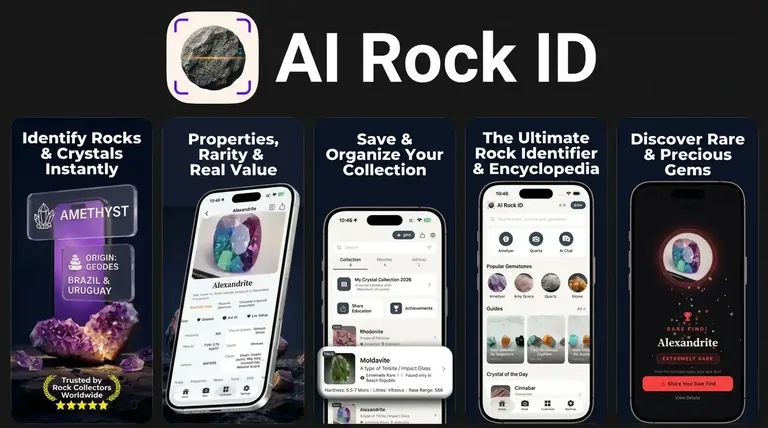
The technology excels at recognizing the distinctive optical signatures of different gem species. A blue stone might be sapphire, tanzanite, blue topaz, aquamarine, or iolite, each with subtle visual differences the AI has learned to detect. Sapphires typically show a deeper, more saturated blue with characteristic silk inclusions, while tanzanite displays violet undertones and stronger pleochroism. Blue topaz tends toward lighter, cleaner blues, and aquamarine shows a distinctive sea-green tint. The AI Rock ID iPhone app brings this same analytical power to mobile identification, letting you analyze gems anywhere.
Understanding the AI's methodology helps you provide better photos for more accurate results. The system weighs color accuracy heavily, so natural daylight photography produces superior identifications compared to artificial lighting that can shift color perception. Similarly, the AI looks for characteristic brilliance patterns, the way light returns from a well-cut diamond differs dramatically from how it behaves in cubic zirconia or moissanite, even though casual observers might find them similar.
Photographing Gems for Accurate Identification
Capturing gem photos that yield accurate AI identification requires attention to lighting, background, and camera positioning. Natural daylight remains the gold standard for gem photography, specifically, indirect northern light or overcast conditions that provide even illumination without harsh shadows or color casts. Avoid direct sunlight, which creates blown-out highlights that obscure the subtle color variations AI needs to distinguish between similar gems.
Background selection significantly impacts identification accuracy. Use a neutral white, gray, or black background that doesn't reflect color onto your gem. Colored backgrounds can shift the apparent hue of your stone, potentially causing the AI to misidentify a pink tourmaline as a ruby or a green peridot as an emerald. For transparent gems, a white background helps reveal color saturation, while opaque cabochons often photograph better against darker surfaces that highlight their luster.
Camera angle and focus deserve careful consideration. Position your camera directly above the gem's table facet for faceted stones, ensuring the entire crown is in sharp focus. For cabochons, angle slightly to capture the dome's curvature and any optical phenomena like chatoyancy or asterism. The RockIdentifier.io upload tool accepts high-resolution images, so use your camera's maximum quality setting. Macro mode or a macro lens helps capture the fine details, inclusions, color zoning, and surface characteristics, that distinguish gem species.
Common Gem Lookalikes and How to Distinguish Them
The gem world contains numerous lookalike pairs that challenge both human experts and AI systems. Blue sapphire and blue spinel share similar color ranges, though spinel typically shows slightly more violet undertones and lacks sapphire's characteristic silk inclusions. Tanzanite mimics fine sapphire but displays stronger trichroism, appearing blue, violet, and burgundy from different angles. When photographing suspected sapphires, capture multiple angles to help the AI detect these directional color changes.
Ruby and red spinel have confused gem buyers for centuries, the famous Black Prince's Ruby in the British Crown Jewels is actually spinel. Both display rich red colors, but rubies typically show stronger fluorescence and may display subtle color zoning. Red garnet, particularly pyrope and almandine varieties, also resembles ruby but lacks ruby's characteristic crystal structure and often appears darker or more brownish. Our AI analyzes these subtle color differences to suggest the most likely identification.
In the green gem category, emerald, tsavorite garnet, chrome tourmaline, and chrome diopside all compete for attention. Emeralds almost always contain visible inclusions, their jardín or garden, while tsavorite tends toward cleaner stones with more yellow-green hues. Chrome tourmaline shows darker, more forest-green colors, and chrome diopside displays strong doubling of back facets when viewed through the table. Providing clear, well-lit photos helps the AI distinguish these visually similar but mineralogically distinct gems.
Colorless gems present particular identification challenges. Diamond, white sapphire, white topaz, white zircon, and moissanite all appear colorless but behave differently optically. Diamonds display balanced brilliance and fire, while moissanite shows excessive rainbow dispersion. White sapphire appears slightly milky compared to diamond's crisp transparency, and zircon exhibits strong doubling of back facets. The AI Rock ID app can help distinguish these based on their characteristic optical signatures captured in your photos.
Understanding Cut Styles and Their Impact on Identification
Gem cutting styles influence both appearance and identification accuracy. Brilliant cuts, round, oval, pear, and marquise shapes with triangular and kite-shaped facets, maximize light return and fire, making them popular for diamonds and colored stones alike. These cuts create distinctive brilliance patterns the AI recognizes, though the intense light play can sometimes obscure body color in lighter stones.
Step cuts like emerald and Asscher shapes feature rectangular facets arranged in parallel rows. Originally developed to showcase emerald's color while minimizing stress on included stones, step cuts now appear across gem varieties. These cuts reveal color and clarity more directly than brilliant cuts, often making AI identification more straightforward. The geometric facet patterns create characteristic light and dark planes that help distinguish genuine gems from glass imitations.
Cabochon cuts, smooth, unfaceted domes, suit opaque and translucent gems as well as stones displaying optical phenomena. Star sapphires, cat's eye chrysoberyl, moonstone, and opal typically receive cabochon cuts to display their asterism, chatoyancy, or play of color. When photographing cabochons for identification, capture the optical effect directly, position your light source to activate the star or cat's eye, or angle opals to show their color play. These distinctive phenomena provide strong identification clues for the AI system.
Limitations of Photo-Based Gem Identification
While AI gem identification provides valuable preliminary assessments, understanding its limitations ensures appropriate use. Photo analysis cannot determine whether a gem is natural or synthetic, laboratory-created rubies, sapphires, and emeralds are chemically identical to natural stones and appear visually indistinguishable in photographs. Similarly, treatments like heat treatment, fracture filling, and diffusion cannot be detected through images alone.
Certain gem properties essential for definitive identification require physical testing. Refractive index, specific gravity, and spectroscopic analysis provide conclusive species identification but require gemological instruments. A photo showing a red stone might suggest ruby, but confirming it isn't red spinel, garnet, or glass requires measuring optical properties. Use RockIdentifier.io results as informed starting points for further investigation rather than final determinations.
Mounted gems present additional challenges. Jewelry settings often obscure portions of the stone, limiting the visible facets available for analysis. Prongs may cast shadows, and metal reflections can alter apparent color. When possible, photograph loose stones for identification. If the gem is mounted, capture multiple angles and ensure the stone's face receives direct, even lighting. The AI performs best when it can analyze the complete visible surface of your gem.
Building Your Gem Identification Skills
Regular use of AI gem identification tools accelerates your learning curve as a gem enthusiast or collector. Each identification provides educational context about the suggested gem species, its typical colors, common sources, relative value, and distinguishing characteristics. Over time, you'll develop intuitive recognition skills that complement the AI's analytical capabilities.
Consider documenting your gem collection systematically using the RockIdentifier.io web tool. Photograph each stone under consistent lighting conditions, record the AI's identification suggestions, and note any additional information you discover through research or professional appraisal. This documentation serves multiple purposes: insurance records, collection management, and a personal reference library that deepens your gemological knowledge.
The AI Rock ID iPhone app enables field identification at gem shows, estate sales, and antique shops. Before purchasing, snap a quick photo to get preliminary identification suggestions. While this shouldn't replace professional appraisal for significant purchases, it provides immediate context about what you're examining. Knowing whether that blue stone is likely sapphire, topaz, or glass helps you ask better questions and make more informed decisions.
From Identification to Authentication
AI photo identification represents the first step in a comprehensive gem evaluation process. Once you have a likely identification, you can pursue appropriate next steps based on the gem's apparent value and your needs. For potentially valuable stones, fine rubies, emeralds, sapphires, or significant diamonds, professional gemological laboratory certification provides definitive identification and treatment disclosure.
Major gemological laboratories including GIA, AGL, Gübelin, and SSEF offer comprehensive gem reports that include species identification, treatment detection, and often origin determination. These reports carry significant weight in the gem trade and provide documentation that supports value claims. For inherited jewelry or estate purchases where provenance is uncertain, laboratory certification transforms unknown stones into documented gems with established identities.
For less valuable stones or personal curiosity, the AI identification combined with basic gemological testing often suffices. A jeweler's loupe reveals inclusions and surface characteristics, while simple tools like a dichroscope can confirm pleochroism in colored stones. Hardness testing, though potentially damaging, provides another identification avenue. The combination of AI suggestions and hands-on examination builds confidence in your identifications without the expense of laboratory certification for every stone in your collection.
How to Use This Gem Identifier
Prepare Your Gem
Clean your gem gently with a soft cloth to remove dust, oils, and fingerprints that could affect photo clarity and color accuracy.
Set Up Lighting
Position your gem in natural daylight or under neutral white LED lighting. Avoid colored lights or direct sunlight that creates harsh shadows.
Choose Your Background
Place the gem on a neutral white, gray, or black background. Ensure no colored surfaces reflect onto the stone.
Capture the Photo
Focus on the gem's table facet from directly above. Use macro mode if available and ensure the entire stone is sharp and well-exposed.
Upload for Analysis
Upload your photo to RockIdentifier.io or the AI Rock ID iPhone app. Review the identification results and suggested gem species.
More Identification Tools
Gemstone Identifier
Identify rough and cut gemstones including mineral specimens and polished stones
Diamond Identifier
Specialized identification for diamonds and diamond simulants
Crystal Identifier
Identify natural crystal formations and crystalline specimens
Mineral Identifier
Comprehensive mineral identification for raw specimens and rocks
Quartz Identifier
Identify quartz varieties including amethyst, citrine, and rose quartz
Glass Identifier
Distinguish natural gems from glass imitations and simulants
Frequently Asked Questions
Can AI identify gems still mounted in jewelry?
Yes, though accuracy may be reduced compared to loose stones. Jewelry settings can obscure facets and cast shadows that limit the AI's analysis. For best results with mounted gems, photograph from directly above the stone with even lighting, ensuring the gem's face is fully visible and not shadowed by prongs or bezels.
How accurate is AI gem identification compared to a gemologist?
AI provides reliable preliminary identification for most common gem species based on visual characteristics. However, professional gemologists use additional tools, refractometers, spectroscopes, and microscopes, that provide definitive identification. Consider AI results as informed suggestions that guide further investigation rather than final certifications.
Can the gem identifier tell if my stone is natural or synthetic?
Photo-based AI cannot distinguish natural gems from laboratory-created synthetics, as they are chemically and optically identical. Detecting synthetic origin requires microscopic examination of growth patterns and inclusions, or advanced spectroscopic analysis. For valuable stones where natural origin matters, seek professional gemological laboratory certification.
Why does the AI suggest multiple possible identifications?
Many gems share similar colors and visual properties. A purple stone might be amethyst, purple sapphire, or purple spinel, all valid possibilities based on appearance alone. The AI provides ranked suggestions based on probability, considering color, transparency, and visible characteristics. Multiple suggestions indicate the need for additional testing to confirm identity.
What's the difference between gem identification and gemstone identification?
The terms overlap significantly, though 'gem' often emphasizes cut and polished stones ready for jewelry use, while 'gemstone' may include rough material. Our gem identifier focuses on faceted and cabochon-cut stones, while our gemstone identifier handles both rough and cut specimens. Use whichever tool matches your specimen's current state.
Can I identify colored diamonds with this tool?
The AI can recognize fancy colored diamonds and suggest diamond as a possible identification based on characteristic brilliance and fire patterns. However, distinguishing natural fancy colored diamonds from treated or synthetic colored diamonds requires laboratory analysis. For potentially valuable colored diamonds, always seek professional certification.
How do I photograph gems that change color in different lighting?
Color-change gems like alexandrite and color-change garnet should be photographed under multiple light sources. Capture images in daylight and incandescent light to document the color shift. Upload both photos or the most dramatic color-change image. Note the lighting conditions when reviewing results, as the AI analyzes the colors visible in your specific photo.
Does gem size affect identification accuracy?
Very small gems (under 3mm) may be difficult to photograph with sufficient detail for accurate identification. Larger gems generally provide more visual information for analysis. If photographing small stones, use macro photography to capture maximum detail. Ensure the gem fills a significant portion of the frame while remaining in sharp focus throughout.