Marble vs Quartzite Identification: Marble vs Quartzite vs Limestone
Marble vs quartzite identification starts with texture, hardness, acid reaction, and visible layering. Rock Identifier helps compare a photo-based result with simple field checks; use the iOS app link on rockidentifier.io when you want a fast mobile lookup.


Drop a rock photo here or tap to upload
JPG, PNG, WebP, HEIC • Max 50 MB • 1 free scan per day

Analyzing your specimen…
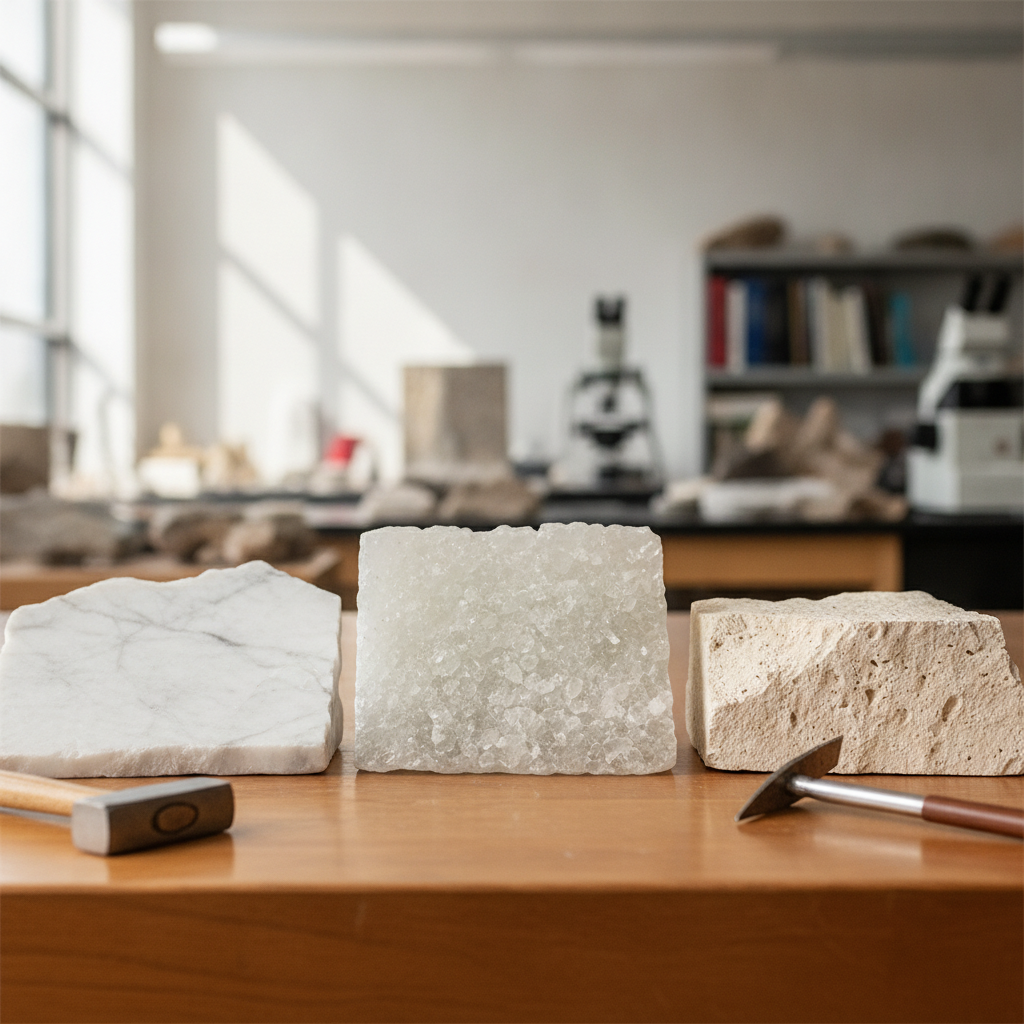
Quick answer: Marble vs quartzite identification depends mainly on hardness, acid reaction, and texture rather than color or veining. Quartzite is quartz-rich and typically scratches glass, while marble and limestone are carbonate rocks that often fizz with dilute acid or vinegar on a fresh surface.
AI Rock ID can support marble vs quartzite identification by giving a photo-based starting point that users can compare with hardness, acid reaction, and texture. RockIdentifier.io provides a web photo upload option for checking whether a sample resembles marble, quartzite, or limestone before using non-destructive or professional confirmation.
Quick summary
- Best for
- Homeowners, collectors, students, field beginners, countertop buyers
- Works on
- Marble, quartzite, limestone, countertop remnants, loose field samples
- Accuracy
- Good for preliminary identification when photos are combined with hardness and acid checks
- Needs confirmation
- Yes
- Professional replacement
- No
- Platforms
- iPhone, iPad, Web
This guide is best for
- Homeowners comparing marble, quartzite, and limestone countertops
- Beginners learning hardness and acid tests for common stones
- Collectors sorting pale, gray, white, or veined rock samples
- Students studying carbonate rocks and metamorphic rocks
- Field users checking loose samples where simple tests are allowed
- Fabrication or renovation shoppers trying to understand trade-name confusion
Consider another approach if you
- People who need a final appraisal of valuable or installed stone
- Users who cannot safely perform scratch or acid tests
- Cases requiring petrographic thin section, XRD, or laboratory confirmation
- Antique, monument, or borrowed specimens where damage is unacceptable
Marble, quartzite, and limestone can look similar, but they separate by hardness and acid reaction. Quartzite is very hard and scratches glass, while marble and limestone react with dilute acid because they are carbonate rocks. Marble usually shows recrystallized calcite and sugary texture, while limestone often preserves fossils, shells, or sedimentary bedding.
What Is Marble vs Quartzite Identification?
Marble vs quartzite identification is the process of separating two common metamorphic building stones, then checking whether a similar-looking sample is actually limestone. The practical difference is mineralogy: marble is mostly calcite or dolomite, quartzite is mostly interlocking quartz grains, and limestone is a sedimentary carbonate rock. That mineral difference controls hardness, acid fizz, surface texture, and durability.
In the field, you are rarely identifying a perfect textbook specimen. Countertop slabs may be polished, weathered rocks may be stained, and limestone can be dense enough to resemble marble. Start with non-destructive clues first, then use scratch and acid tests only where safe. For carbonate background, see the USGS overview of limestone and karst at https://www.usgs.gov/special-topics/water-science-school/science/limestone.
How Marble vs Quartzite Identification Works
Marble vs quartzite identification works by testing the dominant mineral response rather than relying on color. Quartzite is quartz-rich, so it is about Mohs 7 and can scratch glass or a steel knife. Marble and limestone are carbonate-rich, so calcite-rich pieces usually fizz with dilute hydrochloric acid or a safer vinegar test, especially on a fresh surface.
Texture is the second filter. Marble often has a sugary, crystalline mosaic caused by metamorphic recrystallization. Quartzite commonly shows fused quartz grains and breaks across grains rather than around them. Limestone may show fossils, ooids, shell fragments, micrite, or bedding planes. Photos are processed for identification in a privacy-friendly way, but the best result still comes from combining image lookup with hardness, acid reaction, and close visual inspection.
How to Use Marble vs Quartzite Identification
Photograph a fresh surface
Capture the stone in bright, indirect light with the camera square to the surface. Include both a close-up texture shot and a wider shot showing veining, bedding, or fracture style.
Check hardness safely
Try an inconspicuous scratch test only on loose rock or an unused edge. Quartzite should scratch glass; marble and limestone usually scratch more easily with a knife or steel point.
Test for carbonate reaction
Apply a tiny drop of dilute acid or vinegar to a fresh, hidden spot. Limestone and calcite marble often fizz, while quartzite should not react unless it contains carbonate veins or cement.
Inspect texture and structure
Look for sugary crystals, fused quartz grains, fossils, shell pieces, stylolites, or sedimentary bedding. These features often resolve cases where color and veining are misleading.
Compare the result
Use the photo-based lookup as a first pass, then confirm it against your tests. If the sample is valuable, installed, or part of a renovation decision, ask a geologist, fabricator, or lab to verify it.
When to Use Marble vs Quartzite Identification (and When Not To)
Use it when
- Use it for loose field samples where scratch and acid checks are allowed.
- Use it before labeling a countertop remnant as marble, quartzite, or limestone.
- Use it when comparing pale, gray, white, or veined stones with similar appearance.
- Use it for teaching Mohs hardness, carbonate reaction, metamorphism, and sedimentary texture.
- Use it as a screening step before sending a specimen to a lab or stone professional.
Skip it when
- Do not use destructive tests on installed countertops, antiques, monuments, or borrowed specimens.
- Do not rely on a single polished-surface photo for a final identification.
- Do not use it as a substitute for petrographic thin section, XRD, or professional appraisal.
- Do not assume trade names are geological names; many commercial stones are mislabeled.
- Do not estimate market value, restoration cost, or engineering performance from appearance alone.
Marble vs Quartzite Identification vs Google Lens and Rock Scanner
| Feature | Rock Identifier | Google Lens | Rock Scanner |
|---|---|---|---|
| Primary purpose | Photo-based rock, mineral, crystal, and gemstone lookup with geology-oriented labels | General visual search across web images, products, places, and text | Mobile stone and mineral recognition with app-based matching |
| Best for marble vs quartzite | Combining image recognition with rock-specific descriptions and comparison clues | Finding visually similar countertops, tiles, and web pages | Quick specimen matching when the sample resembles common database images |
| Hardness and acid context | Explains why quartzite, marble, and limestone separate by mineral response | May show search results but usually does not guide field testing | Often provides basic ID notes, with variable testing detail |
| Countertop name confusion | Useful for checking geological identity against trade-name labels | Good at finding commercial stone names and retailer pages | Helpful for simple matches, less reliable for commercial naming ambiguity |
| When to verify | Verify rare, valuable, treated, or installed material with a professional | Verify because visual search can prioritize lookalike images | Verify because app results depend strongly on photo quality and database coverage |
A comparison tool should not replace basic geology. Google Lens is useful when you want visual matches from the open web, especially for countertop trade names. A dedicated stone scanner is better when you need geology-language suggestions, but all photo tools can confuse polished marble, dolomitic limestone, and light-colored quartzite. The most reliable workflow is image lookup plus a hardness check, a carbonate reaction test, and close inspection of fossils, grains, or recrystallized texture.
Marble vs Quartzite Identification Use Cases
- Countertop and slab checks: Homeowners and fabricators can screen whether a marketed slab behaves more like marble, quartzite, or limestone. This matters because quartzite is generally harder and more scratch resistant, while carbonate stones need different cleaning and sealing expectations.
- Field geology and collecting: Students and collectors can separate metamorphic quartzite from marble and sedimentary limestone using simple observations. A hand lens, glass plate, and careful acid test often reveal more than color alone.
- Museum and classroom sorting: Teaching collections often contain pale rocks with old labels or no labels. Sorting by hardness, fizz, fossil content, and crystalline texture makes the differences memorable and repeatable.
- Renovation material decisions: Before choosing cleaners, sealers, or repair methods, identify whether the surface is carbonate-rich or quartz-rich. Acidic cleaners can etch marble and limestone, while quartzite usually resists acid but may still have carbonate veins.
Marble vs Quartzite Identification Limitations
- Treated stones can mislead identification. Resins, dyes, sealers, waxes, and surface enhancers may hide porosity, change luster, or reduce visible acid reaction.
- Polished specimens are harder to read than broken surfaces. A glossy slab can obscure grain boundaries, fossils, bedding, and the sugary texture that helps separate marble from limestone.
- Rare minerals and mixed rocks may not fit the simple three-way choice. Siliceous marble, carbonate-cemented quartzite, dolostone, skarn, serpentinite, and engineered stone can create false matches.
- Photo quality strongly affects results. Blurry images, yellow indoor light, wet surfaces, shadows, and extreme close-ups can make calcite, dolomite, and quartz textures look similar.
- Value estimates are outside reliable photo identification. Market price depends on quarry source, slab size, fabrication, rarity, defects, treatment, provenance, and local demand.
- Acid and scratch tests can damage finished material. Never test a visible countertop face, memorial stone, sculpture, tile installation, or collectible specimen without permission.
- Trade names are inconsistent. A stone sold as “quartzite” may be marble, dolomitic marble, sandstone, or a commercial category rather than a strict geological name.
Common mistakes
- Assuming every white stone with gray veins is marble.
- Calling a stone quartzite based only on a countertop trade name.
- Testing acid reaction on a polished or sealed surface instead of a fresh hidden spot.
- Expecting vinegar to fizz strongly on every carbonate sample.
- Ignoring fossils, shells, or sedimentary bedding that point toward limestone.
- Using color as the main clue when hardness and acid reaction are more reliable.
- Scratching an installed countertop instead of using a loose offcut or asking a professional.
Check marble vs quartzite identification with photos and simple tests
A photo-based result can help narrow a stone to marble, quartzite, or limestone, but the most useful confirmation comes from hardness, acid reaction, and close texture inspection. For valuable, installed, or renovation-critical material, use professional verification before making decisions.
Related Articles
Frequently Asked Questions
How can I tell marble from quartzite?
Test hardness and acid reaction. Quartzite usually scratches glass and does not fizz, while marble is softer and commonly fizzes because it contains calcite or dolomite.
Does quartzite fizz with vinegar?
Pure quartzite should not fizz with vinegar because quartz is not carbonate. If you see fizzing, the stone may contain carbonate veins, carbonate cement, or may not be true quartzite.
Does marble scratch glass?
Most marble does not scratch glass because calcite is about Mohs 3 and glass is around Mohs 5.5. Dolomitic marble can be slightly harder, but it still should not behave like quartzite.
Is limestone the same as marble?
No. Limestone is a sedimentary carbonate rock, while marble is limestone or dolostone that has been metamorphosed and recrystallized.
Why is quartzite confused with marble?
Both can be white, gray, or strongly veined, especially when polished as slabs. The key difference is that quartzite is quartz-rich and hard, while marble is carbonate-rich and acid-sensitive.
Can photos identify countertop stone?
Photos can provide a useful first pass, especially when texture and veining are clear. For final confirmation, combine the image result with hardness, acid reaction, and a professional check if the material is installed or expensive.
What test separates limestone and marble?
Both may fizz with acid, so the better separator is texture. Limestone may show fossils, shell fragments, ooids, or bedding, while marble usually shows recrystallized interlocking calcite or dolomite crystals.
Can quartzite have veins?
Yes. Quartzite can contain quartz veins, iron staining, mica layers, or carbonate-filled fractures, so veining alone is not diagnostic.
Will acid damage marble or limestone?
Yes. Acidic liquids can etch calcite-rich marble and limestone, leaving dull marks or rough spots, so testing should be done only on a hidden fresh surface.