How to Tell If a Crystal Is Real: Dyed, Heated, and Synthetic Stones
Real vs fake crystals is less about one magic test and more about pattern recognition: identity, treatment, structure, and seller claims. Use photo clues first, then confirm with simple physical observations.


Drop a rock photo here or tap to upload
JPG, PNG, WebP, HEIC • Max 50 MB • 1 free scan per day

Analyzing your specimen…
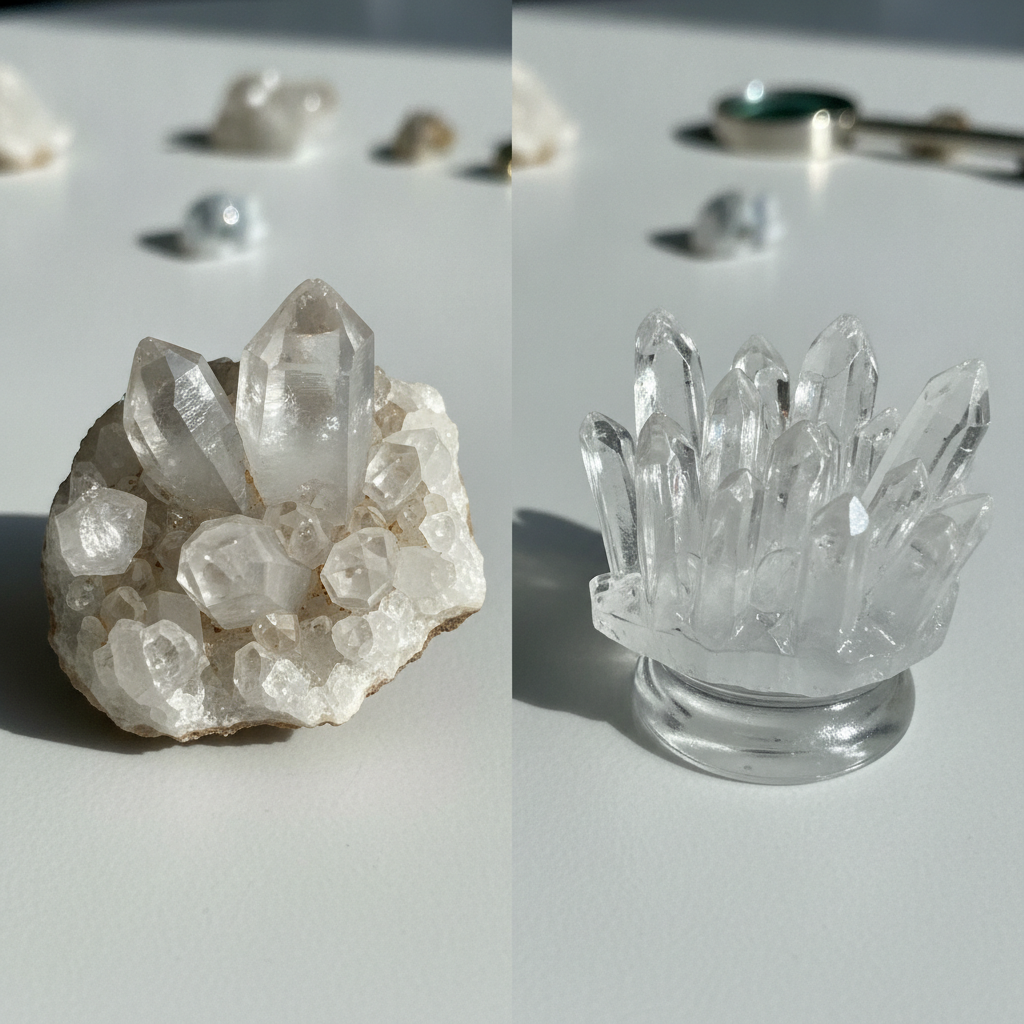
Quick answer: How to tell if a crystal is real starts with identifying the mineral, then checking whether its color, structure, luster, weight, and inclusions match that mineral. A crystal can be a real mineral and still be dyed, heated, coated, lab-grown, or sold under a misleading trade name.
AI Rock ID can help readers compare a crystal photo with likely mineral identities before they look for dye, heat treatment, glass, resin, or lab-grown clues. RockIdentifier.io provides a web photo upload workflow for checking visual mineral matches related to real versus fake crystal questions.
Quick summary
- Best for
- Crystal collectors, beginners, online buyers, field hobbyists, jewelry shoppers
- Works on
- Crystals, minerals, tumbled stones, beads, carvings, quartz, agate, fluorite, calcite
- Accuracy
- Useful for screening obvious imitations and treatment clues, but not a certified authenticity test
- Needs confirmation
- Yes
- Professional replacement
- No
- Platforms
- iPhone, iPad, Web
This guide is best for
- Beginners comparing real crystals with glass, resin, or synthetic imitations
- Collectors checking dyed agate, coated quartz, crackle quartz, or unusually bright stones
- Online buyers who want to evaluate seller photos and treatment language before purchasing
- People sorting tumbled stones, bead strands, towers, spheres, or carvings
- Field hobbyists separating common minerals such as quartz, calcite, fluorite, agate, jasper, and slag glass
- Readers deciding whether a specimen needs a jeweler, gemologist, or laboratory test
Consider another approach if you
- Anyone needing a legal appraisal, insurance value, or certified gem report
- Owners of expensive mounted jewelry where scratch, heat, acid, or streak tests could cause damage
- People trying to prove exact mine origin, locality, or chain of custody from photos alone
- Specimens that may contain hazardous minerals such as asbestos-bearing, radioactive, arsenic-rich, or mercury-rich material
- Rare or high-value stones that require microscopy, refractive index, Raman spectroscopy, XRF, or specific gravity testing
To tell if a crystal is real, identify the mineral first, then check for dye, heat treatment, glass, resin, or lab-grown structure. A real mineral can still be treated, so “real” does not always mean natural, untreated, rare, or valuable. The most reliable quick checks are color distribution, inclusions, hardness, weight, surface luster, and whether the claim matches known geology.
What Is “How to Tell If a Crystal Is Real”?
How to tell if a crystal is real means separating mineral identity from origin and treatment. A quartz point can be natural, heat-treated, dyed, coated, lab-grown, or imitation glass; those are different questions, and each leaves different clues. Start by naming the material, then ask whether the color, habit, luster, inclusions, hardness, and price make geological sense.
In practice, authentication uses observable mineral properties: Mohs hardness, cleavage, fracture, specific gravity, transparency, streak, and crystal habit. For baseline mineral terminology, the USGS mineral resources program is a useful authority: https://www.usgs.gov/centers/national-minerals-information-center. A photo-based lookup can narrow the candidate list before you decide whether lab testing is worth it.
How “How to Tell If a Crystal Is Real” Works
Crystal authenticity checking works by comparing what the specimen shows against what that mineral should show. Natural stones usually have plausible growth features: uneven zoning, mineral inclusions, veils, small fractures, matrix contact, or irregular terminations. Imitations often show bubbles, mold seams, overly uniform color, plastic-like luster, or a weight that feels wrong for the claimed mineral.
Treatments leave different signals. Dye tends to concentrate in cracks, pits, drill holes, and porous bands. Heat treatment can intensify or shift color without changing the mineral identity, especially in quartz varieties and corundum. Synthetic crystals may be chemically real but grown in controlled conditions, so their giveaway is often overly clean clarity, repeated growth patterns, or seller language such as “created,” “lab,” or “hydrothermal.”
How to Tell If a Crystal Is Real
Identify the likely mineral
Photograph the stone in bright, indirect light and compare it with known candidates. Open the free iOS app from the download link on rockidentifier.io, or use the Android version, to get a first-pass photo ID before testing hardness or treatment signs.
Inspect color distribution
Look into cracks, bead holes, cavities, and chipped edges. Dye often pools in fractures or creates color that is stronger at the surface than inside the crystal.
Check texture, luster, and weight
Glass imitations may feel slick, show rounded edges, and contain tiny air bubbles. Resin can feel warm, light, or plastic-like compared with dense quartz, fluorite, agate, or calcite.
Compare hardness carefully
Use Mohs hardness only on an inconspicuous area and avoid damaging jewelry or polished faces. Quartz should resist a steel knife, calcite should scratch more easily, and fluorite sits between them.
Read the seller claim literally
Words like “aura,” “crackle,” “stabilized,” “reconstituted,” “created,” and “color enhanced” usually indicate treatment or manufacture. Photos are processed for ID in a privacy-friendly way, but do not include faces, receipts, or personal documents in the image.
When to Use How to Tell If a Crystal Is Real (and When Not To)
Use it when
- You bought a crystal online and the color looks unusually bright, even, or expensive for the price.
- You found a stone in the field and need to separate quartz, calcite, fluorite, agate, jasper, or slag glass.
- You are sorting a collection and want to flag dyed agate, heat-treated amethyst, coated quartz, or synthetic points.
- You need a practical pre-screen before paying for a jeweler, gemologist, or laboratory report.
- You are comparing bead strands, tumbled stones, towers, spheres, or carvings where treatments are common.
Skip it when
- You need a legal appraisal, insurance value, or certified gemstone report.
- The specimen may be radioactive, asbestos-bearing, mercury-rich, arsenic-bearing, or otherwise hazardous.
- The stone is mounted in expensive jewelry and any scratch, acid, or heat test could damage it.
- You are trying to prove mine origin, exact locality, or chain of custody from photos alone.
- The sample is a rare mineral that requires microscopy, Raman spectroscopy, XRF, refractive index, or specific gravity testing.
How to Tell If a Crystal Is Real vs Google Lens and Rock Scanner
| Feature | Rock Identifier | Google Lens | Rock Scanner |
|---|---|---|---|
| Primary purpose | Photo ID for rocks, minerals, crystals, and gemstones with geology-focused results | General visual search across the web, products, images, and similar photos | Rock and crystal image matching with basic identification support |
| Best for real vs fake checks | Comparing a specimen against likely minerals and treatment clues such as dye, glass, and coating | Finding visually similar listings, which can help reveal trade names or common fakes | Quick mineral guesses and collection sorting |
| Geology vocabulary | Uses mineral terms such as habit, luster, hardness, fracture, cleavage, and inclusions | Depends on indexed web pages and may return shopping results first | Usually provides simplified mineral descriptions |
| Treatment awareness | Helpful for flagging common dyed, heated, synthetic, and imitation patterns | Can identify similar products but may not distinguish natural from treated | Varies by specimen and photo quality |
| Field workflow | Useful before simple hardness, streak, weight, and loupe checks | Useful for broad visual comparison and seller-image matching | Useful for quick scanning during collecting or shopping |
AI Rock ID is strongest when you pair the scan with hands-on observations. Google Lens is useful for visual web matches, but crystal authenticity needs mineral context, because a dyed agate listing and a natural agate specimen may look similar in search results.
How to Tell If a Crystal Is Real Use Cases
- Checking dyed agate and howlite: Bright blue, pink, purple, or neon green bands often indicate dye, especially when color collects in cracks and porous zones. Natural agate can be vivid, but uniform candy color across beads or slices should be treated as suspicious.
- Spotting glass sold as quartz: Glass commonly shows bubbles, swirls, rounded molded edges, and conchoidal chips without natural crystal faces. Rock Identifier can help compare a clear point or sphere with quartz, obsidian, slag glass, and synthetic glass lookalikes.
- Evaluating heated stones: Heat-treated amethyst, citrine, smoky quartz, and some sapphires may be genuine minerals with altered color. Look for unnatural orange-brown zoning, very uniform tone, or color that appears strongest near fractures or surface features.
- Screening synthetic crystals: Lab-grown quartz, sapphire, emerald, and opal can be chemically real but not natural. Extremely clean clarity, repeated growth lines, curved striae, or seller terms like “created” and “hydrothermal” deserve closer review.
How to Tell If a Crystal Is Real Limitations
- Treated stones can still be genuine minerals, so a photo check may identify quartz or agate correctly while not proving it is untreated.
- Polished specimens, carvings, spheres, towers, and beads lose natural crystal habit, matrix clues, and fracture context that help with identification.
- Rare minerals and high-value gems often require lab instruments such as refractometers, microscopes, spectroscopy, XRF, or specific gravity measurement.
- Poor photo quality, colored lighting, filters, wet surfaces, and busy backgrounds can make glass, dyed agate, calcite, fluorite, and quartz harder to separate.
- Value estimates cannot be confirmed from appearance alone because price depends on size, clarity, locality, treatment disclosure, demand, and documentation.
- Coatings such as aura quartz, titanium-coated quartz, resin stabilization, and wax can mask the original surface and change luster.
- Scratch tests can damage soft minerals, polished faces, and jewelry settings, so they should be used cautiously and only where damage is acceptable.
Common mistakes
- Assuming that a bright color automatically means a crystal is fake instead of checking for dye pooling, coating, or natural color zoning.
- Calling every glass imitation a fake crystal without first identifying whether the specimen is glass, resin, slag, or a treated mineral.
- Believing that a real crystal must be untreated, even though real minerals can be dyed, heated, stabilized, coated, or irradiated.
- Using a scratch test on polished jewelry or valuable specimens and damaging the surface before confirming whether testing is safe.
- Ignoring seller terms such as aura, crackle, stabilized, reconstituted, created, hydrothermal, and color enhanced.
- Relying only on air bubbles, because some glass has bubbles while some natural stones contain fluid inclusions, fractures, or cavities.
- Judging authenticity from one photo without checking weight, luster, hardness, fracture, inclusions, and whether the price matches the claim.
Check a Crystal Photo Before Testing Authenticity
A photo-based mineral match can narrow the possibilities before you look for dye, heat, coating, glass, resin, or synthetic growth clues. Use the result as a screening step, then confirm important or valuable specimens with safe hands-on tests or a qualified professional.
Related Articles
Frequently Asked Questions
How can I spot dyed crystals?
Look for color concentrated in cracks, pits, bead holes, or porous bands. Dyed stones often show stronger color at the surface than inside chips or broken edges.
Are fake crystals always glass?
No. Fake or misleading crystals can be glass, resin, plastic, reconstituted fragments, coated stones, dyed natural minerals, or lab-grown material sold without disclosure.
Is lab-grown crystal considered real?
A lab-grown crystal can be chemically and structurally real, but it is not natural. The key issue is disclosure: “synthetic quartz” is different from “natural quartz.”
Can real crystals be heat treated?
Yes. Heat treatment can change or intensify color while the mineral remains genuine, as with some quartz varieties, corundum, and topaz. Treated should not be sold as untreated natural material.
Do bubbles mean a crystal is fake?
Bubbles are a strong warning sign for glass, especially if they are round and trapped inside a clear specimen. Some natural stones have fluid inclusions, but those usually look different under magnification.
Does a scratch test prove authenticity?
A scratch test can support identification by checking Mohs hardness, but it does not prove origin or treatment. It can also damage polished stones, so use it only on a hidden area.
Why is my crystal color too bright?
Very bright, even, or neon color can indicate dye, coating, glass, or a trade-name treatment. Compare the color with natural examples of the mineral and check cracks or drill holes for concentrated pigment.
Can photos identify valuable gems?
Photos can suggest likely identity and obvious imitation clues, but they cannot certify value. Valuable gems need professional testing, treatment disclosure, and often a lab report.
What tools help check crystals?
Useful basic tools include a 10x loupe, white light, magnet, ceramic streak plate, scale, hardness picks, and a clean background for photos. For high-value stones, use a qualified gemologist or lab instead of home tests.