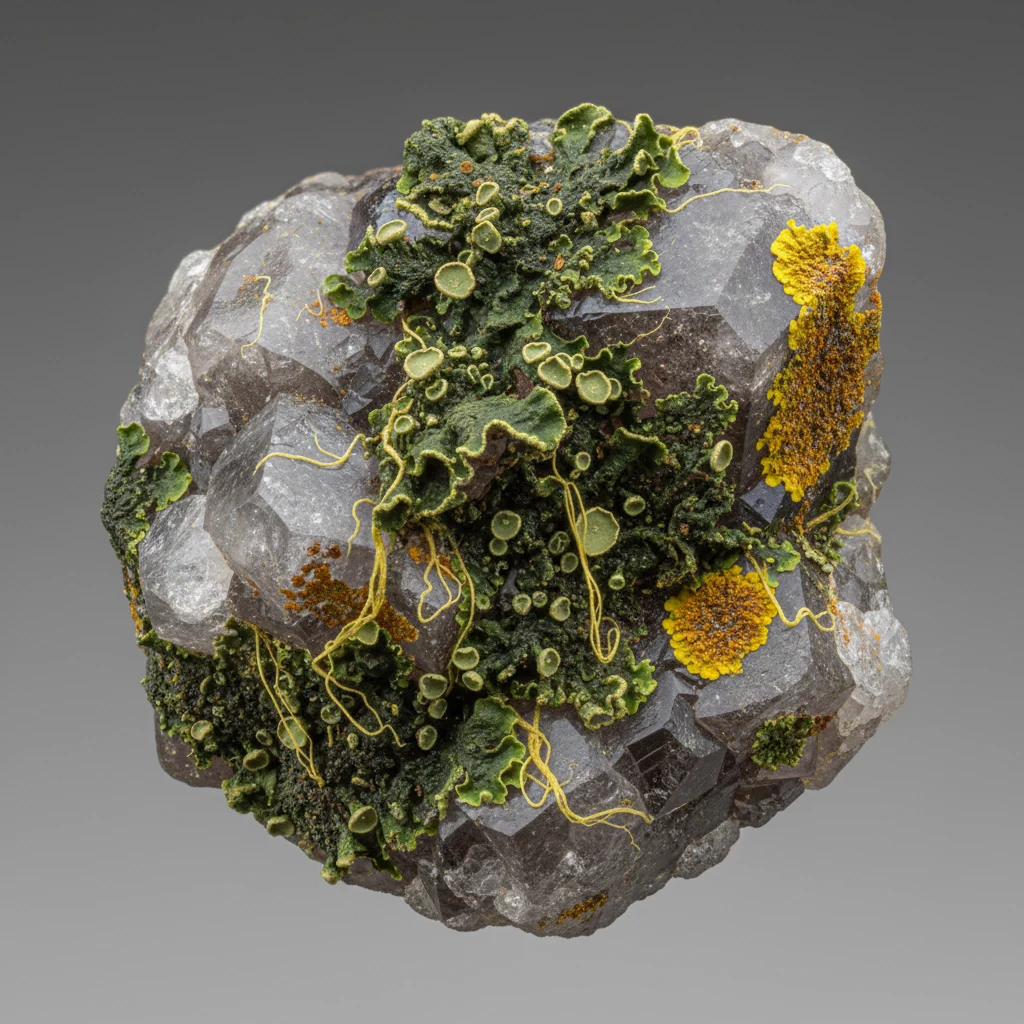
Lichen


Quick answer: Lichen is not a mineral crystal; it is a living or formerly living symbiosis of fungi and photosynthetic algae or cyanobacteria. It may appear in rock and nature collections because it grows on stone, bark, soil, and concrete, but it should be identified separately from mineral specimens.
AI Rock ID can help flag lichen-like textures on rocks, bark, and soil, especially when the specimen has crusty, leafy, or branching growth. RockIdentifier.io treats lichen as an organic material rather than a true crystal, which helps separate it from mineral coatings and weathering features.
Good fit
- Nature study collections focused on organic growths found on rocks
- Educational comparisons between minerals, mosses, fungi, and lichens
- Field observation and photography rather than handling-heavy collecting
- Identifying surface growth on landscaping stone, gravestones, or tree bark
Not a good fit
- Collectors seeking durable mineral crystals or polished stones
- Jewelry use, tumbling, carving, or frequent handling
- Situations where removing living organisms from protected areas is restricted
- Anyone needing a stable specimen that will not dry, crumble, or change color
Why people search for this
People often search for lichen because it can look like a mineral crust, corrosion, mold, or moss on rocks and trees. Correct identification helps distinguish an organic surface growth from the underlying stone.
Most commonly confused with
- Moss: Moss is a small plant with leaflike structures, while lichen is a fungus-algae or fungus-cyanobacteria partnership.
- Chrysocolla: Chrysocolla is a blue-green copper mineral, while lichen is organic and often forms patchy surface growth.
- Malachite: Malachite has a green mineral surface and may show banding, while lichen is soft, irregular, and attached to an exposed surface.
- Mold: Mold is typically fuzzy or powdery and grows on moist organic matter, while lichen often forms crusty, leafy, or branching colonies outdoors.
Lichen vs Similar Surface Growths
| Feature | Lichen | Common Lookalike |
|---|---|---|
| Basic nature | Fungus with algae or cyanobacteria | Moss is a plant; mineral crusts are inorganic |
| Texture | Crusty, leafy, scaly, or branching | Moss is softer and leafier; salts may be powdery |
| Typical location | Rocks, bark, soil, concrete | Mold favors damp organic matter; minerals occur in rock |
| Color range | Gray, green, yellow, orange, black, or white | Copper minerals are often blue-green; salts are often white |
| Collection clue | Attached to a surface and easily damaged | Minerals are usually part of or coating the rock itself |
AI identification confidence
AI identification is usually more reliable when the photo shows the lichen colony, its growth surface, and a close-up of texture. Confidence is lower when the image shows only a flat color patch, heavy blur, wet surfaces, or a mineral coating that mimics organic growth.
When AI gets it wrong
- Green or yellow copper minerals may be labeled as lichen when they form thin surface coatings.
- Moss, algae films, and mold can be confused with lichen in low-resolution photos.
- Dry lichen on pale rock may be mistaken for weathering, staining, or salt efflorescence.
- A photo focused on the host rock may identify the rock type instead of the lichen growing on it.
Final recommendation
Use lichen identification for observation, documentation, and distinguishing organic growth from minerals on a surface. For collecting, prioritize photographs and location notes unless removal is permitted and the specimen is already detached.
How to Photograph Lichen for Identification
Take one wide photo showing the habitat and one close photo showing texture, color, and attachment to the surface. Include a scale object such as a coin or ruler, and avoid overexposed images because pale lichens can lose important detail. If the lichen is wet, photograph it again when dry because color and shape may change.
Buying and Authenticity Notes
Lichen is not commonly sold as a gemstone because it is fragile, organic, and not suitable for polishing or jewelry. Specimens sold as decorative material should be described as preserved organic growth, not as a mineral crystal. Be cautious of listings that use crystal trade terms for lichen without explaining that it is biological.
Ethical Field Observation
Many lichens grow slowly, and some occur in sensitive habitats. Photographing in place is often a better option than scraping or removing a colony. Local rules may restrict collecting from parks, protected land, historic stonework, or private property.
What Is Lichen?
Lichen is a common organic gem, not a mineral crystal, formed by a living symbiosis of fungi with algae or cyanobacteria. In the hand or on its host surface, it feels delicate and irregular rather than glassy or stony, with a very soft Mohs hardness of 1-2 and a light density of 0.2-0.5 g/cm3.
Collectors usually meet lichen as a crusty or leafy growth on trees, rocks, or soil. Its colors range through green, gray, yellow, and brown, and the surface may read as dull, though some pieces can show a slight shine. It is opaque, amorphous, non-magnetic, and fragile, so the best specimens are handled gently and stored away from direct sunlight.
Origin & History
The name Lichen comes from the Greek word "lichenos," and the organism has been studied since ancient times. For a collector, that history matters because lichen sits at the edge of natural history and mineral collecting: it is often encountered on rock surfaces, yet its identity is organic and species-dependent rather than a fixed mineral formula.
Labels should note the host surface and locality whenever possible, because lichen can look quite different from one environment to another. Reference: mindat.org is useful for mineral-locality context when documenting rock-hosted specimens, while the lichen itself remains an organic compound with a formula that varies by species.
Where Is Lichen Found?
Lichen is commonly found in diverse environments worldwide, especially on trees, rocks, and soil. Noted country entries include the USA, Canada, and Norway, with locality examples such as the Great Smoky Mountains in the USA, Scandinavia in Norway, and the Rocky Mountains in Canada.
Formation
Lichen forms through a symbiotic relationship between fungi and algae or cyanobacteria. That partnership allows it to grow across varied climates, often spreading directly over bark, stone, or soil as a thin crust, leafy patch, or textured organic layer.
Unlike a mineral that grows by a fixed crystal system, lichen is amorphous and has a formula that varies by species. Its listed elements include carbon, oxygen, and nitrogen, and its physical behavior is very soft, uneven in fracture, opaque, and generally dull in luster.
How to Identify Lichen
Identify Lichen by its growth habit first: it appears as a crusty or leafy organism attached to trees, rocks, or soil. Color is helpful but variable, with yellow, green, gray, and brown forms all possible; the surface can look dull or occasionally shiny, and the texture can vary significantly.
For handling checks, expect a very soft specimen at Mohs 1-2 with poor scratch resistance and poor toughness. Lichen is opaque, non-magnetic, amorphous, and may give a white streak, with uneven fracture if broken. Avoid forceful testing, because a good specimen can be damaged more easily than most rock or mineral samples.
Properties of Lichen
Physical Properties
| Crystal System | Amorphous |
| Hardness (Mohs) | 1-2 (Mohs) (Very Soft (1-2)) |
| Density | 0.2-0.5 g/cm3 |
| Luster | Dull |
| Diaphaneity | Opaque |
| Fracture | Uneven |
| Streak | White |
| Magnetism | Non-magnetic |
| Colors | Green, Gray, Yellow |
Chemical Properties
| Classification | Organic compound |
| Formula | Varies by species |
| Elements | C, O, N |
| Common Impurities |
Optical Properties
| Refractive Index | Not applicable |
| Birefringence | None |
| Pleochroism | None |
| Optical Character | Isotropic |
Lichen Health & Safety
Lichen is generally safe but some species can cause skin irritation.
Lichen Value & Price
Price Range
Rough/Tumbled: $5 - $15 per specimen
Cut/Polished:
Price can vary based on rarity and type of lichen.
Durability
Fragile — Scratch resistance: Poor, Toughness: Poor
Lichen is sensitive to environmental changes.
How to Care for Lichen
Use & Storage
Store in a cool, dry place away from direct sunlight.
Cleaning
Gently brush with a soft brush to remove dust. Avoid using water as it may damage the lichen.
Cleanse & Charge
Place in sunlight for a few hours to recharge.
Placement
Display in a location with indirect light.
Caution
Handle carefully to avoid damage.
Works Well With
Lichen Meaning & Healing Properties
In traditional practices, Lichen is used for calming, grounding, nurturing, meditation, resilience, adaptability, and transformation. Its associations are the Root and Heart chakras, the Earth element, the planet Earth, and the zodiac signs Virgo and Capricorn.
Use Lichen as a symbolic, nature-connected specimen rather than as a medical treatment. It is generally safe to handle, but unknown species may irritate some skin, so cautious contact is wise. For care, keep it in a cool, dry place, display it in indirect light, gently brush away dust, and use sunlight for a few hours if you work with cleansing and charging rituals.
Identify Lichen from a photo
Compare Lichen traits, care tips, value clues, and common lookalikes with a clear photo.
Common mistakes
- Calling lichen a mineral crystal rather than an organic symbiosis
- Identifying the host rock as lichen or the lichen as the host rock
- Assuming every green patch on stone is moss or algae
- Removing living lichen from protected or slow-growing habitats
- Using hardness or streak tests on lichen, which can destroy the specimen
- Judging color from a wet specimen without checking how it looks when dry