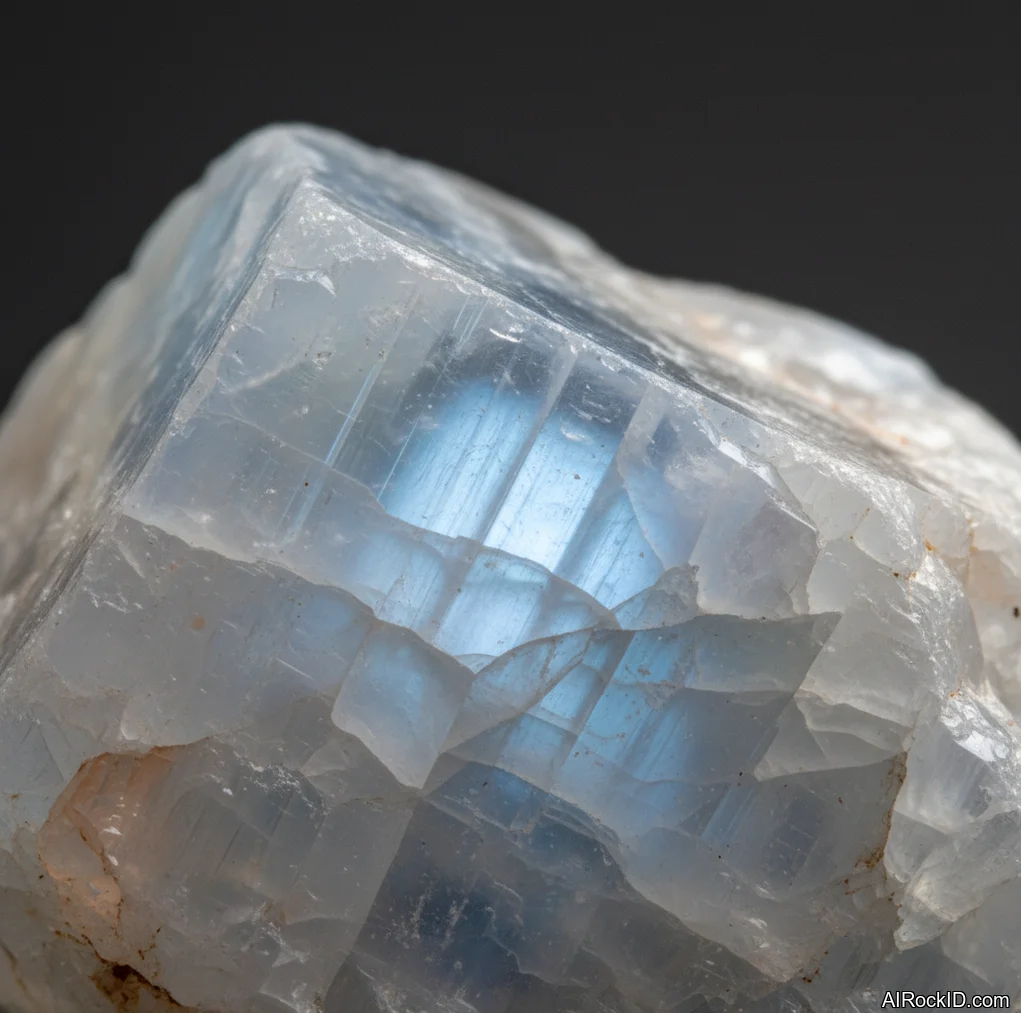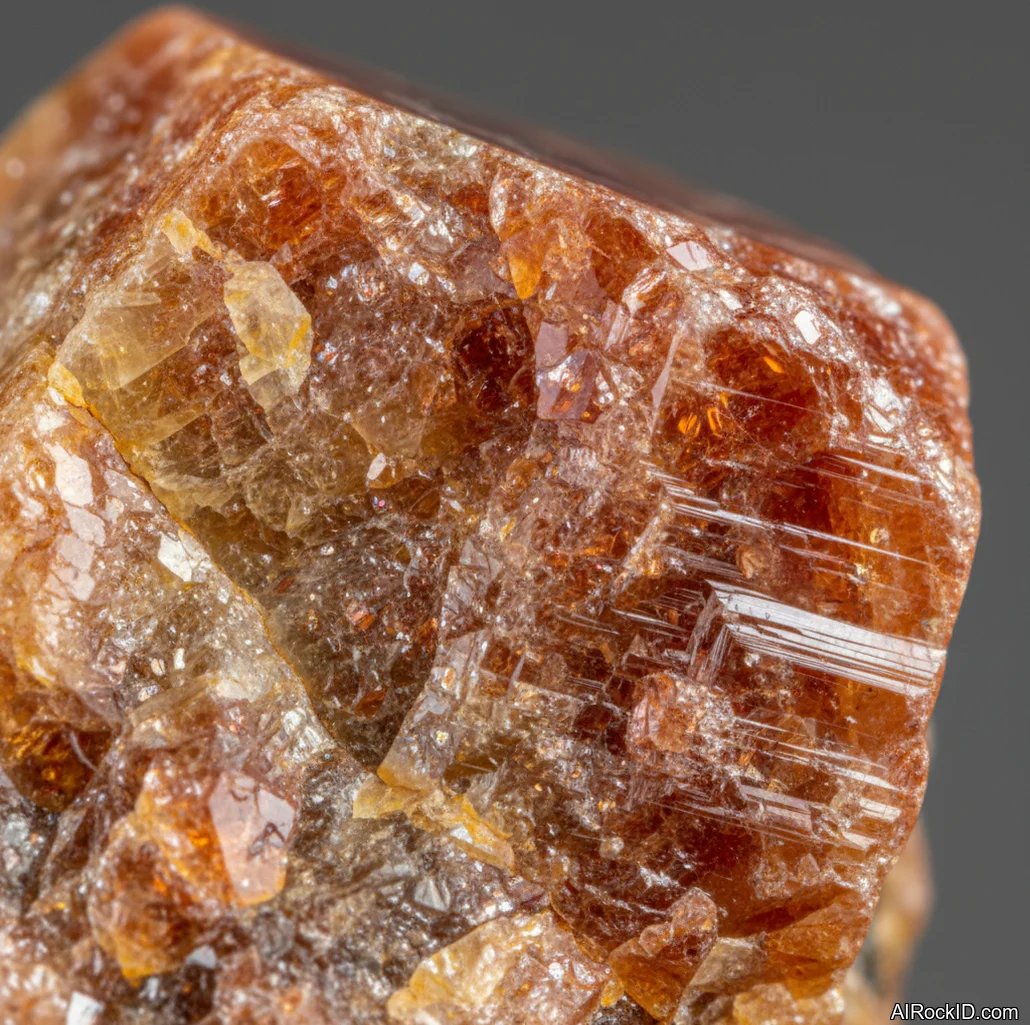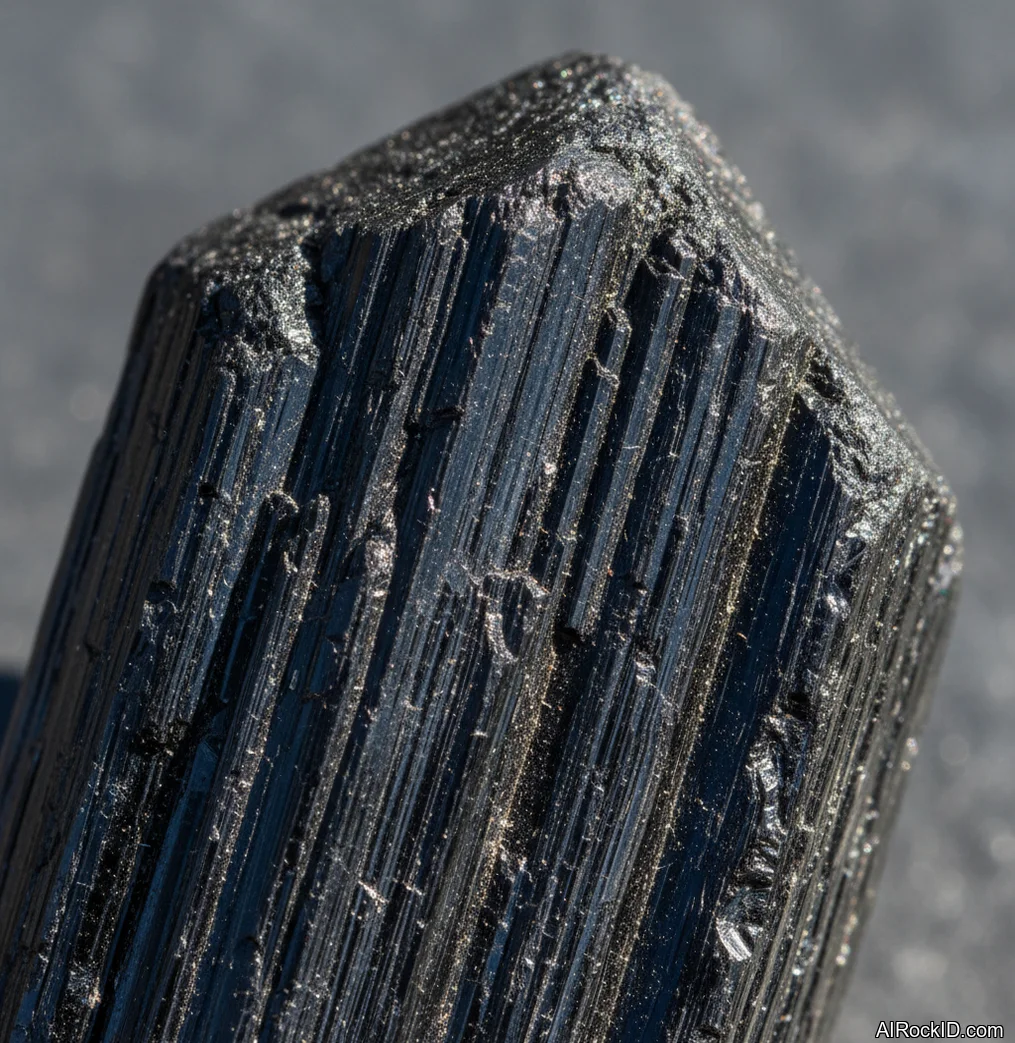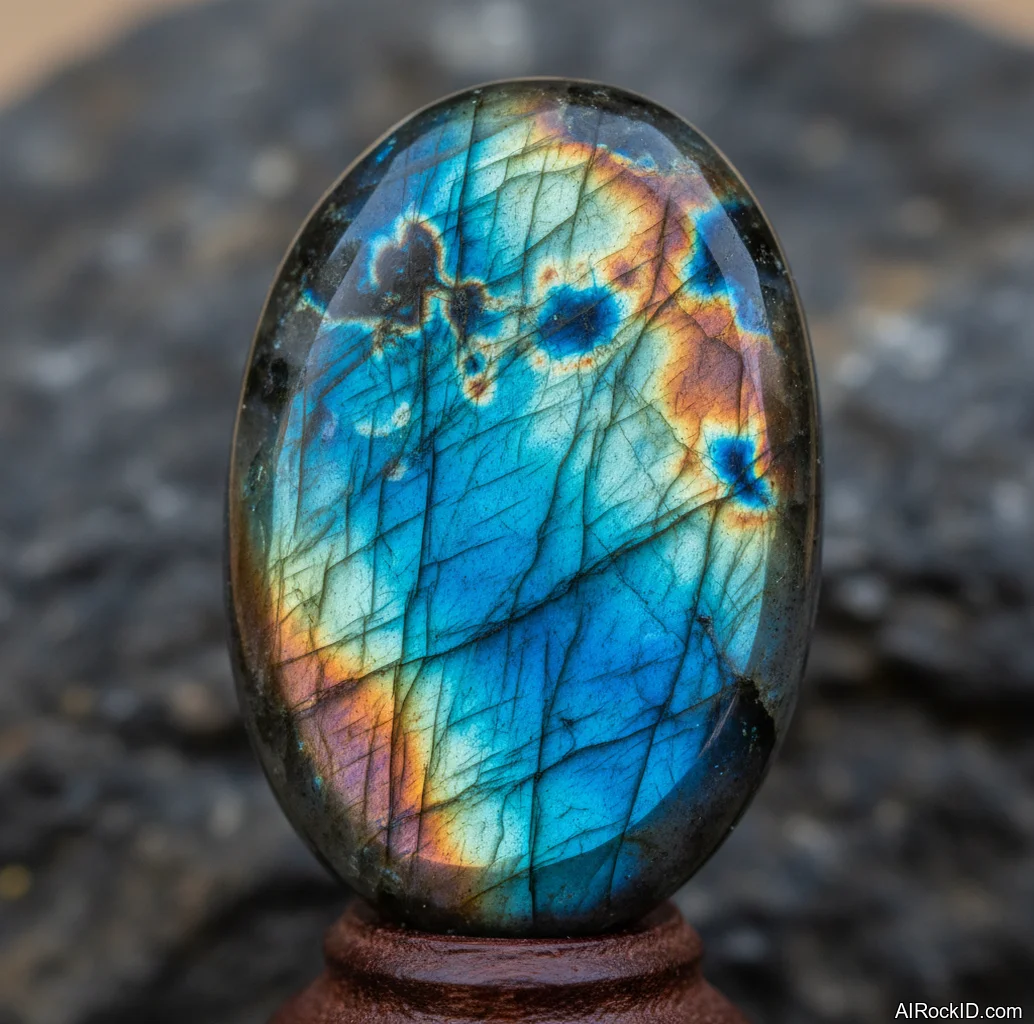
Labradorite


Quick answer: Labradorite is best recognized by its labradorescence: a directional blue, green, gold, or multicolor flash that appears when the stone is turned in light. It is commonly confused with moonstone, spectrolite, larvikite, and dyed or coated feldspar lookalikes.
AI Rock ID can help screen a photo of labradorite by checking color, feldspar texture, and the angle-dependent flash. RockIdentifier.io provides visual identification support, but final confirmation may require hardness, streak, refractive index, or a gemological inspection.
Good fit
- Collectors who want a feldspar with visible blue-green flash
- Jewelry buyers choosing pendants, earrings, or protected ring settings
- Beginners learning to identify optical effects in minerals
- People comparing natural feldspar against dyed or coated imitations
Not a good fit
- Uses that require a very hard gemstone for heavy daily abrasion
- Buyers expecting the flash to appear from every angle
- Situations where precise gemological identification is required from photos alone
Most commonly confused with
- Moonstone: Moonstone usually shows a softer floating adularescence, while labradorite has a sharper directional flash called labradorescence.
- Spectrolite: Spectrolite is a variety of labradorite, often associated with Finnish material and a broader, more vivid color range.
- Larvikite: Larvikite is a feldspar-rich igneous rock with silvery-blue schiller, often appearing more granular than gem labradorite.
- Rainbow Moonstone: Rainbow moonstone is commonly a variety of labradorite or feldspar with a pale body color and blue flash.
Labradorite vs. Common Lookalikes
| Stone | Typical Look | Key Difference | Common Issue |
|---|---|---|---|
| Labradorite | Gray to dark body with blue, green, gold, or rainbow flash | Directional labradorescence from feldspar layers | Flash may be weak if cut poorly |
| Moonstone | White, peach, gray, or colorless with soft glow | Adularescence appears more floating and diffuse | Often mislabeled in trade names |
| Larvikite | Dark gray rock with scattered blue-silver sheen | Coarser rock texture rather than single gem feldspar | Sold as black moonstone in some listings |
| Opalite | Milky glass with blue-orange glow | No natural feldspar cleavage or labradorescence | Often confused in photos |
| Spectrolite | Dark body with intense multicolor flash | A labradorite variety, not a separate mineral species | Name may be used loosely outside Finland |
AI identification confidence
AI identification confidence for labradorite is usually moderate to high when the photo clearly shows a gray feldspar body and angle-dependent blue or green flash. Confidence drops when the image is overexposed, the stone is polished into a featureless cabochon, or only one angle is shown.
When AI gets it wrong
- A single front-facing photo may miss the directional flash needed to separate labradorite from gray glass or quartz.
- Rainbow moonstone and pale labradorite can overlap visually, especially in bright studio lighting.
- Dyed or coated feldspar may show unnaturally even color that looks convincing in online images.
- Larvikite can appear similar when a close-up hides its granular rock texture.
Final recommendation
Choose labradorite with a clear flash, visible from the intended viewing angle, and a surface free of major cracks near setting points. For online purchases, request photos or video under moving light rather than relying on a single edited image.
How to Check Labradorite Authenticity
Natural labradorite should show flash that appears and disappears as the stone is tilted, not a fixed surface color from every angle. Look for a feldspar-like gray, greenish, or brownish body color, natural internal planes, and a vitreous to pearly luster. Be cautious with pieces that look uniformly neon, have a plastic-like coating, or show identical color in every photo.
Buying Tips for Labradorite
The most important buying factor is the quality, coverage, and direction of the flash. A well-cut cabochon or slab should place the flash on the face of the stone rather than only along an edge. Surface cracks, dull polish, and poor orientation can reduce durability and visual appeal even when the material is natural.
Photo Tips for Identifying Labradorite
Photograph labradorite in indirect light and take several images while tilting the stone. Include one image with the flash visible and one image with the flash absent to show the body color. A close-up of the surface can help distinguish a feldspar texture from glass, coating, or a granular rock lookalike.
What Is Labradorite?
Labradorite is a gray to dark plagioclase feldspar, (Na,Ca)(Al,Si)4O8, and it can throw off that bright, shifting color flash people call labradorescence.
Pick up a palm stone and you’ll notice it instantly: that feldspar coolness, like a kitchen tile that’s been sitting in the shade. Most pieces look pretty plain at first. Then you roll it under a single light and, boom, it wakes up. Blue sheets, green fire, and sometimes a little gold flickering near the edge, like oil on water. Move it a few degrees the wrong way and it just… disappears. How is that not weird?
But don’t treat it like it’s bulletproof. It’ll take a decent polish, sure, but it still has feldspar cleavage. So if you’ve ever dropped a labradorite worry stone on concrete and watched a corner snap off clean (that sickening little click), yep. That’s just the material doing what it does.
Origin & History
The name traces back to Labrador, Canada, because that’s where the material first got pushed into wider view in the late 1700s. It was officially described as a mineral species in 1780 by Moravian missionaries working near Nain on the Labrador coast, and “labradorite” just sort of stuck since those early specimens were so tied to that exact spot.
And from a collector’s angle, this is one of those stones that’s always kind of been in the trade. But the modern “flashy cab” scene really took off once big deposits in places like Madagascar started supplying lapidaries with consistent, high-flash rough.
Where Is Labradorite Found?
Good material comes from big feldspar-rich igneous bodies and some metamorphic terrains. In the shop, most of what you’ll see labeled labradorite is Madagascar, with Canada and Finland showing up more in higher-end or locality-focused pieces.
Formation
Most labradorite is plagioclase feldspar that crystallizes in mafic to intermediate igneous rocks like gabbro, basalt, and anorthosite. It grows right in the rock, not as tidy quartz-type points, so “crystal shape” isn’t really the selling point here. What you usually end up with is massive material or those blocky cleavage chunks that want to split along flat planes when you tap them (ask me how I know).
The color flash is the whole reason people care. That labradorescence comes from microscopic lamellae and exsolution structures inside the feldspar, basically tiny internal layers that split light and make it interfere with itself. If you stare at a polished face under a lamp and tilt it around, you can sometimes catch faint, parallel “grain” lines, and they line up with the direction the flash wants to run. And cutters chase that orientation on purpose. Miss it and the stone just goes dead, and nobody’s happy.
How to Identify Labradorite
Color: Body color is typically medium gray, smoky gray, or near-black, with iridescent flashes most often in blue and green, sometimes yellow, orange, or rare red. The flash usually appears in broad sheets rather than sparkly points.
Luster: Vitreous to slightly pearly on cleavage faces, with a strong iridescent sheen on polished surfaces when oriented right.
Pick up a piece and tilt it under one bright lamp, not diffuse room light. Real labradorite “switches on and off” with angle, and the flash tends to look like a plate or window of color that slides across the surface. The real test is the feel and the break: feldspar stays cool in your hand and shows flat cleavage steps if it chips, while a lot of glassy fakes chip with curved, conchoidal breaks and feel a little warmer.
Common Look-Alikes
Labradorite is sometimes confused with these materials:
- Rainbow moonstone (white labradorite feldspar with a softer blue sheen that rides on a milky base)
- Larvikite (often sold as “black labradorite”; dark feldspar with silvery-blue sparkles but usually more peppery and less sheet-like flash)
- Spectrolite (a premium labradorite variety; gets used as a label for regular material, but true spectrolite shows thicker, cleaner multi-color panels)
- Polished blue flash obsidian or “rainbow obsidian” (flash can look similar in photos, but it’s glassy, lighter-feeling, and lacks feldspar cleavage)
- Dichroic glass cabochons (too-perfect neon color bands, often with a foil-like look and a warm-to-touch feel)
Market Cautions & Treatments
When AI Can Get This Wrong
Phone pics love to lie with labradorite, because a single “hero angle” makes larvikite, rainbow moonstone, and even rainbow obsidian look the same. The real test is movement: labradorite throws broad, sheet-like labradorescence that turns on and off with tilt, not a constant glitter or a permanent oily sheen. If you’ve got it in hand, check for feldspar cleavage and that cool, tile-like feel, then do a quick hardness sanity check on an inconspicuous spot since glass fakes scratch easier than a 6 to 6.5 feldspar.
Properties of Labradorite
Physical Properties
| Crystal System | Triclinic |
| Hardness (Mohs) | 6-6.5 (Hard (6-7.5)) |
| Density | 2.68-2.72 g/cm3 |
| Luster | Vitreous |
| Diaphaneity | Translucent to opaque |
| Fracture | Uneven |
| Streak | White |
| Magnetism | Non-magnetic |
| Colors | Gray, Dark gray, Black, Blue (flash), Green (flash), Yellow (flash), Orange (flash), Red (rare flash) |
Chemical Properties
| Classification | Silicates (tectosilicate feldspar) |
| Formula | (Na,Ca)(Al,Si)4O8 |
| Elements | Na, Ca, Al, Si, O |
| Common Impurities | Fe, Ti, K |
Optical Properties
| Refractive Index | 1.559-1.568 |
| Birefringence | 0.008-0.010 |
| Pleochroism | None |
| Optical Character | Biaxial |
Labradorite Health & Safety
Labradorite’s usually fine to handle, and it can get wet without any drama in normal day-to-day use. The real issue isn’t some chemical reaction, it’s the stone getting dinged up if you knock it against a sink edge or a countertop (you know that sharp clack). That’s what tends to do the damage, not water.
Safety Tips
If you’re going to cut it or sand it, put on a dust mask. And keep a little water on it while you work to knock the dust down, just like you’d do with any silicate.
Labradorite Value & Price
Price Range
Rough/Tumbled: $5 - $80 per piece
Cut/Polished: $1 - $15 per carat
Price mostly comes down to the flash color, how much of the face it actually covers, which way that flash sits when you tilt it, and how clean the face is overall. Thick blue-green sheet flash with hardly any gray dead zone? That’s the stuff that costs more. But the pretty flash that looks great for a second and then breaks up into spotty patches as you move it around usually winds up in the bargain bowls.
Durability
Moderate — Scratch resistance: Good, Toughness: Fair
It handles everyday wear okay, but cleavage and edge-chipping are the common failure points, especially in rings.
How to Care for Labradorite
Use & Storage
Store it so the polished faces don’t rub against harder stones like quartz or topaz. I keep labradorite in a soft pouch or a divided box because the edges chip if they clack together.
Cleaning
1) Rinse with lukewarm water and a drop of mild soap. 2) Use a soft toothbrush for skin oils in grooves or drill holes. 3) Rinse well and pat dry; avoid heat and harsh cleaners.
Cleanse & Charge
If you do energy-style cleansing, smoke, sound, or a quick rinse works fine. I skip long salt soaks because it can creep into fractures and make polish look tired.
Placement
Put it where you can control the light angle, like on a shelf with a lamp you can aim. In a window it can look dull most of the day because the light is too diffuse.
Caution
Skip ultrasonic cleaners and steamers. And go easy on rings, because one sharp knock (the kind you feel right up your finger) can cleave a corner clean off. Don’t toss it in a pocket to rattle around with your keys, either.
Works Well With
Labradorite Meaning & Healing Properties
Look closely at why people reach for labradorite and the reason stays pretty consistent: it’s a “shift” stone. You tilt it, the color shifts right along with you. That alone can make it a solid object for meditation, because it gives your brain something to follow without feeling busy or loud.
In my own use, it’s more of a focus tool than a feel-good stone. When I’m journaling or doing planning work, I’ll keep a flat labradorite slab on the desk, right where my lamp hits it. The flash pops when I lean in, then it goes dull when I sit back. That little on and off rhythm. It keeps me here. But I’m not treating it like medicine, and nobody should. If you’re dealing with anxiety, sleep issues, or anything health-related, crystals are just personal rituals alongside real support.
Thing is, labradorite can feel grounding and spacey at the same time, which sounds like a contradiction until you’ve actually carried one around. It’s heavy enough in your hand to feel real (you notice the weight fast), but visually it’s all about that drifting light. And if you want a stone that feels steady 100 percent of the time, you might prefer something like smoky quartz or hematite instead.
Common mistakes
- Assuming every gray stone with blue color is labradorite
- Judging flash strength from only one seller photo
- Confusing rainbow moonstone trade names with a separate mineral species
- Expecting labradorescence to appear equally from all directions
- Buying heavily fractured pieces for exposed ring settings
- Treating coated or dyed surface color as natural labradorescence
Identify Labradorite from a photo
Compare Labradorite traits, care tips, value clues, and common lookalikes with a clear photo.