Chrysocolla


Quick answer: Chrysocolla is commonly recognized by its blue to green color, earthy to vitreous surface, and frequent association with copper minerals. Because it can resemble turquoise, amazonite, malachite mixtures, and dyed stones, identification is strongest when color, hardness, matrix, and mineral associations are considered together.
AI Rock ID can help compare a chrysocolla specimen against visually similar blue-green minerals using color, texture, and pattern clues. RockIdentifier.io provides crystal reference information that can support, but not replace, hands-on testing or professional gemological identification.
Good fit
- Collectors who like blue-green copper minerals with varied patterns
- Buyers looking for cabochons, carvings, or display pieces rather than high-wear rings
- Beginners comparing common copper minerals such as chrysocolla, malachite, and azurite
- People who prefer stones with natural matrix, veining, and mixed-mineral appearances
Not a good fit
- Jewelry that needs high scratch resistance for daily wear
- Buyers who want a single, uniform color with no matrix or variation
- Identification based only on color, since several minerals share similar blue-green tones
Most commonly confused with
- Turquoise: Turquoise is usually harder and more waxy, while chrysocolla is often softer and more variable in texture.
- Amazonite: Amazonite is a feldspar with better hardness and cleavage, not a soft copper silicate.
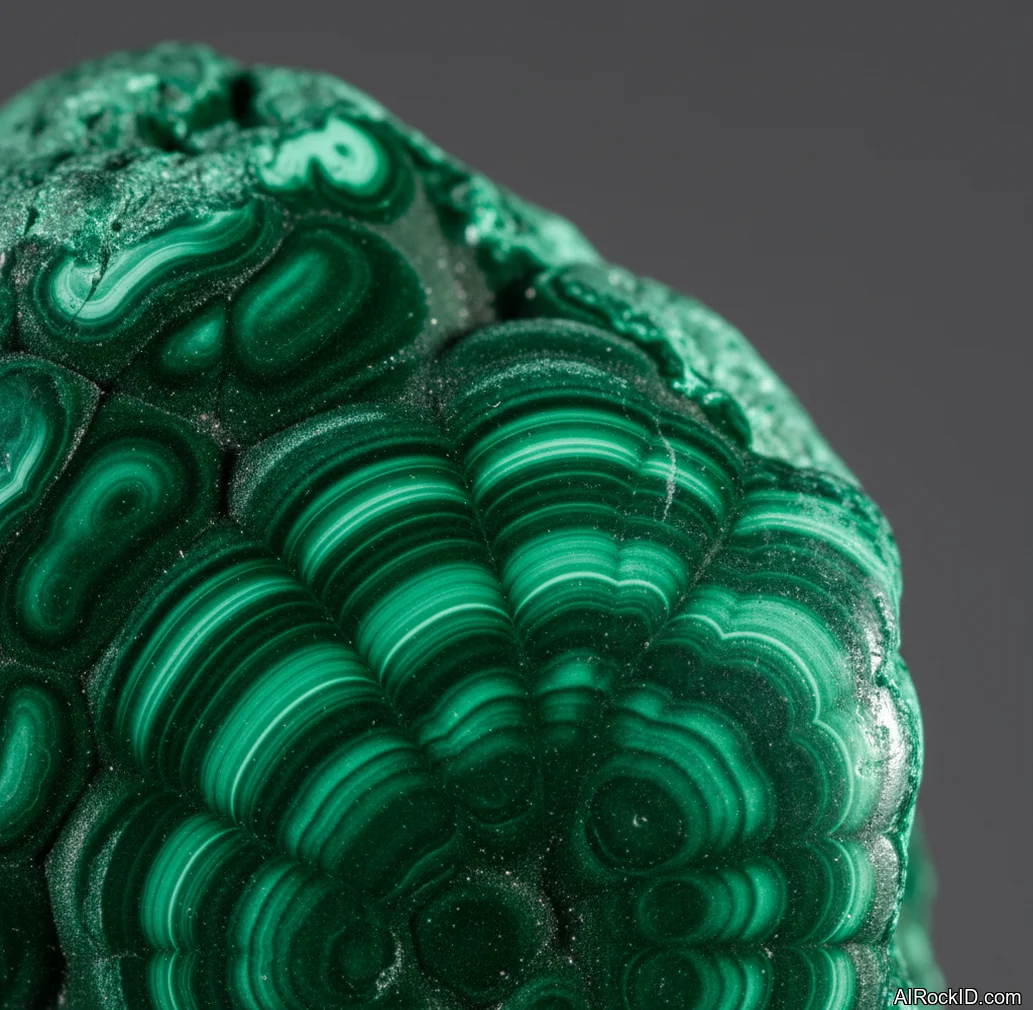
- Malachite: Malachite is typically brighter green with banding and may occur with chrysocolla in the same specimen.
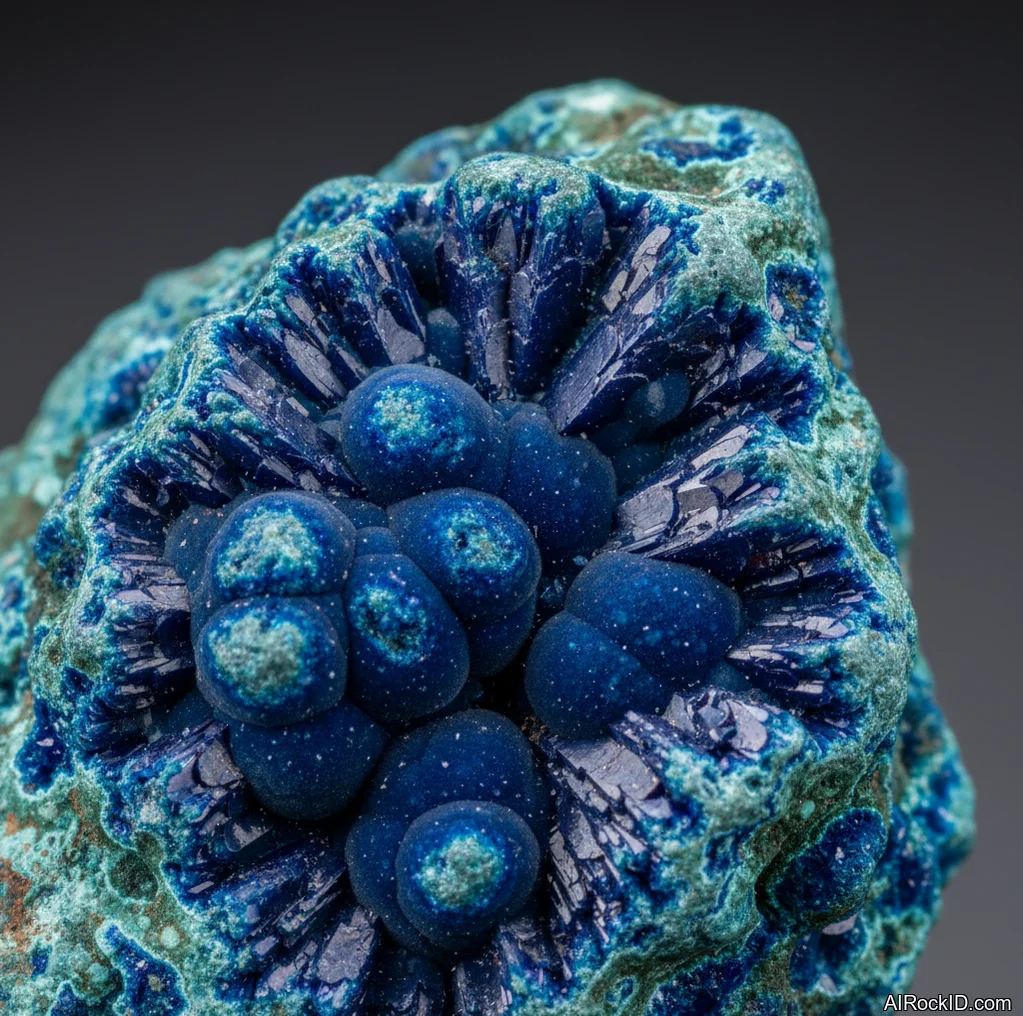
- Azurite: Azurite is usually deeper blue and can alter to green copper minerals over time.
Chrysocolla vs. Similar Blue-Green Stones
| Stone | Typical Clue | Hardness | Common Difference |
|---|---|---|---|
| Chrysocolla | Blue-green, often with copper mineral matrix | 2–4 | Softer and more variable than many lookalikes |
| Turquoise | Waxy blue to green with dark matrix | 5–6 | Usually harder and more compact |
| Amazonite | Blue-green feldspar with cleavage | 6–6.5 | No copper-mineral association |
| Malachite | Green bands or botryoidal texture | 3.5–4 | Greener and commonly banded |
| Dyed Howlite | Blue color concentrated in cracks | 3–3.5 | Artificial color may appear uneven under magnification |
AI identification confidence
AI identification confidence for chrysocolla is usually moderate when the stone shows distinctive blue-green copper coloration with matrix or malachite association. Confidence is lower for polished cabochons, dyed stones, or specimens with quartz because surface appearance can hide the true mineral mixture.
When AI gets it wrong
- The photo has strong color correction, making blue-green stones appear more saturated than they are.
- The specimen is a mixed copper ore where chrysocolla, malachite, azurite, quartz, and other minerals occur together.
- The stone is polished, stabilized, or dyed, reducing visible texture and natural surface clues.
- The image lacks scale, close-up texture, or multiple angles.
Final recommendation
Choose chrysocolla when you want a blue-green copper mineral with natural variation, especially for display pieces, pendants, beads, or cabochons with protective settings. For daily-wear jewelry, a harder blue-green stone or chrysocolla-in-quartz may be more practical.
How to Check Chrysocolla Authenticity
Authentic chrysocolla often shows natural variation, uneven blue-green color, and associations with minerals such as quartz, malachite, azurite, or limonite. Be cautious with stones that have extremely uniform color, dye pooled in cracks, or a price that seems inconsistent with size and quality. A simple hardness check can help separate chrysocolla from harder lookalikes, but scratch testing should be avoided on finished jewelry or valuable specimens.
Buying Chrysocolla: What to Look For
For jewelry, look for stable material with a good polish and minimal surface pits, especially if the stone is used in a ring or bracelet. Chrysocolla mixed with quartz is often more durable than soft, porous material and may be better suited for cabochons. Ask whether the stone has been stabilized, dyed, or backed, since treatments can affect durability and disclosure expectations.
Natural Chrysocolla Associations
Chrysocolla commonly forms in oxidized copper deposits and may occur with malachite, azurite, cuprite, quartz, and iron oxides. These mineral mixtures can create attractive patterns but also make exact identification more complex. A specimen labeled chrysocolla may be a mixed rock or copper ore rather than a pure mineral sample.
What Is Chrysocolla?
Chrysocolla is a blue to blue-green hydrated copper silicate, and you usually see it turning up as a secondary mineral down in the oxidized zones of copper deposits.
Grab a decent chunk and you’ll notice the feel before anything else. Some chrysocolla is chalky, almost dusty right on the edges, like it’s just waiting to shed grit if you tap it against a hard table. But then you get those silica-rich pieces that feel smoother and colder in your hand, and they’ll take a polish so glassy it can trick people into thinking it’s tougher than it really is (it isn’t).
At a quick glance, people in copper country will call anything blue-green “chrysocolla.” Thing is, that label gets messy fast. Out in the field it’s often tangled up with quartz, chalcedony, malachite, cuprite, tenorite, and limonite, and that’s why one cabochon will scratch if you breathe on it wrong while the next one holds up just fine in a pendant. Same name. Totally different behavior. Who hasn’t seen that happen?
Origin & History
The name comes from Greek words for “gold” and “glue,” since ancient metalworkers used copper-rich stuff as a soldering or flux helper when they were working with gold. Back then nobody was calling it a “chrysocolla cabochon.” It was shop material. Practical. The kind of thing you’d keep near the hot workbench, next to the soot and the little crusty bits that build up around a flame.
As an actual mineral species, chrysocolla got described in the modern sense in the 1800s, and it’s been a bit of a headache ever since. Thing is, it’s often poorly crystalline and mixed right into other copper minerals, so clean ID can get messy fast. Most dealers still go by what it looks like and where it came from, and yeah, that’s basically how it gets bought and sold at shows too. Why pretend otherwise?
Where Is Chrysocolla Found?
It turns up anywhere oxidized copper deposits are doing their thing, especially in arid to semi-arid mining districts where the blue-green copper minerals have room to build crusts and seams.
Formation
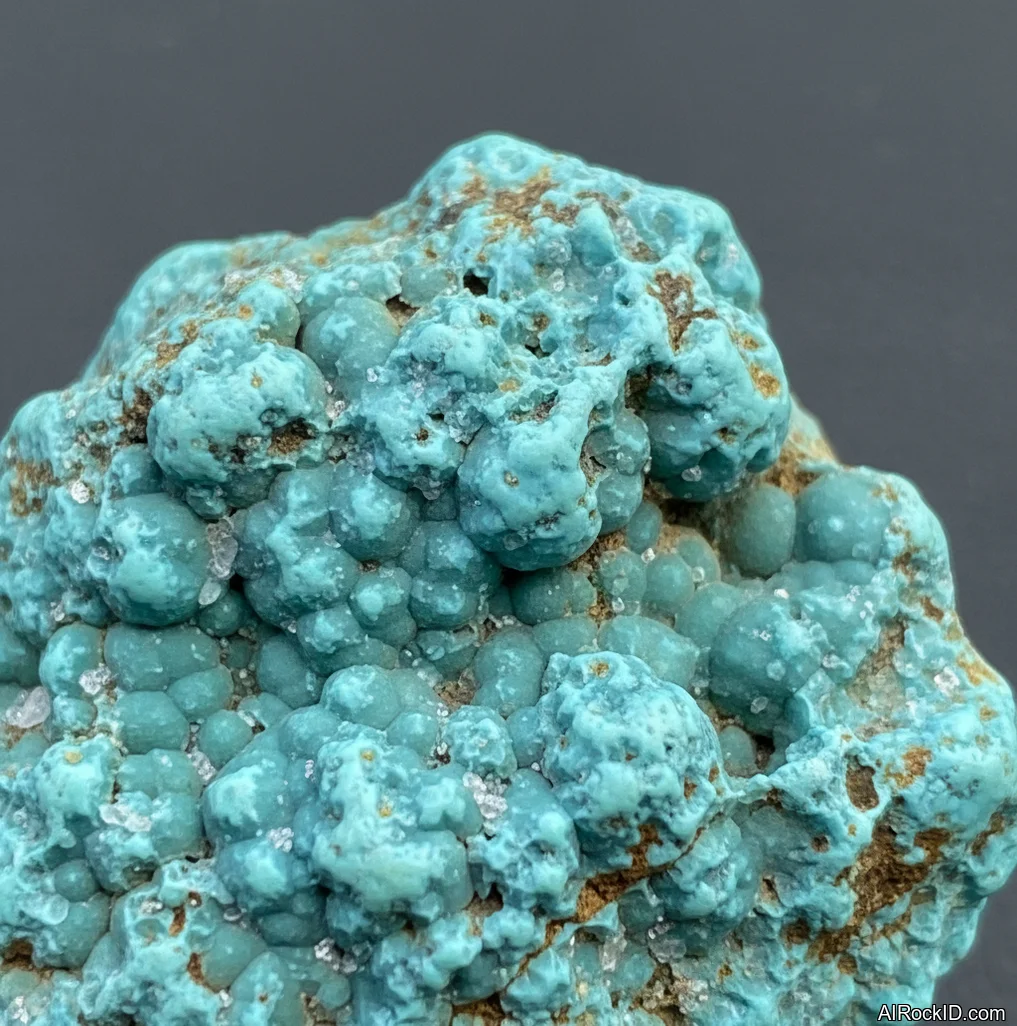
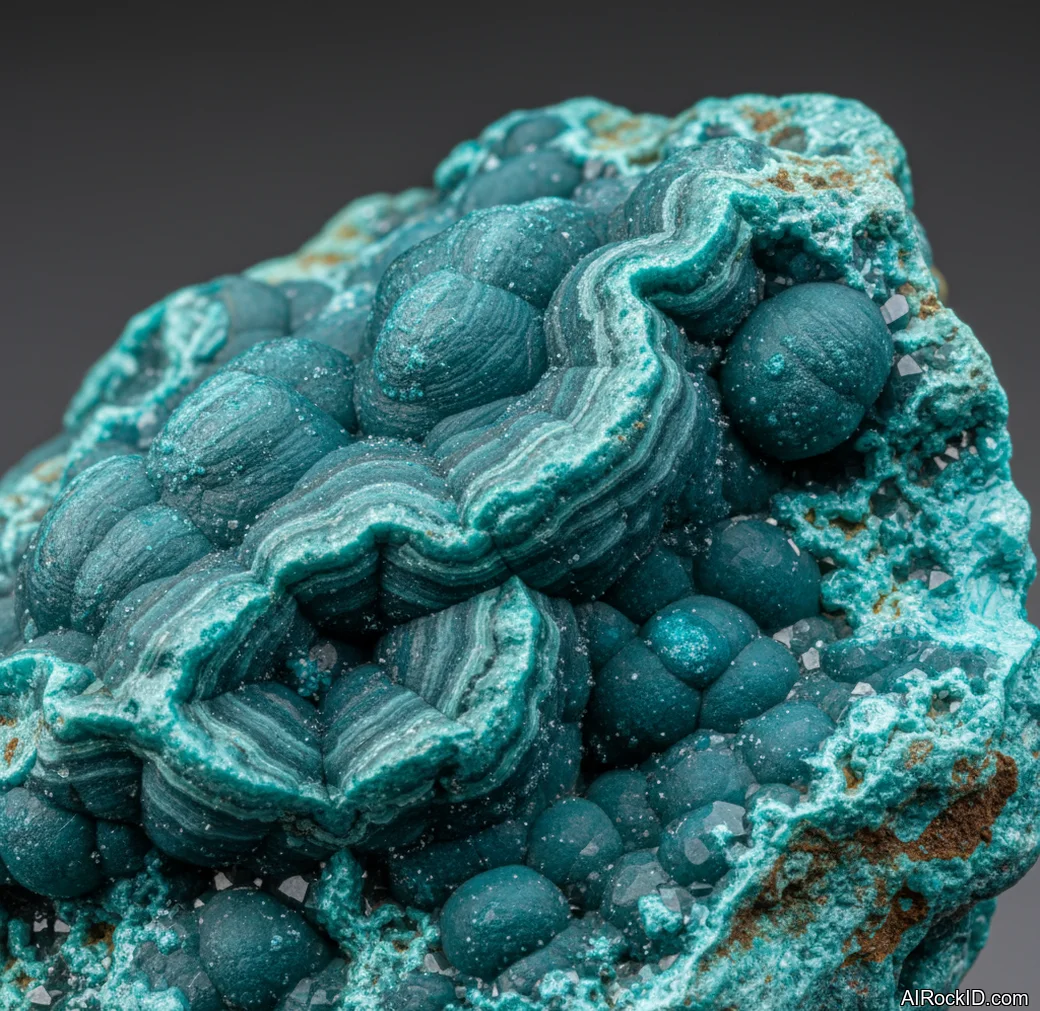
Raw chunks from copper mines usually turn up in the oxidized zone. That’s the part where groundwater and oxygen get in and start chewing up primary sulfides like chalcopyrite and bornite. Copper goes mobile, silica’s hanging around, and chrysocolla drops out in fractures and vugs, sometimes as those botryoidal crusts that look like little frozen bubbles. You’ll also see it filling brecciated rock pretty often, with iron oxides staining everything that dusty brown in the background.
But here’s the collector reality: a lot of the best-looking “chrysocolla” you see in jewelry isn’t pure chrysocolla at all. It’s chrysocolla hosted in quartz or chalcedony. That extra silica makes the material harder, denser, and more stable, which is why some of it gets sold as “gem silica.” And if you’ve handled both, you know right away. The silica-rich stuff has this glassy chill to it and a tighter, cleaner surface, while the softer material feels a little grabby under your thumb (almost like it wants to drag).
How to Identify Chrysocolla
Color: Color runs from robin’s-egg blue through teal and green, often with black or brown matrix and occasional malachite-green patches. Bands, swirls, and puddly color zoning are common.
Luster: Luster ranges from dull/earthy on porous material to waxy or vitreous when it’s silica-rich and well polished.
If you scratch it with a steel needle and it powders or leaves a trench easily, you’re in the softer chrysocolla range, not the silica-rich stuff. Look closely at polished pieces under a bright light: quartz-hosted material has a tighter, more glassy surface, while porous chrysocolla shows tiny pits and a softer glow. The problem with online photos is saturation, so I like to tilt it in hand and watch how the shine moves across the surface, because that tells you a lot about texture.
Common Look-Alikes
Chrysocolla is sometimes confused with these materials:
- Turquoise (including stabilized turquoise sold as “high grade” when it’s mostly resin)
- Larimar (pectolite), especially polished cabochons in blue-white patterns
- Hemimorphite (blue botryoidal), which can look like “blue chrysocolla” in photos
- Amazonite (microcline feldspar), when chrysocolla is pale blue-green and mottled
- Dyed howlite or dyed magnesite sold as “chrysocolla” or “sea jasper”
- Blue-green glass or resin composites sold as “chrysocolla quartz” or “gem silica”
Market Cautions & Treatments
When AI Can Get This Wrong
At first glance, phone cams tag chrysocolla as turquoise, larimar, or hemimorphite because all three do the same blue-green, white-mottled thing when the lighting’s flat. The real test is hardness and texture: chrysocolla often scratches with a copper coin or steel point in softer areas, while turquoise and hemimorphite usually hold up better unless they’re heavily stabilized. Look closely at the surface too, real chrysocolla commonly has that waxy-to-chalky patchiness and tiny porous pits that AI tends to smooth over in photos.
Properties of Chrysocolla
Physical Properties
| Crystal System | Amorphous |
| Hardness (Mohs) | 2–4 (Soft (2-4)) |
| Density | 2.0–2.4 g/cm3 |
| Luster | Waxy |
| Diaphaneity | Opaque |
| Fracture | Uneven |
| Streak | Light blue to greenish blue |
| Magnetism | Non-magnetic |
| Colors | Blue, Blue-green, Green, Turquoise, Teal, Cyan, Black, Brown |
Chemical Properties
| Classification | Silicates |
| Formula | Cu2H2Si2O5(OH)4·nH2O |
| Elements | Cu, H, Si, O |
| Common Impurities | Fe, Mn, Al, Ca |
Optical Properties
| Refractive Index | 1.46–1.57 |
| Birefringence | None |
| Pleochroism | None |
| Optical Character | Isotropic |
Chrysocolla Health & Safety
Handling it is pretty low risk. But if you’re doing lapidary work, you’ll kick up super fine dust, and you really don’t want to breathe that stuff in. If the rough leaves a chalky powder on your fingers (you’ll feel that gritty film), wash your hands afterward.
Safety Tips
If you need to cut it or sand it, do it wet and wear the right respirator. And when you’re done, wipe up the muddy slurry while it’s still damp instead of letting it sit there and dry into dust.
Chrysocolla Value & Price
Price Range
Rough/Tumbled: $5 - $80 per piece
Cut/Polished: $5 - $60 per carat
Prices climb fast as hardness and polish get better, which is why silica-rich chrysocolla in quartz (the stuff you’ll see labeled gem silica) is where the real money is. Thing is, I’d take clean, even color with hardly any pitting and a solid, crack-free cab preform over a bigger piece any day.
Durability
Fragile — Scratch resistance: Poor, Toughness: Fair
Softer chrysocolla can dry out, pit, or bruise with wear, while silica-rich material holds up much better but still doesn’t love impacts.
How to Care for Chrysocolla
Use & Storage
Keep it away from harder stones in the same pouch, because it’ll pick up scratches fast. I store mine wrapped or in a compartment box, especially polished cabs.
Cleaning
1) Rinse quickly with lukewarm water and a tiny bit of mild soap. 2) Use a soft toothbrush only if the surface is solid and not chalky. 3) Pat dry and let it fully air-dry before putting it back in a box.
Cleanse & Charge
If you do energy-style cleansing, stick to smoke, sound, or a quick pass over a selenite plate. I wouldn’t leave softer pieces soaking in anything, even if plain water won’t instantly harm them.
Placement
On a desk or shelf is easy living for chrysocolla, and you can actually enjoy the patterns up close. For jewelry, pick silica-rich material and protect it from knocks.
Caution
Don’t use ultrasonic or steam cleaners. And don’t throw it into a tumble with quartz, either. Quartz is harder, and the softer stuff will get chewed up fast, especially where there are those hairline fractures you can barely see until the edge starts to chip.
Works Well With
Chrysocolla Meaning & Healing Properties
Look at how chrysocolla actually gets used, and most of it comes down to turning the emotional heat down a notch. It lives in that blue-green zone people associate with keeping your voice steady, cooling off, and not blurting out the sentence you’ll wish you could reel back in later. I’ve carried a palm stone at mineral shows when the room’s loud, the fluorescent lights are buzzing, and my brain feels cooked, and honestly, rubbing that slick, cool surface just gives my hands something to do. That part’s real. The rest? It’s personal.
But I’ve also watched the story get over-sold: some sellers talk like it’ll fix your whole life. It won’t. What it can do, if you’re the type who uses objects as little reminders, is nudge you back to your breath and your tone. A chunky piece on the nightstand can be the signal to grab a notebook instead of doom-scrolling (because who hasn’t done that at 1 a.m.?).
If you’re wearing it on the body, treat durability as part of the deal. Softer chrysocolla gets knocked up fast, and that can be a bummer if you’re attached to that perfect polish. I had a cab that picked up a small bruise right on the edge after one dumb drop, and that was enough to teach me to choose silica-rich material for rings, then keep the softer, chalkier pieces for display and meditation stones.
Common mistakes
- Identifying any blue-green stone as chrysocolla without checking hardness or mineral associations
- Assuming all chrysocolla is durable enough for daily-wear rings
- Confusing chrysocolla mixed with quartz for pure chrysocolla
- Overlooking dye or stabilization in very bright, uniform cabochons
- Using color alone to separate chrysocolla from turquoise, amazonite, or dyed howlite
- Expecting every chrysocolla specimen to have the same shade of blue or green
Identify Chrysocolla from a photo
Compare Chrysocolla traits, care tips, value clues, and common lookalikes with a clear photo.