Rose Quartz


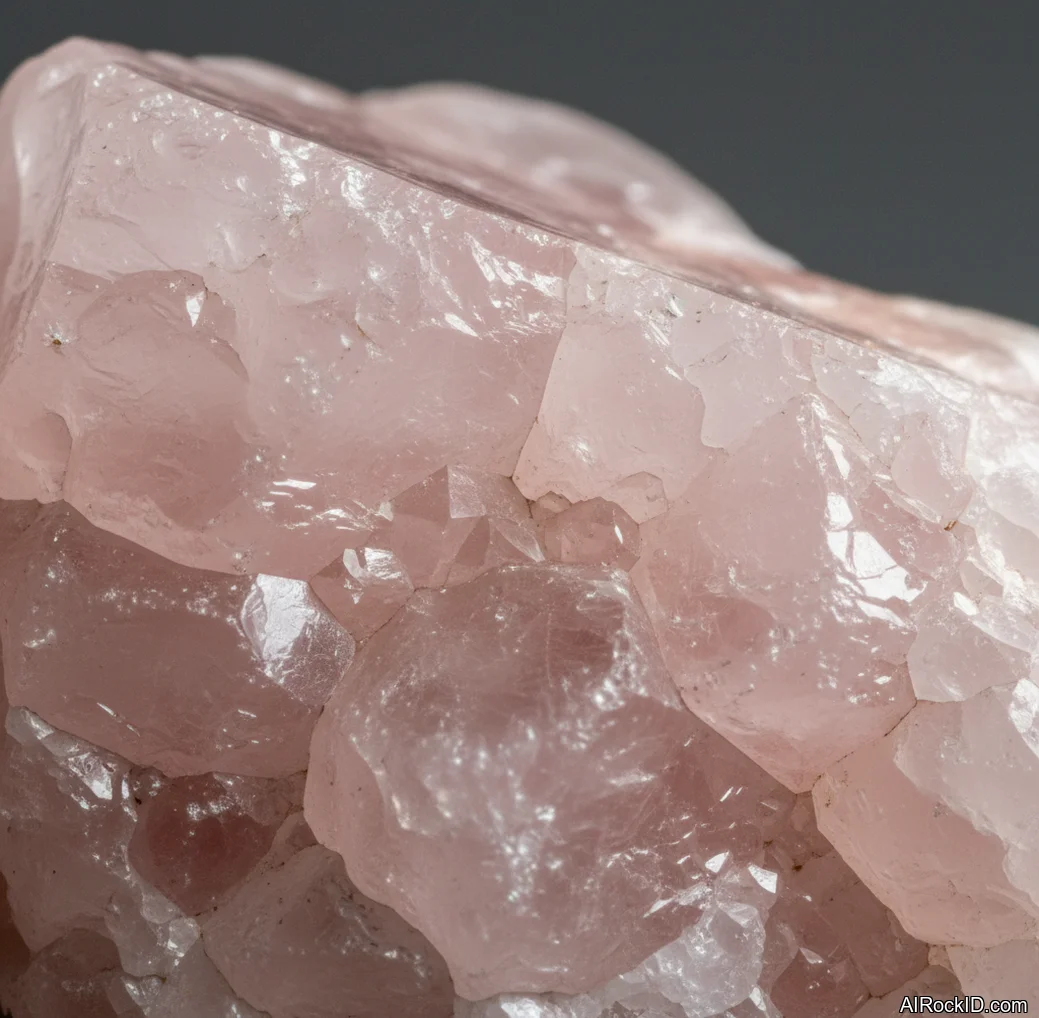
Quick answer: Rose quartz is commonly identified by its soft pink color, glassy to slightly cloudy appearance, and quartz-level hardness. It is often confused with pink opal, rhodonite, morganite, and dyed quartz, so color, luster, transparency, and hardness should be checked together.
AI Rock ID can help compare a rose quartz photo against visually similar pink minerals using color, texture, and surface clues. RockIdentifier.io provides crystal information and identification support, but uncertain results should be confirmed with simple physical tests or a qualified gemologist for valuable pieces.
Good fit
- Collectors who want an affordable pink quartz specimen
- Jewelry buyers looking for a durable gemstone for everyday wear
- Beginners learning to recognize quartz varieties
- People comparing natural pink stones with dyed or glass imitations
Not a good fit
- Buyers who need a rare or high-value gemstone with strong resale demand
- Identification based on color alone, because several minerals can appear pink
- Situations where medical or therapeutic claims are being evaluated
Most commonly confused with
- Pink Opal: Pink opal is usually softer and more waxy or porcelain-like, while rose quartz has a glassier quartz luster.
- Rhodonite: Rhodonite is often deeper pink to red with black manganese veining, unlike the usually softer, cloudy pink of rose quartz.
- Morganite: Morganite is a beryl gemstone with higher brilliance and different crystal habit, often sold as faceted jewelry.
- Dyed Quartz: Dyed quartz may show concentrated color in cracks, pits, or bead holes rather than an even natural pink tone.
Rose Quartz vs. Similar Pink Materials
| Material | Typical Look | Key Difference |
|---|---|---|
| Rose Quartz | Pale to medium pink, translucent to cloudy | Mohs 7 quartz with glassy luster |
| Pink Opal | Opaque to slightly translucent, waxy pink | Softer and more waxy-looking |
| Rhodonite | Pink to reddish with possible black veins | Commonly shows dark manganese veining |
| Morganite | Peach-pink to pink, often transparent when gem-grade | Beryl gemstone with higher brilliance |
| Pink Glass | Uniform pink, may be very clear | Can show bubbles or molded features |
AI identification confidence
AI identification of rose quartz is often reasonably confident when the photo shows a pale pink, cloudy, glassy specimen with typical quartz texture. Confidence drops for polished beads, overexposed photos, very pale pieces, and transparent faceted gems because many pink materials can look similar in images.
When AI gets it wrong
- The stone is photographed under warm or pink lighting that changes the apparent color.
- The specimen is a polished bead or cabochon with few natural surface clues.
- The material is dyed quartz, pink glass, or resin with a rose-quartz-like color.
- The photo lacks scale, close-up detail, or multiple viewing angles.
Final recommendation
For casual collecting, rose quartz is a durable and widely available pink crystal, but buyers should still check for dye, glass, and mislabeled lookalikes. For expensive jewelry or unusually vivid specimens, request clear photos, treatment information, and professional verification when needed.
How to Spot Dyed or Fake Rose Quartz
Natural rose quartz usually has a soft pink color that may appear cloudy, milky, or uneven within the stone. Dyed material can show stronger color trapped in cracks, around drill holes, or along surface pits. Glass imitations may look too uniform, contain round bubbles, or feel lighter or warmer than expected for quartz.
Buying Rose Quartz Beads and Jewelry
Rose quartz beads are common, but very bright, perfectly even pink strands should be examined for dye or coating. Natural color can fade slightly in strong sunlight, so jewelry photos taken in different lighting are useful. Durable quartz hardness makes rose quartz suitable for many jewelry styles, but it can still chip if struck.
Photo Tips for Identifying Rose Quartz
Use daylight or neutral white lighting and photograph the stone against a plain background. Include one close-up, one image showing the whole specimen, and one image beside a coin or ruler for scale. Avoid color filters because small shifts in pink tone can make rose quartz look like opal, glass, or beryl.
What Is Rose Quartz?
Rose quartz is the pink form of quartz (SiO2), and you usually find it in big, translucent chunks instead of those sharp, pointy, terminated crystals people picture when they hear “quartz.”
Pick up a piece and you notice the classic quartz feel right away. Not crazy heavy like hematite, but still solid, cool in the hand, with that slightly “milky” drag on your fingers where the surface isn’t polished. The pink can run from barely-there blush to straight bubblegum, and it’s basically never perfectly uniform. Tilt it under a bright shop light and you’ll catch the internal haze, those wispy little veils, and sometimes faint banding that only pops at the right angle.
Thing is, most of what gets sold as rose quartz is that massive material, so don’t expect a tray full of crisp points like you’d see with amethyst. Real crystal faces do show up, but they’re rare, and the price usually reflects it. And yes, there’s one annoying practical detail: rose quartz can fade. I’ve had a nice pink palm stone turn washed-out after sitting on a sunny windowsill for a summer, so now I stash the best color in a drawer or cabinet.
Origin & History
Quartz has been known since antiquity. But “rose quartz” as a named variety didn’t really settle into mineral and gem trade use until the 19th century, when color varieties of quartz started getting treated more formally. The word “quartz” comes through German usage (Quarz), and “rose” is just the plain color callout dealers and cutters needed.
In older lapidary and jewelry writing, you’ll see “rose quartz” used pretty loosely, and honestly that still happens at shows, right there on the little handwritten tags in the trays. Some sellers also mix it up with “pink quartz,” which can mean different material depending on the context, so I always ask what the source is and whether it’s massive or actually crystallized.
Where Is Rose Quartz Found?
Large commercial rough comes mainly out of Brazil and Madagascar, with classic North American material from South Dakota. True well-formed crystals are much more locality-sensitive and less common in the market.
Formation
Most rose quartz turns up in pegmatites and quartz veins, basically where silica-rich fluids are the last to cool down and crystallize as a granite body is nearing the end of its life. So you’ll often see it as those big, chunky masses jammed in with feldspar and mica, the same pegmatite mix you hit in a lot of “dig-your-own” pits (the kind where everything feels a little gritty and feldspar-y under your fingers).
The pink color comes from trace components and tiny microscopic inclusions, and the exact reason can change depending on the material you’ve got in front of you. In a hand sample, it acts like regular quartz: there’s essentially no cleavage, it breaks with that curved conchoidal snap when you crack it, and a fresh chip has that clean glassy shine. But thing is, it tends to be cloudy. And that’s why cutters usually lean into cabochons, beads, carvings, or palm stones, instead of trying to facet it.
How to Identify Rose Quartz
Color: Soft pink to medium pink, usually with cloudy white zones; the color is commonly uneven rather than perfectly uniform. Some pieces show a slightly lavender-pink cast under cool lighting.
Luster: Vitreous (glassy) when fresh or polished, sometimes slightly waxy on worn surfaces.
If you scratch it with a steel nail, it won’t give easily, and it should scratch ordinary window glass. The real test is temperature and feel: genuine quartz stays cool in your hand and has that hard, slick-to-glassy surface when polished, not a plastic drag. Cheap dyed lookalikes often have color pooled in cracks or around drill holes, so check bead strands and tumbled stones with a loupe.
Common Look-Alikes
Rose Quartz is sometimes confused with these materials:
- Pink glass (especially in tumbled form)
- Dyed quartz (especially from Brazil and India)
- Pink chalcedony
- Pink aventurine
- Kunzite
- Heat-treated amethyst (sold as 'pink quartz')
Market Cautions & Treatments
When AI Can Get This Wrong
AI photo ID mixes up rose quartz with pink glass, pink chalcedony, and sometimes kunzite—especially in polished or tumbled stones. Photos hide the cloudy, fibrous structure you see up close in real rose quartz. The real test is using a steel nail: rose quartz scratches glass, glass fakes don't scratch much. Look for the subtle, uneven color and that cloudy, almost 'fibrous' texture inside real pieces.
Properties of Rose Quartz
Physical Properties
| Crystal System | Trigonal |
| Hardness (Mohs) | 7 (Hard (6-7.5)) |
| Density | 2.60-2.65 g/cm3 |
| Luster | Vitreous |
| Diaphaneity | Translucent |
| Fracture | Conchoidal |
| Streak | White |
| Magnetism | Non-magnetic |
| Colors | Pale pink, Pink, Medium pink, Pinkish lavender, White |
Chemical Properties
| Classification | Silicates |
| Formula | SiO2 |
| Elements | Si, O |
| Common Impurities | Ti, Mn, Fe, Al, P |
Optical Properties
| Refractive Index | 1.544-1.553 |
| Birefringence | 0.009 |
| Pleochroism | None |
| Optical Character | Uniaxial |
Rose Quartz Health & Safety
Rose quartz isn’t toxic, so you can handle it without worrying. But it’s still quartz, and when you cut or grind it you can kick up that super-fine dust that hangs in the air and gets everywhere (you’ll see it settle on the bench). So yeah, don’t breathe the dust.
Safety Tips
Use water while you grind or sand quartz. Keep the air moving too, like a fan pulling dust away instead of letting it hang right in front of your face. And don’t rely on a flimsy paper mask. Wear a proper respirator that actually seals around your nose and cheeks (you can feel it tug a little when you inhale).
Rose Quartz Value & Price
Price Range
Rough/Tumbled: $3 - $30 per piece
Cut/Polished: $1 - $10 per carat
Price mostly comes down to color saturation, translucency, and size. Deep, clean carving-grade rough (the kind that looks almost wet when you turn it under a light, not dusty) pulls more money than chalky, pale material. And true crystallized rose quartz specimens? Those, plus strong star material, shoot way up in price compared to everyday tumbles.
Durability
Durable — Scratch resistance: Good, Toughness: Good
It’s stable for normal wear, but prolonged sunlight can fade the pink in some pieces.
How to Care for Rose Quartz
Use & Storage
Keep it out of direct sun if you care about the color staying strong. I store deeper pink pieces in a box or cabinet, and I don’t let them sit in a south-facing window.
Cleaning
1) Rinse with lukewarm water and a drop of mild soap. 2) Use a soft toothbrush to get grime out of pits and seams. 3) Rinse well and pat dry; skip harsh chemicals and long soaks if it’s set in jewelry.
Cleanse & Charge
A quick rinse and a wipe-down is usually enough for day-to-day handling. If you like ritual cleansing, gentle methods like moonlight or sound won’t risk fading the way strong sun can.
Placement
Set it where it won’t get scratched by harder stuff like topaz or corundum, because countertop bowls turn into a rock tumbler over time. On a desk or nightstand is fine, just not in blasting light.
Caution
Keep it out of long, direct sun if you can. That’s how the color starts to wash out over time. And if you’re cutting or drilling it, don’t breathe in the dust. Silica dust is a respiratory hazard (it gets in your lungs fast).
Works Well With
Rose Quartz Meaning & Healing Properties
Look at how people actually use rose quartz and it’s mostly about mood and emotional tone, not fireworks. Back when I worked in a shop, people would pick up five different stones, chat for a while, and rose quartz was the one they’d keep absentmindedly rubbing with their thumb the whole time. It’s got this smooth, comforting feel when it’s polished, almost like a worn bar of soap, and that texture alone can settle you down if you’re the kind of person who needs something in your hand.
Clear quartz points can feel sharp and electric by comparison. Rose quartz usually gets used to soften the edges of a rough day: being a little kinder to yourself, cooling off after an argument, getting out of your own head. But I’m going to say the quiet part out loud. None of that is medical care. If someone’s dealing with real anxiety, depression, or trauma, a pink stone isn’t a treatment plan. It can be a reminder and a tool, like a worry coin you keep in your pocket, but it’s not a replacement for help.
Most dealers will tell you rose quartz is “for love,” and sure, that’s the shorthand. In real life, I see it used more for rebuilding trust with yourself or setting a gentler baseline at home (especially in the bedroom or on a nightstand). And when the stone’s pale or cloudy, people sometimes assume it’s low quality in a spiritual sense. That’s just market brain. Cloudiness is normal for this material, and some of the most comforting pieces I’ve owned looked like pink milk glass.
Common mistakes
- Assuming every pale pink stone is rose quartz without checking hardness, luster, and texture.
- Mistaking dyed quartz or pink glass for natural rose quartz because the color looks attractive.
- Using only one photo for identification, especially if the stone is polished or faceted.
- Expecting all rose quartz to be strongly pink; many natural pieces are very pale.
- Leaving specimens in direct sunlight for long periods, which may cause some color fading.
Identify Rose Quartz from a photo
Compare Rose Quartz traits, care tips, value clues, and common lookalikes with a clear photo.