Amethyst


Quick answer: Amethyst is the purple variety of quartz, typically colored by iron-related defects and natural or induced irradiation. It is a Mohs 7 crystal, so it is durable for many jewelry and display uses, but its color can fade with prolonged strong sunlight.
AI Rock ID can help screen amethyst by analyzing visible color zoning, crystal habit, transparency, and surface features from a photo. RockIdentifier.io provides crystal identification support, but final confirmation may require gemological testing when value, treatment, or synthetic origin matters.
Good fit
- Collectors who want a widely available purple quartz specimen
- Beginners learning to identify hexagonal quartz crystals and geode habits
- Jewelry buyers looking for a relatively durable purple gemstone
- People comparing natural amethyst with dyed, glass, or synthetic lookalikes
Not a good fit
- Situations where strong sunlight exposure is unavoidable for long periods
- Buyers who need proof of untreated natural origin without lab documentation
- Collectors seeking rare minerals with limited worldwide availability
Most commonly confused with
- Fluorite: Fluorite is softer, has perfect cleavage, and often shows cubic crystal form rather than quartz points.
- Purple Glass: Glass may show bubbles, swirl marks, or mold-like shapes and lacks natural quartz crystal faces.
- Iolite: Iolite shows strong pleochroism, shifting from violet-blue to grayish or yellowish tones when rotated.
- Sugilite: Sugilite is usually massive and opaque to translucent, with a waxy look rather than transparent quartz points.
Amethyst vs Common Purple Lookalikes
| Material | Key visual clue | Hardness / structure | Common issue |
|---|---|---|---|
| Amethyst | Purple quartz with possible color zoning and hexagonal points | Mohs 7; no cleavage | May be heat-treated or synthetic |
| Fluorite | Purple, green, or banded; often cubic or cleaved | Mohs 4; perfect cleavage | Scratches much more easily |
| Purple glass | Uniform color, bubbles, or molded shapes | Variable; amorphous | Sold as crystal when not mineral quartz |
| Iolite | Blue-violet color shifts with viewing angle | Mohs 7–7.5; distinct pleochroism | Can be mistaken for darker amethyst gems |
| Sugilite | Opaque to translucent purple masses | Mohs 5.5–6.5; massive habit | Often confused in tumbled stones |
AI identification confidence
AI photo identification of amethyst is usually stronger when the image shows quartz crystal points, geode interiors, or clear purple zoning. Confidence is lower for polished beads, dark cabochons, very pale stones, or images taken under colored lighting.
When AI gets it wrong
- Purple fluorite can look like amethyst in photos if cleavage planes or cubic shapes are not visible.
- Dyed quartz or dyed agate may appear naturally purple when color concentration is hidden in cracks or bands.
- Synthetic amethyst can match natural amethyst visually and may require gemological testing to separate.
- Purple glass can be misread as crystal if bubbles, mold seams, or unnatural shapes are not shown clearly.
Final recommendation
Choose amethyst when you want a durable purple quartz specimen or gemstone and the seller clearly describes treatments, origin, and whether the piece is natural or synthetic. For higher-value faceted stones or unusual colors, request reliable documentation rather than relying on appearance alone.
How to Tell If Amethyst Is Real
Natural amethyst commonly shows uneven violet zoning rather than perfectly flat color throughout the stone. Quartz crystal points should have a hexagonal habit, glassy luster, and no easy scratching from a steel knife. Bubbles, molded shapes, painted surfaces, or color concentrated only along cracks can indicate glass, dye, or an altered material.
Natural, Heat-Treated, and Synthetic Amethyst
Some amethyst on the market is natural, some is heat-treated to change or lighten color, and some is laboratory-grown quartz. Synthetic amethyst has the same basic chemistry as natural quartz, so visual identification alone is often not enough for certainty. Sellers should disclose treatments and synthetic origin, especially for faceted gems and high-priced specimens.
Buying Checks for Amethyst Specimens
Check whether the specimen is a natural cluster, a cut geode, a repaired point, or a dyed decorative piece. Look for stable mounting, intact crystal tips, natural color distribution, and any signs of glue, cement, or added backing. Origin labels such as Brazil or Uruguay can be useful, but they should not be treated as proof of quality or authenticity by themselves.
What Is Amethyst?
Amethyst is the purple variety of quartz, colored mainly by iron impurities and natural irradiation. In hand, it feels cool, glassy, and heavier than many imitations, with sharp crystal points that can catch a sleeve or nick a fingertip if the cluster is chipped.
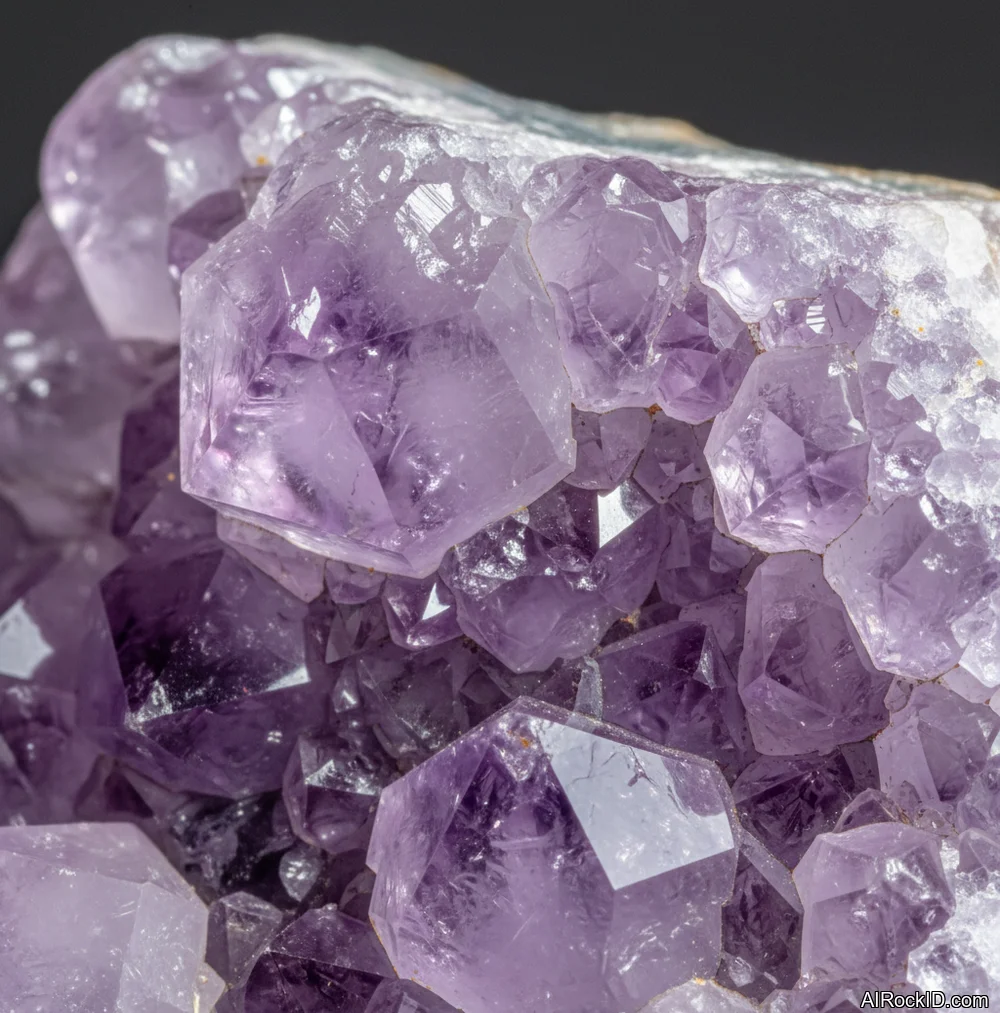
Good amethyst is not just “purple.” Look through a point and you may see a pale base, deeper violet tip, reddish-purple flash, or faint chevron zoning stacked inside the crystal. Mineral references such as https://www.mindat.org/min-198.html treat amethyst as quartz by variety, which matches how it behaves in a collector’s tray: hard, vitreous, and unmistakably quartz-like.
Origin & History
Amethyst gets its name from the Greek *amethystos*, which people usually translate as “not intoxicated.” That’s why you keep bumping into the old story about wine cups and staying sober. But honestly, as a collector, I think the name survived because it’s a word people can actually say out loud, remember, and pass along without mangling it.
On the mineralogy side, amethyst is just quartz. Quartz was recognized and used way back in antiquity, long before anyone was writing down formal species descriptions or arguing over classifications in print. Quartz itself got formally described as a mineral species in the early days of modern mineralogy, and ever since then amethyst has been treated as a color variety, not a separate species. And yeah, that lines up with what you see when you’ve actually got a piece in hand and put it under the scope: it behaves like quartz, just purple.
Where Is Amethyst Found?
Amethyst is found in many quartz-bearing environments, but the big display geodes on the market most often come from southern Brazil and Uruguay. These pieces are usually cut flat on the back so the purple crystal lining can stand upright on a shelf.
Collector-grade single crystals and specialty material also come from places such as Zambia, Four Peaks in Arizona, Thunder Bay in Ontario, the Ural Mountains, and Alpine pockets in Switzerland. Local style matters: some localities produce dense geode interiors, while others are known for sharper, more individual crystals.
Formation
Amethyst forms when silica-rich fluids deposit quartz in open spaces, and the right trace impurities and natural irradiation give that quartz its purple color. In basalt-hosted geodes, old gas bubbles in lava become hollow cavities later lined with sparkling quartz points.
It also forms in hydrothermal veins and pocket systems, including Alpine-style clefts. You can feel the difference between these habits: a heavy cathedral geode has thousands of tiny snagging points, while a pocket crystal may have a single sharp termination, glassy faces, and stronger color concentrated near the tip.
How to Identify Amethyst
Identify amethyst by its purple quartz look: vitreous luster, cool glassy feel, conchoidal chips, no cleavage planes, and color that often zones from lighter base to deeper violet tip. It should scratch glass and should not be easily scratched by a steel knife.
Watch for look-alikes. Purple fluorite may show easy cleavage, lepidolite feels flaky and mica-like, and purple glass can look syrupy or show bubbles. Dyed quartz, agate, and geode slices often have color pooled in cracks, drill holes, or rims instead of natural zoning inside the crystal.
Common Look-Alikes
Amethyst is sometimes confused with these materials:
- Purple fluorite (often sold as "amethyst fluorite")
- Purple glass (including "Andara" style glass marketed as amethyst)
- Dyed quartz or dyed agate/geode slices sold as "amethyst"
- Heat-treated amethyst (sold as citrine or "Madeira" citrine)
- Purple sapphire/spinel in jewelry photos (color overlap, different luster and hardness)
- Lepidolite (lavender mica, sparkly flakes that can fool people in quick pics)
Market Cautions & Treatments
When AI Can Get This Wrong
Phone pics trip up hard on purple. In photos, amethyst gets confused with purple fluorite and lepidolite because the camera flattens luster and hides cleavage, so everything just reads as "lavender rock." The real test is a quick hardness and break check: amethyst (quartz) should scratch glass and won’t show fluorite’s easy cleavage planes, and it stays cool and glassy-sharp on the edges instead of feeling soft or flaky.
Properties of Amethyst
Physical Properties
| Crystal System | Trigonal |
| Hardness (Mohs) | 7 (Hard (6-7.5)) |
| Density | 2.65 g/cm3 |
| Luster | Vitreous |
| Diaphaneity | Transparent to translucent |
| Fracture | Conchoidal |
| Streak | White |
| Magnetism | Non-magnetic |
| Colors | Light lavender, Lilac, Purple, Violet, Reddish purple |
Chemical Properties
| Classification | Silicates |
| Formula | SiO2 |
| Elements | Si, O |
| Common Impurities | Fe, Al, Mn |
Optical Properties
| Refractive Index | 1.544-1.553 |
| Birefringence | 0.009 |
| Pleochroism | Weak |
| Optical Character | Uniaxial |
Amethyst Health & Safety
Amethyst is usually safe to handle and keep on display. Thing is, the only real “risk” is just physical stuff: those sharp points and little chipped edges on a cluster can nick you if you run your finger along them.
Safety Tips
If you’re going to trim it or grind it, put on eye protection and a proper dust mask. And keep the work wet the whole time, so you don’t end up breathing silica dust.
Amethyst Value & Price
Price Range
Rough/Tumbled: $5 - $150 per piece
Cut/Polished: $2 - $30 per carat
Most of the price comes down to how saturated the color is, how clean the stone looks, and whether the terminations are still crisp and unchipped (those little points tell on you fast). Uruguay usually pulls higher numbers when it’s that inky, tight-crystal geode material you can feel is dense in your hand. But the big, pale Brazilian cathedrals? They’re priced for sheer size.
Durability
Durable — Scratch resistance: Excellent, Toughness: Good
It’s stable in normal conditions, but prolonged strong sunlight can fade the purple over time.
How to Care for Amethyst
Use & Storage
Store it where the points won’t rub other stones, because quartz will scratch a lot of stuff. And keep deep-color pieces out of a sunny window if you don’t want the purple to wash out.
Cleaning
1) Rinse with lukewarm water to remove dust. 2) Use a soft toothbrush with a drop of mild soap to get between points, then rinse well. 3) Pat dry and let it air-dry fully before putting it back on a shelf.
Cleanse & Charge
If you do energy-style cleansing, a quick rinse and a night on a windowsill with indirect moonlight is the low-risk route. Skip long sun baths if you care about color.
Placement
On a bookshelf or bedside table is fine, but set clusters on something stable so they don’t tip and chip points. If it’s a geode half, I like a little rubber or felt under it so it doesn’t skate on wood.
Caution
Skip harsh household cleaners, and don’t leave it sitting in strong sunlight for a long stretch. And please don’t hit geodes with boiling water or any sudden temperature swing, because those tiny internal fractures can let go and you’ll hear that awful, heartbreaking little crack.
Works Well With
Amethyst Meaning & Healing Properties
In modern crystal healing, amethyst is used as a calming, clarifying stone associated with the Third Eye and Crown chakras. People often keep it by a bedside, meditation space, or desk because its cool purple points give a quiet, focused presence rather than a loud decorative feel.
These meanings are spiritual traditions, not medical claims. As a specimen, amethyst is best appreciated for what you can actually observe: violet zoning, glassy quartz faces, and a color range from pale lilac to deep purple. Handle clusters carefully, because broken points can be surprisingly sharp.
Common mistakes
- Assuming every purple crystal is amethyst without checking hardness, crystal habit, and cleavage.
- Mistaking purple fluorite for amethyst even though fluorite is much softer and cleaves easily.
- Buying very bright, uniform purple stones without considering dye, glass, or synthetic origin.
- Placing amethyst in direct sunlight for long-term display and expecting the color to remain unchanged.
- Treating country-of-origin labels as proof that a specimen is natural, untreated, or high grade.
- Using phone photos under purple or warm lighting for identification without a neutral daylight image.
Identify Amethyst from a photo
Compare Amethyst traits, care tips, value clues, and common lookalikes with a clear photo.