Malachite


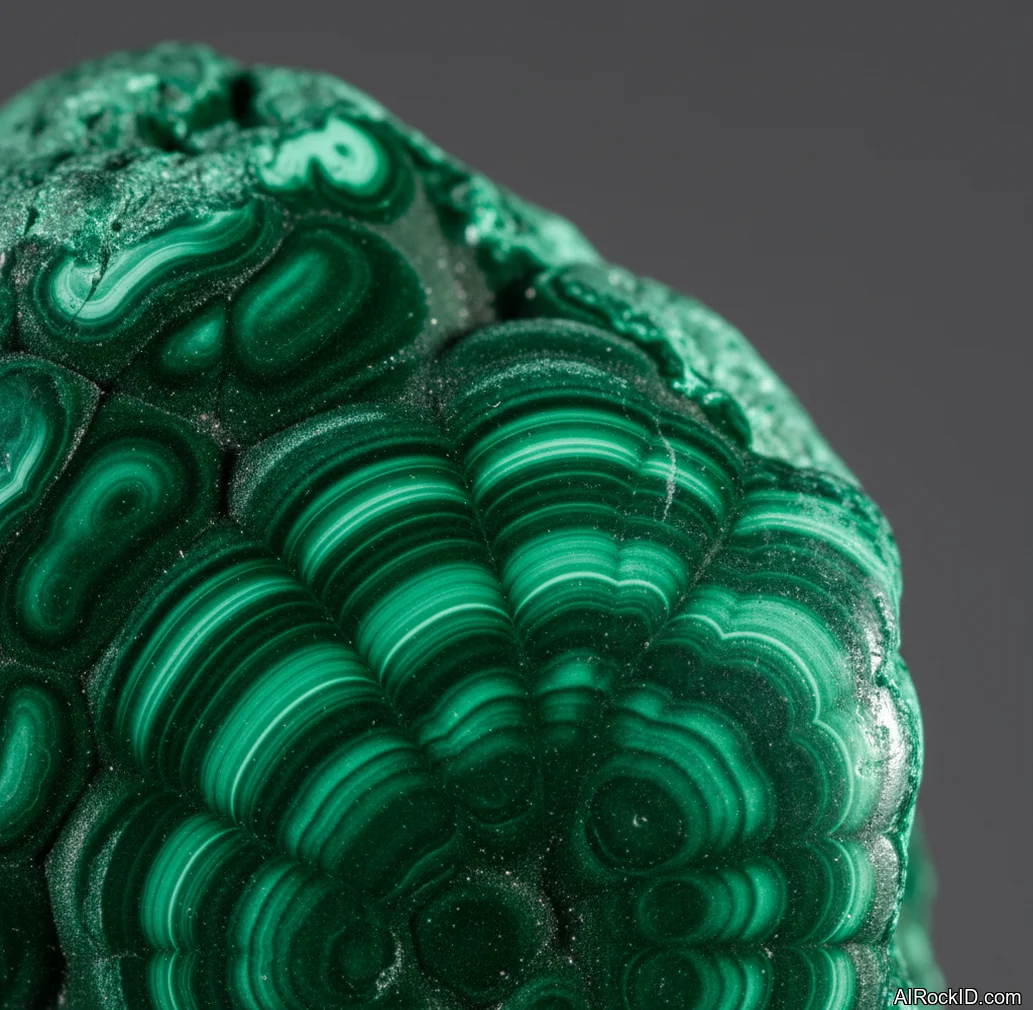
Quick answer: Malachite is a distinctive green copper carbonate mineral known for curved bands, rings, and botryoidal patterns. Because it is relatively soft and reactive with acids, identification should consider both its appearance and basic handling clues rather than color alone.
AI Rock ID can help screen a suspected malachite specimen by comparing visible color, banding, luster, and surface texture from a photo. RockIdentifier.io provides mineral information that can support visual identification, but physical tests and expert confirmation are useful for valuable or treated pieces.
Good fit
- Collectors who want a visually distinctive green copper mineral
- People comparing banded green stones before buying jewelry or carvings
- Specimens with clear concentric banding, silky masses, or botryoidal texture
- Educational collections focused on copper minerals and secondary ore minerals
Not a good fit
- Rings or daily-wear jewelry that will be exposed to knocks and abrasion
- Acid testing, vinegar cleaning, or ultrasonic cleaning
- Unsealed rough pieces intended for frequent handling by children
- Situations where a durable green gemstone such as jade or chrysoprase is needed
Most commonly confused with
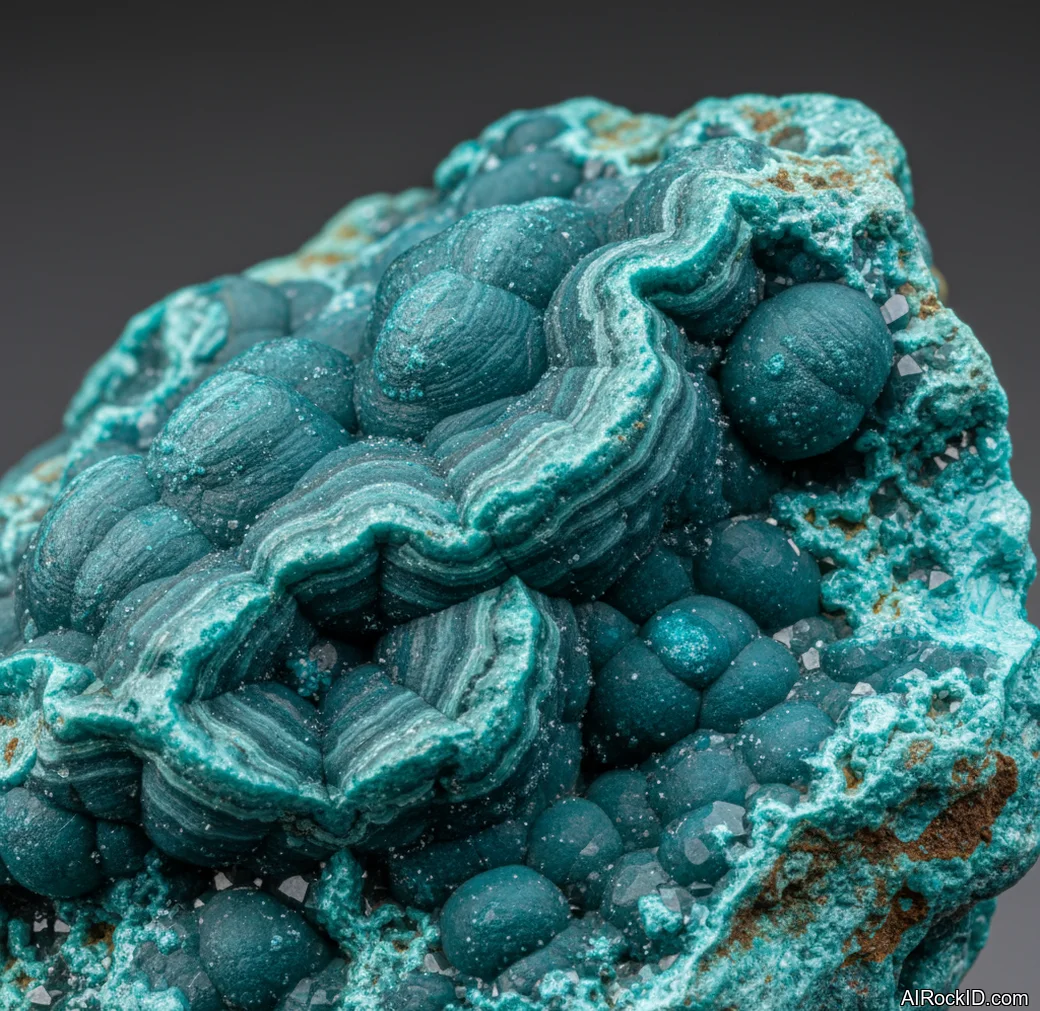
- Chrysocolla: Chrysocolla is usually blue-green to turquoise and often softer-looking, while malachite is typically richer green with clear banding.
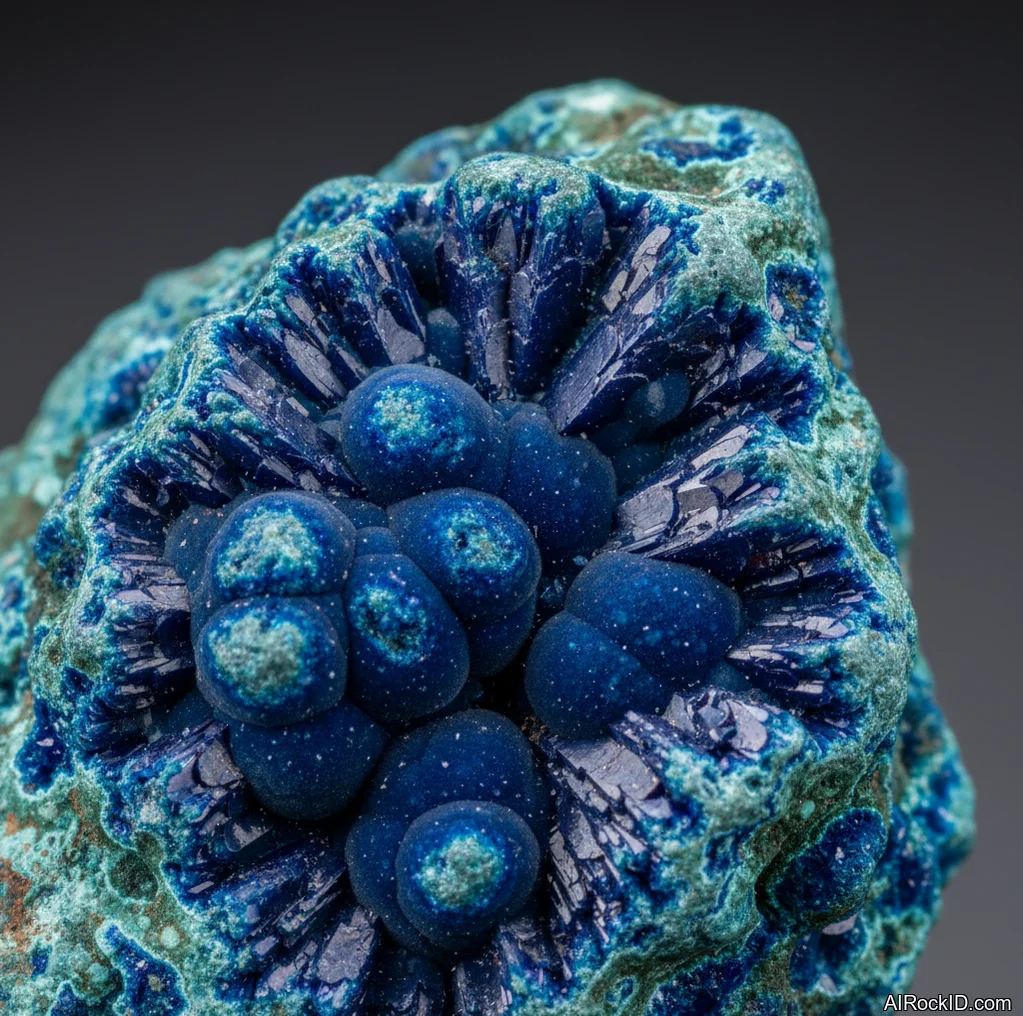
- Azurite: Azurite is deep blue and may occur with malachite, but pure malachite is green rather than blue.
- Jade: Jade is tougher and usually more uniform or mottled, while malachite commonly shows curved green bands.
- Serpentine: Serpentine is often waxy yellow-green to olive and lacks malachite’s copper-green banded patterns.
Malachite vs Similar Green Minerals
| Feature | Malachite | Common Lookalikes |
|---|---|---|
| Typical color | Medium to deep green bands | Chrysocolla blue-green; jade olive to emerald; serpentine yellow-green |
| Pattern | Curved bands, eyes, or botryoidal surfaces | Often mottled, veined, or more uniform |
| Hardness clue | Mohs 3.5–4; scratches more easily than quartz | Jade is much tougher; chrysocolla varies; serpentine is similar to slightly harder |
| Acid reaction risk | Can react with acids because it is a carbonate | Many silicate lookalikes do not react the same way |
| Common use | Cabochons, beads, carvings, display specimens | Jewelry, carvings, tumbled stones, decorative objects |
AI identification confidence
AI identification is often more confident when malachite shows sharp green banding, eye-like rings, or botryoidal texture in a well-lit photo. Confidence is lower for polished green beads, dyed materials, mixed copper ores, or close-up images without scale.
When AI gets it wrong
- The photo shows only a smooth green surface with no banding or texture.
- The specimen is a composite, resin-filled, reconstructed, or dyed material.
- Malachite is mixed with azurite, chrysocolla, quartz, or host rock.
- Lighting makes blue-green chrysocolla or dark jade appear malachite-green.
Final recommendation
For buying, choose malachite with natural-looking bands, consistent polish, and clear disclosure about stabilization, reconstruction, or dye. For important purchases, request seller photos in natural light and avoid pieces with vague names such as “green copper stone” without mineral identification.
How to Spot Real Malachite When Buying
Real malachite commonly has irregular curved bands, bullseye patterns, or layered green tones rather than perfectly repeating stripes. Very large, very cheap beads or carvings with identical patterns may be imitation, reconstructed material, or resin-based composite. A reputable listing should state whether the piece is natural, stabilized, reconstituted, dyed, or synthetic.
Natural, Stabilized, and Reconstructed Malachite
Natural malachite is mined and cut with minimal treatment, though some pieces may be sealed or backed for durability. Stabilized malachite has resin or another material added to improve strength, while reconstructed malachite is made from fragments or powder bound together. These treatments affect value and should be disclosed in sales descriptions.
Malachite in Mixed Copper Minerals
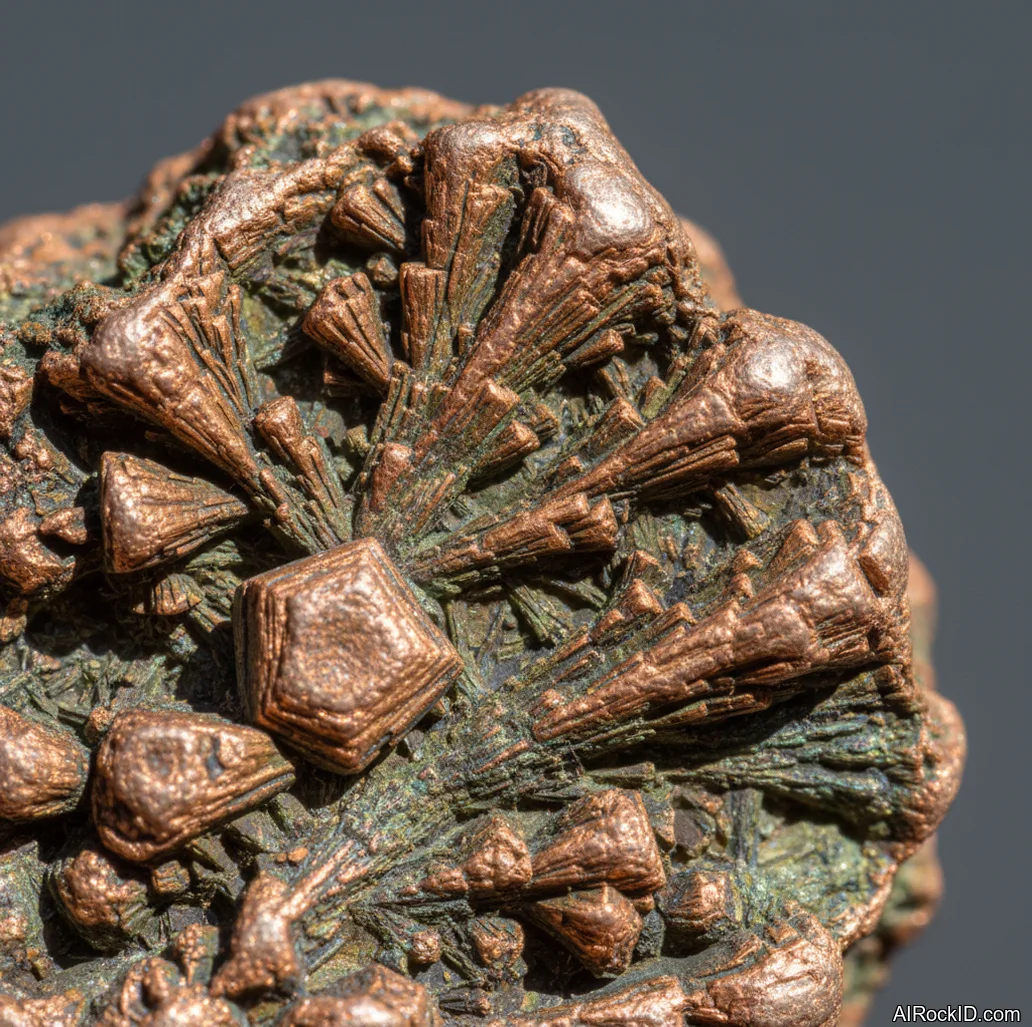
Malachite often forms with other secondary copper minerals, especially azurite, chrysocolla, cuprite, and limonite-stained host rock. Mixed specimens can show green, blue, brown, black, or rusty zones in the same piece. Identification should describe the visible minerals separately when possible rather than labeling the entire specimen as pure malachite.
What Is Malachite?
Malachite is a green, banded copper carbonate hydroxide mineral with the formula Cu2CO3(OH)2.
Pick up a hand-sized piece and the first thing that hits you is the weight. It’s weirdly heavy in your palm for something that, from across the room, could pass as “just a green rock.” And the really good stuff? You’ll see those crisp bullseyes and tight ribbons that look like somebody painted them on and then sealed them.
At a quick glance it just looks bright green. But stare for a minute and the color splits up: minty bands, near-black forest-green bands, and those silky patches where the polish turns almost glassy (you can feel it, too, that slick, cold surface). Thing is, it isn’t a tough stone. I’ve literally seen someone toss a malachite palm stone in a pocket with keys and, by the end of the day, the surface was scuffed up and kind of sad-looking. Who wants that?
Origin & History
Most dealers will swear malachite’s been around forever, and honestly, they’re not wrong. People mined it as a copper ore and crushed it into pigment way before “modern mineralogy” was even a thing. That part checks out.
Ground malachite got used for green color in art and decoration across several ancient cultures. If you’ve ever seen it in person, you know the powder has that chalky, dusty feel, and it clings to everything the second it’s ground down (messy stuff).
The name itself comes from the Greek “molochitis,” linked to the mallow plant, basically a nod to that leaf-green color. But as an officially described mineral species, malachite was described in 1747 by J.G. Wallerius, right when chemistry and mineral identification started getting organized instead of leaning on guesswork and folklore.
Where Is Malachite Found?
Malachite turns up in the oxidized zones of copper deposits worldwide. The showy stuff most people recognize comes heavily from central Africa and classic old copper districts.
Formation
Look at where malachite turns up and you’ll start seeing the same story over and over: it’s a weathering mineral. Copper sulfides like chalcopyrite and bornite break down close to the surface, groundwater hauls the copper along, and malachite drops out once the chemistry lines up.
It shows up as crusts, those rounded botryoidal “bubble” skins you can feel with your fingertip, fibrous sprays, and the banded chunks cutters go nuts for. But it rarely shows up alone. Azurite’s the usual sidekick, and you’ll also see chrysocolla, cuprite, limonite, plus the occasional bit of quartz tucked in there. Thing is, the “malachite” you see sold in big bulk lots is often a mix of materials. That’s not bad. Just know what you’re actually buying, right?
How to Identify Malachite
Color: Medium to dark green with lighter green banding, swirls, or concentric “eye” patterns. Color is usually opaque and can look almost black-green in thick zones.
Luster: Vitreous to silky when well-polished, and dull to earthy on rough crusts.
Pick up a piece and compare the heft to a similar-sized quartz or jasper. Malachite feels noticeably heavier because of the copper content. If you scratch it with a steel nail, it can mark or gouge, especially on a matte spot, since it’s only Mohs 3.5 to 4. Cheap versions are sometimes dyed howlite or resin composites, and the giveaway is color that looks too uniform and “printed,” plus they feel warmer in the hand than real stone that stays cool for a bit.
Common Look-Alikes
Malachite is sometimes confused with these materials:
- Dyed howlite or dyed magnesite sold as "malachite" (often called "reconstituted" or "block malachite")
- Dyed/treated serpentine (sometimes sold as "new jade")
- Chrysocolla (especially when it’s green and mixed with quartz)
- Banded calcite/aragonite (green onyx) that’s been dyed green
- Glass or resin imitations with printed/painted banding
Market Cautions & Treatments
When AI Can Get This Wrong
Photo ID tools mix malachite up with chrysocolla and dyed howlite all the time because banding and “green” are doing most of the work in a picture. The real test is a quick streak and hardness check: malachite leaves a pale green streak and scratches with a copper coin or steel nail, while dyed howlite stays white underneath and often shows dye concentrating in pores and drill holes.
Properties of Malachite
Physical Properties
| Crystal System | Monoclinic |
| Hardness (Mohs) | 3.5-4 (Soft (2-4)) |
| Density | 3.6-4.0 g/cm3 |
| Luster | Vitreous |
| Diaphaneity | Opaque |
| Fracture | Uneven |
| Streak | light green |
| Magnetism | Non-magnetic |
| Colors | green, light green, dark green, blackish green |
Chemical Properties
| Classification | Carbonates |
| Formula | Cu2CO3(OH)2 |
| Elements | Cu, C, O, H |
| Common Impurities | Fe, Mn, Si |
Optical Properties
| Refractive Index | 1.655-1.909 |
| Birefringence | 0.254 |
| Pleochroism | Strong |
| Optical Character | Biaxial |
Malachite Health & Safety
Normal handling’s fine. But if you’re cutting it, grinding it, or sanding it, don’t breathe the dust. Seriously. That fine powder gets everywhere, especially after a few passes on a wheel (you’ll see it settle like a light film). And if you’re doing lapidary work, keep it well away from food prep areas. No one wants grit near a cutting board, right?
Safety Tips
If you’re shaping or polishing malachite, don’t do it dry. Keep it wet, set up good ventilation, and wear a proper respirator rated for fine particulates (the kind that actually seals to your face, not a floppy dust mask). And when you’re done, wash your hands.
Malachite Value & Price
Price Range
Rough/Tumbled: $5 - $150 per piece
Cut/Polished: $2 - $15 per carat
Tight banding, a glassy polish, and rock that feels solid in your hand with hardly any cracks will bump the value up fast. And yeah, the big display slabs cost more, especially the heavier ones that thunk down on the table, and the old-school Ural-style patterning runs pricier too compared to little tumbled pieces.
Durability
Nondurable — Scratch resistance: Fair, Toughness: Fair
Malachite is soft and can be damaged by acids, ammonia cleaners, and rough wear, so it’s better treated like a display stone than an everyday ring stone.
How to Care for Malachite
Use & Storage
Store it in a soft pouch or a separate box slot so harder stones don’t scuff it. And don’t stack malachite slabs face-to-face unless you want micro-scratches.
Cleaning
1) Wipe with a soft, slightly damp microfiber cloth. 2) If needed, use a drop of mild soap in water and rinse quickly. 3) Dry right away and keep it out of ultrasonic and steam cleaners.
Cleanse & Charge
Smoke cleansing, sound, or setting it on a dry selenite plate are common choices. Skip salt water baths and harsh “detox” soaks.
Placement
On a shelf or desk is great, especially where you’ll actually see the banding in side light. Keep it out of direct sun if you’re worried about the polish looking tired over time.
Caution
Skip acids, vinegar, lemon juice, plus bathroom cleaners, and don’t wear malachite anywhere it’s likely to get knocked around. Think gym bag, backpack pocket with keys, even banging against a desk edge. And if you’re shopping for jewelry, go for a protective setting, because yeah, you should expect some wear as the years go by (that’s just how it is).
Works Well With
Malachite Meaning & Healing Properties
Malachite feels different from most of the stones people gush about. Pick it up and it hits you right away: cool on the fingertips, then it takes its time warming up, and the heft in your palm is grounding before anyone even starts talking about “energy.”
In crystal lore, malachite gets linked to protection and emotional processing, especially the stubborn old patterns that keep coming back around. Look, this is how I put it in the shop: if the symbolism speaks to you, let it be a cue to pause, notice your reactions, and slow down a bit. But don’t treat it like a medical tool. Really.
And the “protection” thing isn’t just woo, honestly. Malachite is literally a copper mineral from the oxidation zone, and it often shows up with other copper minerals that can stain your fingers and even leave marks on your tools. When I’m handling rough pieces at a show, I watch the dust, keep my hands away from my face (it’s easy to forget), and I wash up after. That careful, respectful handling tends to spill over into how people work with it in their own routines.
Common mistakes
- Assuming every bright green banded stone is malachite.
- Using vinegar, lemon juice, or other acids as a casual home test on a finished piece.
- Confusing stabilized or reconstructed malachite with untreated natural material.
- Buying malachite beads based only on color without checking pattern repetition and seller disclosure.
- Wearing malachite in high-impact jewelry settings without considering its softness.
- Ignoring blue or turquoise areas that may indicate mixed azurite or chrysocolla rather than pure malachite.
Identify Malachite from a photo
Compare Malachite traits, care tips, value clues, and common lookalikes with a clear photo.