Quartz


Quick answer: Quartz is a common silicon dioxide mineral that appears in many habits, from clear crystals to massive milky, smoky, rose, or amethyst-colored material. Because quartz is widespread and often altered, dyed, or imitated, identification is strongest when color, transparency, crystal shape, hardness, and context are considered together.
AI Rock ID can help screen quartz photos by comparing visible features such as crystal habit, luster, color zoning, and fracture style. RockIdentifier.io supports quartz identification as a reference tool, but hands-on checks such as hardness, glass-like luster, and absence of cleavage can improve confidence.
Good fit
- Beginners learning to recognize common minerals
- Collectors who want durable display specimens
- People comparing clear, smoky, rose, amethyst, or milky varieties
- Users checking whether a stone may be glass, calcite, fluorite, or another lookalike
Not a good fit
- Identifying treated color without lab testing
- Confirming geographic origin from appearance alone
- Distinguishing every quartz variety from a single close-up photo
- Using as a substitute for professional gem or mineral appraisal
Most commonly confused with
- Glass: Glass may show bubbles, swirl marks, or mold lines, while natural quartz commonly shows crystal faces, fractures, or mineral inclusions.
- Calcite: Calcite is softer, has strong cleavage, and may react with dilute acid, unlike quartz.
- Fluorite: Fluorite is softer and often shows cubic or octahedral cleavage, while quartz has no true cleavage.
- Topaz: Topaz is harder than quartz and has perfect basal cleavage, which can produce different breakage surfaces.
Quartz vs. Common Lookalikes
| Material | Typical clue | Hardness clue | Cleavage |
|---|---|---|---|
| Quartz | Glassy luster, hexagonal crystals or conchoidal fracture | Scratches glass | None |
| Glass | Bubbles, flow lines, or uniform molded shapes may appear | Usually softer than quartz | None |
| Calcite | Rhombohedral cleavage surfaces common | Scratched by quartz | Perfect in 3 directions |
| Fluorite | Cubic habit or octahedral cleavage common | Scratched by quartz | Perfect in 4 directions |
| Topaz | Often prismatic with strong basal break direction | Scratches quartz | Perfect in 1 direction |
AI identification confidence
AI identification of quartz is often moderate to high when the photo shows crystal shape, surface luster, fractures, and scale. Confidence drops for tumbled stones, dyed material, heavily included pieces, and color-only images because many minerals and glass items can look similar.
When AI gets it wrong
- The photo shows only a polished or tumbled surface with no crystal structure.
- The specimen is dyed, heat-treated, irradiated, or coated.
- Lighting makes clear quartz appear like glass, calcite, or topaz.
- The image lacks scale, multiple angles, or a view of fracture and surface texture.
Final recommendation
For everyday identification, quartz is best checked with several clues rather than color alone: glassy luster, hardness near Mohs 7, lack of cleavage, and common hexagonal crystal form. For valuable, unusually colored, or claimed rare specimens, ask for provenance or testing documentation before buying.
How to Spot Real Quartz When Buying
Real quartz should generally feel hard, show a glassy luster, and lack obvious mold seams or perfectly repeated manufactured shapes. Bubbles, overly uniform color, plastic-like shine, or unusually low prices for rare-looking colors can suggest glass, dye, or treatment. Seller photos should show multiple angles, natural surfaces when possible, and enough scale to judge crystal habit.
Natural, Treated, and Synthetic Quartz
Natural quartz forms in geological settings and may contain inclusions, veils, fractures, or growth zoning. Treated quartz can be dyed, heated, irradiated, coated, or altered to enhance color or surface appearance. Synthetic quartz exists and is chemically quartz, but it is grown in controlled conditions and should be disclosed when sold as a specimen or gem material.
Photo Tips for Quartz Identification
Use bright, indirect light and include at least one image of the whole specimen, one close-up, and one side view. Place the specimen next to a ruler or coin for scale and avoid heavy filters that change color or transparency. If the stone is polished, include any broken edge, natural pocket, or unpolished area because those features can be more diagnostic than the shine.
What Is Quartz?
Quartz is a silicon dioxide (SiO2) mineral, and it usually shows up as those hexagonal-looking prismatic crystals or as big, solid masses in rocks basically everywhere on Earth.
Pick up a clean quartz point. It has that glassy feel, but it’s colder than glass, and it’s usually a little heavier than you’d guess for something that can look so clear. If you angle it under a light, the crystal faces often have fine horizontal growth lines, like tiny ripples that flash for a second when the shop lighting hits them just right. And yeah, dig through any bin and you’ll see lots of points with small nicks on the termination. Normal. Quartz is tough enough to make it through transport and weathering, but those tips still chip if they’ve been bouncing around in someone’s pocket or sliding around in a dealer’s flat.
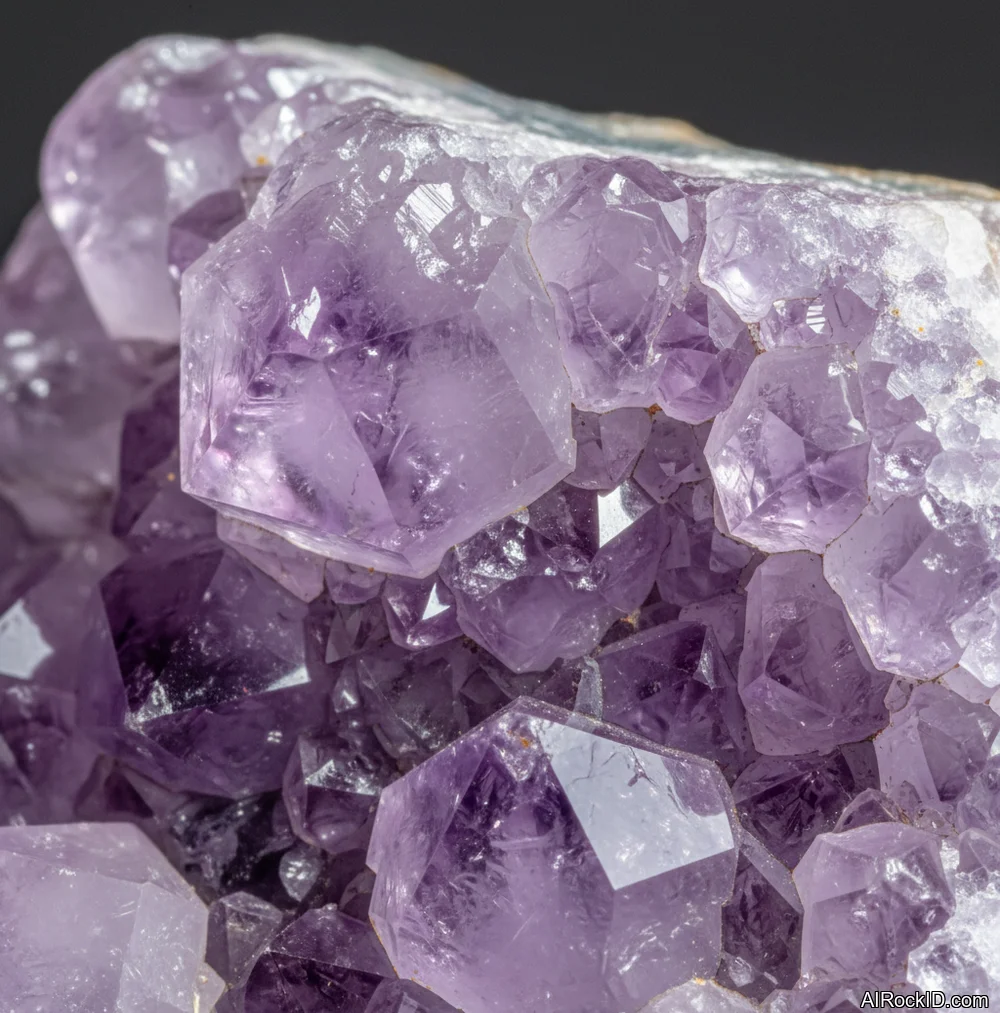
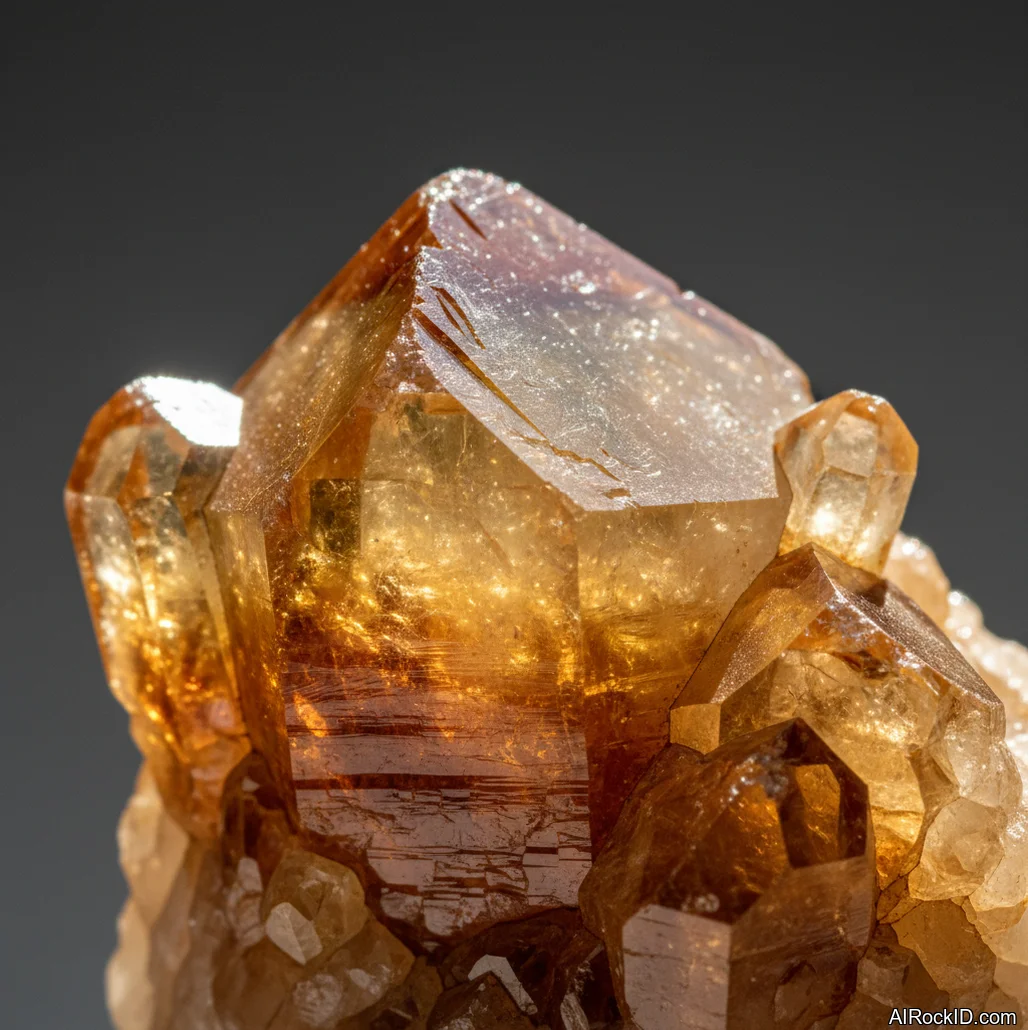
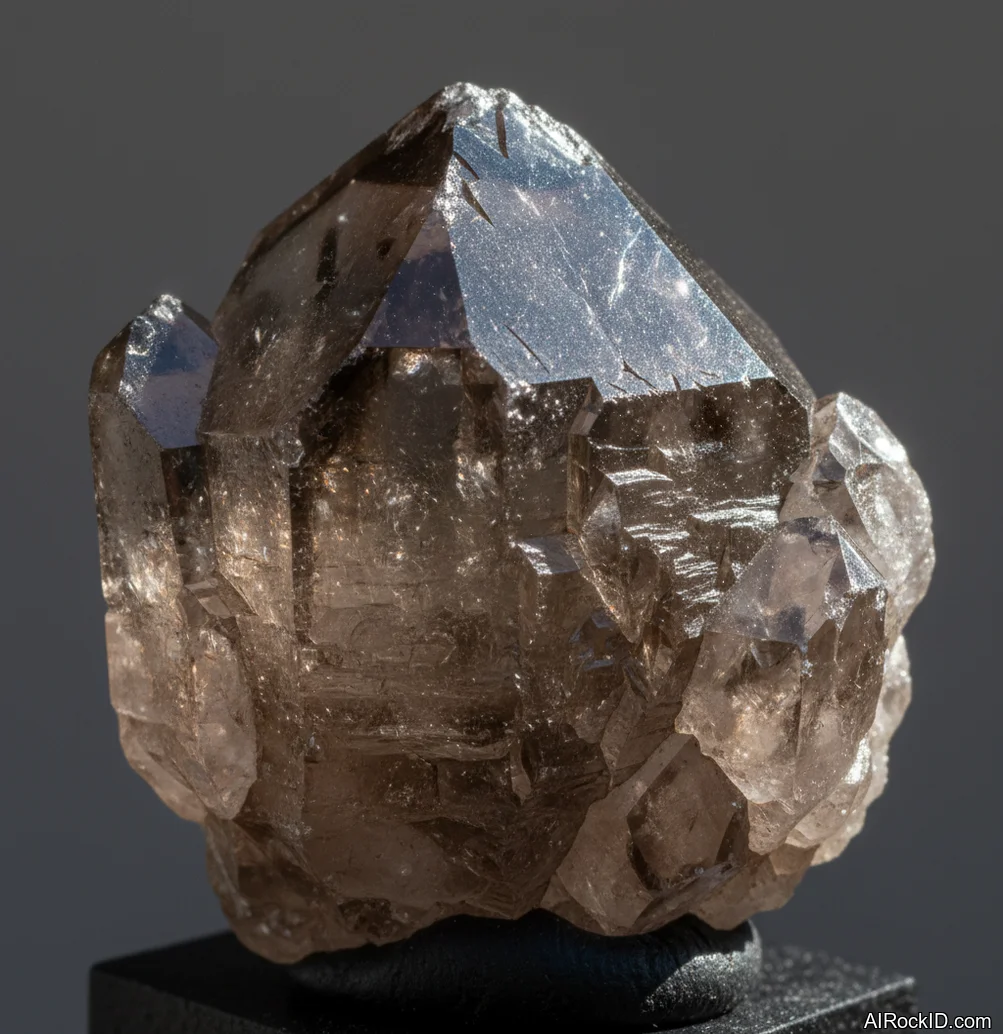
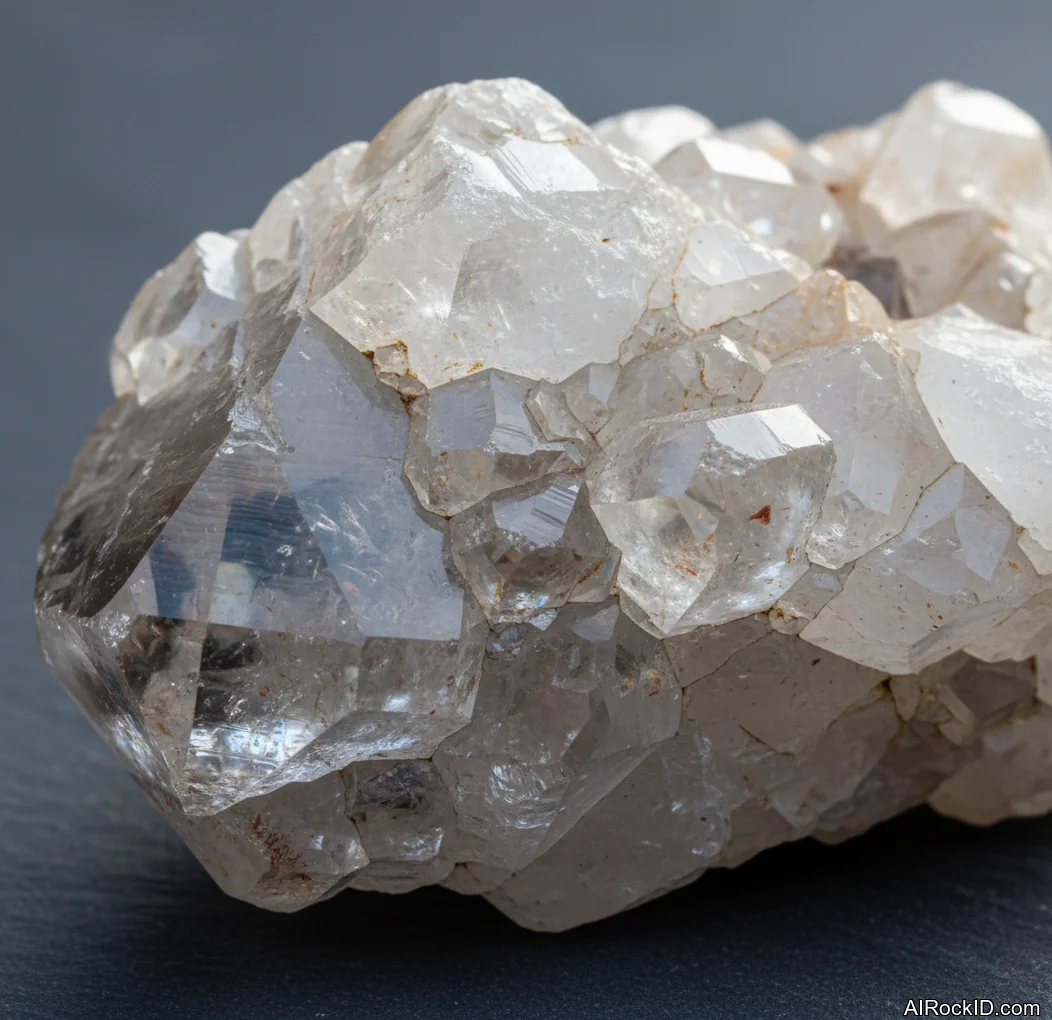
At first, quartz can seem kind of… plain, because it’s everywhere. But then you start catching the different “personalities”: water-clear rock crystal, smoky pieces that look like they’re holding onto a shadow, milky chunks that sort of glow in soft, diffuse light, plus clusters with dozens of points that glitter like a handful of ice. Thing is, the most “basic” looking quartz often ends up being the handiest reference in a collection, because once you know how quartz feels in your hand, you can spot a lot of lookalikes fast.
Origin & History
“Quartz” gets its name by way of German (Quarz), and it shows up in scientific writing in the 1500s, usually pinned on Georgius Agricola in 1546. And if you’ve ever flipped through old mineral books or handled those brittle, yellowed museum tags, you’ll notice “rock crystal” popping up too, meaning clear quartz, especially when the crystals are nicely formed with clean faces and sharp points.
Quartz has been in the human toolkit forever, mostly for plain reasons: it’s hard, it’s everywhere, and when it breaks it can leave edges that feel almost razor-like if you run a finger the wrong way (don’t ask). So people leaned on quartz-rich stones for tools, and later on, the clear stuff got carved into little objects, drilled for beads, or shaped into lenses. But in modern geology it’s one of those workhorse minerals you bump into constantly, and industry still leans on it because of its piezoelectric behavior and because very pure silica can be processed.
Where Is Quartz Found?
Quartz shows up on every continent in igneous, metamorphic, and sedimentary settings. The classic collector localities include Alpine cleft crystals and big Brazilian pockets, but you can find decent quartz in a lot of ordinary gravel too.
Formation
Most quartz crystals start out when silica-rich fluid snakes through fractures, little cavities, and any open space it can find. That empty room matters, because it lets points grow instead of everything turning into one solid, chunky mass. In pegmatites and hydrothermal veins, the fluid can cool off or its chemistry can shift, and then quartz drops out along with feldspar, mica, tourmaline, plus sulfides. If the pocket stays open, you’ll see clean terminations. But if the space gets jammed up, the crystals come out stubby and tangled together.
Quartz shows up in metamorphic rocks too, when heat and pressure rearrange what’s already there. And after weathering breaks other minerals down, quartz ends up as a major piece of sandstones. The annoying thing about the question “where does it form?” is the honest answer is basically “everywhere.” So if you’ve ever cracked open a vein in the field, you know the look: fresh quartz has that clean, bright surface, and when it breaks it gives that sharp conchoidal snap you recognize right away (even before you think about it).
How to Identify Quartz
Color: Quartz ranges from colorless to white, gray, brown, black, yellow, pink, purple, and more, depending on inclusions, impurities, and radiation effects. Clear quartz is transparent; milky quartz is cloudy from microscopic inclusions and internal fractures.
Luster: Vitreous luster, like fresh broken glass.
If you scratch it with a steel knife, the knife won’t bite, but quartz will leave a faint scratch line on the metal and it’ll scratch glass easily. The real test is the feel and the break: quartz tends to fracture conchoidally, so a fresh chip looks like a curved shell. And watch for fakes in “crystal shops”: glass can look similar, but it often feels warmer in the hand and shows round bubbles or flow lines instead of crisp growth features.
Common Look-Alikes
Quartz is sometimes confused with these materials:
- Glass (including leaded “crystal” and cast glass points sold as quartz)
- Calcite (clear/white calcite sold as “quartz,” especially in polished towers)
- Gypsum / selenite (clear to white, often mistaken for quartz wands)
- Fluorite (colorless to pale material can photo-match quartz, but it’s softer and cleaves)
- Dyed crackle quartz (heat-shocked quartz that’s dyed bright colors and sold as “aura” or “colored quartz”)
- Synthetic quartz (lab-grown quartz sold as natural points, sometimes with too-clean clarity)
Market Cautions & Treatments
When AI Can Get This Wrong
In photos, clear quartz gets mixed up with glass, calcite, and even fluorite because they all read as “clear shiny point” to an algorithm. The real test is hardness and cleavage: quartz will scratch window glass cleanly, while calcite and fluorite won’t and they’ll show flat cleavage breaks instead of conchoidal chips. Look closely for bubbles or swirly flow lines too, since AI misses those but your eye won’t once you know to hunt for them.
Properties of Quartz
Physical Properties
| Crystal System | Trigonal |
| Hardness (Mohs) | 7 (Hard (6-7.5)) |
| Density | 2.65 g/cm3 |
| Luster | Vitreous |
| Diaphaneity | Transparent to translucent |
| Fracture | Conchoidal |
| Streak | White |
| Magnetism | Non-magnetic |
| Colors | Colorless, White, Gray, Brown, Black, Purple, Pink, Yellow, Orange, Red |
Chemical Properties
| Classification | Silicates |
| Formula | SiO2 |
| Elements | Si, O |
| Common Impurities | Fe, Al, Ti, Li, Na, K, Mn |
Optical Properties
| Refractive Index | 1.544-1.553 |
| Birefringence | 0.009 |
| Pleochroism | None |
| Optical Character | Uniaxial |
Quartz Health & Safety
Solid quartz is fine to touch, and it’s fine sitting in water too. The real issue only pops up when you cut it or grind it: that’s when you can kick up silica dust, that super-fine powder that clings to everything (you’ll find it on your hands and on the bench). And yeah, you don’t want to breathe that stuff in.
Safety Tips
If you’re cutting or grinding quartz, do it wet, wear the right respirator, and keep the dust from getting airborne. That fine powder gets everywhere. For regular collecting and rinsing a piece off at the sink, plain hand washing is plenty.
Quartz Value & Price
Price Range
Rough/Tumbled: $2 - $200 per specimen
Cut/Polished: $1 - $30 per carat
Price swings usually come down to clarity, crystal form, and locality. Pieces with sharp terminations, larger sizes, and clean clusters will run higher, while chipped points and milky chunks (the kind that look cloudy even after you rinse off the dust) tend to stay cheap.
Durability
Durable — Scratch resistance: Excellent, Toughness: Good
Quartz is chemically stable for everyday wear and display, but points and edges can chip if it’s rattling around with harder minerals or metal.
How to Care for Quartz
Use & Storage
Store quartz points so the tips aren’t rubbing against other stones. I keep clusters in a box with a towel, because one short car ride can turn a perfect termination into a tiny chip.
Cleaning
1) Rinse with lukewarm water to remove grit. 2) Wash with a drop of mild dish soap and a soft toothbrush, especially between points. 3) Rinse well and air dry; use compressed air for tight crevices if you have it.
Cleanse & Charge
If you do energetic cleansing, running water, smoke, or a night on a windowsill are common choices. Just be practical: if it’s a delicate cluster, skip anything that risks knocking points together.
Placement
On a desk, quartz looks best with side lighting so the growth lines and internal fractures show. Keep dyed or coated pieces out of harsh sun, since some treatments fade or look worse over time.
Caution
Skip harsh acids and heavy-duty cleaners on specimens that could have carbonates or sulfides stuck to them, because the matrix can fizz or tarnish even if the quartz itself just sits there. And don’t throw quartz points loose in a bag with other minerals unless you like finding new chips and scratched faces later.
Works Well With
Quartz Meaning & Healing Properties
Next to a lot of “named” crystals, quartz is basically the plain white T-shirt of the metaphysical world. It’s the one people reach for when they want clarity or focus without a ton of drama. And in my own stash, it’s what I grab when I don’t want a loud vibe or some neon color bossing the whole mood around. Hold a clear point and my brain just… settles. Like you’ve swept the grit off a workbench and suddenly you can see what you’re doing.
But look, quartz talk online gets big and weird fast. Quartz isn’t a medical tool. It won’t replace sleep, therapy, or a good plan. What it can do, in a practical sense, is work as a physical anchor for a routine: your meditation timer, a little desk reminder, something to hold while you slow your breathing (and actually notice you’re breathing). I’ve watched customers pick a point because it felt “quiet” in their hand, and yeah, that’s real, just not in a lab-measurement way. It’s attention. It’s intention. It’s the weight sitting in your palm, the cool slick feel when you first pick it up, the way the edges catch a bit if it’s a crisp point.
Different looks nudge people toward different uses. Smoky quartz tends to be used for grounding and stress. Clear quartz is the go-to for focus and that “clean signal” kind of thinking. Thing is, a lot of the effect is the object itself. A sharp, well-formed point makes you handle it carefully, like you don’t want to chip the tip. A scratched, river-worn pebble practically tells you to unclench. Either way, you’re interacting with it. That’s usually where the value lives, right?
Common mistakes
- Identifying quartz by color alone, especially when comparing clear, purple, pink, or smoky stones.
- Assuming every clear stone is quartz without checking hardness, cleavage, and bubbles.
- Mistaking dyed quartz or coated quartz for a naturally rare color variety.
- Using a scratch test on finished jewelry or valuable specimens, which can cause damage.
- Assuming a trade name proves mineral identity without seller documentation.
- Overlooking scale, since tiny quartz crystals and large glass pieces can look similar in cropped photos.
Identify Quartz from a photo
Compare Quartz traits, care tips, value clues, and common lookalikes with a clear photo.