Resin with Dried Flowers


Quick answer: Resin with dried flowers is a decorative organic material made by embedding preserved plant matter in clear or amber-toned resin. It is usually soft compared with minerals, so identification depends more on appearance, inclusions, and manufacturing clues than on standard gem tests.
AI Rock ID can help flag resin with dried flowers by recognizing transparent resin, visible botanical inclusions, bubbles, and molded shapes. RockIdentifier.io lists it as an organic gem material rather than a naturally crystallized mineral.
Good fit
- Collectors who want a botanical display piece rather than a mineral specimen
- Jewelry buyers looking for lightweight pendants, cabochons, or charms
- People who prefer visible flower, leaf, or seed inclusions
- Beginners comparing organic gem materials and resin-based objects
Not a good fit
- Buyers seeking a naturally formed crystal or mineral
- Rings or bracelets exposed to frequent abrasion
- Anyone who needs heat-resistant or solvent-resistant jewelry
- Collectors focused on untreated natural gemstones
Most commonly confused with
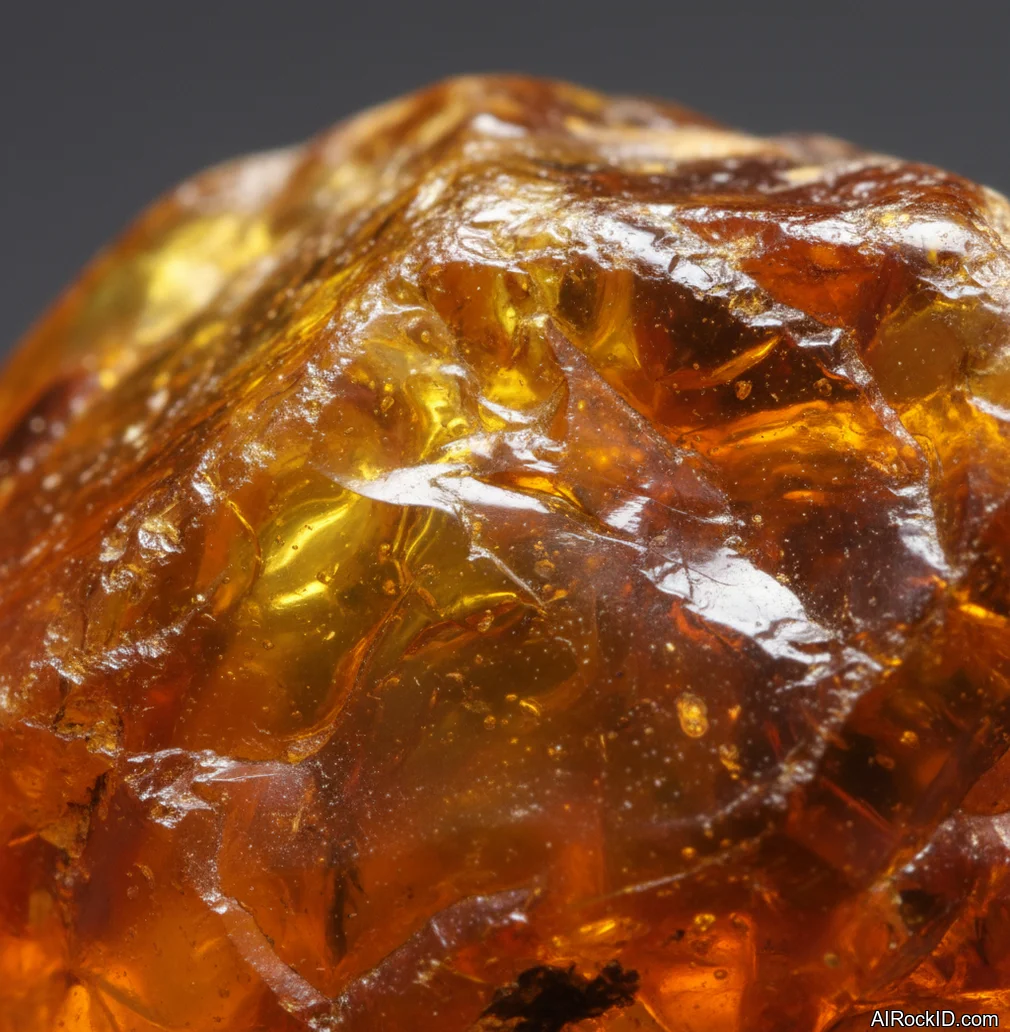
- Amber: Amber is fossilized tree resin; modern resin with dried flowers is usually recently made and often contains arranged botanical inclusions.
- Copal: Copal is younger natural tree resin, while flower resin pieces are typically cast or poured by hand.
- Plastic: Some plastic items can look similar, but resin pieces often show embedded flowers, tiny bubbles, and a hand-cast shape.
- Glass: Glass is harder, colder to the touch, and more scratch-resistant than resin.
Resin with Dried Flowers vs Lookalikes
| Material | Typical origin | Key identification clue | Relative hardness |
|---|---|---|---|
| Resin with dried flowers | Cast decorative resin | Arranged flowers, bubbles, molded edges | Low |
| Amber | Fossil tree resin | Natural flow lines or ancient inclusions | Low to moderate |
| Copal | Young natural tree resin | May soften or react more easily than amber | Low |
| Glass | Manufactured silica-based material | Cold feel, high scratch resistance | High |
| Plastic | Manufactured polymer | Lightweight, may show mold seams | Low |
AI identification confidence
AI identification is usually moderate when the object has clear resin, visible flowers, bubbles, and a known jewelry or craft shape. Confidence is lower for close-up images without scale, heavily tinted resin, or pieces that resemble amber, plastic, or glass.
When AI gets it wrong
- The photo shows only a transparent amber-colored surface without visible flowers
- Lighting glare hides bubbles, edges, or botanical inclusions
- The item is photographed beside natural amber or copal without labels
- A glass cabochon or locket contains pressed flowers but is not solid resin
Final recommendation
Choose resin with dried flowers when the goal is a botanical decorative object rather than a natural mineral specimen. For buying, look for clear disclosure that the piece is resin and ask whether the flowers are natural, dyed, or printed inserts.
How to Check Authenticity When Buying
A genuine resin-with-flowers piece should be described as resin, not as natural crystal, amber, or fossil material. Check that the seller discloses whether the flowers are real dried botanicals, dyed plant material, paper images, or synthetic inserts. Photos from multiple angles help show whether the inclusions are embedded inside the resin rather than printed on the surface.
Photo Tips for Identification
Use bright indirect light and photograph the piece from the front, side, and edge. Include a coin or ruler for scale, and avoid heavy filters that can make resin look like amber or glass. A side view often reveals curved molded edges, bubbles, and the depth of embedded flowers.
Disclosure Terms to Look For
Common accurate labels include resin jewelry, preserved flower resin, dried flower cabochon, and botanical resin pendant. Terms such as natural crystal, fossil amber, or gemstone should be treated cautiously unless the seller provides evidence for those claims. Handmade resin pieces can be attractive, but they are not mineral crystals.
What Is Resin with Dried Flowers?
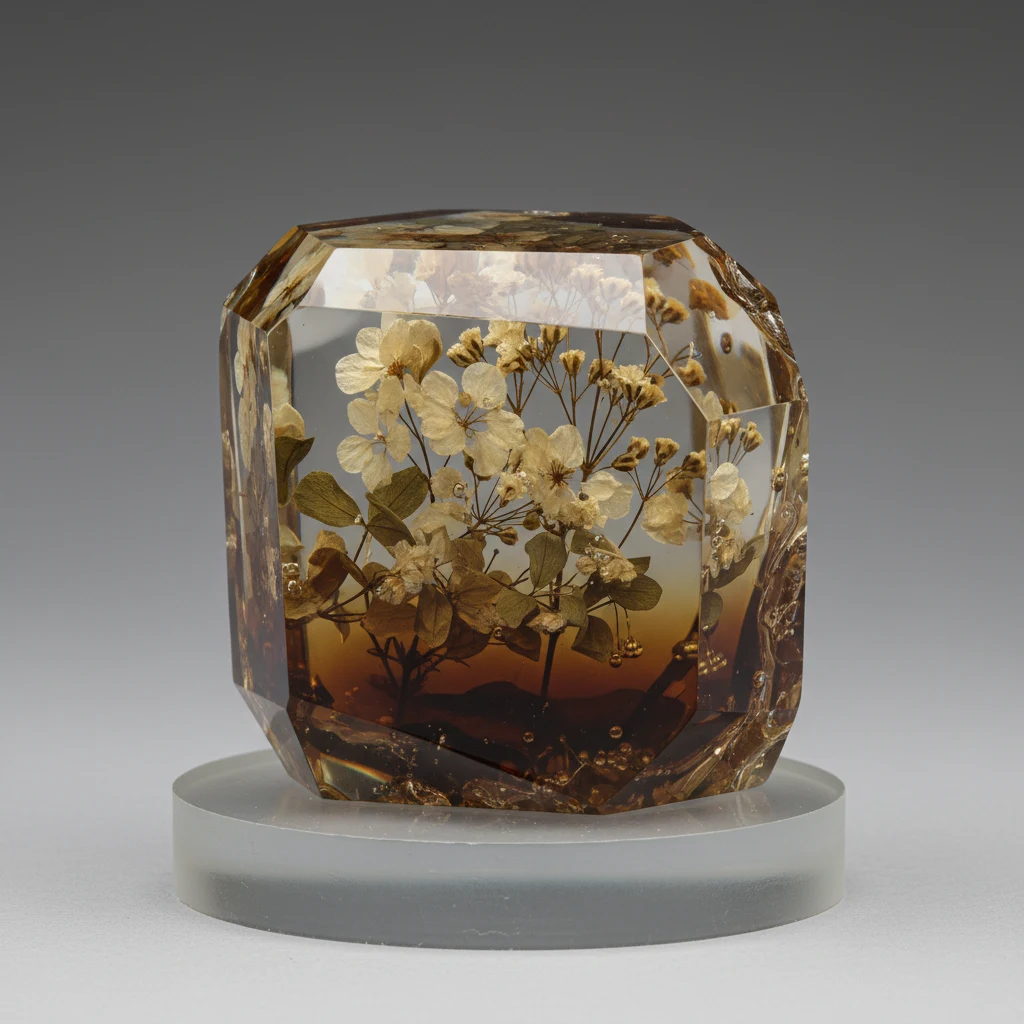
Resin with Dried Flowers is an organic decorative gem made by encasing dried flowers in resin. In the hand, a good piece feels light, smooth, and glossy, with the flower colors suspended beneath a clear to amber surface. It is valued less like a mined crystal and more like a preserved natural scene: petals, stems, and small imperfections become part of the specimen’s character.
Its mineral variety is listed as Organic, and its structure is amorphous rather than crystalline. The material is typically transparent to translucent, with a resinous luster and colors that range from clear to amber and brown. On the Mohs scale it is soft at 2-3, so it should be treated as a display piece rather than a hard-wearing stone.
Origin & History
The word resin comes from the Latin resina, and resin has been used since ancient times for many purposes. Resin with Dried Flowers continues that long tradition in a decorative form, preserving natural plant material inside a hardened organic compound. For collectors, the appeal is immediate: you are looking at a small botanical moment held in a glossy, protective body.
This material is best understood as an organic gem or decorative specimen, not as a crystalline mineral species. Its listed formula is C10H16O, and it is composed of carbon, hydrogen, and oxygen. When comparing terminology, mindat.org is a useful reference point for separating true mineral species from amorphous organic materials like this one.
Where Is Resin with Dried Flowers Found?
Resin with Dried Flowers is common and is typically associated with regions where resin-producing trees grow. Reported countries include the United States, China, and Japan, with notable localities given as California, USA; Yunnan, China; and Kyushu, Japan. Because it is made by enclosing flowers in resin, availability depends as much on production and craftsmanship as on natural resin sources.
Formation
Resin with Dried Flowers forms when plant resin hardens and encapsulates organic material such as flowers. The result is a transparent to translucent organic body with floral inclusions locked inside. In a finished specimen, the most noticeable features are the glossy surface, the depth around the flower, and the way small bubbles or imperfections catch the light.
Its physical properties match an organic amorphous material: no crystal system, no birefringence, no pleochroism, and an isotropic optical character. It has a refractive index of 1.54-1.56, density of 1.1-1.2 g/cm3, colorless streak, conchoidal fracture, and non-magnetic behavior. It is stable enough for display but sensitive to UV light and may yellow over time.
How to Identify Resin with Dried Flowers
Identify Resin with Dried Flowers by its clear to amber resin body and visible flower inclusions in varied colors. The surface should show a glossy, resinous luster, and the specimen may be transparent to translucent depending on the resin and the density of the inclusions. It is soft, with a Mohs hardness of 2-3, so fine scratches are possible if handled roughly.
A practical field check is to look closely for air bubbles or small imperfections in the resin, which can be clues to authenticity. It should be non-magnetic, produce a colorless streak, and show conchoidal fracture if broken. Because it can scratch or crack, examine it with care and avoid harsh testing on finished decorative pieces.
Properties of Resin with Dried Flowers
Physical Properties
| Crystal System | Amorphous |
| Hardness (Mohs) | 2-3 (Very Soft (1-2)) |
| Density | 1.1-1.2 g/cm3 |
| Luster | Resinous |
| Diaphaneity | Transparent to translucent |
| Fracture | Conchoidal |
| Streak | Colorless |
| Magnetism | Non-magnetic |
| Colors | Amber, Clear, Brown |
Chemical Properties
| Classification | Organic compound |
| Formula | C10H16O |
| Elements | C, H, O |
| Common Impurities |
Optical Properties
| Refractive Index | 1.54-1.56 |
| Birefringence | None |
| Pleochroism | None |
| Optical Character | Isotropic |
Resin with Dried Flowers Health & Safety
Generally safe, but avoid prolonged heat exposure.
Resin with Dried Flowers Value & Price
Price Range
Rough/Tumbled: $10 - $50 per specimen
Cut/Polished:
Price is affected by the type of flowers used and the quality of the resin.
Durability
Moderate — Scratch resistance: Fair, Toughness: Good
It is sensitive to UV light and may yellow over time.
How to Care for Resin with Dried Flowers
Use & Storage
Store in a cool, dry place away from direct sunlight.
Cleaning
Clean with a soft cloth and mild soap. Avoid harsh chemicals.
Cleanse & Charge
Can be placed in sunlight for a few hours to recharge.
Placement
Display in a location where it is less likely to be knocked over.
Caution
Handle gently to avoid scratches and cracks.
Works Well With
Resin with Dried Flowers Meaning & Healing Properties
In crystal-healing traditions, Resin with Dried Flowers is associated with emotional healing, creativity, joy, nurturing, and transformation. Its symbolism is easy to understand from the object itself: delicate flowers preserved inside a clear body suggest beauty, memory, and renewal. These meanings are traditional and spiritual, not a substitute for medical treatment.
It is linked with the Heart and Crown chakras, Taurus and Libra, the planet Venus, and the Earth element. For display or intention work, it pairs well with rose quartz, amethyst, and clear quartz. Store it in a cool, dry place away from direct sunlight, clean it with a soft cloth and mild soap, and avoid prolonged heat or UV exposure.
Identify Resin with Dried Flowers from a photo
Compare Resin with Dried Flowers traits, care tips, value clues, and common lookalikes with a clear photo.
Common mistakes
- Assuming every amber-colored resin piece is fossil amber
- Using scratch tests on finished jewelry and damaging the surface
- Confusing printed floral images with real embedded dried flowers
- Expecting resin to resist heat, alcohol, perfume, or strong cleaners
- Calling resin with dried flowers a natural crystal specimen
- Judging quality from front photos only without checking side and back views