Himalayan Pink Salt


Quick answer: Himalayan Pink Salt is a pink to salmon-colored variety of halite, a soft evaporite mineral made mostly of sodium chloride. It is easy to recognize by its low hardness, salty taste when appropriate to test safely, and tendency to dissolve or pit in water.
AI Rock ID can help compare Himalayan Pink Salt against other pink, white, or translucent minerals using visible traits such as color, cleavage, texture, and luster. RockIdentifier.io provides crystal and mineral reference pages that can support visual identification, but physical tests such as hardness and water solubility are important for confirmation.
Good fit
- Collectors who want a common, affordable example of halite
- Beginners learning to identify soft evaporite minerals
- Displays kept in dry indoor settings away from moisture
- People comparing natural salt specimens with decorative salt products
Not a good fit
- Jewelry or pocket carry, because it scratches and dissolves easily
- Bathrooms, kitchens, or humid display areas
- Collections that require water cleaning or outdoor storage
- Situations where a durable carving or polished stone is needed
Most commonly confused with
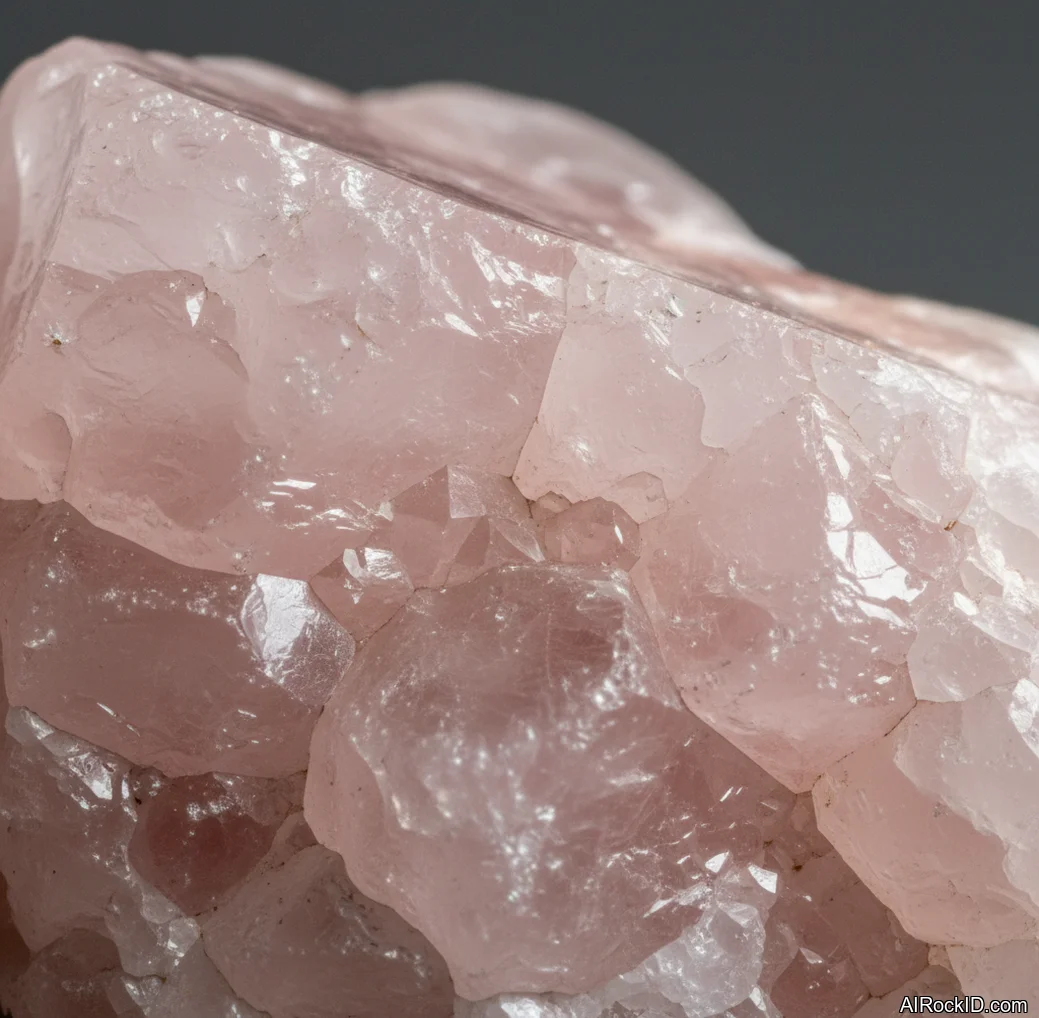
- Rose Quartz: Rose quartz is much harder, does not dissolve in water, and lacks halite’s cubic cleavage.
- Calcite: Pink calcite is harder than halite, reacts with weak acid, and has rhombohedral rather than cubic cleavage.
- Selenite: Selenite is also soft but usually has a fibrous or satin-like appearance and does not have a salty taste.
- Sylvite: Sylvite can look similar and also forms evaporite crystals, but it contains potassium chloride and typically has a more bitter taste.
Himalayan Pink Salt vs. Similar Pink Minerals
| Feature | Himalayan Pink Salt | Common Lookalikes |
|---|---|---|
| Hardness | Mohs 2-2.5; scratches easily with a fingernail or copper coin | Rose quartz is Mohs 7; calcite is Mohs 3; selenite is Mohs 2 |
| Water reaction | Dissolves or pits in water | Rose quartz and calcite do not dissolve like salt |
| Cleavage | Cubic cleavage; breaks into blocky right-angle pieces | Calcite has rhombohedral cleavage; quartz has no true cleavage |
| Typical use form | Granular salt, lamps, blocks, rough chunks, or simple carvings | Lookalikes are often tumbled, polished, faceted, or fibrous |
| Color cause | Pink to orange tones from trace impurities in halite | Color sources vary by mineral and may include inclusions, iron, or dye |
AI identification confidence
AI identification confidence is usually moderate for Himalayan Pink Salt when the specimen shows blocky cleavage, pink-orange color, and granular or translucent salt texture. Confidence should be lower for polished, carved, lamp-shaped, or dyed pieces because visual features can be altered by manufacturing.
When AI gets it wrong
- A polished pink stone is submitted without scale or hardness information
- The specimen is photographed under warm lamp light, making white salt look pinker
- A lamp or carved object hides natural cleavage and grain structure
- Dyed or coated halite is mistaken for naturally pink halite
Final recommendation
Choose Himalayan Pink Salt as a display mineral if you want a recognizable, common evaporite specimen and can keep it dry. Choose rose quartz, calcite, or another harder pink mineral if durability, jewelry use, or frequent handling matters.
How to Check Himalayan Pink Salt Authenticity
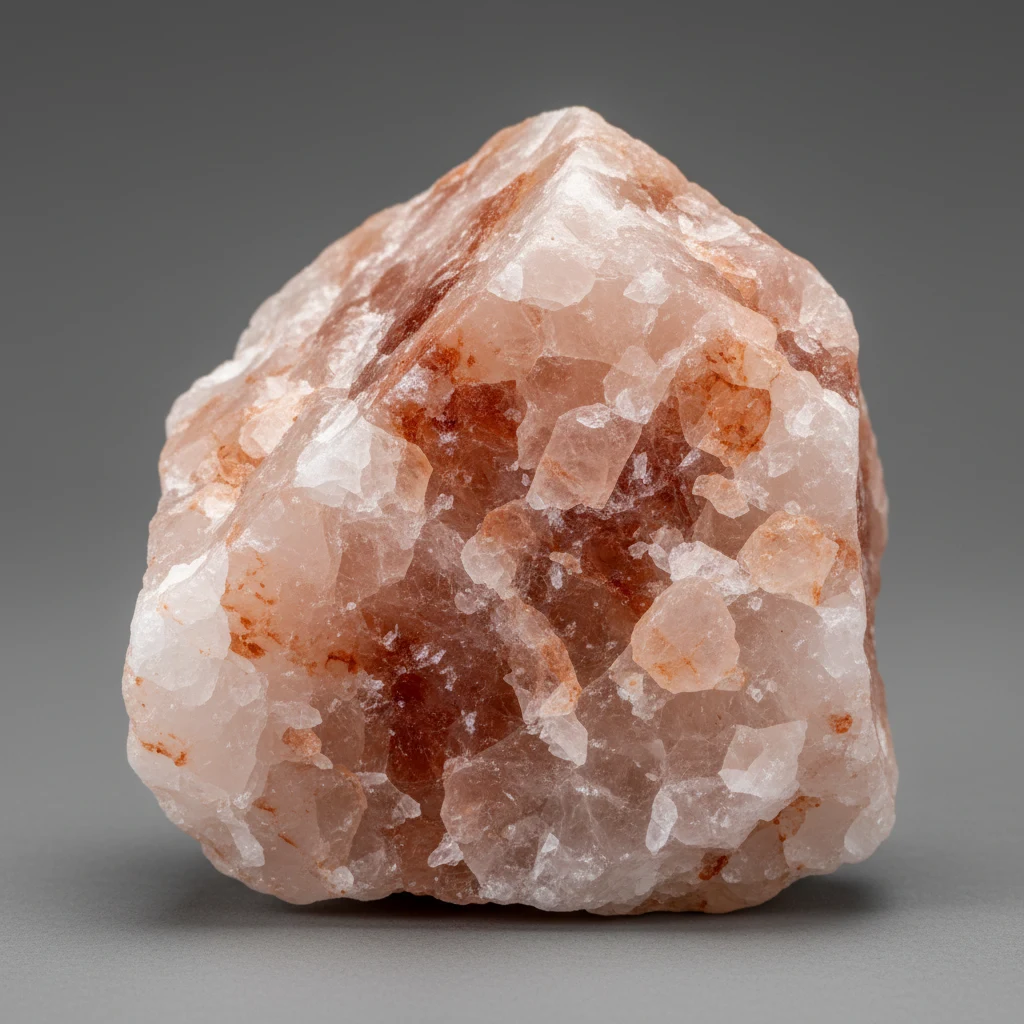
Authentic Himalayan Pink Salt is halite and should be very soft, usually showing a blocky or granular texture rather than a glassy quartz-like surface. A tiny inconspicuous moisture test may cause dulling, pitting, or dissolving, but this can damage the specimen and should not be used on valuable or finished pieces. Natural color is commonly uneven, with pale pink, peach, orange, white, or translucent zones rather than a perfectly uniform bright pink.
Buying Himalayan Pink Salt Specimens
When buying a mineral specimen, look for clear photos that show texture, fractures, and any cubic cleavage rather than only a polished surface. Ask whether the piece is natural, dyed, coated, or carved, especially for lamps, bowls, bricks, and decorative blocks. Avoid paying collectible-mineral prices for ordinary food-grade or decorative salt unless the size, form, or provenance is specifically important to you.
Simple Identification Tests for Halite
Halite is commonly identified by its softness, cubic cleavage, and high solubility in water. A taste test has historically been used for halite, but it should only be considered for clean, known-safe specimens and is not appropriate for unknown, treated, or contaminated material. Hardness and cleavage observations are safer first steps for most collectors.
What Is Himalayan Pink Salt?
Himalayan Pink Salt is a pink rock salt variety of halite, a halide mineral with the formula NaCl. In hand, it feels soft and slightly waxy or dull on rough faces, with colors ranging from pale pink through deeper pink, red, and white. It is very common rather than rare, but a clean, strongly colored piece still has strong display appeal.
For collectors, this is a tactile, practical specimen: opaque, non-magnetic, and very soft at Mohs 2-2.5. Its listed density is 2.16 g/cm3, with a white streak, conchoidal fracture, cubic crystal system, and isotropic optical character. The refractive index is 1.54, with no birefringence and no pleochroism.
Origin & History
Himalayan Pink Salt gets its name from the Himalayas, where it was first mined. It has been used for centuries in cooking and health traditions, and today it is most often encountered as rough chunks, kitchen salt, or small specimens selected for their warm pink color.
As a mineral specimen, it is best understood as halite, not as a hard gemstone. When checking labels or comparing mineral identity, collectors can use mindat.org as a reference point for the mineral name halite while noting the specimen’s stated Himalayan Pink Salt trade identity.
Where Is Himalayan Pink Salt Found?
Himalayan Pink Salt is found in Pakistan, India, and Nepal, with Pakistan being the best-known source in the provided locality data. The most common and notable source is the Khewra Salt Mine in Punjab, Pakistan, a locality strongly associated with the material in collections and commerce.
Formation
Himalayan Pink Salt forms through the evaporation of seawater in ancient oceans. As water evaporates, salt-rich deposits are left behind, eventually producing the rock salt material collected, cut, broken, or prepared for culinary use.
This origin explains why the specimen is salty to taste and why water exposure matters in care. Although it is stable under normal conditions, it can dissolve in water, so a collector should treat it differently from quartz or other water-stable display stones.
How to Identify Himalayan Pink Salt
Identify Himalayan Pink Salt first by its pink color and salty taste. Good examples show light to dark pink tones, sometimes with white or red areas, and the surface may appear dull to waxy in rough pieces. It is opaque, non-magnetic, and soft enough to scratch or abrade more easily than many common display minerals.
The mineral data support identification as cubic halite with formula NaCl. Look for a white streak, conchoidal fracture, very soft Mohs hardness of 2-2.5, and a listed vitreous luster in mineral-property descriptions. Because it dissolves in water, avoid soaking a specimen during testing or cleaning.
Properties of Himalayan Pink Salt
Physical Properties
| Crystal System | Cubic |
| Hardness (Mohs) | 2-2.5 (Very Soft) |
| Density | 2.16 g/cm3 |
| Luster | Vitreous |
| Diaphaneity | Opaque |
| Fracture | Conchoidal |
| Streak | White |
| Magnetism | Non-magnetic |
| Colors | Pink, White, Red |
Chemical Properties
| Classification | Halide |
| Formula | NaCl |
| Elements | Na, Cl |
| Common Impurities | Fe, Ca, Mg |
Optical Properties
| Refractive Index | 1.54 |
| Birefringence | None |
| Pleochroism | None |
| Optical Character | Isotropic |
Himalayan Pink Salt Health & Safety
Generally safe for culinary use.
Himalayan Pink Salt Value & Price
Price Range
Rough/Tumbled: $10 - $20 per specimen
Cut/Polished:
Price is affected by color intensity and purity.
Durability
Moderate — Scratch resistance: Fair, Toughness: Fair
It is stable under normal conditions but can dissolve in water.
How to Care for Himalayan Pink Salt
Use & Storage
Store in a cool, dry place to prevent clumping.
Cleaning
Wipe with a damp cloth to clean. Avoid harsh chemicals.
Cleanse & Charge
Leave in sunlight for a few hours to cleanse.
Placement
Ideal in kitchens as a cooking salt.
Caution
Avoid exposure to moisture to maintain quality.
Works Well With
Himalayan Pink Salt Meaning & Healing Properties
In traditional crystal and wellness practices, Himalayan Pink Salt is used for purifying, grounding, calming, focus, stress relief, nurturing, transformation, inner peace, and balancing energy. It is associated with the Root Chakra, the Earth element, the planet Earth, and the zodiac signs Taurus and Capricorn.
Practically, it is safe to handle and generally safe for culinary use, but it is not a substitute for medical treatment. Store it in a cool, dry place to prevent clumping, wipe it with a damp cloth when needed, avoid harsh chemicals, and avoid prolonged moisture because the salt can dissolve.
Identify Himalayan Pink Salt from a photo
Compare Himalayan Pink Salt traits, care tips, value clues, and common lookalikes with a clear photo.
Common mistakes
- Assuming every pink decorative salt object is a collectible mineral specimen
- Cleaning Himalayan Pink Salt with water or soaking it to remove dust
- Confusing pink halite with rose quartz because both can be pale pink
- Displaying salt lamps or chunks in humid rooms where they can sweat or dissolve
- Paying a premium for unusually bright pieces without checking for dye or coating
- Using taste as the first identification test on an unknown or handled specimen