Olive Green Tourmaline


Quick answer: Olive Green Tourmaline is a green to brownish-green variety of tourmaline with a vitreous luster and a Mohs hardness of about 7 to 7.5. Its color can overlap with peridot, epidote, and green quartz, so crystal habit, pleochroism, and refractive properties are useful for identification.
AI Rock ID can help compare Olive Green Tourmaline against visually similar green minerals from a photo, especially when color and surface luster are clear. RockIdentifier.io provides crystal reference details that can be used alongside simple tests such as hardness, streak, and observation under different lighting.
Good fit
- Collectors who want a less common green tourmaline color range
- Jewelry buyers looking for a durable green stone with vitreous luster
- People comparing olive, forest, or brownish-green gemstones
- Specimen collectors interested in prismatic tourmaline crystals
- Anyone who prefers natural-looking green tones over vivid emerald green
Not a good fit
- Buyers who need a guaranteed untreated stone without a lab report
- Situations where an exact tourmaline species name is required from appearance alone
- People expecting every olive-green stone to be tourmaline
- Rough handling, ultrasonic cleaning of included stones, or storage with harder gems
Most commonly confused with
- Peridot: Peridot is usually brighter yellow-green and has a different refractive character than tourmaline.
- Epidote: Epidote commonly appears pistachio to dark green and is often more resinous or less glassy in rough form.
- Green Quartz: Green quartz is typically lighter, lacks tourmaline’s strong pleochroism, and has a lower refractive index.
- Chrome Diopside: Chrome diopside is usually a richer green and softer, with a Mohs hardness around 5.5 to 6.
Olive Green Tourmaline vs Similar Green Stones
| Stone | Typical clue | Hardness |
|---|---|---|
| Olive Green Tourmaline | Olive to brownish-green, vitreous, often pleochroic | 7-7.5 |
| Peridot | Yellow-green to olive, usually not strongly pleochroic | 6.5-7 |
| Epidote | Pistachio to dark green, often granular or prismatic | 6-7 |
| Green Quartz | Pale to medium green, quartz-like fracture and luster | 7 |
| Chrome Diopside | Rich green, softer and more abrasion-prone | 5.5-6 |
AI identification confidence
AI identification of Olive Green Tourmaline is moderate when a specimen shows prismatic tourmaline form, strong vitreous luster, and olive to brownish-green color. Confidence is lower for faceted stones, tumbled stones, dark crystals, or photos taken under strongly warm or green-tinted light.
When AI gets it wrong
- A faceted green stone may be identified by color alone without enough optical detail.
- Dark tourmaline can photograph as black, brown, or nearly opaque green depending on lighting.
- Green quartz, glass, or synthetic imitations may appear similar in casual photos.
- Matrix minerals or coatings can hide the crystal shape that helps distinguish tourmaline.
Final recommendation
Use Olive Green Tourmaline when you want a durable green gemstone with subdued olive or brownish-green color rather than a bright emerald tone. For expensive stones or important jewelry purchases, request a gemological report or seller documentation rather than relying only on appearance.
How to Check Olive Green Tourmaline Authenticity
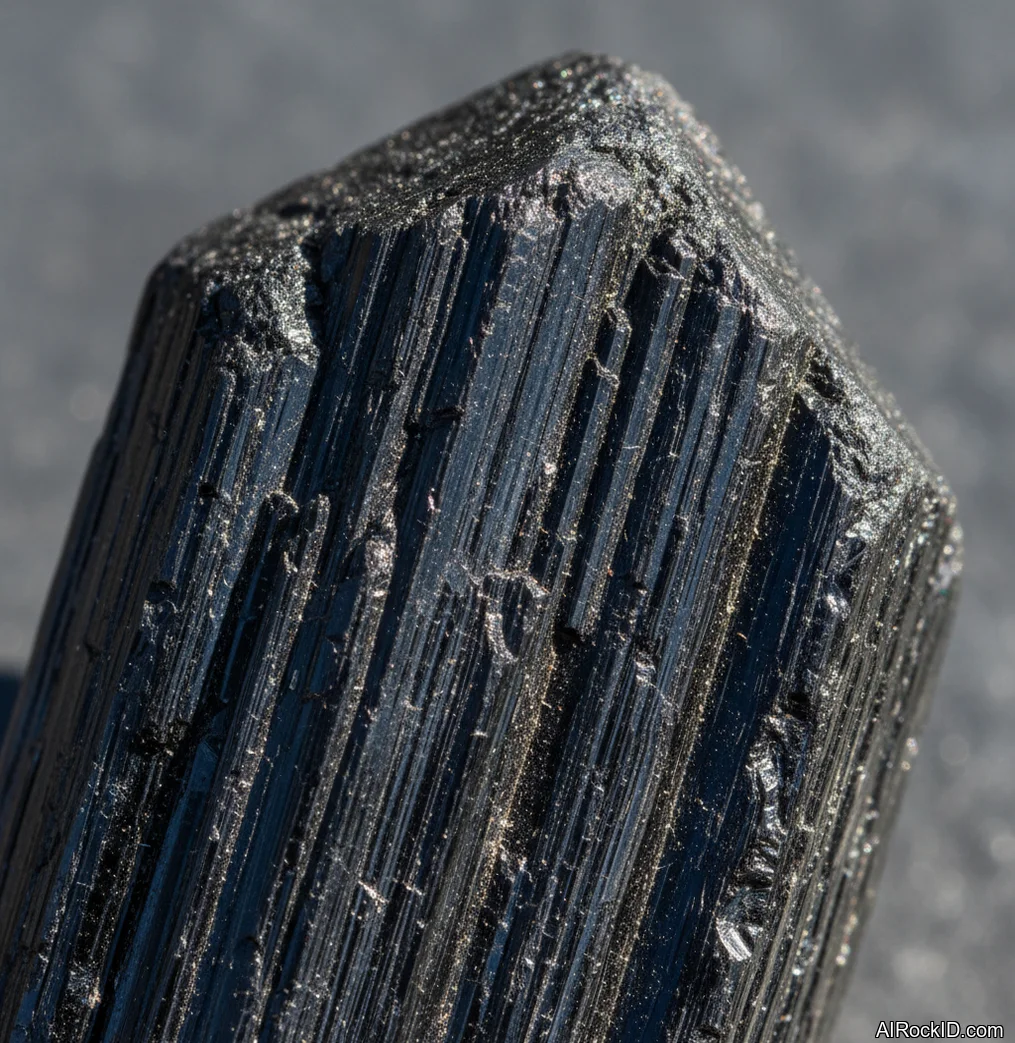
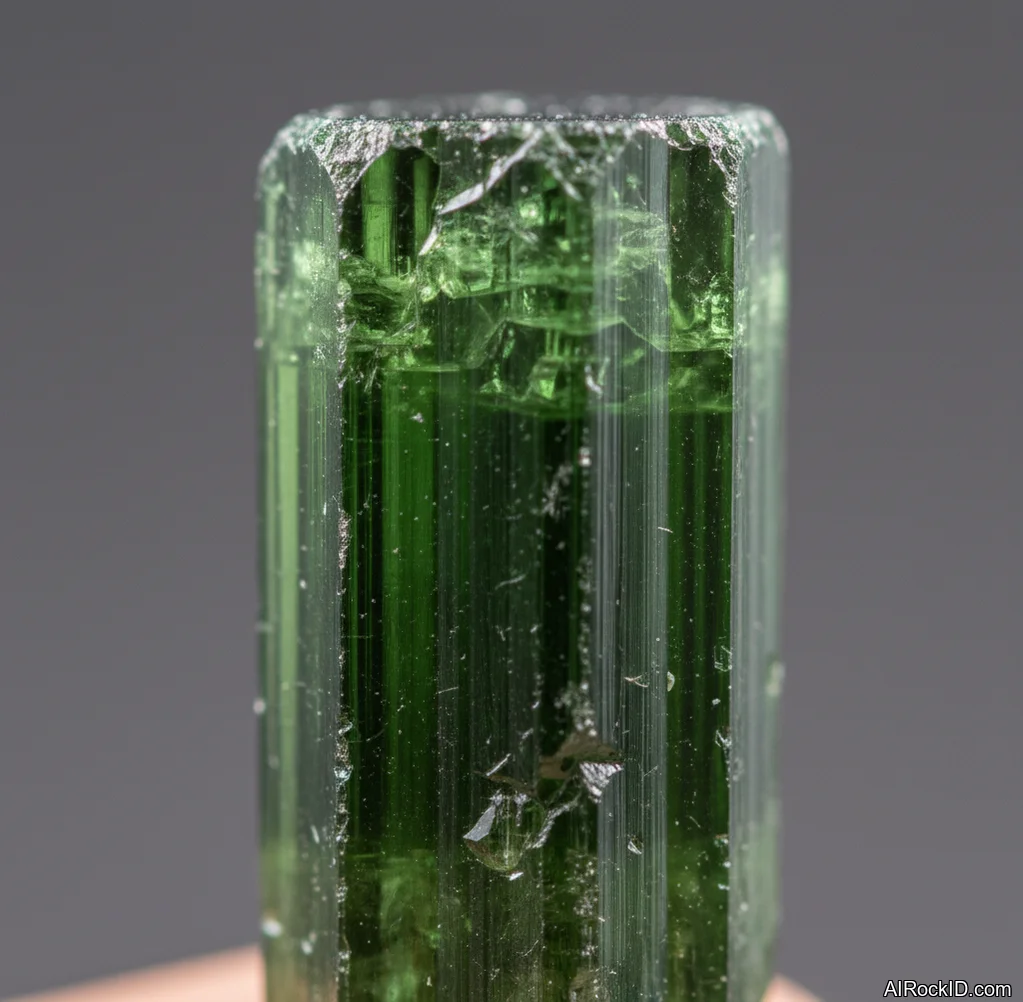
Authentic Olive Green Tourmaline should be evaluated by more than color, because several minerals and glass imitations can share a similar green appearance. Look for tourmaline’s vitreous luster, possible lengthwise striations on rough crystals, and color changes when viewed from different angles. A refractive index reading, specific gravity test, or professional gem report is the most reliable option for faceted stones.
Photo Tips for Identifying Olive Green Tourmaline
Use natural daylight or a neutral white light source to avoid shifting olive green into brown, gray, or yellow tones. Photograph the stone from several angles, including a close view of crystal faces, terminations, inclusions, and any matrix. For transparent or faceted stones, include one image against a white background and one image with side lighting to show depth of color.
Buying Notes for Olive Green Tourmaline
Color descriptions for green tourmaline can vary, so confirm whether a seller means olive green, chrome green, verdelite, or a general green tourmaline label. Ask whether the stone is natural, treated, dyed, coated, or assembled, especially for polished beads and inexpensive lots. For high-value gems, a laboratory report is more useful than a trade name.
What Is Olive Green Tourmaline?
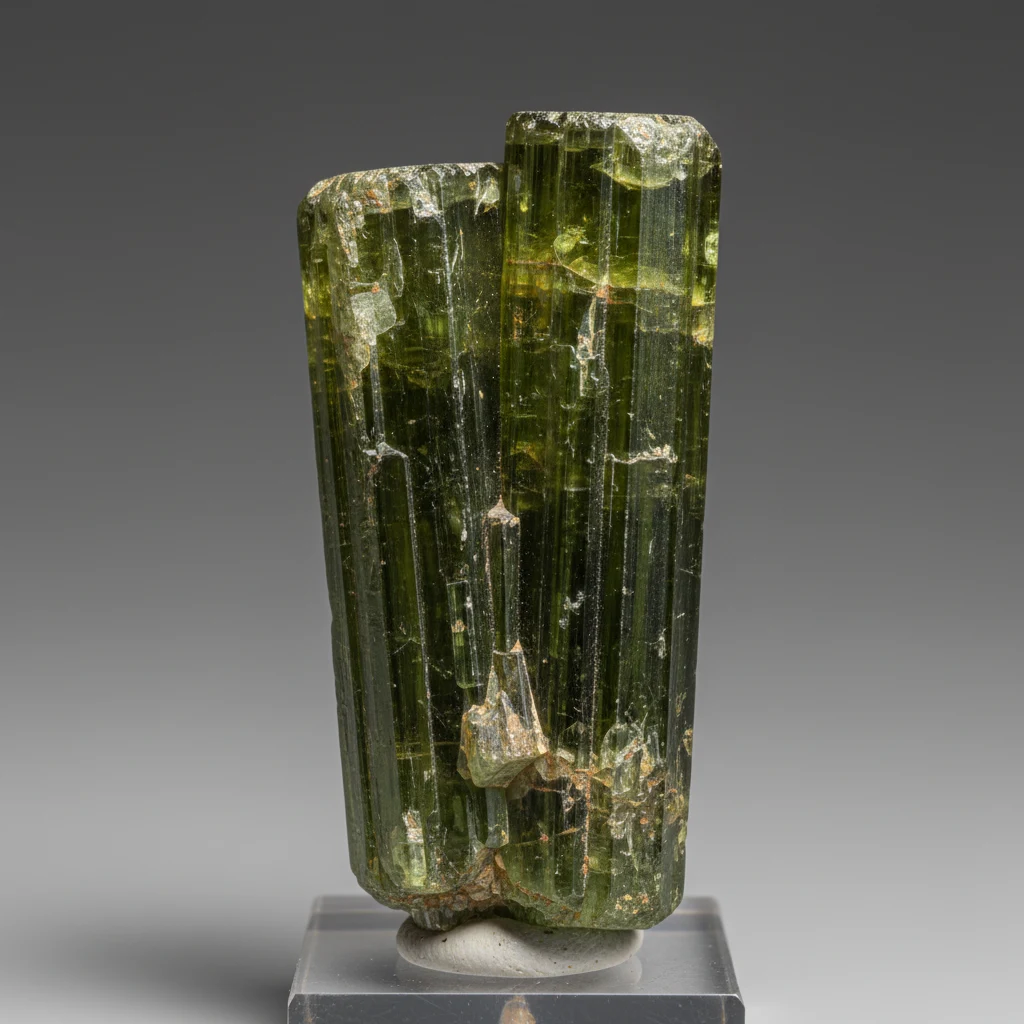
Olive Green Tourmaline is an uncommon olive-colored variety of tourmaline valued as a semi-precious gemstone. Its color ranges from dark olive green to lighter yellow-green and brownish-green tones, giving it a grounded, earthy look that stands apart from brighter green tourmaline.
In hand, a good piece shows a vitreous, glassy luster and may be transparent to translucent. With a Mohs hardness of 7-7.5, it has good scratch resistance for jewelry use, though its toughness is only fair, so collectors usually store it in a soft pouch rather than loose with harder or sharper specimens.
Origin & History
The name tourmaline comes from the Sinhalese word “turmali,” and tourmaline was first described in the 18th century. Olive Green Tourmaline follows that broader mineral tradition but is recognized by its distinct olive green body color, which makes it especially appealing to collectors who like quieter, natural-looking greens.
As a labeled specimen, Olive Green Tourmaline is best understood as a color variety within the tourmaline group rather than a separate mineral name. When checking old labels or comparing locality information, collectors often use mindat.org alongside specimen notes to keep the tourmaline variety, country, and mine-area details consistent.
Where Is Olive Green Tourmaline Found?
Olive Green Tourmaline is found in Brazil, Nigeria, and Afghanistan, with Brazil and Nigeria listed as the most common sources. Notable localities include Minas Gerais in Brazil, Oyo State in Nigeria, and Kunar Province in Afghanistan.
Formation
Olive Green Tourmaline forms in igneous and metamorphic rocks through the cooling and crystallization of molten material. Its chemical classification is cyclo-silicate, with the formula Na(Li,Al,Mg,Fe)(Al,Fe)3(BO3)3Si6O18(OH)4.
That composition includes silicon, oxygen, boron, aluminum, magnesium, and iron, with iron and manganese listed as common impurities. In practice, the olive, yellow-green, and brownish-green colors are the first thing a collector notices, but the mineral’s trigonal crystal system, vitreous luster, and strong pleochroism are part of the deeper identification picture.
How to Identify Olive Green Tourmaline
Identify Olive Green Tourmaline first by its olive green color range, vitreous luster, and transparent to translucent body. It may appear dark olive green, yellow-green, or brownish-green, and its white streak, conchoidal fracture, and non-magnetic response support the identification.
For a practical check, note the trigonal crystal system and use a careful scratch test only when appropriate, since its Mohs hardness is 7-7.5. The provided identification guidance also points to its characteristic color and cleavage; for gem testing, its refractive index of 1.61-1.64, birefringence of 0.009, strong pleochroism, and uniaxial optical character are useful confirmation features.
Properties of Olive Green Tourmaline
Physical Properties
| Crystal System | Trigonal |
| Hardness (Mohs) | 7-7.5 (Hard (6-7.5)) |
| Density | 3.06-3.20 g/cm3 |
| Luster | Vitreous |
| Diaphaneity | Transparent to translucent |
| Fracture | Conchoidal |
| Streak | White |
| Magnetism | Non-magnetic |
| Colors | Olive green, Yellow-green, Brownish-green |
Chemical Properties
| Classification | Cyclo-silicate |
| Formula | Na(Li,Al,Mg,Fe)(Al,Fe)3(BO3)3Si6O18(OH)4 |
| Elements | Si, O, B, Al, Mg, Fe |
| Common Impurities | Fe, Mn |
Optical Properties
| Refractive Index | 1.61-1.64 |
| Birefringence | 0.009 |
| Pleochroism | Strong |
| Optical Character | Uniaxial |
Olive Green Tourmaline Health & Safety
It poses no significant health risks when handled properly.
Olive Green Tourmaline Value & Price
Price Range
Rough/Tumbled: $50 - $150 per specimen
Cut/Polished: $100 - $500 per carat
Price is influenced by color, clarity, and size.
Durability
Durable — Scratch resistance: Good, Toughness: Fair
It is stable under normal conditions but can be sensitive to harsh chemicals.
How to Care for Olive Green Tourmaline
Use & Storage
Store in a soft pouch to prevent scratches.
Cleaning
Clean with warm soapy water and a soft cloth. Avoid harsh chemicals.
Cleanse & Charge
Charge under moonlight for a few hours.
Placement
Place in a location where it receives indirect sunlight.
Caution
Avoid exposure to extreme temperatures.
Works Well With
Olive Green Tourmaline Meaning & Healing Properties
Olive Green Tourmaline is believed to promote balance, harmony, protection, peace, and emotional healing. In crystal practice it is associated with the Heart chakra, Venus, the Earth element, and the zodiac signs Libra and Pisces.
Practitioners often choose it for grounding, calming, meditation, trust, love, stress relief, inner peace, and self-discovery work. These meanings are cultural and spiritual associations, not medical claims, and Olive Green Tourmaline should not be used as a substitute for professional medical treatment.
Identify Olive Green Tourmaline from a photo
Compare Olive Green Tourmaline traits, care tips, value clues, and common lookalikes with a clear photo.
Common mistakes
- Assuming every olive-green gemstone is tourmaline based only on color
- Confusing trade color terms with a verified mineral or species identification
- Using a scratch test on a finished gem or jewelry piece, which can cause damage
- Judging color under warm indoor lighting that can make green stones look brown
- Ignoring pleochroism, inclusions, and crystal habit when comparing lookalikes
- Buying faceted stones without asking about treatments, coatings, or lab documentation