Olivine


Quick answer: Olivine is a green magnesium-iron silicate mineral best known as the mineral group that includes gem-quality peridot. It is usually identified by its olive to yellow-green color, granular texture in many rocks, glassy luster, and occurrence in basalt, peridotite, and some meteorites.
AI Rock ID can help compare olivine against similar green minerals by evaluating color, texture, luster, and visible crystal habit from a photo. RockIdentifier.io provides visual identification support, but field context and simple tests such as hardness and streak can improve confidence.
Good fit
- Collectors studying mantle minerals, basalt inclusions, or volcanic rocks
- Beginners who want to learn the difference between olivine and peridot
- Anyone comparing green minerals found in igneous rocks
- Meteorite enthusiasts checking for possible green silicate grains
- Buyers who want basic authenticity checks before purchasing peridot jewelry
Not a good fit
- Users needing a lab-confirmed gem report for valuable peridot
- Collectors looking for soft, easy-to-carve decorative stones
- Anyone relying on color alone to identify a green mineral
- People seeking medical or health outcomes from a mineral specimen
Most commonly confused with
- Peridot: Peridot is gem-quality olivine, usually transparent and faceted, while ordinary olivine is often granular or included in rock.
- Chrysoberyl: Chrysoberyl is harder, typically has different crystal forms, and is not the same magnesium-iron silicate mineral.
- Epidote: Epidote is often pistachio green with a more elongated crystal habit and usually darker, less olive coloring.
- Serpentine: Serpentine is softer, commonly waxy, and may form from altered olivine in ultramafic rocks.
Olivine vs Similar Green Minerals
| Mineral | Typical Appearance | Key Difference |
|---|---|---|
| Olivine | Olive to yellow-green grains or crystals in igneous rocks | Mohs 6.5-7; common in basalt, peridotite, and some meteorites |
| Peridot | Transparent yellow-green faceted gem or crystal | Gem-quality variety of olivine rather than a separate mineral species |
| Serpentine | Green, waxy, massive, or fibrous material | Softer and often an alteration product of olivine-rich rocks |
| Epidote | Pistachio to dark green elongated crystals or granular masses | Different chemistry and usually more elongated crystal habit |
| Green Tourmaline | Prismatic green crystals with lengthwise striations | Harder-looking prismatic habit and different geological origin |
AI identification confidence
AI identification confidence for olivine is usually higher when the photo shows green grains embedded in dark basalt, peridotite, or a clearly igneous rock. Confidence is lower for isolated green tumbled stones, polished gems, or photos without scale, lighting control, or geological context.
When AI gets it wrong
- A polished green stone is submitted without visible crystal habit or host rock.
- Yellow-green glass, synthetic material, or dyed stone is photographed under warm lighting.
- Serpentine or epidote appears in a similar olive-green shade.
- Small green grains in a rock are too blurry to distinguish from pyroxene, glass, or alteration minerals.
Final recommendation
For visual identification, check olivine against hardness, luster, color range, and the host rock instead of relying on green color alone. For valuable transparent peridot, request seller disclosure and consider a gemological report from a recognized laboratory.
How to Check Olivine Authenticity
Authentic olivine in rock is commonly seen as olive-green grains in dark volcanic or ultramafic material, while gem peridot should show natural inclusions or growth features under magnification. Be cautious with very bright green glass, unusually flawless large stones, or listings that use “olivine” and “peridot” interchangeably without explaining quality. A simple scratch test should not be used on finished jewelry, but hardness and professional gem testing can help separate olivine from softer lookalikes.
Buying Olivine and Peridot
Rough olivine specimens are usually valued for geological interest, crystal form, host rock, locality, and display quality. Peridot value depends more on transparency, color, cut, size, and treatment disclosure. Buyers should ask whether a stone is natural peridot, olivine in matrix, synthetic material, or a different green mineral sold under a loose trade name.
Where Olivine Is Commonly Found
Olivine is common in mafic and ultramafic igneous rocks, including basalt, gabbro, dunite, and peridotite. It can also occur as green crystals in volcanic bombs, as grains in some beach sands, and as silicate material in certain stony-iron meteorites. Locality information is useful because olivine alters easily to serpentine, iddingsite, or other secondary minerals.
What Is Olivine?
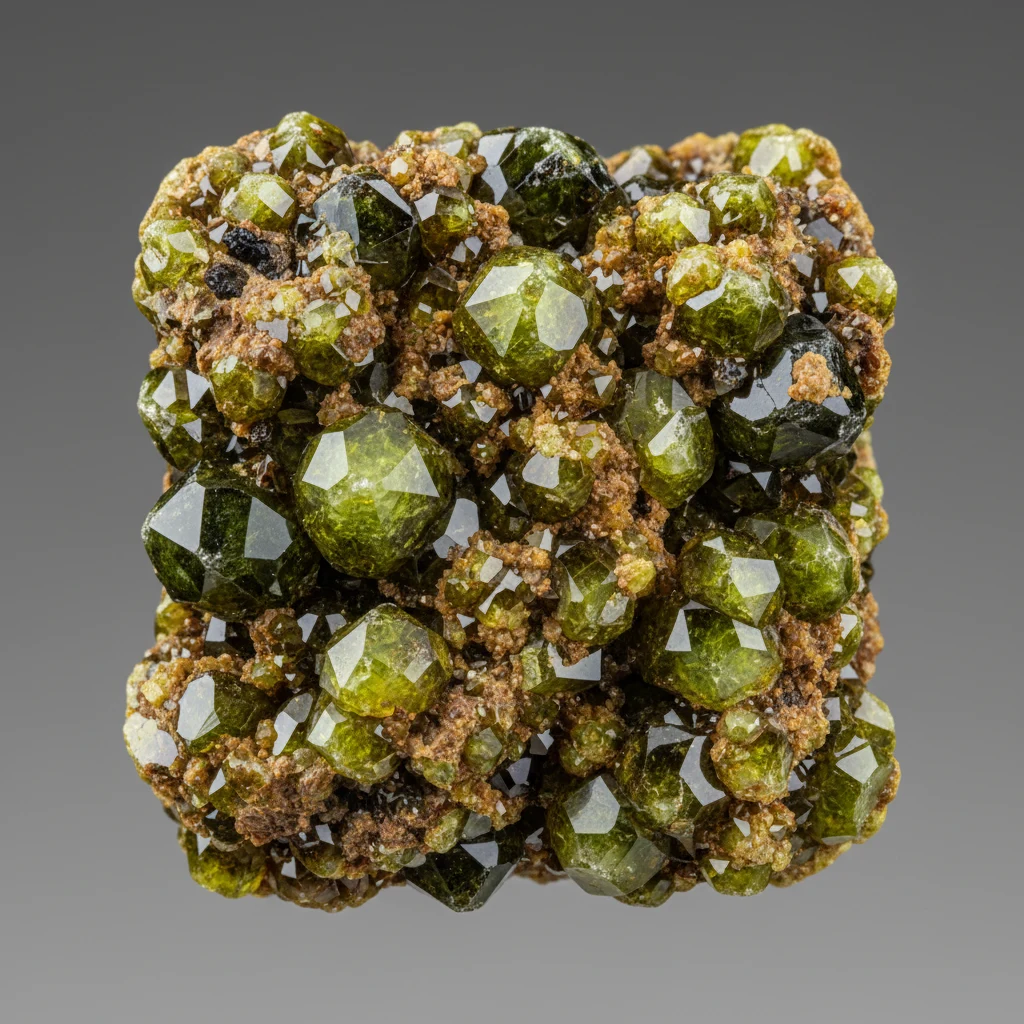
Olivine is a common olive-green to yellow-green magnesium-iron nesosilicate and a major rock-forming mineral in Earth’s mantle. In most hand specimens it appears as glassy, sugary green grains in basalt, gabbro, peridotite, or dunite rather than as showy isolated crystals.
Collectors often meet olivine in two very different forms: ordinary granular rock material and transparent gem-quality peridot. Fresh surfaces can look vitreous to slightly oily, with colors from bottle green and yellow-green to brownish green; darker iron-rich material may approach brown or nearly black.
Origin & History
The name olivine directly refers to the mineral’s typical olive-green color. It was introduced in the late 18th century and is commonly credited to Abraham Gottlob Werner, giving a modern mineral name to a material whose gem variety had already been prized for a very long time.
Peridot, the transparent gem form of olivine, has been used since antiquity, especially from the historic Red Sea locality on Zabargad Island, Egypt. For checking locality names and mineral records, mindat.org is a useful plain-text reference alongside specimen labels and museum catalog information.
Where Is Olivine Found?
Olivine is found worldwide in mafic and ultramafic igneous rocks, especially basalt, gabbro, peridotite, and dunite. It is also known from some volcanic sands and from certain meteorites, including pallasites and chondrites, making it important to both field collectors and planetary-material collectors.
Formation
Olivine forms at high temperatures from magnesium- and iron-rich magmas. It is especially abundant in mantle-derived rocks such as peridotite and dunite, and it also crystallizes in basalt and gabbro, where it may stand out as green granular crystals against darker rock.
At Earth’s surface, olivine weathers relatively easily over geologic time. Moist, acidic, or hydrothermal conditions can alter it to serpentine, iddingsite, iron oxides, and clay minerals, so fresh green grains are usually more desirable to collectors than crumbly brown altered patches.
How to Identify Olivine
Identify olivine by looking for olive-green to yellow-green glassy grains, commonly in basalt, peridotite, or dunite. It has a Mohs hardness of about 6.5-7, a white to colorless streak, no obvious cleavage, and a conchoidal to uneven brittle fracture.
In the hand, olivine usually looks granular and sparkly rather than long and prismatic. It can be separated from epidote by its lack of strong cleavage, and from pyroxene by its greener color and more sugary granular habit; iron-rich pieces may be darker and only very weakly magnetic.
Properties of Olivine
Physical Properties
| Crystal System | Orthorhombic |
| Hardness (Mohs) | 6.5-7 (Hard) |
| Density | 3.2-4.4 g/cm³, increasing with iron content |
| Luster | Vitreous to oily |
| Diaphaneity | Transparent to translucent; commonly translucent in rock-forming grains |
| Fracture | Conchoidal to uneven; brittle |
| Streak | White to colorless |
| Magnetism | Usually nonmagnetic; iron-rich varieties may show very weak magnetic response |
| Colors | Olive green, Yellow-green, Bottle green, Brownish green, Yellow, Brown, Nearly black |
Chemical Properties
| Classification | Nesosilicate |
| Formula | (Mg,Fe)2SiO4; forsterite Mg2SiO4 to fayalite Fe2SiO4 |
| Elements | Magnesium, Iron, Silicon, Oxygen |
| Common Impurities | Nickel, Manganese, Calcium, Chromium, Aluminum |
Optical Properties
| Refractive Index | Approximately 1.63-1.88, depending on Mg-Fe composition |
| Birefringence | About 0.035-0.052 |
| Pleochroism | None to weak; iron-rich material may show weak yellow-green to greenish-brown pleochroism |
| Optical Character | Biaxial positive or biaxial negative depending on composition |
Olivine Health & Safety
Olivine is not considered toxic for normal handling. The main risk is inhaling mineral dust when cutting, grinding, or polishing, especially from mixed rock specimens that may contain other silicates.
Olivine Value & Price
Price Range
Rough/Tumbled: Common olivine-bearing rock specimens are often inexpensive, roughly $2-$30. Attractive peridot crystals or mantle xenolith specimens may range from about $20-$300+, with fine gem crystals or historic-locality specimens higher.
Cut/Polished:
Value depends on whether the specimen is ordinary rock-forming olivine, gem-quality peridot, or a scientifically interesting mantle xenolith or meteorite occurrence. Color, transparency, crystal form, locality, size, and freshness are important; weathered brown olivine is less desirable.
Durability
Good for specimens; moderate for jewelry when gem-quality — Scratch resistance: Hard enough to resist many everyday scratches, but not as hard as corundum or topaz., Toughness: Fair to good; brittle and can chip along fractures.
Stable under normal indoor conditions, but olivine can alter or weather over geologic time, especially in moist, acidic, or hydrothermal environments. Avoid harsh acids and prolonged soaking of fractured specimens.
How to Care for Olivine
Use & Storage
Store olivine and peridot specimens separately from softer minerals and protect transparent crystals from knocks and abrasion.
Cleaning
Clean with lukewarm water, mild soap, and a soft brush. Dry thoroughly after rinsing.
Cleanse & Charge
For metaphysical use, cleanse with gentle smoke, sound, or brief running water, and charge in indirect sunlight or on a dry quartz cluster.
Placement
Display away from high-humidity environments if the specimen is altered or crumbly. Transparent peridot crystals look best under soft, bright lighting.
Caution
Avoid ultrasonic cleaners, steam cleaning, strong acids, and hard impacts. Do not soak fragile matrix specimens for long periods.
Works Well With
Olivine Meaning & Healing Properties
In modern crystal healing traditions, olivine and peridot are associated with renewal, growth, confidence, warmth, prosperity, and emotional release. These meanings are cultural and spiritual beliefs, not scientifically proven effects, but many collectors choose olivine for its bright green, forward-moving feel.
Metaphysical users commonly connect olivine with the Heart and Solar Plexus chakras, and with Leo, Virgo, and Libra. For ritual care, use gentle smoke, sound, brief running water, indirect sunlight, or a dry quartz cluster; avoid harsh acids, steam, ultrasonic cleaners, and long soaking of fragile matrix pieces.
Identify Olivine from a photo
Compare Olivine traits, care tips, value clues, and common lookalikes with a clear photo.
Common mistakes
- Calling every green olivine specimen peridot, even when it is opaque or rock-forming material.
- Identifying olivine by olive-green color alone without checking hardness, luster, and host rock.
- Confusing serpentine after olivine alteration with fresh olivine.
- Assuming a meteorite identification because green grains are present in a dark rock.
- Using destructive scratch tests on faceted peridot or finished jewelry.
- Overlooking seller terms such as simulated, glass, dyed, or synthetic in green gem listings.