Okenite


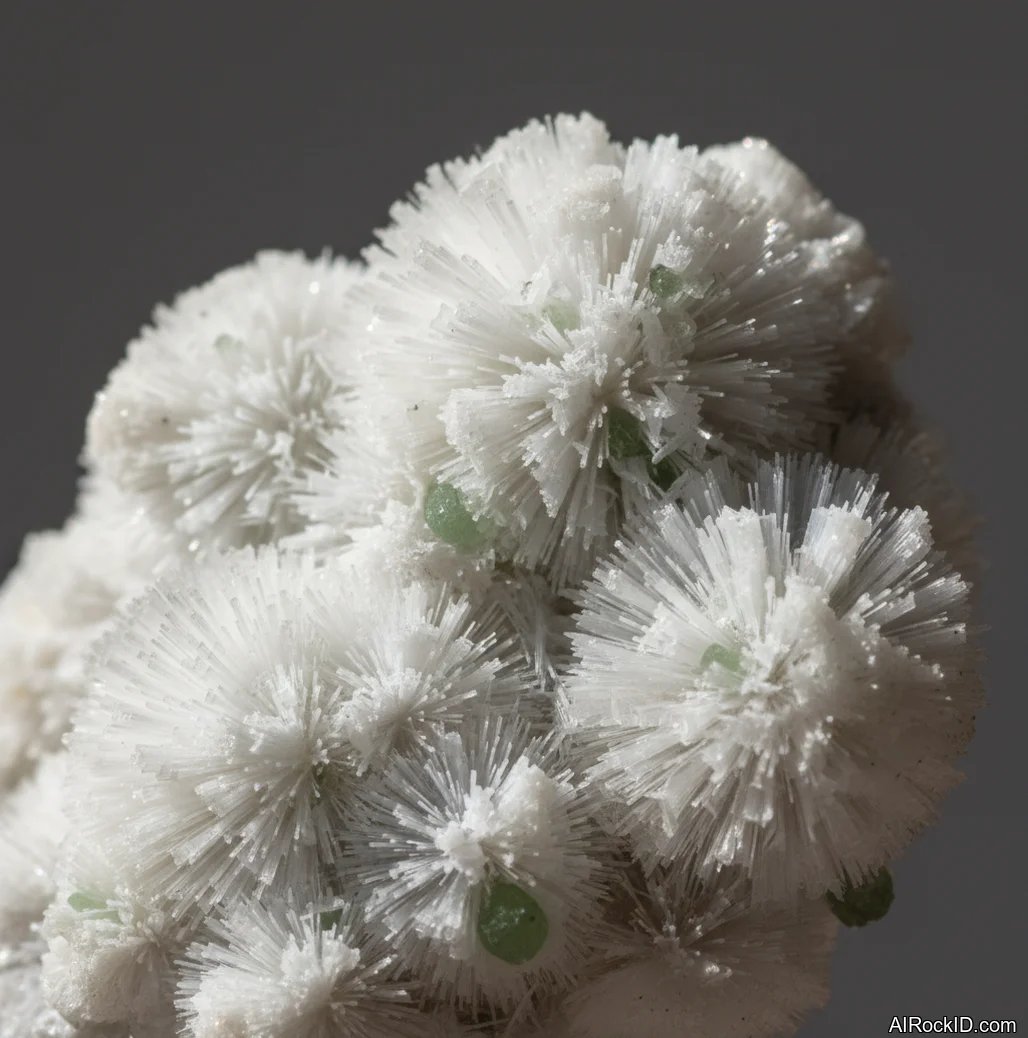
Quick answer: Okenite is best recognized by its white to cream, cottony sprays or rounded fibrous balls, usually found lining basalt cavities. Because the fibers are delicate and the mineral is soft, identification should emphasize texture, crystal habit, and matrix rather than scratch testing.
AI Rock ID can help compare an okenite specimen against visually similar white fibrous minerals using photo-based features such as habit, color, and matrix context. RockIdentifier.io provides crystal identification support, but fragile fibrous specimens like okenite may still need expert confirmation when locality or mineral associations are unclear.
Good fit
- Collectors who like delicate zeolite-cavity specimens
- Display collections where the specimen will not be handled often
- Anyone comparing white fibrous or cottony-looking minerals
- Buyers who want a soft, distinctive mineral rather than a jewelry stone
Not a good fit
- Rings, bracelets, or other wearable jewelry
- Specimens that will be frequently touched, cleaned, or transported
- Beginners who need a durable mineral for handling practice
- Households where fragile mineral fibers may be bumped or crushed
Most commonly confused with
- Natrolite: Natrolite commonly forms white needle-like sprays, but its crystals are usually more rigid and glassy than okenite’s cottony fibers.
- Scolecite: Scolecite can form silky white sprays, but it typically shows longer acicular crystals rather than rounded puffball clusters.
- Mesolite: Mesolite may appear as fine white needles in basalt cavities, but its sprays are usually sharper and less cotton-like.
- Gypsum: Fibrous gypsum can look silky and white, but it is less commonly found as rounded cottony balls on zeolite-rich basalt matrix.
Okenite vs. Similar White Fibrous Minerals
| Feature | Okenite | Common Lookalikes |
|---|---|---|
| Typical habit | Cottony balls, tufts, or fibrous sprays | Needles, silky sprays, blades, or massive fibers |
| Feel and durability | Very soft and easily crushed | Often firmer, sharper, or more elastic depending on mineral |
| Common setting | Basalt cavities with zeolites | Basalt cavities, evaporites, veins, or sedimentary settings |
| Visual texture | Downy, wool-like, matte to silky | Glassy, silky, satin-like, or crystalline |
| Safe ID approach | Photo, locality, matrix, and associated minerals | May require hardness, crystal form, or lab confirmation |
AI identification confidence
AI identification confidence for okenite is usually moderate when the photo clearly shows cottony white spheres on basalt matrix with zeolite associations. Confidence drops when the image is close-cropped, overexposed, or shows only a generic white fibrous surface without scale or locality information.
When AI gets it wrong
- White fibrous zeolites such as natrolite, scolecite, or mesolite are photographed without scale.
- A specimen is labeled only by color, and the matrix or cavity structure is not visible.
- The photo is overexposed, making glassy needles and cottony fibers look similar.
- Synthetic fibers, dust, or altered mineral coatings are mistaken for natural okenite texture.
Final recommendation
Choose okenite as a display mineral if the specimen has intact fibers, a stable matrix, and clear provenance. Avoid pieces with crushed, matted, or artificially brightened-looking fibers unless the price reflects the condition.
How to Check Okenite Before Buying
Look for intact, airy fibers rather than flattened or matted patches. A good specimen should usually show its cavity matrix, and associated zeolite minerals can support the identification. Ask whether the piece has been repaired, stabilized, or cleaned, because aggressive cleaning can damage the soft fibers.
Okenite Locality Clues
Many well-known okenite specimens come from basalt cavities in India, especially the Deccan Traps region. Locality is useful because okenite commonly occurs with zeolites such as apophyllite, stilbite, and heulandite. A seller who provides locality and association details gives buyers more information than a listing based only on color and appearance.
Photography Tips for Okenite Identification
Use soft, even lighting to avoid washing out the fine white fibers. Include one photo of the whole specimen, one close-up of the fibrous habit, and one angle that shows the matrix. A ruler or coin for scale helps separate cottony okenite from longer needle-like zeolite sprays.
What Is Okenite?
Okenite is a hydrated calcium silicate mineral that grows in silky sprays of needle-like fibers, usually as those white, cotton-ball spheres tucked into basalt cavities.
Pick up a specimen and you immediately figure out what not to do: don’t touch the fibers. I’ve seen folks at shows lean in with a thumb like they’re stroking a fuzzy peach, and you can actually watch the spot they hit go flat and kind of greasy-looking where the needles got crushed. It’s not “soft” in a cozy way. It’s soft like a delicate spiderweb made of glass hairs. Unforgiving.
It looks snow-white at first. But under warm display lights it can shift a little creamy, and if you hit it with a phone flashlight the fibers kick back this silky shine that almost reads wet. Most of what you see for sale comes out of Indian basalt pockets, and it tends to show up as small geodes or half-nodules, with the okenite sitting there like a puffball beside peach stilbite or clear apophyllite (that pairing is half the draw, honestly). The okenite itself isn’t flashy. Thing is, that strange, unreal texture it has? Almost nothing else pulls it off the same way.
Origin & History
Back in 1828, Armand Lévy, the French mineralogist who spent a ton of time untangling stubborn silicates, was the one who described okenite. He named it after Lorenz Oken, a German naturalist and philosopher, which is such a very-1800s move (in a good way).
And for collectors, okenite didn’t really turn into a real “show mineral” until big amounts started coming out of the Deccan Traps in India. Older European sources do mention it from Alpine-type settings, but the fluffy cotton-ball habit people picture now is the look that the Indian material made famous in the trade.
Where Is Okenite Found?
Most collector specimens come from basalt cavities in the Deccan Traps of India, where it grows with zeolites like stilbite and apophyllite. Smaller occurrences are reported from Alpine and a few US localities.
Formation
Look closely at where it’s sitting and the whole story kind of gives itself away. Okenite usually lines or fills vesicles in basalt, those gas-bubble pockets that later turn into little chemical kitchens once groundwater starts threading through. The fluids bring in silica and calcium, and as the conditions drift around, different cavity minerals take turns growing.
Next to chunky calcite or quartz, okenite shows up late and it’s fragile. It piles on as radiating sprays of super fine acicular crystals, and when the growth stays even all the way around, that’s when you get the famous sphere. But thing is, it’s picky. If the fluid chemistry shifts, you end up with half-formed balls, shaggy mats, or just a thin coat that looks more like white felt than a puff. In Indian pockets it’s common to see it sitting on top of stilbite, with apophyllite crystals poking nearby like they got there early (and never really moved).
How to Identify Okenite
Color: Most okenite is white to off-white, sometimes with a faint cream or gray cast from the host basalt dusting. Staining from iron in the cavity can tint nearby matrix but the fibers themselves stay pale.
Luster: Silky to pearly on fiber surfaces, especially when you rake light across it.
The real test is the texture and habit: radiating cottony balls or fibrous sprays that look like they’d be soft, but feel prickly if you barely brush them. If you scratch it with a fingernail, it’ll mark easily, and that’s a clue because it’s around Mohs 5. But don’t do that on a display piece, do it on a tiny loose chip if you have one. And if someone’s selling a “fluffy okenite” that’s rubbery, warm, or lint-like, it’s probably synthetic fiber glued into a cavity.
Common Look-Alikes
Okenite is sometimes confused with these materials:
- Mesolite (zeolite) sprays and balls
- Natrolite (zeolite) needle clusters
- Scolecite (zeolite) silky radiating bundles
- Gypsum satin spar rosettes and fibrous sprays
- Cotton or synthetic fiber glued into basalt vugs (craft fake)
- White glassy “snowball” blobs sold as okenite (glass fake)
Market Cautions & Treatments
When AI Can Get This Wrong
At first glance, phone photos mix up okenite with zeolites like mesolite, natrolite, and scolecite because they all read as white, radiating fuzz in a dark basalt pocket. The real test is touch and structure: okenite collapses and mats down with the lightest brush, while most zeolite needles stay crisp and spiky, and a loupe will show okenite’s ultra-fine silky hairs instead of thicker, glassier needles.
Properties of Okenite
Physical Properties
| Crystal System | Triclinic |
| Hardness (Mohs) | 4.5-5 (Medium (4-6)) |
| Density | 2.28-2.33 g/cm3 |
| Luster | Silky |
| Diaphaneity | Translucent |
| Fracture | Splintery |
| Streak | White |
| Magnetism | Non-magnetic |
| Colors | White, Off-white, Cream, Pale gray |
Chemical Properties
| Classification | Silicates |
| Formula | CaSi2O5·2H2O |
| Elements | Ca, Si, O, H |
| Common Impurities | Fe, Al, Mg |
Optical Properties
| Refractive Index | 1.527-1.533 |
| Birefringence | 0.006 |
| Pleochroism | None |
| Optical Character | Biaxial |
Okenite Health & Safety
The biggest risk here is mechanical. Those fibrous crystals can make your skin itch if you keep rubbing them, and if you scrape up the specimen you can kick loose damaged fibers that float off as dust. So handle it like a fragile display mineral, the kind you’d set on a shelf and maybe pick up with clean, dry fingers, not something you toss in your pocket and fidget with.
Safety Tips
Handle the matrix, not the fibers. And don’t brush or blow debris off the surface (it just kicks stuff up). If a piece is shedding, put it in a bag, then wash your hands after you’re done handling it.
Okenite Value & Price
Price Range
Rough/Tumbled: $25 - $300 per specimen
Prices shoot up fast as the piece gets bigger, keeps that intact “puff” shape, and shows a clean white pop against dark basalt, especially when there’s good stilbite or apophyllite sitting with it. But okenite’s the headache in real life: shipping and handling. It’s so touchy that one careless brush, a quick tap against foam, even lifting it wrong (you can feel the fibers catch) can ding it and drop the value right away.
Durability
Fragile — Scratch resistance: Fair, Toughness: Poor
Chemically it’s fairly stable as a cabinet specimen, but the fibers crush and shed easily with vibration, rubbing, or repeated handling.
How to Care for Okenite
Use & Storage
Store it in a box or a closed display case so nothing brushes the fibers. I keep mine in a specimen perky box with a little foam collar so it can’t rattle on the drive home.
Cleaning
1) Skip running water and definitely skip ultrasonic cleaners. 2) Use a soft hand blower or very gentle canned air from a distance to move loose dust. 3) If you must, dab the matrix with a damp cotton swab, staying well away from the okenite fibers.
Cleanse & Charge
For non-contact cleansing, use smoke, sound, or just time in a clean, dry spot away from direct sun. If you do moonlight, keep it protected from wind and curious fingers.
Placement
Put it somewhere it won’t get bumped, like a shelf you don’t use daily. Side lighting makes the silky fibers pop, so a small lamp set low works great.
Caution
Don’t rub the fibers. Don’t toss it in the tumble cycle. And at a show, don’t let it rattle around loose in a bag where it’ll bang and bounce every time you move. Skip ultrasonic cleaners, too, and stay away from harsh chemical cleaners.
Works Well With
Okenite Meaning & Healing Properties
Most dealers bring up okenite and start talking about “calm” and “softness,” which always makes me laugh a little because, in your hand, it’s basically the least cuddly thing on the table. Those little cotton-ball sprays look fluffy until you actually get close, then you see the fine needles and that chalky, fibrous texture that makes you pull your fingers back. But energy-wise? I get why people frame it that way. If one’s just sitting on a shelf near you, it feels quiet. And the look of it, honestly, slows your brain down before you’ve even decided to slow down.
Thing is, the second you pick up the matrix, you notice you’re treating it like it matters. You cradle it, you tip it carefully, you avoid brushing the fibers (because you know you’ll regret it). You automatically get more patient. That’s the whole point for a lot of folks. In crystal shop chatter, okenite usually gets linked to easing overstimulation, turning down mental noise, and taking the hard edges off a room. I keep that in the realm of personal practice, not medicine. If you’ve got real anxiety or sleep problems, that’s a doctor conversation, not a mineral conversation. Right?
But as a simple, practical ritual, it’s great as a “don’t touch, just breathe” piece. I’ve watched people park one by a reading chair or on a nightstand, not because it performs some on-demand magic trick, but because it’s a visual reminder to unclench your jaw and let your shoulders drop (you know the feeling). And if you’re the kind of person who can’t stop fidgeting with stones, okenite will teach you fast. One poke and you’re cured.
Common mistakes
- Assuming every white fibrous mineral in basalt is okenite.
- Testing hardness directly on the fibers, which can permanently crush the specimen.
- Buying a specimen from a cropped photo that hides the matrix and broken edges.
- Confusing dust-covered zeolite sprays with naturally cottony okenite.
- Cleaning okenite with water pressure, brushes, or ultrasonic tools.
Identify Okenite from a photo
Compare Okenite traits, care tips, value clues, and common lookalikes with a clear photo.