Epidote


Quick answer: Epidote is commonly identified by its pistachio-green to yellow-green color, prismatic crystal habit, and occurrence in metamorphic rocks, skarns, and hydrothermal veins. It can resemble several other green minerals, so hardness, crystal form, and matrix context are useful for identification.
AI Rock ID can help compare Epidote against visually similar green minerals using a clear photo and basic context such as locality or host rock. RockIdentifier.io provides crystal identification support, but visual results should be checked against hardness, luster, streak, and crystal habit when accuracy matters.
Good fit
- Collectors who like green prismatic crystals and granular metamorphic specimens
- Students comparing minerals from skarn, greenschist, or hydrothermal environments
- Buyers who want a relatively durable display mineral when handled with care
- People interested in minerals often found with quartz, calcite, garnet, or actinolite
Not a good fit
- Anyone needing a crystal that can be confidently identified by color alone
- Jewelry wearers looking for a highly scratch-resistant everyday stone
- Collectors who avoid specimens with possible mixed mineral associations
- Buyers who want bright emerald-green color without checking for lookalikes
Most commonly confused with
- Vesuvianite: Vesuvianite may be green to brown and occurs in skarns, but it often has a different crystal habit and typically lacks Epidote’s strong pistachio-green look.
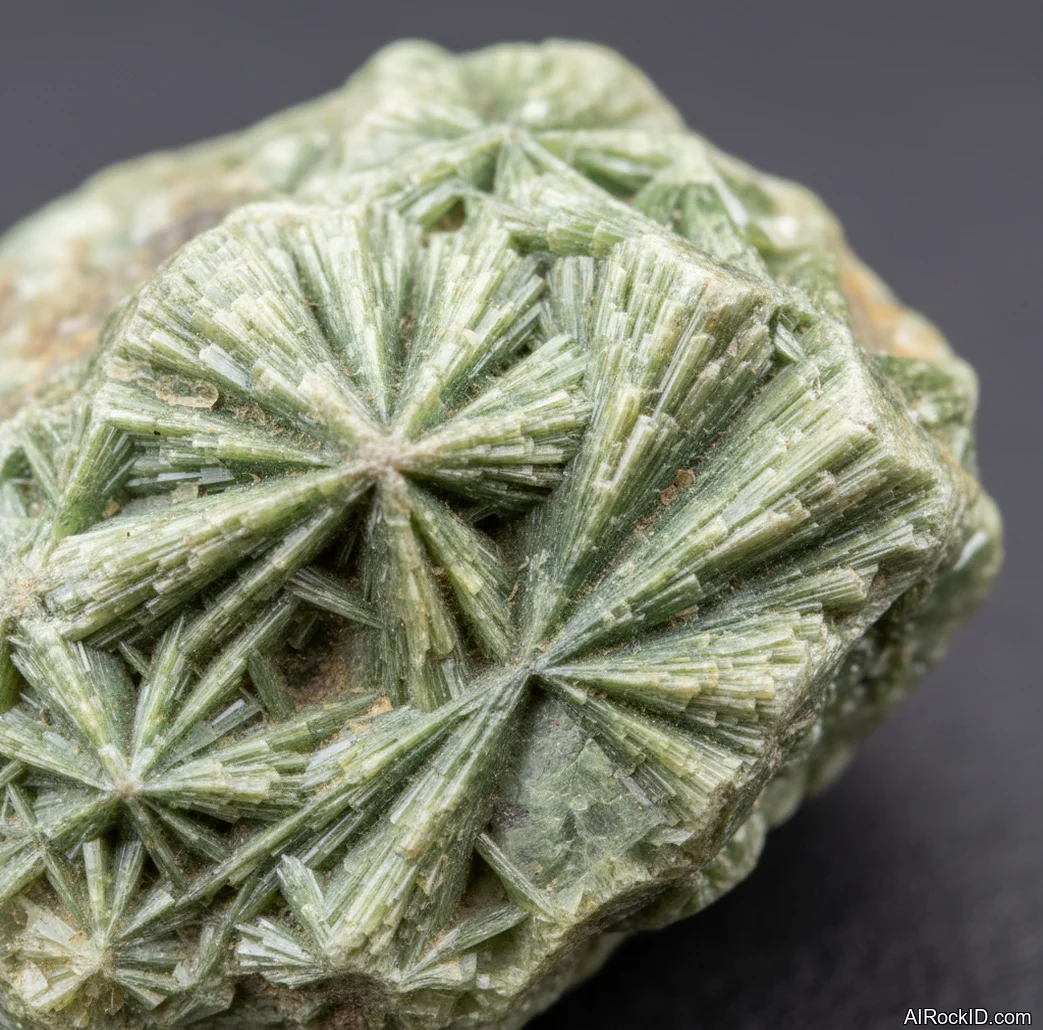
- Actinolite: Actinolite is commonly fibrous or bladed, while Epidote more often forms prismatic crystals or granular masses.
- Olivine: Olivine is usually olive green and granular in igneous rocks, while Epidote is more common in metamorphic and hydrothermal settings.
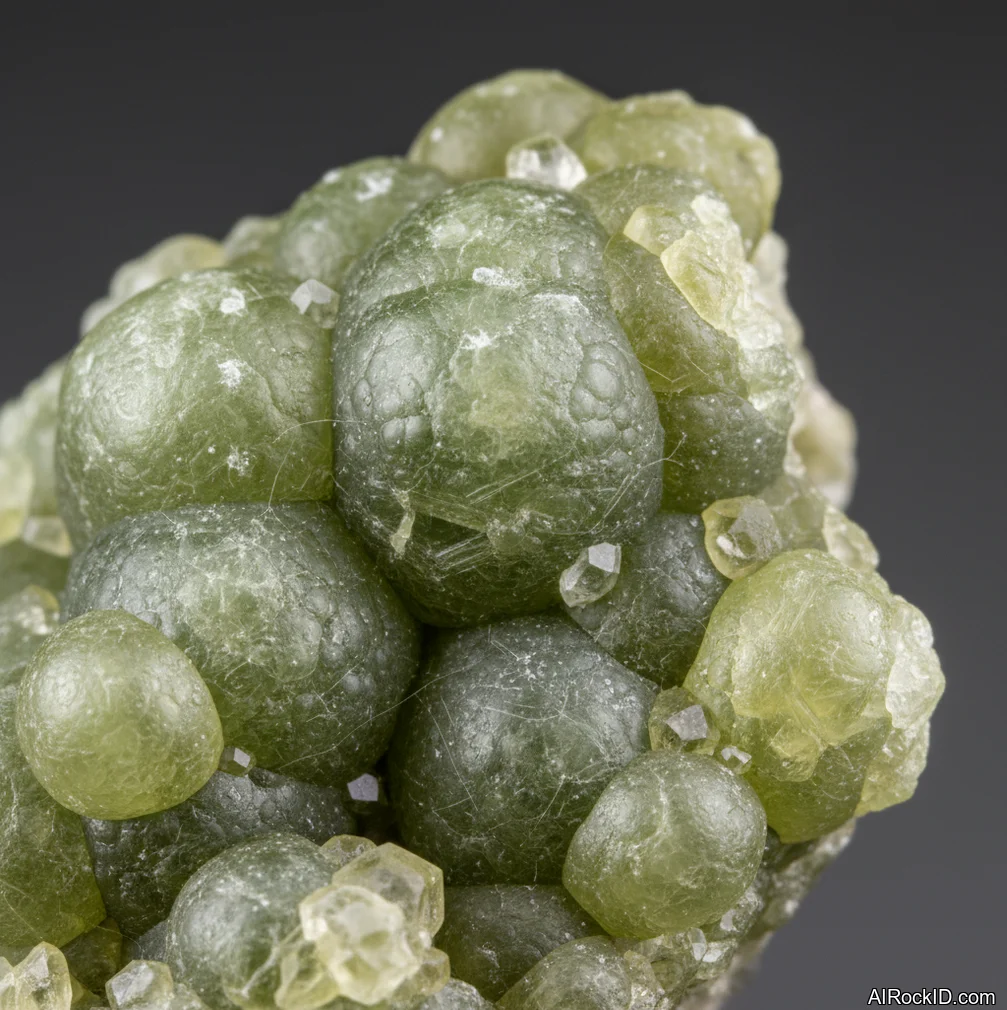
- Prehnite: Prehnite is usually pale green with a waxy to vitreous appearance and botryoidal or tabular forms, unlike Epidote’s sharper prismatic crystals.
Epidote vs. Similar Green Minerals
| Mineral | Typical Look | Key Difference | Common Setting |
|---|---|---|---|
| Epidote | Pistachio to yellow-green, prismatic or granular | Mohs 6–7 with vitreous luster and common metamorphic association | Metamorphic rocks, skarns, veins |
| Actinolite | Dark green, fibrous to bladed | More fibrous habit and amphibole cleavage | Metamorphic rocks |
| Vesuvianite | Green, yellow-brown, or brown crystals | Often occurs in skarns but with different crystal symmetry and habit | Contact metamorphic rocks |
| Prehnite | Pale green, waxy, botryoidal or tabular | Softer look, lighter color, and rounded aggregates | Veins and altered basalts |
| Olivine | Olive-green granular grains | Igneous origin and lack of prismatic Epidote habit | Basalt, peridotite, meteorites |
AI identification confidence
AI identification confidence for Epidote is usually moderate when photos show color, crystal habit, luster, and matrix clearly. Confidence decreases when the specimen is massive, dark, weathered, or mixed with other green minerals.
When AI gets it wrong
- The photo shows only a green color without crystal faces or texture.
- The specimen is a mixed rock containing Epidote, actinolite, chlorite, quartz, or calcite together.
- Lighting makes yellow-green Epidote appear closer to jade, prehnite, or olivine.
- The sample is tumbled or polished, removing crystal habit and matrix clues.
Final recommendation
For buying or identifying Epidote, prioritize specimens with clear pistachio-green color, visible crystal habit, and reliable locality information. If a piece is sold as rare, gemmy, or from a famous locality, compare it with verified examples and ask for provenance before paying a premium.
How to Check Epidote Authenticity
Authentic Epidote usually shows green to yellow-green color with a vitreous luster and may appear as prismatic crystals, radiating clusters, or granular masses. A basic hardness check can help separate it from softer green materials, but testing should be done on an inconspicuous spot. Locality, matrix minerals, and crystal habit are often more useful than color alone.
Buying Tips for Epidote Specimens
Look for clear photos taken in natural or neutral lighting, because strong lighting can exaggerate green color. Well-formed crystals, attractive contrast with quartz or calcite, and documented localities can affect price. Be cautious with vague labels such as “green crystal” or “healing Epidote” when mineral identification details are missing.
Photo Tips for Identifying Epidote
Use a sharp, well-lit photo that shows the crystal from more than one angle, including any host rock or associated minerals. Include a size reference and avoid heavy color filters. Close-up images of terminations, cleavage, and texture can improve identification results.
What Is Epidote?
Epidote is a calcium aluminum iron sorosilicate mineral, and you usually see it as green prismatic crystals or lumpy, granular masses in metamorphic rocks and hydrothermal veins.
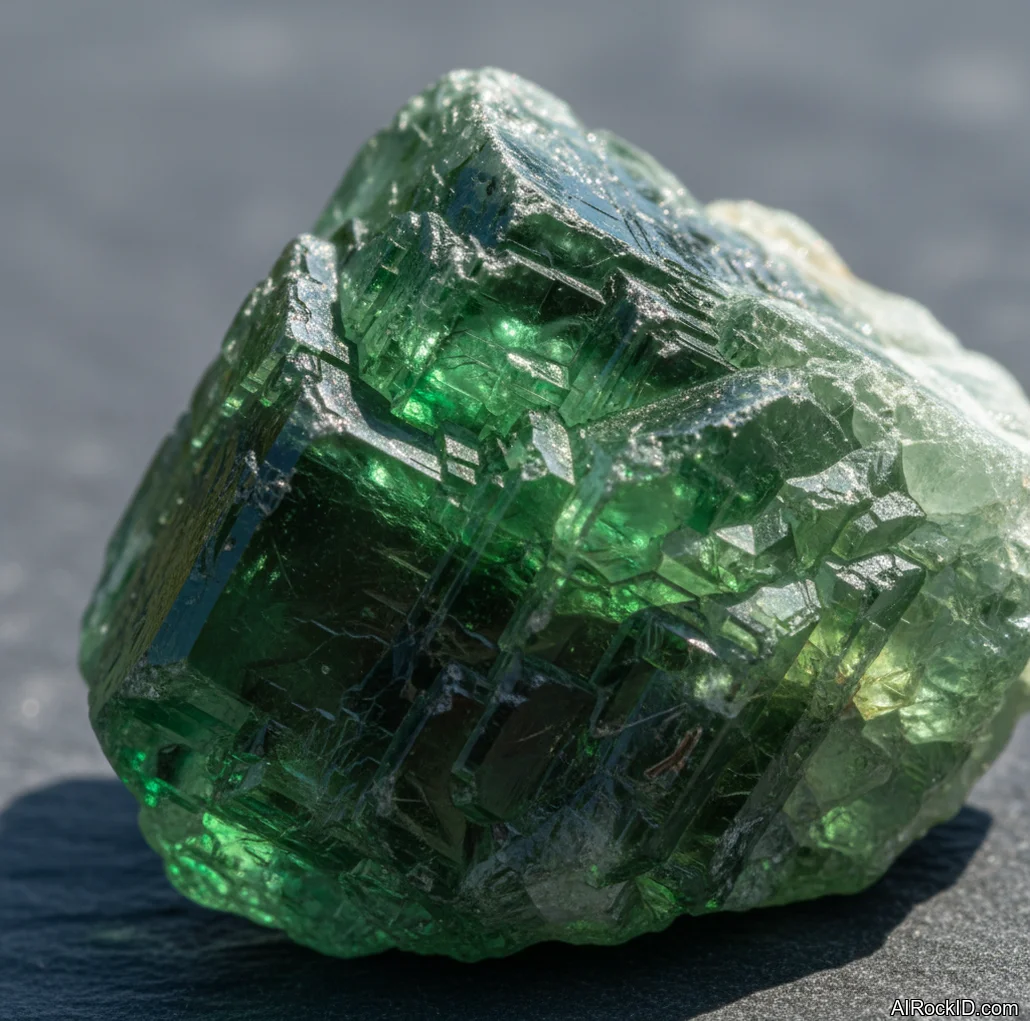
Grab a chunky bit in your hand and you’ll notice it right away: it just feels more “rocky” than quartz. It isn’t light and airy. And it doesn’t have that slick, sugary feel calcite gets after it’s been bumped around in a bucket. Most epidote sits in that pistachio-to-bottle-green range, with occasional yellow-green edges where the light catches thin crystal tips just right. When it’s fresh, the luster can be properly glassy too, like somebody actually waxed the crystal faces (you can almost see a clean shine rolling across them when you tilt it).
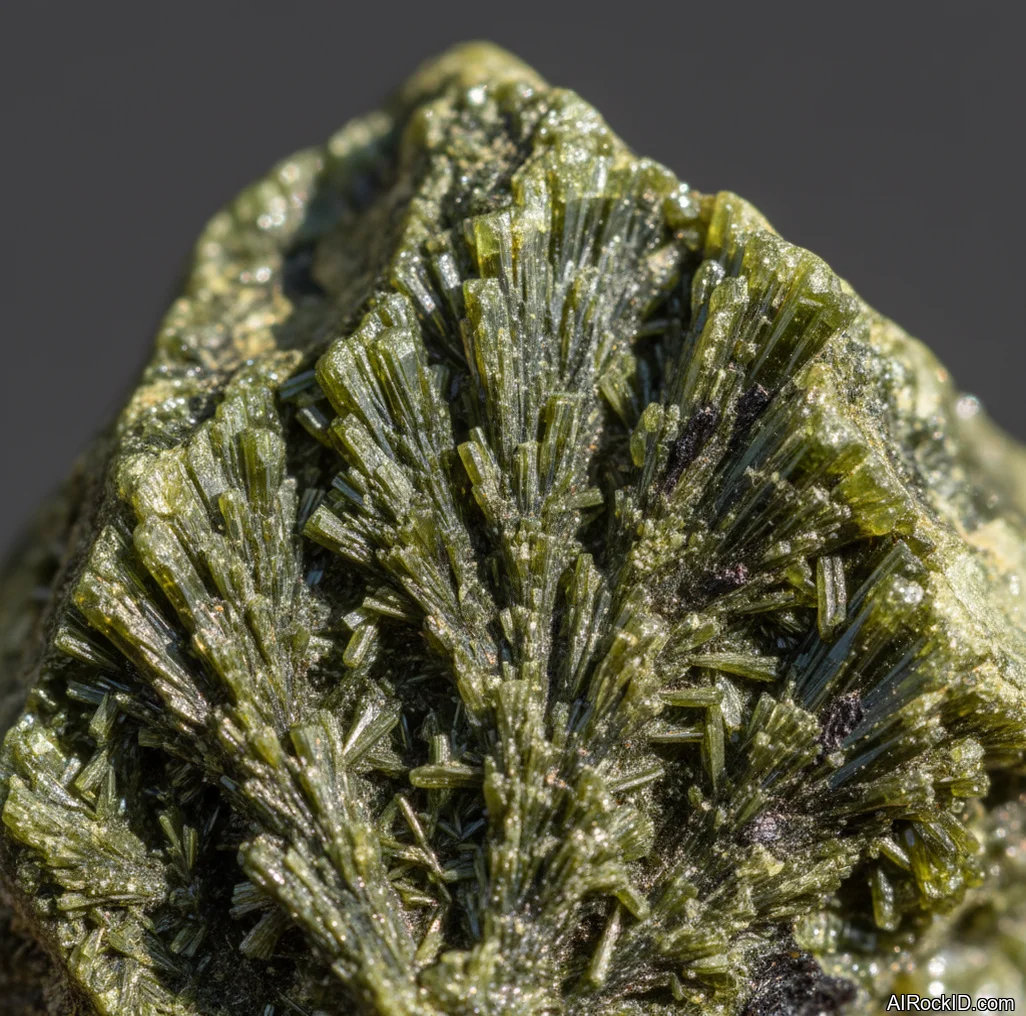
People mix it up at first with green tourmaline, or even diopside, which I get. But epidote has its own look. The crystals are often striated lengthwise, and a lot of pieces have that crowded brushy thing going on, like a bundle of green pencils stuck together. Thing is, it also shows damage fast. Lots of specimens have tiny chips on the terminations, because epidote isn’t all that forgiving once it’s been rattled around in a flat of rocks at a show.
Origin & History
Back in 1801, René Just Haüy pinned epidote down as a mineral species and named it from the Greek “epidosis,” meaning “increase.” Thing is, he wasn’t being poetic. He was pointing at a very specific quirk: one crystallographic axis runs longer than you see in closely related minerals, the kind of measured, ruler-on-the-page detail Haüy was obsessed with.
People who collect minerals got familiar with epidote early on because it turns up in those classic European alpine pockets, and you’ll also bump into it in metamorphic terrains just about everywhere. It’s never really had the whole “royal gem” kind of backstory. But if you’re the type who wants actual geology sitting in the case (not just shiny polished pieces), epidote’s one of those cornerstone minerals you end up respecting.
Where Is Epidote Found?
Epidote turns up in metamorphic belts and skarn zones worldwide, plus in hydrothermal veins where hot fluids altered the host rock. Alpine pockets and skarns are where you see the showy crystals.
Formation
Quartz will grow just about anywhere it can squeeze in, but epidote? Not so much. It’s one of those “the conditions have to line up” minerals. You usually see it when calcium-rich rocks are getting cooked and squeezed during metamorphism, or when hot fluids shove their way through and chemically alter the rock, trading elements back and forth. And if there’s enough calcium around and the chemistry behaves, epidote will pop up along fractures and in little cavities.
Skarns are the classic place to find it. That’s the zone where an intrusive body runs into limestone or dolostone and the whole area goes chemically strange. Epidote can show up alongside garnet, diopside, vesuvianite, and calcite. I’ve cracked open skarny chunks where the epidote sits there like green needles wedged between honey-colored calcite and dull brown garnet, and you can feel the gritty, sugary break on the fresh surface when it snaps. It isn’t always pretty in the rough (some pieces look downright ugly), but the textures tell the whole story if you actually look.
How to Identify Epidote
Color: Most epidote runs yellow-green to deep green, often with a pistachio tone. Some pieces look almost black-green until you hit them with a bright light on a thin edge.
Luster: Fresh crystal faces are usually vitreous, sometimes edging toward resinous on darker material.
Look closely for long prismatic crystals with parallel striations and a “brush” cluster habit. If you scratch it with a steel blade, it’ll usually resist better than calcite or fluorite, but it won’t feel as bulletproof as quartz. The real test is a hand lens on the terminations: epidote tips often look wedgey and a little uneven, not cleanly hexagonal like tourmaline.
Common Look-Alikes
Epidote is sometimes confused with these materials:
- Actinolite
- Green tourmaline (verdelite)
- Peridot
- Olivine
- Prase (green quartz)
- Dyed green aventurine
Market Cautions & Treatments
When AI Can Get This Wrong
AI photo ID tends to mix up epidote with actinolite and green tourmaline, especially if it's a chunky crystal cluster. In photos, the prismatic habit and color can look close. Field test: scratch it with a steel nail. Real epidote leaves a grayish streak and feels much harder than actinolite or prase.
Properties of Epidote
Physical Properties
| Crystal System | Monoclinic |
| Hardness (Mohs) | 6-7 (Hard (6-7.5)) |
| Density | 3.3-3.6 g/cm3 |
| Luster | Vitreous |
| Diaphaneity | Transparent to translucent |
| Fracture | Uneven |
| Streak | White to grayish white |
| Magnetism | Non-magnetic |
| Colors | Pistachio green, Yellow-green, Dark green, Greenish black, Brownish green |
Chemical Properties
| Classification | Silicates (sorosilicate) |
| Formula | Ca2(Al,Fe)3(SiO4)3(OH) |
| Elements | Ca, Al, Fe, Si, O, H |
| Common Impurities | Mn |
Optical Properties
| Refractive Index | 1.733-1.768 |
| Birefringence | 0.035 |
| Pleochroism | Strong |
| Optical Character | Biaxial |
Epidote Health & Safety
Epidote’s generally considered non-toxic, so it’s safe to handle with your bare hands. But treat it like any other rock: if you’re cutting or grinding it and that fine greenish dust starts hanging in the air (and you can feel that gritty stuff on your fingers), don’t breathe it in.
Safety Tips
Use water and wear a respirator when lapidary work kicks up that super-fine dust (the kind that hangs in the air and leaves a gritty film on your glasses). And once you’re done handling dusty specimens, wash your hands.
Epidote Value & Price
Price Range
Rough/Tumbled: $5 - $250 per specimen
Cut/Polished: $5 - $40 per carat
Prices jump fast when the terminations are sharp, the luster is really strong, and you’ve got that clean matrix contrast (white albite or quartz makes it pop). But most dealers will knock the price way down on chipped clusters, because epidote doesn’t hide damage, and those tip bruises catch the light right away.
Durability
Moderate — Scratch resistance: Good, Toughness: Fair
Epidote is generally stable in normal room conditions, but crystal tips can chip easily if it’s stored loose with harder minerals.
How to Care for Epidote
Use & Storage
Store epidote so the crystal tips aren’t rubbing anything harder than they are. I keep nicer clusters in a little box with foam because those terminations love to snag and chip.
Cleaning
1) Rinse briefly with lukewarm water to float off grit. 2) Use a soft toothbrush with a drop of mild dish soap to work around the crystal bases. 3) Rinse well and air-dry; don’t bake it in direct sun on a windowsill.
Cleanse & Charge
If you do energy-style cleansing, stick to gentle stuff like running water, smoke, or leaving it on a piece of selenite. Avoid salt soaks if your epidote sits on a matrix that could react or crumble.
Placement
Put it where side-light can rake across the striations, like a shelf with a small lamp. Dark epidote looks way better with angled light than with overhead room lighting.
Caution
Don’t throw epidote clusters in a tumbler and think you’ll pull them out with sharp, crisp crystal faces. You won’t. They come back rounded and beat up, like they’ve been rattling around in a coffee can with gravel. And if the epidote’s sitting on calcite, don’t reach for acids or even vinegar. The calcite will fizz right away, you’ll see those tiny bubbles creep across the surface, and the matrix gets eaten out from under the piece. Why risk it?
Works Well With
Epidote Meaning & Healing Properties
Most folks selling in the metaphysical section will tag epidote as a “growth” stone, and yeah, I can see why. It’s got this steady, earthy vibe. Not airy. When I’m back home after a show sorting flats on the table, epidote feels grounding in a very no-nonsense way. Cold at first touch, a little weighty, kind of stern in your palm, like, “Hey. Focus.”
If you use crystals as reminders or as a meditation anchor, epidote fits best with routines. The plain stuff. Journaling, budgeting, cleaning out the corner you keep ignoring, getting your calendar under control. But look, I want to be blunt about this: none of that is medical care. It won’t cure depression, anxiety, or anything else by itself, and you really shouldn’t dodge real support just because a green stone felt comforting for a minute.
Thing is, the epidote hype can get weird. Some listings swear it “amplifies everything,” like it’s a magic volume knob you can crank up. In my experience, what it actually boosts is your ability to notice what’s already there, especially the loops you keep running. Helpful? Sure. Also irritating (because do we really want to see our patterns that clearly all the time?).
And if you’re already feeling raw, a darker, heavier piece of epidote can hit too hard. When that happens, I’ll grab something softer like prehnite, let things settle, then circle back to epidote later.
Common mistakes
- Identifying any pistachio-green mineral as Epidote without checking hardness or crystal habit
- Confusing fibrous actinolite or chlorite-rich rock with massive Epidote
- Assuming polished green stones can be identified reliably from color alone
- Overlooking mixed specimens where Epidote occurs with quartz, calcite, garnet, or amphiboles
- Treating trade names or metaphysical labels as proof of mineral identity
Identify Epidote from a photo
Compare Epidote traits, care tips, value clues, and common lookalikes with a clear photo.