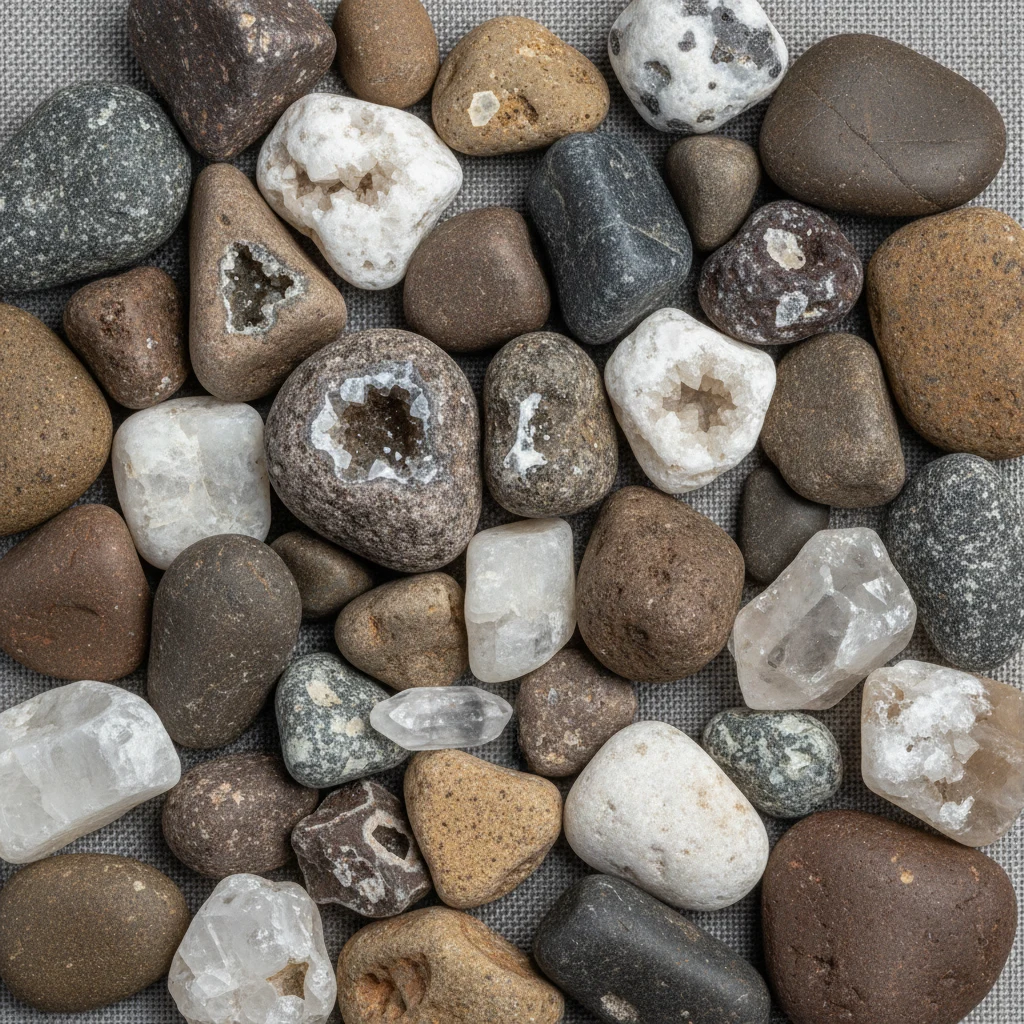
Pebbles and gravel


Quick answer: Pebbles and gravel are small, naturally rounded or broken rock fragments rather than a single mineral species. Their appearance, hardness, and durability vary because they may be made of quartz, basalt, limestone, granite, chert, or other rocks.
AI Rock ID can help sort pebbles and gravel by visible traits such as color, grain size, texture, layering, and luster. RockIdentifier.io provides identification support for common rock fragments, but mixed gravel may require close-up photos or simple hardness and acid tests for better confidence.
Good fit
- People identifying mixed stones from beaches, rivers, trails, or landscaping material
- Beginner rock collectors learning texture, hardness, and sediment transport clues
- Aquarium, garden, or craft users who need to screen stones for suitability
- Anyone comparing rounded natural fragments with tumbled stones or manufactured aggregate
Not a good fit
- Identifying a precise mineral species from a mixed handful without testing
- Assuming all pebbles are safe for aquariums, terrariums, or fire pits
- Determining commercial gemstone value from appearance alone
Most commonly confused with
- Quartz: Quartz pebbles are usually hard, glassy to waxy, and may scratch glass; many gravel mixes contain quartz but are not entirely quartz.
- Jasper: Jasper is an opaque microcrystalline quartz with consistent color or patterns, while ordinary gravel often contains multiple rock types.
- Chert: Chert commonly breaks with sharp, curved fractures and has a waxy surface, unlike many softer or grainier gravel stones.
- Basalt: Basalt pebbles are typically dark, fine-grained, and dense, while mixed gravel may include light quartz, feldspar-rich rocks, and sedimentary fragments.
Pebbles and Gravel Lookalike Comparison
| Material | Typical surface | Key distinction | Simple check |
|---|---|---|---|
| Natural river or beach pebbles | Rounded, matte to smooth | Mixed rock types shaped by transport | Look for varied colors, grains, and hardness |
| Tumbled stones | Polished, glossy, uniformly smooth | Machine-finished and often selected by mineral type | Check for consistent polish across all sides |
| Crushed gravel | Angular to subangular | Broken mechanically for construction or landscaping | Edges are sharper than water-worn pebbles |
| Quartz pebbles | Glassy to waxy, often white or translucent | Single hard mineral-rich fragments | Often scratches glass and resists a steel nail |
| Limestone gravel | Dull, pale, sometimes fossiliferous | Calcium carbonate rock, softer than quartz | May fizz with diluted vinegar or acid |
AI identification confidence
AI identification confidence for pebbles and gravel is usually moderate because a photo may show shape and texture but not full mineral composition. Confidence improves when one stone is photographed close up in natural light with scale, dry and wet views, and notes from hardness, streak, magnetism, or acid testing.
When AI gets it wrong
- A mixed pile is labeled as one mineral even though it contains several rock types.
- Wet stones appear darker, glossier, or more colorful than they look when dry.
- Polished tumbled stones are mistaken for naturally rounded river pebbles.
- Limestone, quartzite, chert, and pale quartz are confused without hardness or acid tests.
Final recommendation
Treat pebbles and gravel as a mixed rock category unless a specific fragment is tested and identified. For practical use, sort stones by hardness, reactivity, porosity, and cleanliness rather than by appearance alone.
How to Tell Natural Pebbles from Polished Stones
Natural pebbles usually show small pits, uneven wear, mineral grains, or weathered surfaces from water, sand, ice, or soil movement. Polished stones tend to have a uniform glossy finish, rounded edges on every side, and fewer natural surface irregularities. A natural pebble may look much brighter when wet, while a polished stone stays glossy when dry.
Buying Pebbles and Gravel: Authenticity Checks
When buying decorative pebbles or gravel, ask whether the material is natural, dyed, resin-coated, waxed, or polished. Dyed stones may show color concentrated in cracks, rub off slightly when soaked, or fade with outdoor exposure. For aquariums or terrariums, avoid unknown coated stones and test carbonate-rich rocks if water chemistry matters.
Field Tests for Sorting Mixed Gravel
A scratch test can separate hard quartz-rich pebbles from softer limestone or shale fragments. Diluted vinegar or a proper geologic acid test can indicate carbonate rocks when fizzing occurs, though weak reactions may be hard to see. A magnet can help detect magnetite-rich dark stones, but lack of magnetism does not identify the rock by itself.
What Is Pebbles and gravel?
Pebbles and gravel are small, rounded fragments of rock, classed here as a sedimentary rock material rather than a single mineral species. In the hand, they are easy to recognize: smooth surfaces, mixed brown, gray, and white colors, and a worn shape that looks worked by moving water or ice.
Collectors value pebbles and gravel less for rarity and more for texture, locality, and natural variety. Their Mohs hardness range is 5-7, with good scratch resistance, good toughness, and general stability under normal conditions. Most specimens are opaque, non-magnetic, and dull to slightly shiny.
Origin & History
The word “gravel” comes from the Old French “gravele,” and the term has been in use since at least the 14th century. That long history fits the material: gravel is familiar, practical, and often collected exactly where people first notice it, along paths, beaches, and river margins.
As a collecting subject, pebbles and gravel are best understood by place and appearance rather than by one fixed formula. Composition varies, with quartz pebbles represented by SiO2, and common impurities may include Fe and Ca. For locality checking and specimen naming, collectors often compare notes with mindat.org.
Where Is Pebbles and gravel Found?
Pebbles and gravel are commonly found in riverbeds and beaches. Notable listed localities include the Missouri River in the USA, the Thames River in the UK, and the Great Barrier Reef in Australia, with broader occurrences noted in the United States, Canada, and Australia.
Formation
Pebbles and gravel form through weathering and erosion of larger rocks. As parent rock breaks down, fragments are moved, rubbed, and rounded, then commonly deposited by rivers or glaciers. The finished material feels smooth because its edges have been worn away during transport.
This process also explains the wide range in color and composition. Brown, gray, and white pieces can sit together in the same handful, and the formula varies by composition rather than remaining fixed. Their amorphous structure, opaque appearance, and white to gray streak help describe them as mixed rock fragments rather than a single crystal species.
How to Identify Pebbles and gravel
Identify pebbles and gravel by their rounded shapes, smooth textures, and small size compared with larger stones. They commonly appear brown, gray, or white, with a dull luster that may become slightly shiny on well-worn surfaces. Most are opaque and non-magnetic.
A practical check is to sort by touch and appearance first: rounded edges, water-worn surfaces, and mixed colors are the strongest clues. The listed hardness is Mohs 5-7, density is 1.5-3.0 g/cm3, fracture may be conchoidal, and the streak is white to gray. Avoid sharp tools during testing, as they may chip the pieces.
Properties of Pebbles and gravel
Physical Properties
| Crystal System | Amorphous |
| Hardness (Mohs) | 5-7 (Medium) |
| Density | 1.5-3.0 g/cm3 |
| Luster | Dull |
| Diaphaneity | Opaque |
| Fracture | Conchoidal |
| Streak | White to gray |
| Magnetism | Non-magnetic |
| Colors | Brown, Gray, White |
Chemical Properties
| Classification | Sedimentary rock |
| Formula | Varies by composition (e.g., SiO2 for quartz pebbles) |
| Elements | Si, O |
| Common Impurities | Fe, Ca |
Optical Properties
| Refractive Index | Varies, typically around 1.5 |
| Birefringence | None |
| Pleochroism | None |
| Optical Character | Isotropic |
Pebbles and gravel Health & Safety
There are no significant health risks associated with handling pebbles and gravel.
Pebbles and gravel Value & Price
Price Range
Rough/Tumbled: $0.10 - $1.00 per specimen
Cut/Polished:
Price is affected by size, color, and local availability.
Durability
Durable — Scratch resistance: Good, Toughness: Good
Generally stable under normal conditions.
How to Care for Pebbles and gravel
Use & Storage
Store in a dry place to avoid mold or decay.
Cleaning
Rinse with water to remove dirt. Use a soft brush for stubborn spots.
Cleanse & Charge
Place under sunlight or moonlight for a few hours.
Placement
Display in a bowl or use in landscaping.
Caution
Avoid using sharp tools that may chip them.
Works Well With
Pebbles and gravel Meaning & Healing Properties
Pebbles and gravel are commonly used for grounding, stability, and connection to nature. In a practice setting, they suit simple tactile work: holding a smooth pebble, placing gravel in a bowl, or using it as an earthy focus during meditation. These uses are cultural and spiritual, not a replacement for medical treatment.
They are associated with the Root chakra, the Earth element, and the planet Earth. The listed zodiac links are Taurus, Virgo, and Capricorn, matching their steady, practical feel. For crystal layouts or display bowls, they pair well with crystal quartz, jasper, and agate.
Identify Pebbles and gravel from a photo
Compare Pebbles and gravel traits, care tips, value clues, and common lookalikes with a clear photo.
Common mistakes
- Calling an entire gravel sample quartz because several white or translucent pieces are present.
- Judging hardness from rounded shape; water-worn soft rocks can look as smooth as harder stones.
- Using unknown gravel in aquariums without checking for carbonate reaction, coatings, or contaminants.
- Assuming bright color means a rare mineral; many decorative gravels are dyed or coated.
- Identifying wet beach pebbles from color alone, since water can temporarily intensify patterns and luster.
- Placing damp or porous stones in high heat, where trapped moisture can cause cracking or popping.