Chert


Quick answer: Chert is a microcrystalline quartz rock that often appears gray, brown, black, white, red, or green. It is commonly recognized by its waxy to dull surface, sharp conchoidal fracture, and ability to resemble flint, jasper, or chalcedony.
AI Rock ID can help compare a chert specimen against visually similar silica-rich materials such as flint, jasper, chalcedony, and obsidian. RockIdentifier.io provides visual identification support, but field context, hardness, fracture, and streak observations are still useful for confirming chert.
Good fit
- Collectors interested in common sedimentary silica rocks
- Beginners learning conchoidal fracture and quartz-based materials
- People comparing flint, jasper, chalcedony, and other lookalikes
- Educational kits focused on sedimentary rocks and prehistoric tool materials
Not a good fit
- Collectors seeking transparent gem-grade quartz
- Anyone expecting a rare or consistently high-value material
- People who want a crystal with a highly diagnostic single color
- Users needing identification based only on color
Most commonly confused with
- Flint: Flint is often considered a dark, fine-grained variety of chert and may be difficult to separate without geological context.
- Jasper: Jasper is opaque microcrystalline quartz that is usually more strongly colored by iron and often used as a lapidary material.
- Chalcedony: Chalcedony is a broader microcrystalline quartz material that may be more translucent than typical chert.
- Obsidian: Obsidian is volcanic glass, usually glassier and less grainy than chert, with a different geological origin.
Chert vs Common Lookalikes
| Material | Typical appearance | Key difference |
|---|---|---|
| Chert | Opaque, waxy to dull, fine-grained | Sedimentary microcrystalline quartz with conchoidal fracture |
| Flint | Dark gray, black, or brown, very fine-grained | Often treated as a chert variety, commonly linked to chalk or limestone deposits |
| Jasper | Opaque red, yellow, brown, green, or patterned | Usually more colorful due to mineral impurities |
| Chalcedony | Waxy, sometimes translucent | Broader quartz category and often more translucent than chert |
| Obsidian | Glassy black, brown, or rainbow-sheened | Volcanic glass rather than quartz-rich sedimentary rock |
AI identification confidence
AI identification of chert is usually moderate because many silica-rich rocks share similar colors, textures, and fracture patterns. Confidence improves when the photo shows a fresh broken edge, surface luster, scale, and any surrounding host rock or field context.
When AI gets it wrong
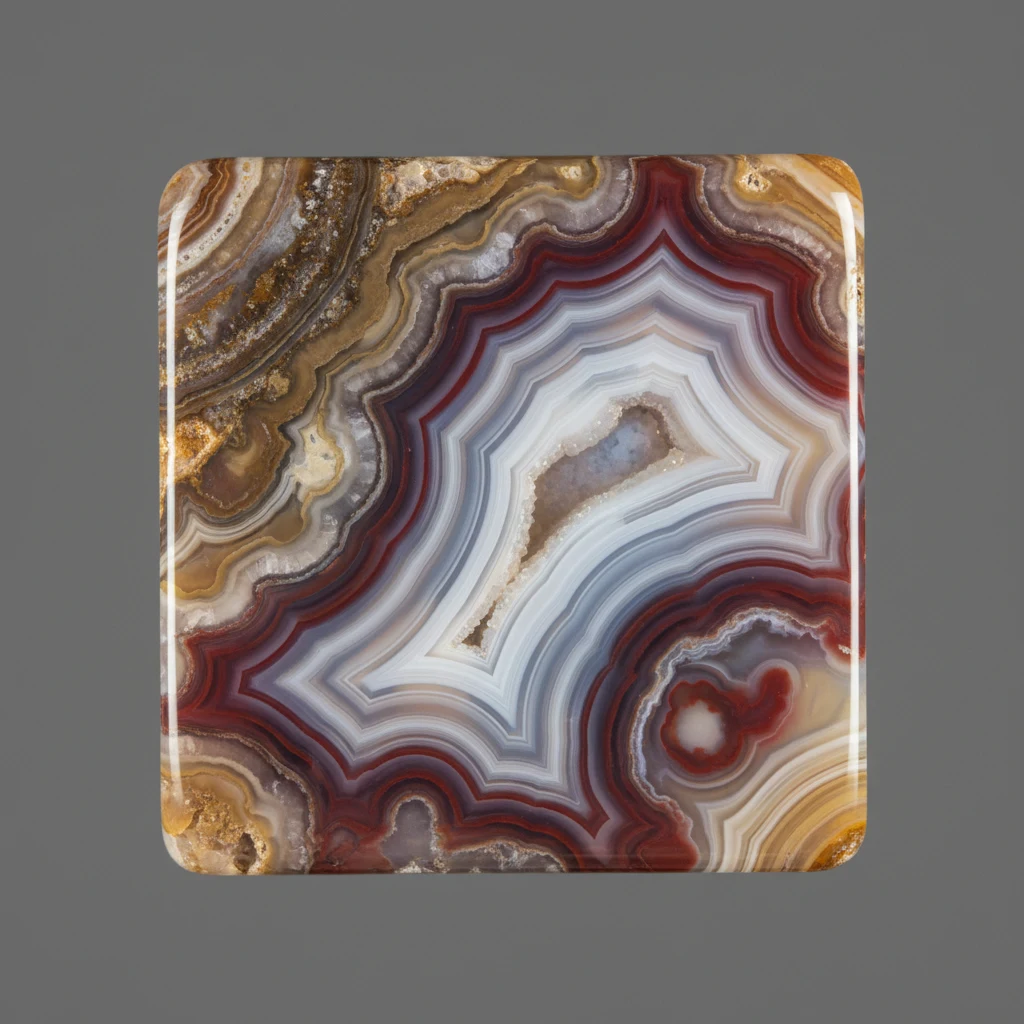
- A polished piece may look like jasper, agate, or chalcedony instead of chert.
- A dark, glassy broken surface may be mistaken for obsidian or flint.
- Weathered chert with a chalky rind may be confused with limestone or other sedimentary rocks.
- Strong color banding can cause chert to be labeled as agate or jasper.
Final recommendation
Use chert identification as a combination of visual texture, fracture, hardness, and geological setting rather than color alone. For buying or collecting, prioritize clear labeling, uncoated surfaces, and photos that show both natural exterior and fresh fracture.
How to Identify Chert in Photos
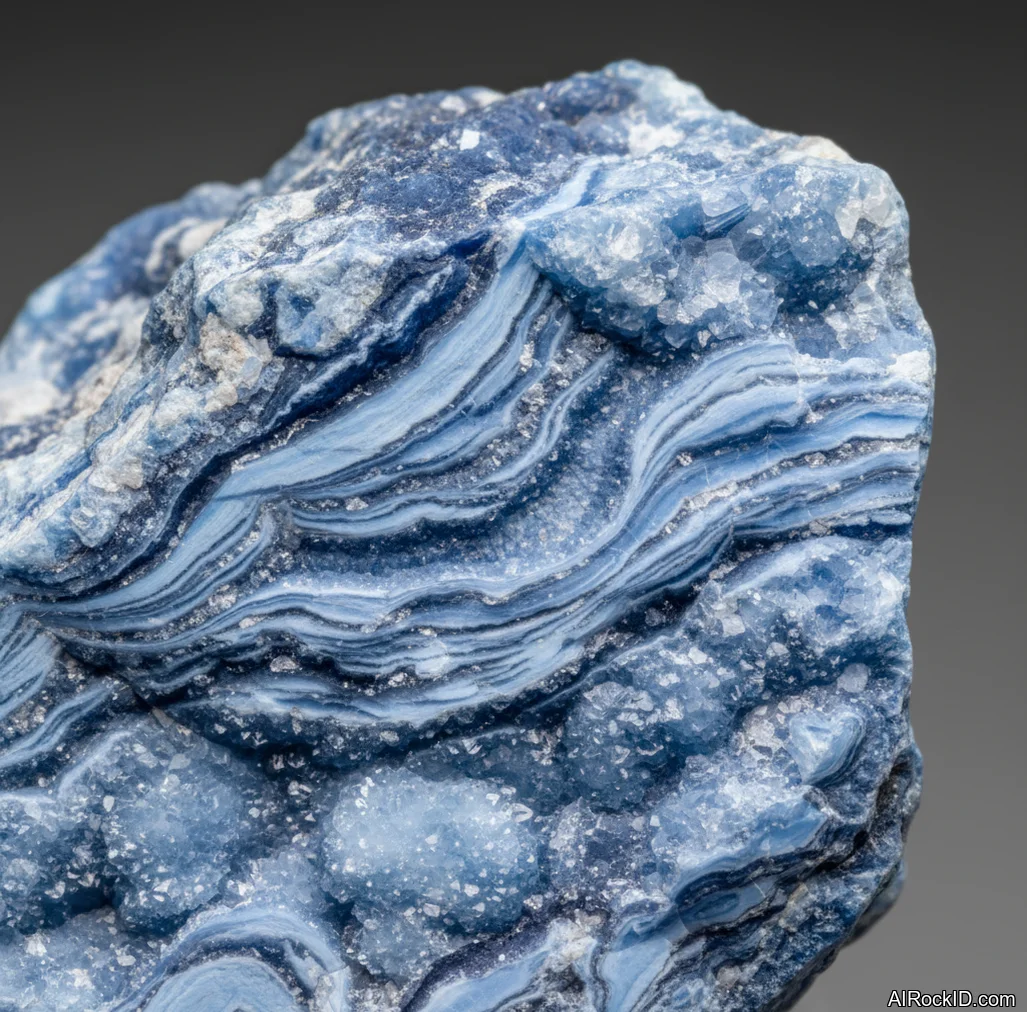
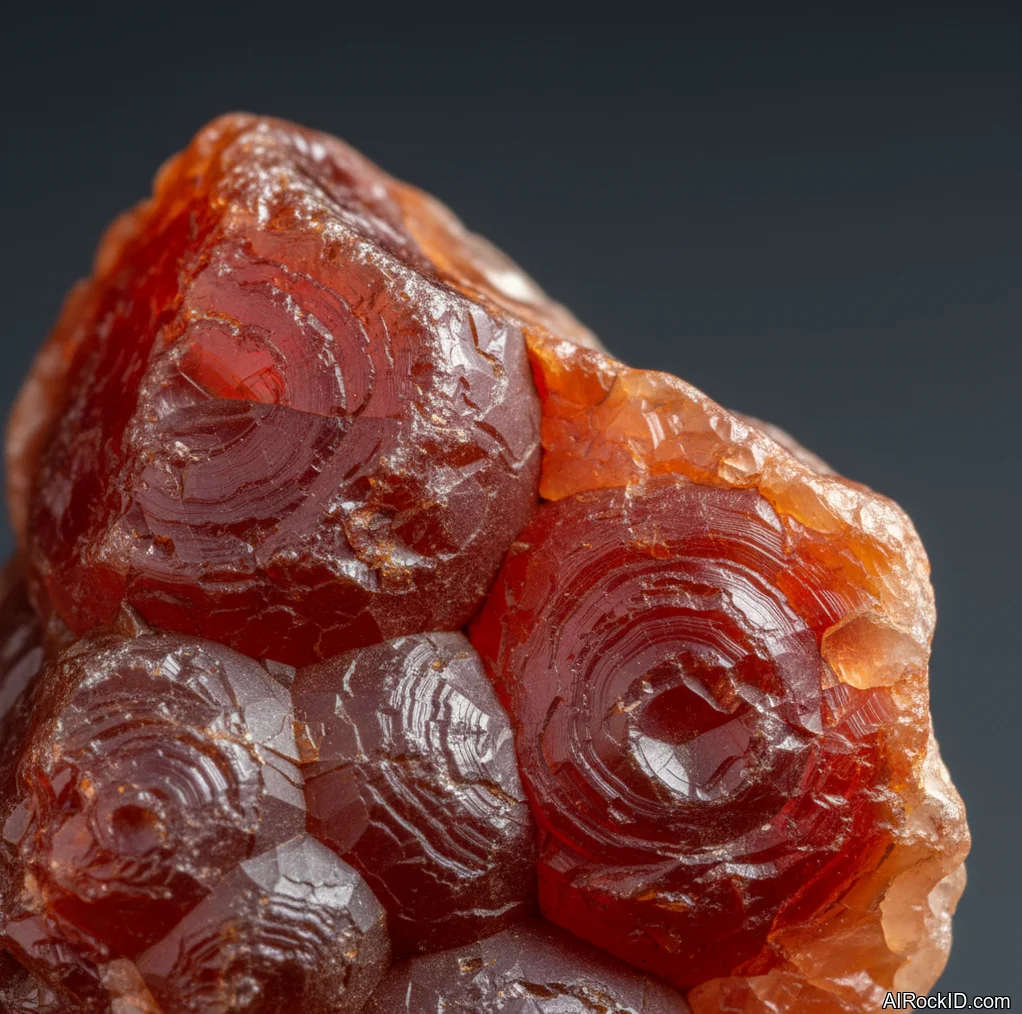
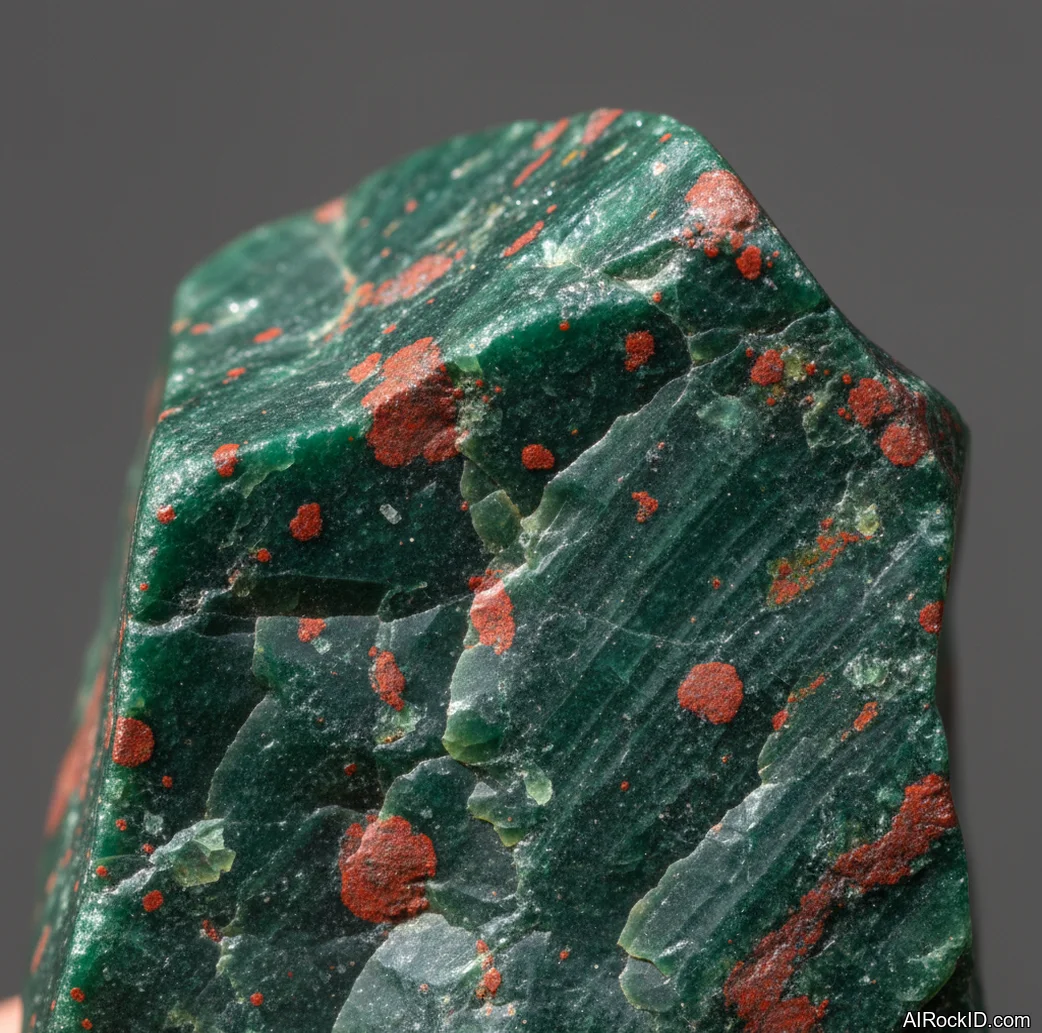
Useful chert photos show a fresh broken surface, an unpolished exterior, and the rock next to a scale object. Look for a fine-grained texture with no visible quartz crystals, a waxy to dull luster, and curved conchoidal fracture marks. Color alone is not reliable because chert can be gray, black, brown, red, green, white, or mottled.
Buying and Authenticity Tips
Chert is common, so most authenticity issues involve mislabeling rather than synthetic material. Sellers may use names such as flint, jasper, or chalcedony depending on color, polish, or local tradition. Ask for natural-light photos and whether the piece is rough, tumbled, dyed, coated, or stabilized.
Field Clues and Geological Context
Chert commonly occurs as nodules, lenses, or beds within limestone, chalk, dolostone, and other sedimentary rocks. A pale weathered rind with a darker fresh interior is common in many nodular specimens. Geological setting can help separate chert from volcanic glass, quartzite, or man-made slag.
What Is Chert?
Chert is a hard, dense, fine-grained siliceous sedimentary rock made mainly of microcrystalline to cryptocrystalline quartz. In the hand, it feels compact and almost grainless, with weathered faces that may look dull or earthy and fresh breaks that can turn waxy to slightly vitreous. Its Mohs hardness is 6.5-7, so it readily scratches glass and many softer minerals.
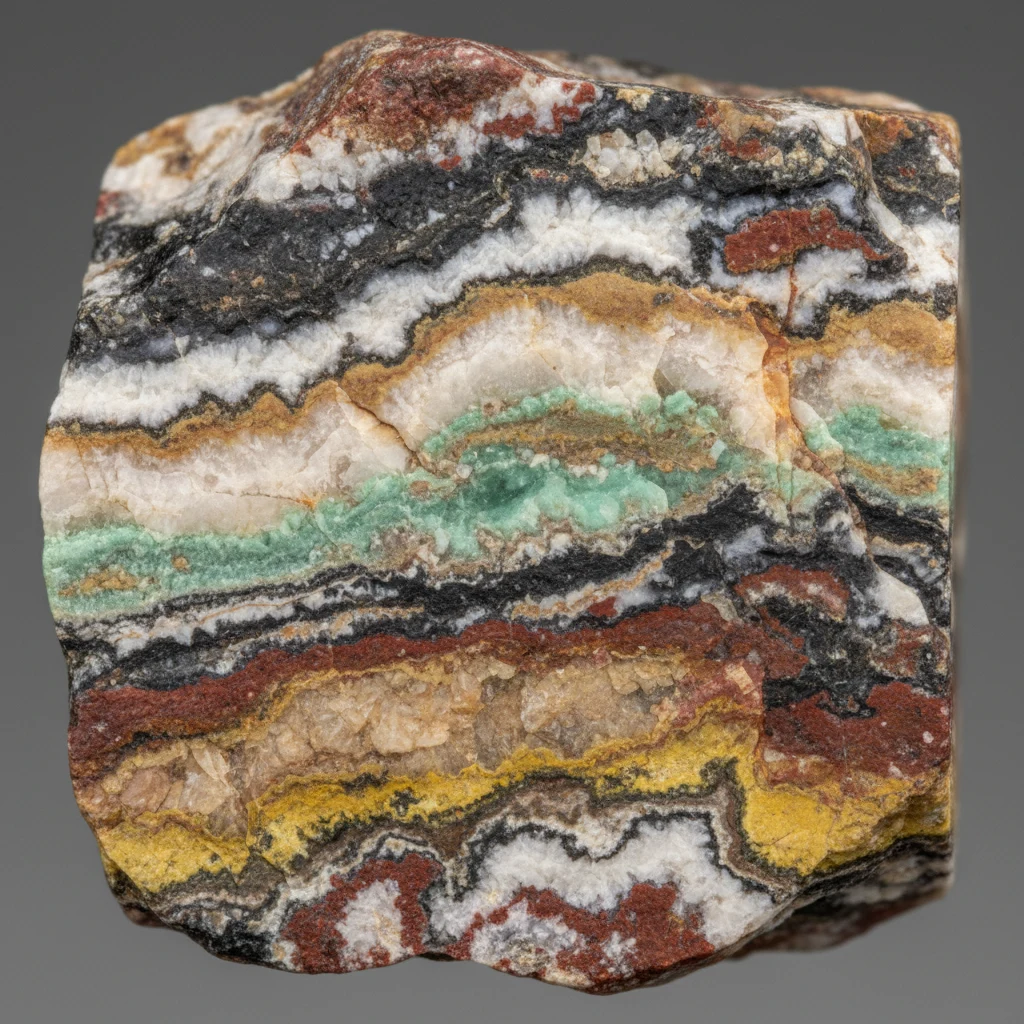
Collectors meet chert under several familiar names, including flint, hornstone, and silex. Its colors range from white, gray, tan, brown, and black to red, yellow, green, cream, or banded material, depending on impurities such as iron oxides, organic matter, clay, carbonate minerals, manganese oxides, or aluminum. The most field-useful clue is its sharp, shell-like conchoidal fracture, which can leave razor-edged chips.
Origin & History
Chert has been recognized since prehistory because it can be fractured into sharp, workable edges. Dark flint nodules and other chert pieces were widely shaped into tools, blades, scrapers, and fire-starting materials. When you hold a clean broken piece, the same dense texture that made it useful is obvious: it breaks through itself rather than around visible grains.
The word chert is a traditional geological term for compact, fine-grained silica rocks, while flint is often used for dark chert nodules, especially those found in chalk or limestone. In modern geology, chert helps interpret ancient oceans, biogenic silica production, and chemical conditions in sedimentary basins. For locality checking on labeled specimens, mindat.org is a useful reference point alongside field notes and collection records.
Where Is Chert Found?
Chert is common and widespread worldwide. It occurs in limestone, chalk, dolostone, marine shale, radiolarian deposits, and banded iron formations, where it may appear as nodules, lenses, thin beds, massive layers, or replacement bodies within carbonate rocks. Field pieces are especially familiar as hard nodules weathering out of softer host rock.
Formation
Chert forms when silica is deposited or recrystallized in sedimentary settings. Much chert begins with the accumulation and diagenesis of microscopic silica skeletons from radiolarians, diatoms, or sponge spicules. Other chert forms by chemical precipitation of silica from pore waters or by replacement of limestone and chalk during diagenesis.
Over time, amorphous opal-A or opal-CT may recrystallize into chalcedony and microcrystalline quartz. That slow tightening of silica explains why finished chert feels so dense, tough under a scratch point, yet brittle under impact. It is chemically stable under normal indoor conditions and resistant to weathering, although porous or impure pieces may stain.
How to Identify Chert
Identify chert by its hardness, fine texture, and fracture. A typical specimen has no visible sand grains, gives a white streak, and scratches glass because it is quartz-rich. Freshly broken surfaces often show smooth conchoidal curves, while weathered surfaces may look dull, waxy, or earthy. Thin edges may be translucent, but most pieces are opaque.
Color alone is not enough: chert may be gray, white, tan, brown, black, red, green, yellow, cream, mottled, nodular, or banded. It usually does not fizz in dilute hydrochloric acid unless carbonate impurities or attached carbonate matrix are present. Dark nodular chert in chalk or limestone is often called flint, while opaque red, yellow, brown, or decorative material may be called jasper.
Properties of Chert
Physical Properties
| Crystal System | Trigonal quartz in microscopic aggregate; rock has no single crystal form |
| Hardness (Mohs) | 6.5-7 (Hard) |
| Density | 2.5-2.7 g/cm³ |
| Luster | Dull, waxy, vitreous on fresh fracture |
| Diaphaneity | Opaque to translucent at thin edges |
| Fracture | Conchoidal to splintery; sharp edges common |
| Streak | White |
| Magnetism | Non-magnetic |
| Colors | White, Gray, Black, Brown, Tan, Red, Yellow, Green, Cream |
Chemical Properties
| Classification | Silicate rock; microcrystalline silica |
| Formula | SiO2, commonly with minor impurities |
| Elements | Silicon, Oxygen |
| Common Impurities | Iron oxides, Clay minerals, Carbonate minerals, Organic matter, Manganese oxides, Aluminum |
Optical Properties
| Refractive Index | Approximately 1.544-1.553 for quartz; rock aggregates are usually not measured as a single optical material |
| Birefringence | Approximately 0.009 for quartz; aggregate values may be obscured by microcrystalline texture |
| Pleochroism | None |
| Optical Character | Uniaxial positive for quartz; aggregate rock is microcrystalline |
Chert Health & Safety
Solid chert is generally safe to handle, but broken pieces can have very sharp edges. Cutting, grinding, knapping, or polishing chert can produce respirable crystalline silica dust, which is a serious lung hazard if inhaled.
Chert Value & Price
Price Range
Rough/Tumbled: Common field pieces are often free to $5; attractive nodules, polished pieces, fossils in chert, or locality specimens may range from $5-$50 or more.
Cut/Polished:
Value depends on color, pattern, polish quality, size, provenance, archaeological association, fossil content, and whether the material is sold as flint, jasper, or decorative chert.
Durability
Durable but brittle — Scratch resistance: High; chert is quartz-rich and can scratch glass and many metals., Toughness: Fair to poor; it is hard but brittle and can chip into sharp fragments.
Chemically stable under normal indoor conditions and resistant to weathering, though porous or impure pieces may stain. Avoid dropping, striking, or thermal shock.
How to Care for Chert
Use & Storage
Store chert specimens separately from softer stones because they can scratch them. Wrap sharp fractured pieces or place them in a labeled box.
Cleaning
Clean with water, mild soap, and a soft brush. Dry thoroughly before storage. Avoid aggressive acids if the piece contains carbonate matrix or fossils.
Cleanse & Charge
If used in metaphysical practice, cleanse by rinsing briefly, wiping dry, or placing near clear quartz; charging in indirect sunlight is suitable for most colors.
Placement
Display on a stable shelf or in a specimen tray. Keep sharp knapped pieces away from children and high-traffic surfaces.
Caution
Do not inhale dust from cutting or grinding. Fresh breaks can be razor sharp, and chert can damage glass or softer mineral specimens.
Works Well With
Chert Meaning & Healing Properties
In crystal-healing traditions, chert and flint are associated with grounding, endurance, practical focus, protection, resilience, and ancestral memory. These are cultural and spiritual beliefs, not scientifically proven medical effects. Practitioners often choose chert when they want a stone that feels plain, dense, and workmanlike rather than flashy.
Chert is linked with the Root chakra, the zodiac signs Aries and Capricorn, the planets Earth and Mars, and the elements Earth and Fire. For metaphysical use, it may be rinsed briefly, wiped dry, placed near clear quartz, or charged in indirect sunlight. Handle fractured pieces carefully: solid chert is safe, but fresh breaks can be sharp, and cutting or grinding can create hazardous respirable crystalline silica dust.
Identify Chert from a photo
Compare Chert traits, care tips, value clues, and common lookalikes with a clear photo.
Common mistakes
- Identifying chert by color alone instead of texture, fracture, and context.
- Assuming all black chert is obsidian.
- Calling every colorful opaque silica rock jasper without checking geological context.
- Mistaking a weathered chalky rind for the true interior color.
- Overlooking that flint and chert may overlap in naming depending on region and tradition.
- Judging a polished piece without viewing an unpolished surface or broken edge.