Trilobite Fossil


Quick answer: Trilobite fossil is the preserved remains or impression of an extinct marine arthropod, most often found in sedimentary rock such as shale, limestone, or sandstone. Most specimens are collected for their visible body segmentation, age, species detail, and preservation quality rather than for mineral hardness or crystal clarity.
AI Rock ID can help compare a trilobite fossil photo against common fossil and rock lookalikes by checking shape, segmentation, and matrix clues. RockIdentifier.io provides reference information to support visual identification, but unusual specimens may still need confirmation from a fossil specialist.
Good fit
- Collectors who want an ancient marine fossil with recognizable anatomy
- Beginners learning to identify fossils in sedimentary rock
- Educational displays about Paleozoic life and extinction
- People who prefer natural history specimens over polished crystals
Not a good fit
- Anyone looking for a durable pocket stone or jewelry gem
- Buyers who want a guaranteed species name without expert documentation
- Collectors who dislike repaired, prepared, or matrix-backed fossils
- Use in water, salt, or abrasive cleaning routines
Most commonly confused with
- Ammonite Fossil: Ammonites usually show a coiled shell, while trilobites have segmented three-lobed bodies.
- Orthoceras Fossil: Orthoceras fossils are straight, tapered cephalopod shells rather than jointed arthropod bodies.
- Fossiliferous Limestone: Fossiliferous limestone may contain many shell fragments, but it does not always preserve a distinct trilobite outline.
- Pyrite: Pyrite can replace fossils with a metallic surface, but pyrite itself forms brassy crystals and masses without trilobite anatomy.
Trilobite Fossil vs Common Lookalikes
| Specimen | Key Visual Clue | Typical Difference |
|---|---|---|
| Trilobite fossil | Three-lobed, segmented body with head, thorax, and tail | Arthropod anatomy is usually visible |
| Ammonite fossil | Coiled spiral shell | Cephalopod shell, not a jointed body |
| Orthoceras fossil | Long straight cone with chambers | Straight shell form rather than oval segmentation |
| Fossiliferous limestone | Mixed shell or fossil fragments in rock | Often lacks a complete trilobite shape |
| Replica or cast | Uniform texture, painted color, or repeated details | May not share the same material as its matrix |
AI identification confidence
AI identification is usually strongest when the photo shows the full outline, body segments, and surrounding rock matrix in sharp focus. Confidence drops when the fossil is heavily prepared, broken, coated, partially buried in matrix, or shown only in a close-up without scale.
When AI gets it wrong
- A cast or resin replica has convincing surface detail but no natural matrix relationship
- A weathered shell fossil creates a segmented pattern that resembles a trilobite
- A partial trilobite fragment is photographed without enough surrounding context
- Heavy restoration or carving changes the original anatomy
Final recommendation
Choose a trilobite fossil with clear segmentation, visible matrix contact, and seller photos from multiple angles. For higher-priced specimens, ask about repairs, restoration, species identification, locality, and whether the piece is a natural fossil, prepared fossil, or replica.
How to Check Trilobite Fossil Authenticity
Authentic trilobite fossils usually show some relationship between the fossil surface and the surrounding sedimentary matrix. Look for natural color variation, fine cracks that continue into the rock, and anatomical details that are not overly uniform. Restored specimens are common in the fossil market, so repaired spines, filled cracks, or carved missing parts should be disclosed by the seller.
Buying Notes for Trilobite Fossils
Important buying details include species, geologic age, locality, preparation quality, completeness, and whether the specimen has been repaired or enhanced. A less complete but well-documented fossil may be more useful for study than a visually dramatic piece with unclear provenance. Very detailed spiny trilobites often require careful preparation, so restoration disclosure matters.
Best Photos for Trilobite Fossil Identification
Use bright, indirect light and include a ruler or coin for scale. Photograph the specimen from the front, side, and back so the fossil and matrix can both be evaluated. Avoid heavy filters, wetting the fossil for contrast, or using only extreme close-ups, because those images can hide repairs and matrix texture.
What Is Trilobite Fossil?
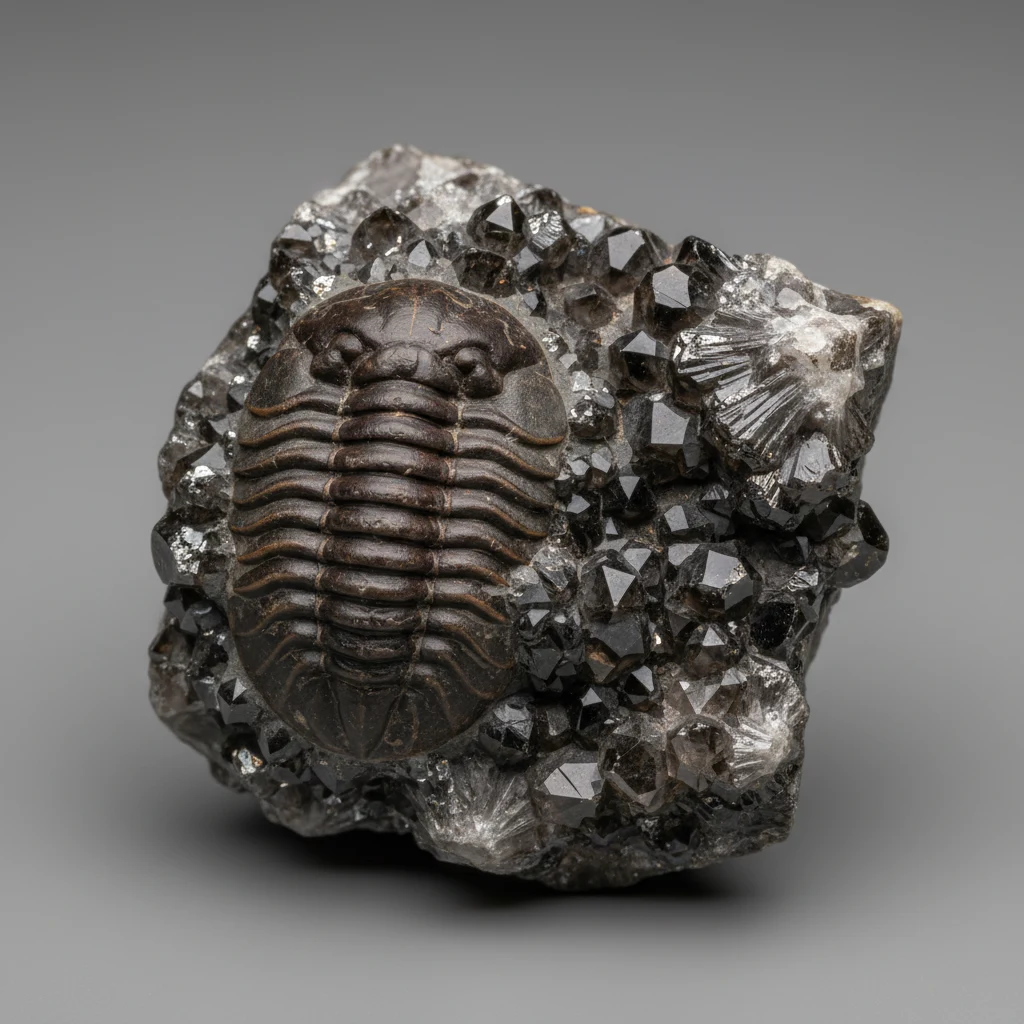
A Trilobite Fossil is the preserved remain of an ancient marine arthropod, recognized by its segmented body and three-lobed form. In the hand, a typical specimen feels more like a piece of worked sedimentary history than a crystal: opaque, usually brown, gray, or black, with a dull surface that may catch a slight shine on raised details.
Collectors value trilobite fossils for their readable anatomy. The head, body segments, and prominent eyes can make even a common specimen feel highly individual. As an organic gem and fossil, it is classed as amorphous, with Mohs hardness of 2-4, light gray to brown streak, conchoidal fracture, and a density of 2.5-3.0 g/cm3.
Origin & History
The name Trilobite Fossil comes from “trilobite,” a word rooted in the Greek words for “three lobes.” That name is practical: when you look across the fossil’s body, the form divides visually into three lengthwise lobes, a field mark that makes these ancient marine arthropods easy to recognize even for new collectors.
Trilobites were first described in the early 19th century, and their fossils remain popular because they connect a specimen cabinet directly to ancient marine life. For labeling and locality comparison, collectors commonly verify fossil localities with references such as mindat.org. On a tray, a well-preserved trilobite reads as both a natural object and a small scientific record.
Where Is Trilobite Fossil Found?
Trilobite fossils are most commonly found in sedimentary rock formations. The supplied localities include Morocco, the United States, and Canada, with notable examples from the Burgess Shale in Canada, the Himalayas in India, and Devonian rocks in Morocco. For a collector, the matrix matters: these fossils are usually encountered as preserved forms held in rock, not as loose crystals. Moroccan Devonian material is often seen in the fossil trade, while Burgess Shale material is especially notable by locality name. When buying, keep the country and rock formation information with the specimen, because the label adds scientific and collecting context.
Formation
Trilobite fossils formed through the burial and mineralization of trilobite remains in sediment over hundreds of millions of years. The animal’s remains were covered, preserved, and gradually changed into a fossil record within sedimentary material. That is why the finished specimen often feels earthy and compact rather than glassy or crystalline.
This formation history also explains the fossil’s moderate durability. Although toughness is listed as good, trilobite fossils can be fragile and should be handled with care to avoid chipping or breaking. Raised eyes, ribs, and body segments are the features collectors most want to protect, so display in a case and keep the piece in a cool, dry place away from direct sunlight.
How to Identify Trilobite Fossil
Identify a Trilobite Fossil by its three-lobed body and segmented exoskeleton. Look for a central axis with side lobes, repeated body segments, and, when preserved, prominent eyes. Color is usually in the brown, gray, or black range, and the surface is commonly dull to slightly shiny rather than bright or transparent.
Physical checks should be gentle. Trilobite Fossil is opaque, non-magnetic, and relatively soft at Mohs 2-4, with a light gray to brown streak and conchoidal fracture. Because it may chip, avoid scratch testing on display-quality pieces. In practice, the best identification comes from the fossil shape: the segmented arthropod outline is more diagnostic than color alone.
Properties of Trilobite Fossil
Physical Properties
| Crystal System | Amorphous |
| Hardness (Mohs) | 2-4 (Mohs) (Soft (2-4)) |
| Density | 2.5-3.0 g/cm3 |
| Luster | Dull |
| Diaphaneity | Opaque |
| Fracture | Conchoidal |
| Streak | Light gray to brown |
| Magnetism | Non-magnetic |
| Colors | Brown, Gray, Black |
Chemical Properties
| Classification | Organic remains |
| Formula | N/A |
| Elements | C, Ca |
| Common Impurities | Fe, Si |
Optical Properties
| Refractive Index | N/A |
| Birefringence | None |
| Pleochroism | None |
| Optical Character | Isotropic |
Trilobite Fossil Health & Safety
There are no significant health risks associated with handling trilobite fossils.
Trilobite Fossil Value & Price
Price Range
Rough/Tumbled: $10 - $100 per specimen
Cut/Polished:
Price is influenced by the rarity and quality of the fossil.
Durability
Moderate — Scratch resistance: Fair, Toughness: Good
Trilobite fossils can be fragile and should be handled with care.
How to Care for Trilobite Fossil
Use & Storage
Store in a cool, dry place away from direct sunlight.
Cleaning
Gently clean with a soft brush to remove dust. Avoid harsh chemicals.
Cleanse & Charge
Place under moonlight for cleansing.
Placement
Display in a case to prevent damage.
Caution
Handle with care to avoid chipping or breaking.
Works Well With
Trilobite Fossil Meaning & Healing Properties
In crystal healing traditions, Trilobite Fossil is used for grounding, stability, and protection. Its cultural associations center on the Root chakra, Earth element, and a feeling of connection to the Earth. Many collectors choose it for meditation or desk placement because the fossil’s age and weighty visual texture make it feel steady and anchoring.
Trilobite Fossil is also associated with stress relief, emotional healing, insight, and confidence, though it is not a substitute for medical treatment. It is considered safe to handle, with no significant health risks noted. For energetic care, place it under moonlight for cleansing, and for physical care, dust it gently with a soft brush and avoid harsh chemicals.
Identify Trilobite Fossil from a photo
Compare Trilobite Fossil traits, care tips, value clues, and common lookalikes with a clear photo.
Common mistakes
- Assuming every trilobite-shaped item is a natural fossil rather than a cast or carved replica
- Ignoring restoration, especially filled cracks, rebuilt spines, or enhanced surface grooves
- Buying based only on species name without checking locality or seller documentation
- Cleaning with water, vinegar, salt, or abrasive tools that may damage the fossil or matrix
- Judging authenticity only by color, since natural trilobites can occur in many mineralized tones
- Expecting all trilobite fossils to be museum-grade complete specimens