Petrified Wood


Quick answer: Petrified Wood is identified by its wood-like grain, growth-ring patterns, opaque surface, and quartz-like hardness. The strongest clues are a natural wood texture or ring structure combined with the weight, hardness, and glassy-to-waxy fracture of silica-rich stone.
AI Rock ID can help compare a Petrified Wood photo against similar stones by checking visible grain, color zoning, opacity, and surface texture. RockIdentifier.io is useful as a first-pass identification tool, but hardness, streak, weight, and provenance should also be considered for reliable confirmation.
Good fit
- Collectors who like fossils with visible natural growth patterns
- Beginners looking for a durable, easy-to-handle specimen
- People who prefer earthy colors such as brown, tan, red, gray, or cream
- Lapidary users interested in polished slices, bookends, cabochons, or display pieces
- Buyers who want a fossil material that is commonly available in many sizes
Not a good fit
- Anyone expecting lightweight natural wood, because Petrified Wood is stone
- Buyers who want transparent or faceted gemstones
- Collectors seeking a rare specimen without verifying locality and quality
- Outdoor display use in harsh freeze-thaw conditions without protection
Most commonly confused with
- Agate: Agate may show banding and similar hardness, but it usually lacks natural wood grain or growth-ring structure.
- Jasper: Jasper can be opaque and earthy-colored, but it generally has more massive color patterns rather than fossil wood anatomy.
- Tiger's Eye: Tiger's Eye has silky chatoyancy, while Petrified Wood usually shows grain, rings, or bark-like textures instead of a moving light band.
- Fossil Coral: Fossil Coral displays flower-like or honeycomb coral structures rather than linear wood grain.
Petrified Wood vs Similar Materials
| Material | Typical visual clue | Key difference |
|---|---|---|
| Petrified Wood | Wood grain, rings, bark texture, earthy colors | Fossil wood replaced by silica or other minerals |
| Agate | Curved bands, translucent edges in some pieces | Usually lacks preserved wood structure |
| Jasper | Opaque, solid or mottled color | No consistent growth rings or wood-cell patterns |
| Tiger's Eye | Golden-brown silky shimmer | Shows chatoyancy rather than fossil grain |
| Fossil Coral | Flower, star, or honeycomb fossil pattern | Preserves coral anatomy, not wood anatomy |
AI identification confidence
AI identification is usually moderate to high when a specimen shows clear wood grain, rings, bark-like texture, and natural earthy colors. Confidence drops with heavily polished, dyed, broken, or close-up images that do not show the overall pattern.
When AI gets it wrong
- A polished slice has agate-like banding but no visible wood anatomy
- The photo is too close, blurry, wet, or taken under colored lighting
- Dyed or resin-coated material hides natural texture and fracture clues
- A jasper, agate, or fossil coral specimen has similar brown or red coloration
Final recommendation
Choose Petrified Wood with visible grain, rings, or bark-like structure if authenticity is the main concern. For higher-priced pieces, ask for locality information, unedited photos in natural light, and disclosure of dye, resin, or stabilization treatments.
How to Tell If Petrified Wood Is Real
Real Petrified Wood should feel stone-like, cool, and heavier than ordinary wood of the same size. Look for preserved grain, rings, knots, bark texture, or cell-like structures rather than painted lines on the surface. A steel knife should not easily scratch quartz-rich Petrified Wood, although softer mineral replacement can occur in some specimens.
Buying Tips for Petrified Wood
Common buying factors include size, polish quality, visible wood structure, color contrast, locality, and whether the piece is a natural rough specimen or a cut-and-polished item. Bright blues, purples, greens, or uniform neon colors should be treated as possible dye unless the seller clearly explains the treatment. Large display logs and premium polished slabs may also require legal provenance, because some collecting sites restrict removal.
Photo Tips for Identifying Petrified Wood
Use natural light and photograph the entire specimen, a close-up of the grain, and any broken or unpolished edge. Include a coin or ruler for scale, and avoid wetting the stone before taking identification photos because water can exaggerate color and hide surface texture. Multiple angles help separate true fossil wood structure from simple agate or jasper patterns.
What Is Petrified Wood?
Petrified wood is wood that’s fossilized because the original material got replaced by silica, usually quartz, and you’ll see that as chalcedony or agate.
Pick up a decent chunk and the first thing that hits you is the weight. It’s heavy. Like a smooth river cobble kind of heavy, not “this used to be a tree” heavy. I’ve held pieces where you can literally follow the grain with a fingertip, and it almost feels like the lines were stamped in (but nope), except it’s all locked into stone.
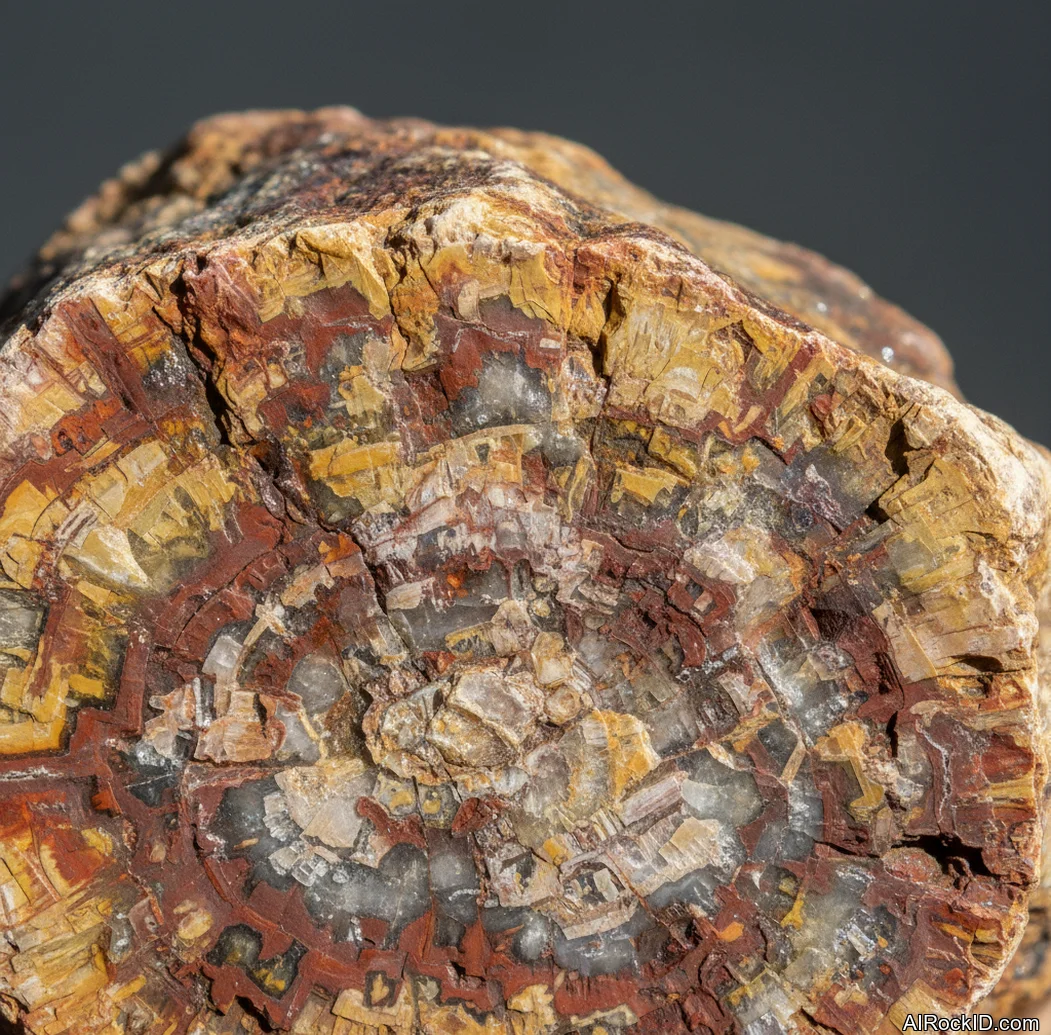
At a quick glance, sure, it can read as “just a brown rock.” And honestly, some pieces really are like that. But when the material’s good, you’ll spot crisp growth rings, those little knot eyes, plus that waxy-to-glassy shine that shows up once the silica takes a polish. And if you’ve got a rough piece that’s already broken, the fresh interior can surprise you with tiny sparkly quartz pockets you couldn’t see from the outside. How is that not cool?
Origin & History
“Petrified” traces back to the Greek root *petra*, which literally means rock. And petrified wood has been understood as “wood turned to stone” since ancient times, even if people kept arguing about what actually caused it.
In a lot of early European natural history books, you’ll see it filed under “lapides” or “figured stones.” That’s because the whole idea that fossils were once-living things took a while to really stick, so writers treated them more like odd rocks you’d label and shelve.
In the United States, petrified wood turned into a classic collector’s item in the late 1800s and early 1900s, when western geology surveys started mapping fossil forests. Then came protected places like Petrified Forest National Park in Arizona. That park matters culturally, sure, but it also drew a line collectors still have to respect: you don’t collect from protected land. Period.
Where Is Petrified Wood Found?
Big deposits show up where ancient forests were buried fast by ash, sediment, or floods and then saturated with silica-rich groundwater. The US Southwest, Indonesia, Madagascar, and Patagonia are the names you’ll hear most at shows.
Formation
Fast burial is the whole game. A tree drops or gets knocked over, and then it has to get buried before it can rot all the way out. Volcanic ash beds are a common setup, but river and lake sediments can pull it off too, as long as oxygen stays low.
Then groundwater takes over, inching along. Silica dissolves into that water and starts sneaking into the tiny cell spaces, plus any cracks and little voids. Given enough time, the original organic material gets replaced, sometimes molecule by molecule in spots, until what you’ve got is chalcedony, agate, and every so often little pockets of crystalline quartz. Iron and manganese are usually what give you the reds, yellows, and blacks. And that “rainbow” petrified wood people talk about? That’s chemistry and timing clicking into place, not paint.
How to Identify Petrified Wood
Color: Most petrified wood runs tan, caramel, chocolate brown, and cream, often with banding or ring patterns. Reds, yellows, and blacks are common, and rare pieces can show green, blue, or multi-color patches from trace minerals.
Luster: Polished surfaces are typically waxy to vitreous, like agate.
Look closely for wood structure: growth rings, grain, and knot patterns, not just random stripes. If you scratch it with a steel nail, it usually won’t bite, but it will scratch glass like quartz does. And a real chunk feels cool and dense in your hand; lightweight “wood-looking” decor pieces are often resin or compressed material.
Common Look-Alikes
Petrified Wood is sometimes confused with these materials:
- Banded agate or jasper sold as “petrified wood” (especially when it’s just generic brown banding with no real grain or growth rings)
- Picture jasper (landscape-style patterns that mimic wood grain in photos, but it lacks true ring structure and wood pore texture)
- Coconut petrified wood or palm root (often marketed as regular petrified wood, but it shows dotty vascular bundles instead of classic tree rings)
- Dyed agate/chalcedony slices marketed as “petrified wood slabs” (dye loves the cracks and end-grain pores)
- Resin or “reconstituted stone” composites made with wood chips and filler (lighter in the hand, plastic feel when warmed)
- Brown slag glass or glass “wood” fakes (swirly flow lines, too glossy, and the pattern looks melted instead of cellular)
Market Cautions & Treatments
When AI Can Get This Wrong
Phone ID apps mix petrified wood up with picture jasper and banded agate all the time because the brown banding reads as “wood grain” in a flat photo. A quick reality check is tactile: real petrified wood often has subtle growth rings, pores, or ray lines you can feel on a cut face, and it stays cool and heavy like quartz. If you’ve got an unpolished edge, a steel nail won’t bite it easily, but it’ll scratch glass like other chalcedony.
Properties of Petrified Wood
Physical Properties
| Crystal System | Trigonal |
| Hardness (Mohs) | 6.5-7 (Hard (6-7.5)) |
| Density | 2.58-2.65 |
| Luster | Vitreous |
| Diaphaneity | Opaque |
| Fracture | Conchoidal |
| Streak | White |
| Magnetism | Non-magnetic |
| Colors | Brown, Tan, Cream, Red, Yellow, Black, Gray, Orange, White |
Chemical Properties
| Classification | Silicates |
| Formula | SiO2 |
| Elements | Si, O |
| Common Impurities | Fe, Mn, Al, Ca |
Optical Properties
| Refractive Index | 1.530-1.539 |
| Birefringence | 0.004 |
| Pleochroism | None |
| Optical Character | Uniaxial |
Petrified Wood Health & Safety
Solid pieces are fine to pick up and they don’t care if they get wet. The only thing that bites you in the real world is silica dust, and that’s only if you start cutting it or grinding it (you’ll see that chalky, floaty haze right at the blade or wheel).
Safety Tips
If you’re sawing, grinding, or sanding, keep it wet and wear the right respirator. Silica dust is nasty stuff, and you really don’t want to breathe it in.
Petrified Wood Value & Price
Price Range
Rough/Tumbled: $5 - $60 per piece
Cut/Polished: $1 - $10 per carat
Prices jump when the piece has crisp ring detail, rare colors, a clean polish you can actually see in the light (no hazy scuffing), or a big slab size that feels heavy in your hand. But the plain brown tumbles? They’re all over the place, and they stay cheap.
Durability
Durable — Scratch resistance: Good, Toughness: Good
It’s basically quartz, so it holds up well, but sharp edges and thin slabs can chip if you knock them around.
How to Care for Petrified Wood
Use & Storage
Store it like you’d store agate: separated from softer stones so it doesn’t scratch them. If it’s a thin slab, keep it flat so it doesn’t flex and chip at the corners.
Cleaning
1) Rinse with lukewarm water. 2) Use a drop of mild soap and a soft brush for dirt in pits. 3) Rinse again and dry with a soft cloth.
Cleanse & Charge
A quick rinse and a wipe is enough for most people. If you do intention-based work, leaving it on a windowsill for a short time is fine, but don’t bake it in harsh sun for days if it has delicate surface polish.
Placement
It’s great as a desk stone because it doesn’t mind being handled. Bigger pieces look best where side light hits the ring patterns, like near a lamp instead of flat overhead lighting.
Caution
Don’t breathe in the dust when you’re cutting or grinding. That fine, gritty stuff that ends up on your sleeves and tastes chalky if it gets in your mouth? It can be silica dust, and silica dust is a serious hazard. And don’t pull material from protected parks or restricted fossil sites. Just don’t.
Works Well With
Petrified Wood Meaning & Healing Properties
Most folks who grab petrified wood are chasing that steady, grounded feeling. It’s slow. That’s honestly the best way I can say it. When I’m sorting fresh rough at the shop, this is the one I can hold in one hand for ten minutes without fidgeting, because it’s got that heavy, settled weight to it, like it wants to stay put.
In crystal tradition, it’s linked to grounding, patience, and that “old growth” kind of energy, and yeah, I get it. You’re literally holding a former tree that had time to be a tree, then had time to turn into stone. But I’m not going to act like it fixes anything medical. If you use stones more like reminders or little anchors for habits, petrified wood is great for routines, long projects, and getting yourself back on track after you’ve been scattered.
But here’s the catch: a lot of what’s out there gets polished into super glossy palm stones, and that shine can blur the actual wood character. So if you want to feel connected to the original material, grab at least one piece that’s only lightly polished, or a cut slab where the structure is obvious when you tilt it in the light (those lines and rings don’t lie). And if a seller’s pushing dyed “blue petrified wood,” ask questions. Real weird colors do happen, sure, but dye is absolutely a thing.
Common mistakes
- Assuming every brown, banded stone is Petrified Wood without checking for grain or ring structure
- Mistaking dyed agate or dyed jasper for naturally colorful Petrified Wood
- Expecting Petrified Wood to feel light because it originated as wood
- Using color alone for identification instead of hardness, texture, and fossil pattern
- Buying large or expensive pieces without asking about locality, treatments, and legal sourcing
- Confusing polish marks, saw lines, or surface coatings with natural fossil features
Identify Petrified Wood from a photo
Compare Petrified Wood traits, care tips, value clues, and common lookalikes with a clear photo.