Turtle Shell


Quick answer: Turtle shell, often called tortoiseshell in jewelry and antiques, is an organic material made largely of keratin. Because many historical pieces came from protected sea turtles, identification should include legal, ethical, and authenticity checks, not just appearance.
AI Rock ID can help compare turtle shell-like materials by visible color, translucency, growth pattern, and surface texture from a clear photo. RockIdentifier.io treats turtle shell as an organic gem material and should be used as a screening tool rather than a legal or conservation certification.
Good fit
- Collectors documenting inherited or antique organic gem materials
- Users comparing mottled brown-yellow material with horn, plastic, or amber
- People researching conservation-sensitive jewelry materials
- Museum-style cataloging where legal provenance is already known
Not a good fit
- New jewelry purchases without clear legal documentation
- Items intended for international travel or resale without permits
- Wearers who want a durable daily-use gem material
- Anyone seeking an animal-free or vegan material
Why people search for this
People often search for turtle shell to identify old combs, eyeglass frames, boxes, and jewelry with mottled brown, black, amber, or yellow patches. Many searches are driven by the need to distinguish real shell from plastic imitation or horn.
Most commonly confused with
- Amber: Amber is fossilized tree resin and is usually lighter in weight, often more uniformly translucent, and not made of keratin.
- Horn: Horn is also keratin-based but usually shows fibrous or layered striations rather than the same plate-like mottling seen in turtle shell.
- Celluloid: Celluloid imitations can copy tortoiseshell colors but may show molded patterns, seam lines, or a chemical smell when deteriorating.
- Acrylic: Acrylic tortoiseshell patterns are synthetic, often more uniform, and may show bubbles or machine-cut edges.
Turtle Shell vs Common Lookalikes
| Material | Typical Clue | Key Difference |
|---|---|---|
| Turtle shell | Mottled brown, black, yellow, or amber patches | Organic keratin plate material; legality depends on source and age |
| Horn | Fibrous or streaky layers | Keratin-based but usually from hoof or horn, not shell scutes |
| Amber | Warm translucency and resinous look | Plant resin, not keratin; may contain natural inclusions |
| Celluloid | Pattern may look printed or repeated | Early plastic; can age, yellow, or smell chemical |
| Acrylic | Crisp molded pattern and polished plastic edges | Modern plastic with no biological growth structure |
AI identification confidence
AI identification confidence for turtle shell is usually moderate at best because several plastics and horn can closely imitate the same mottled pattern. A reliable result depends on sharp photos of the front, back, edge, translucency, and any wear, seams, or tool marks.
When AI gets it wrong
- The object is photographed under warm light that makes plastic look more amber-like.
- Only a polished front surface is shown, hiding edge structure and thickness.
- The item is a molded plastic imitation with a realistic tortoiseshell pattern.
- The material has been dyed, lacquered, repaired, or heat-altered.
Final recommendation
Treat suspected turtle shell as a material that needs both gemological and legal context. For buying, selling, shipping, or traveling with an item, seek documentation from a qualified appraiser or relevant wildlife authority.
Legal and Ethical Identification
Many objects historically labeled turtle shell or tortoiseshell were made from sea turtle species that are now protected under wildlife laws. Age alone does not automatically make an item legal to sell, export, or import. Documentation, local regulations, and species restrictions should be checked before any transaction or travel.
How to Photograph Turtle Shell for Identification
Use natural, indirect light and photograph the object from the front, back, edge, and any damaged or worn areas. Include one photo with light shining through a thin section, if it can be done safely, because translucency and internal structure can help separate shell from plastic. Avoid filters and strong yellow lighting, which can make synthetic materials appear more natural.
Buying and Authenticity Notes
Modern items described as tortoiseshell are often plastic patterns rather than real turtle shell. A seller should be able to explain whether the description refers to color pattern, imitation material, or actual shell. For older pieces, request provenance, age evidence, and any applicable legal paperwork before purchase.
What Is Turtle Shell?
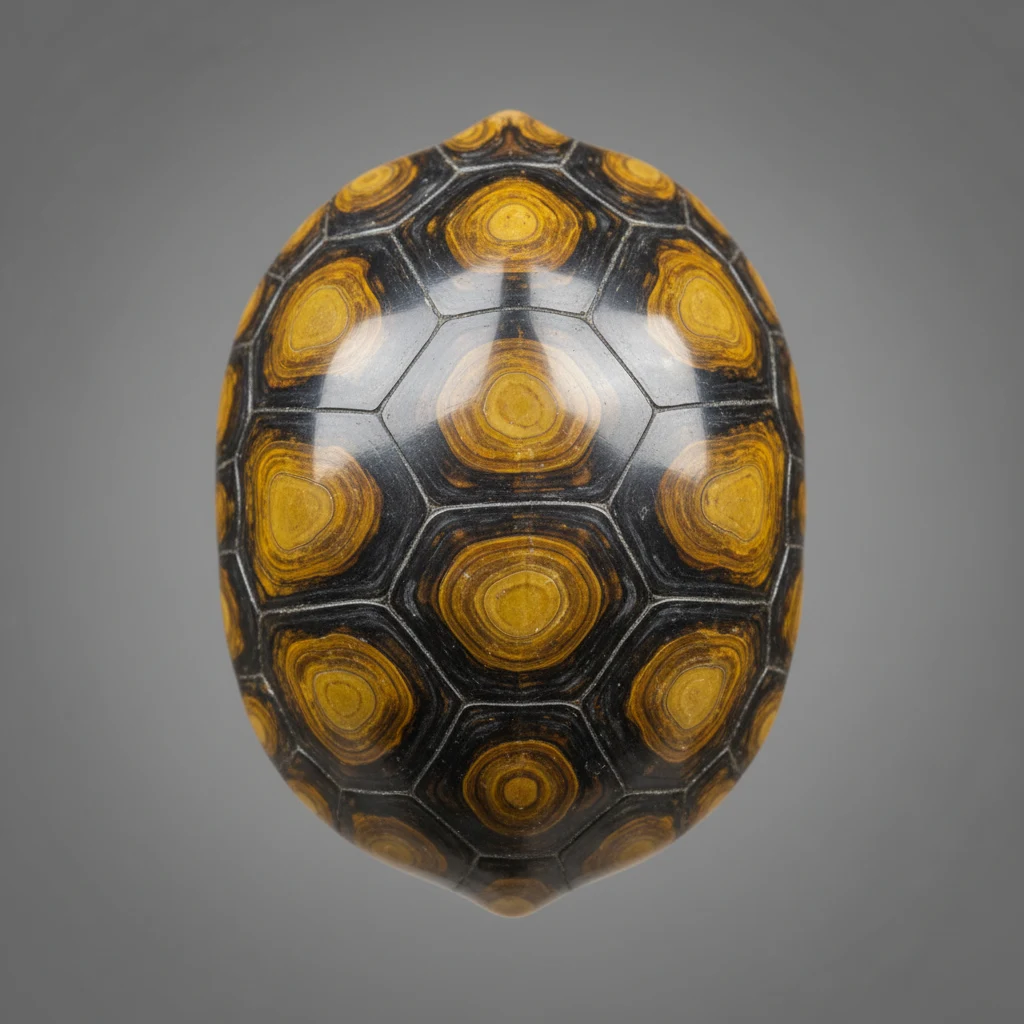
Turtle Shell is an organic gem: the hard, protective shell of a turtle, made from keratin over bony structure. In hand, it reads less like a crystal and more like a worked natural surface—opaque, patterned, and tactile, with mottled brown, black, and yellow areas that can look glossy or dull depending on wear.
As a collectible material, Turtle Shell is classed as amorphous and relatively soft at Mohs 2.5-3, with a density of about 1.2 g/cm3. Its luster ranges from dull to glossy, its streak is colorless, and it is non-magnetic. Collectors value it mainly for pattern, condition, size, and the distinctive shell texture.
Origin & History
Turtle Shell refers historically to the carapace of turtles, and the term has been used for centuries. It has been utilized in various cultures for both decorative and functional purposes, which is why older specimens are often discussed as cultural objects as much as organic gem material.
Unlike a crystalline mineral entry a collector might cross-check on mindat.org, Turtle Shell is best understood as an organic gem. Its identity comes from keratin, growth structure, color pattern, and surface texture rather than a mineral crystal habit.
Where Is Turtle Shell Found?
Turtle Shell is most commonly found in coastal regions where turtles inhabit. Listed countries include the United States, Japan, and Australia, with notable localities including Hawaii, USA; Okinawa, Japan; and the Great Barrier Reef, Australia. For a collector examining a specimen, locality matters less visually than the shell’s condition, size, and pattern, but coastal origin is part of the material’s basic context.
Formation
Turtle Shell forms as the turtle grows, with the carapace developing from bony structures covered by keratin scales. That layered biological origin is what gives the material its protective character and patterned surface, rather than the faces, terminations, or cleavage expected in a mineral crystal.
In practical identification, this growth history explains why Turtle Shell is amorphous, opaque, and textural. A specimen may show a dull or glossy worn surface, conchoidal fracture, and a mottled brown, black, and yellow appearance tied to its organic structure.
How to Identify Turtle Shell
Identify Turtle Shell by its distinctive mottled pattern, organic texture, and opaque body. Typical colors are brown, black, and yellow, often arranged in natural-looking patches rather than the even banding or crystal zoning seen in many minerals.
Handle it like a soft organic gem: Mohs 2.5-3 means it has only fair scratch resistance, though its toughness is described as good. Check the surface luster, which may be dull to glossy, and examine the inner structure when authenticity needs confirmation. It is non-magnetic, isotropic, and has no birefringence or pleochroism.
Properties of Turtle Shell
Physical Properties
| Crystal System | Amorphous |
| Hardness (Mohs) | 2.5-3 (Soft (2-4)) |
| Density | 1.2 g/cm3 |
| Luster | Dull to glossy |
| Diaphaneity | Opaque |
| Fracture | Conchoidal |
| Streak | Colorless |
| Magnetism | Non-magnetic |
| Colors | Brown, Black, Yellow |
Chemical Properties
| Classification | Organic |
| Formula | C35H60N2O3 |
| Elements | C, H, N, O |
| Common Impurities |
Optical Properties
| Refractive Index | 1.54 |
| Birefringence | None |
| Pleochroism | None |
| Optical Character | Isotropic |
Turtle Shell Health & Safety
There are no significant health risks when handling turtle shells.
Turtle Shell Value & Price
Price Range
Rough/Tumbled: $20 - $150 per specimen
Cut/Polished: $50 - $300 per carat
Price is affected by size, pattern, and condition of the shell.
Durability
Moderate — Scratch resistance: Fair, Toughness: Good
It can be damaged by excessive moisture and heat.
How to Care for Turtle Shell
Use & Storage
Store in a cool, dry place away from direct sunlight.
Cleaning
Clean with a damp cloth and mild soap. Avoid harsh chemicals.
Cleanse & Charge
Place in sunlight or moonlight for cleansing.
Placement
Display in a stable location to avoid damage.
Caution
Avoid exposing to extreme temperatures.
Works Well With
Turtle Shell Meaning & Healing Properties
Turtle Shell is associated with protection, grounding, and stability. In a practitioner setting, it is often chosen as a steadying object—something to hold or place nearby when the intention is resilience, emotional calm, nurturing, trust, and inner peace.
Its listed chakra is the Root Chakra, and its cultural correspondences include the Moon, the Water element, Cancer, and Pisces. These meanings are traditional and reflective rather than medical; Turtle Shell is not a substitute for medical advice. For care, clean with a damp cloth and mild soap, avoid harsh chemicals, and store it cool, dry, and away from direct sunlight.
Identify Turtle Shell from a photo
Compare Turtle Shell traits, care tips, value clues, and common lookalikes with a clear photo.
Common mistakes
- Assuming every tortoiseshell pattern is real turtle shell
- Using color alone to separate shell from horn or plastic
- Ignoring legal restrictions when selling or shipping antique pieces
- Testing with heat, flame, or chemicals, which can damage the object and create fumes
- Assuming an inherited item is automatically legal to trade
- Relying on a single photo for identification