Agate Geode


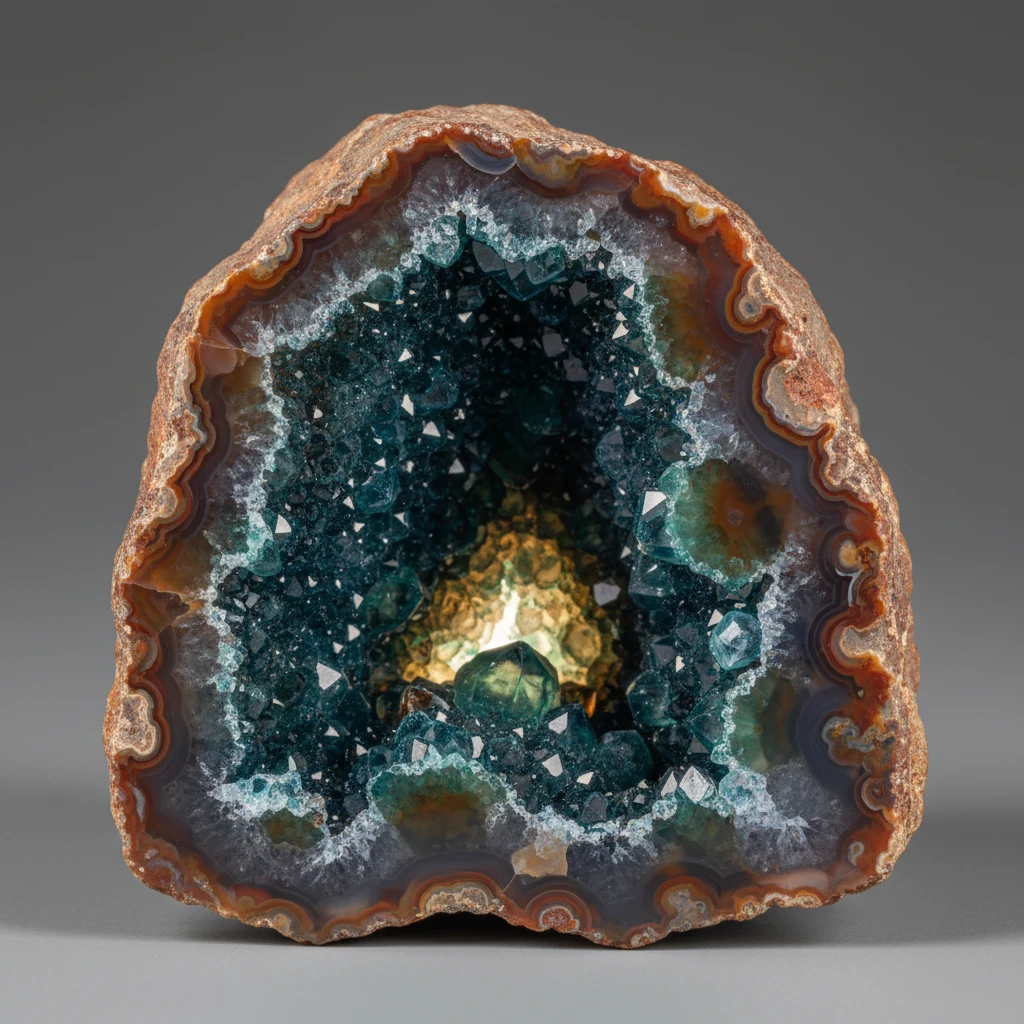
Quick answer: Agate geode is a hollow or partially hollow chalcedony nodule lined with quartz or druzy crystals. It is commonly identified by an outer rind, concentric agate banding, and a sparkling crystal-lined cavity.
AI Rock ID can help separate agate geode from similar hollow nodules by checking banding, cavity shape, crystal texture, and visible matrix. RockIdentifier.io provides visual identification support, but close-up photos, scale, and location details improve accuracy.
Good fit
- Collectors who want a specimen with both agate banding and visible crystal growth
- Beginners learning to recognize chalcedony, quartz, and geode structures
- Decorative display where a cut or polished interior can be viewed easily
- Buyers comparing natural geodes with dyed or enhanced pieces
Not a good fit
- Situations where a fully solid, durable carving stone is needed
- Buyers who want only untreated natural color without verifying the seller's disclosure
- Rings or high-impact jewelry designs, because geode cavities and druzy surfaces can catch or chip
Most commonly confused with
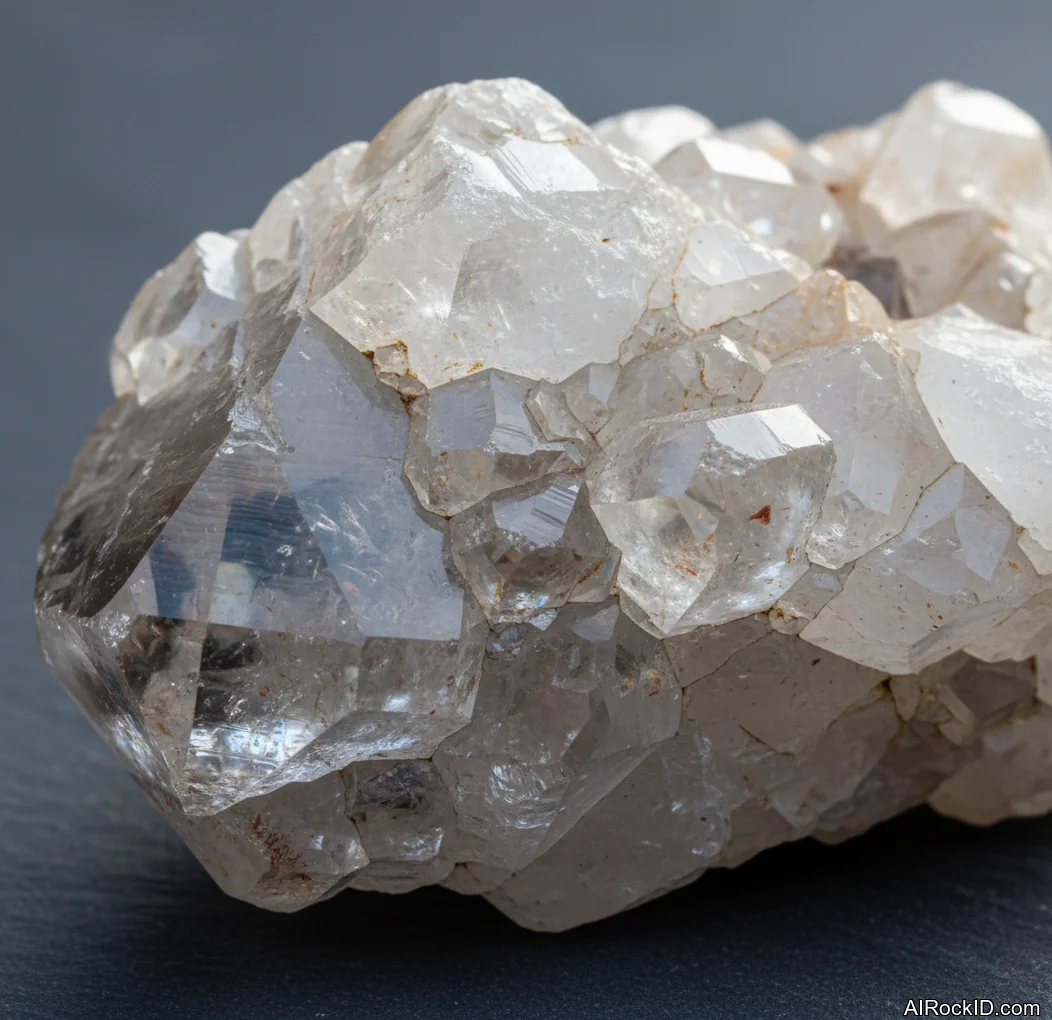
- Quartz Geode: Quartz geodes may lack the distinct chalcedony banding that defines many agate geodes.
- Druzy Agate: Druzy agate has a sparkling crystal surface, but it may be a flat slab or pocket rather than a rounded hollow geode.
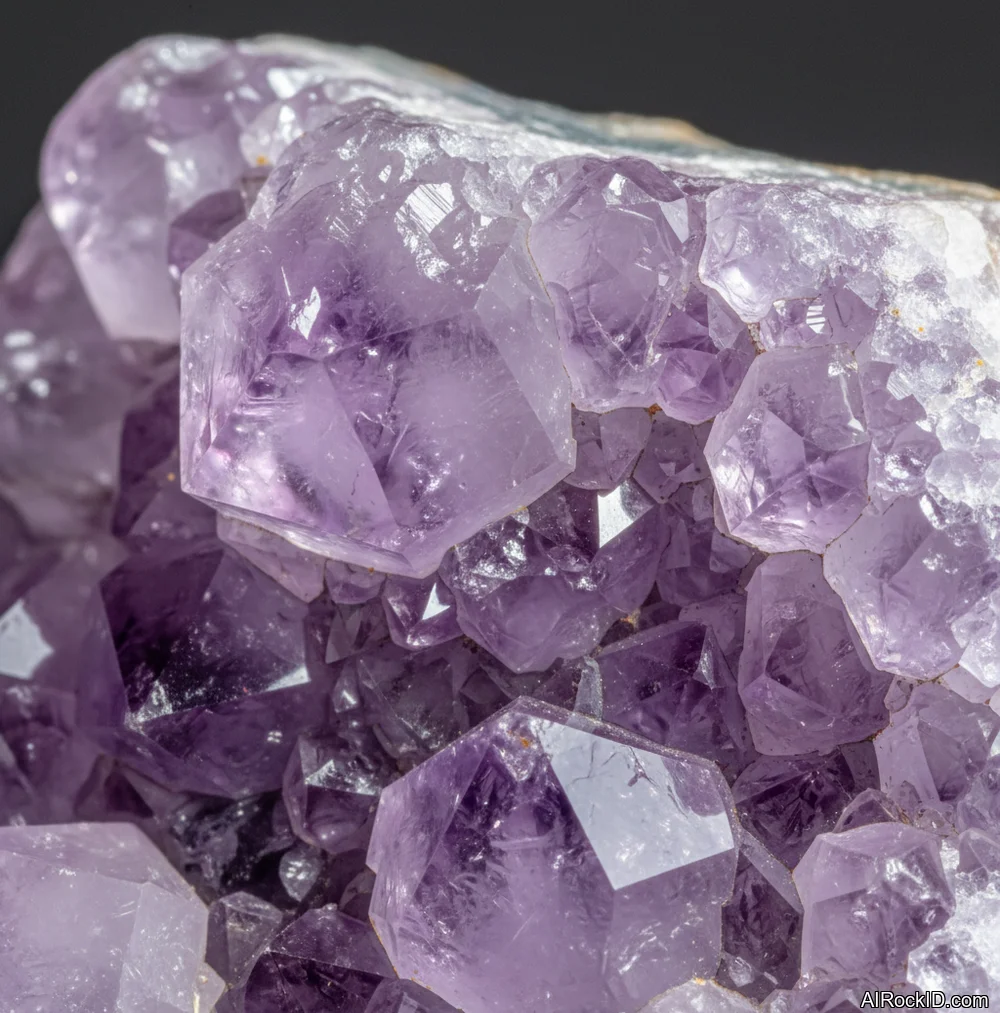
- Amethyst Geode: Amethyst geodes show purple quartz crystals, while agate geodes are identified mainly by chalcedony banding around the cavity.
- Thunderegg: Thundereggs are solid or partly filled nodules that often show agate interiors but are not always hollow.
Agate Geode vs. Common Lookalikes
| Specimen | Key Visual Clue | Typical Difference |
|---|---|---|
| Agate Geode | Banded chalcedony shell with a crystal-lined cavity | Hard quartz/chalcedony structure, usually Mohs 6.5–7 |
| Quartz Geode | White or clear quartz crystals inside a hollow nodule | May show little or no agate banding |
| Druzy Agate | Fine sparkling quartz crystals on agate | Often sold as slabs, cabochons, or pockets rather than whole geodes |
| Amethyst Geode | Purple quartz crystal interior | Color comes from amethyst; banded agate rim may or may not be present |
| Calcite Geode | Rhombohedral or scalenohedral calcite crystals | Softer than quartz and can fizz with dilute acid |
AI identification confidence
AI identification is usually stronger when the photo shows the outer rind, banded agate rim, and close-up crystal texture in one set of images. Confidence is lower for dyed slices, cropped close-ups of druzy surfaces, or specimens photographed under colored lighting.
When AI gets it wrong
- A close-up of only the crystal cavity may be labeled quartz geode instead of agate geode.
- Dyed blue, pink, or green geodes may be mistaken for naturally colored agate varieties.
- Flat druzy agate slabs can be confused with whole geodes if the outer shape is not visible.
- Calcite-lined cavities may be misread as quartz without hardness, acid reaction, or crystal-shape checks.
How to Check Agate Geode Authenticity
Natural agate geodes usually show irregular banding, a rough outer rind, and uneven crystal growth inside the cavity. Very bright neon colors, uniform saturation, or color concentrated in cracks can indicate dyeing. A seller should disclose dyeing, heating, polishing, cement repairs, or glued mounting bases when those treatments are present.
Buying Tips for Agate Geode Specimens
When buying an agate geode, compare the size, weight, banding quality, cavity condition, and whether the specimen is whole, cut, polished, or paired as bookends. Check photos for chips along the rim, loose druzy crystals, repaired breaks, and artificial color enhancement. For online listings, clear photos under neutral light are more useful than heavily saturated display images.
Natural Color vs. Dyed Agate Geode
Natural agate geodes commonly appear gray, white, cream, brown, reddish, or softly tinted, though regional deposits can vary. Dyed agate geodes may appear vivid blue, hot pink, purple, green, or other saturated colors that penetrate porous zones. Dyeing does not make the specimen fake, but it changes how the piece should be described, priced, and collected.
What Is Agate Geode?
Agate Geode is a hollow chalcedony formation lined with crystals, typically quartz, and it is prized for colorful banding and a surprising internal cavity. In hand, a good cut piece shows two personalities at once: a firm, banded outer agate shell and a glittering interior where crystals grew inward over time.
As a semi-precious gemstone, Agate Geode is common but still highly collectible because no two interiors look exactly alike. Its colors can include blue, green, and brown, and its luster ranges from vitreous on crystal faces to waxy along the chalcedony bands. With a Mohs hardness of 6.5 to 7, it feels durable enough for display, handling, and many lapidary uses.
Origin & History
Agate takes its name from the Achates River in Sicily, where it was first described in ancient times. Agate geodes have been studied for centuries because they preserve both banded chalcedony and crystal-lined cavities in a single specimen, making them useful to collectors, lapidaries, and mineral students.
The appeal is partly historical and partly tactile: a plain-looking nodule can open to reveal bands, translucency, and sparkling quartz. For modern locality and mineral-reference checking, collectors often compare labels and occurrence notes with resources such as mindat.org, especially when sorting agate geodes from Brazil, Uruguay, or Mexico.
Where Is Agate Geode Found?
Agate Geode is found in Brazil, Uruguay, and Mexico, with notable localities including Rio Grande do Sul in Brazil, Artigas in Uruguay, and Puebla in Mexico. These are classic source regions for geodes that show banded chalcedony shells and hollow interiors lined with crystals.
Formation
Agate Geode forms when mineral-rich water fills a cavity in rock and leaves material behind over time, allowing chalcedony bands and internal crystals to grow. The result is a rounded or irregular hollow rock with a solid agate wall and a crystal-lined center, often associated with volcanic or sedimentary environments.
This slow filling process is why a cut geode can show layered bands on the outside and open crystal growth toward the middle. The chemistry is silica-based, with the formula SiO2, and common impurities can include iron and manganese. For a broad geologic frame on silica minerals and rock environments, USGS resources are a useful plain-text reference.
How to Identify Agate Geode
Identify Agate Geode by looking for banded chalcedony, a hollow cavity when cut, and a vitreous to waxy luster. The specimen may show blue, green, or brown tones, with translucent areas and a white streak. Its fracture is conchoidal, so broken edges can curve smoothly rather than splitting in flat planes.
A hardness test can help confirm it: Agate Geode falls at 6.5 to 7 on the Mohs scale, making it relatively hard and scratch-resistant. It is non-magnetic, has a density of 2.5 to 2.7 g/cm3, and belongs to the trigonal crystal system as chalcedony. In close inspection, the key giveaway is the contrast between outer banding and the open, crystal-lined interior.
Properties of Agate Geode
Physical Properties
| Crystal System | Trigonal |
| Hardness (Mohs) | 6.5 - 7 (Hard (6-7.5)) |
| Density | 2.5 - 2.7 g/cm3 |
| Luster | Vitreous |
| Diaphaneity | Translucent |
| Fracture | Conchoidal |
| Streak | white |
| Magnetism | Non-magnetic |
| Colors | blue, green, brown |
Chemical Properties
| Classification | Silicate |
| Formula | SiO2 |
| Elements | Si, O |
| Common Impurities | Fe, Mn |
Optical Properties
| Refractive Index | 1.54 - 1.55 |
| Birefringence | None |
| Pleochroism | None |
| Optical Character | Isotropic |
Agate Geode Health & Safety
Agate geodes pose no significant health risks.
Agate Geode Value & Price
Price Range
Rough/Tumbled: $10 - $100 per specimen
Cut/Polished: $5 - $50 per carat
Price varies based on size, color, and quality of the geode.
Durability
Durable — Scratch resistance: Good, Toughness: Good
Agate geodes are stable under normal conditions.
How to Care for Agate Geode
Use & Storage
Store in a soft cloth or padded box to avoid scratches.
Cleaning
Clean with mild soap and water, using a soft brush if needed. Avoid harsh chemicals.
Cleanse & Charge
Place under sunlight or moonlight for cleansing.
Placement
Display in a stable area to prevent falls.
Caution
Avoid exposing to extreme temperature changes.
Works Well With
Agate Geode Meaning & Healing Properties
Agate Geode is believed to support emotional balance, harmony, grounding, stability, and protection. In a practitioner setting, people often use it as a steadying display stone: the solid outer bands suggest containment, while the open crystal center gives a calm focal point for meditation, stress relief, insight, trust, and confidence.
It is associated with the Root and Heart chakras, the zodiac signs Gemini and Cancer, the planet Earth, and the Earth element. These meanings are cultural and spiritual rather than medical; Agate Geode is not a substitute for medical treatment. For care, it is safe to handle and safe in water, and it can be cleansed by placing it under sunlight or moonlight.
Identify Agate Geode from a photo
Compare Agate Geode traits, care tips, value clues, and common lookalikes with a clear photo.
Common mistakes
- Assuming every hollow crystal-lined rock is an agate geode, even when no chalcedony banding is visible.
- Calling a dyed geode a natural-color specimen without checking the seller's treatment disclosure.
- Identifying a geode from only one close-up photo of the crystals and ignoring the outer rind or cut edge.
- Using color alone to separate agate, quartz, amethyst, and calcite geodes.
- Overlooking repaired rims, glued bases, or filled cracks when evaluating a display specimen.