Quartz Geode


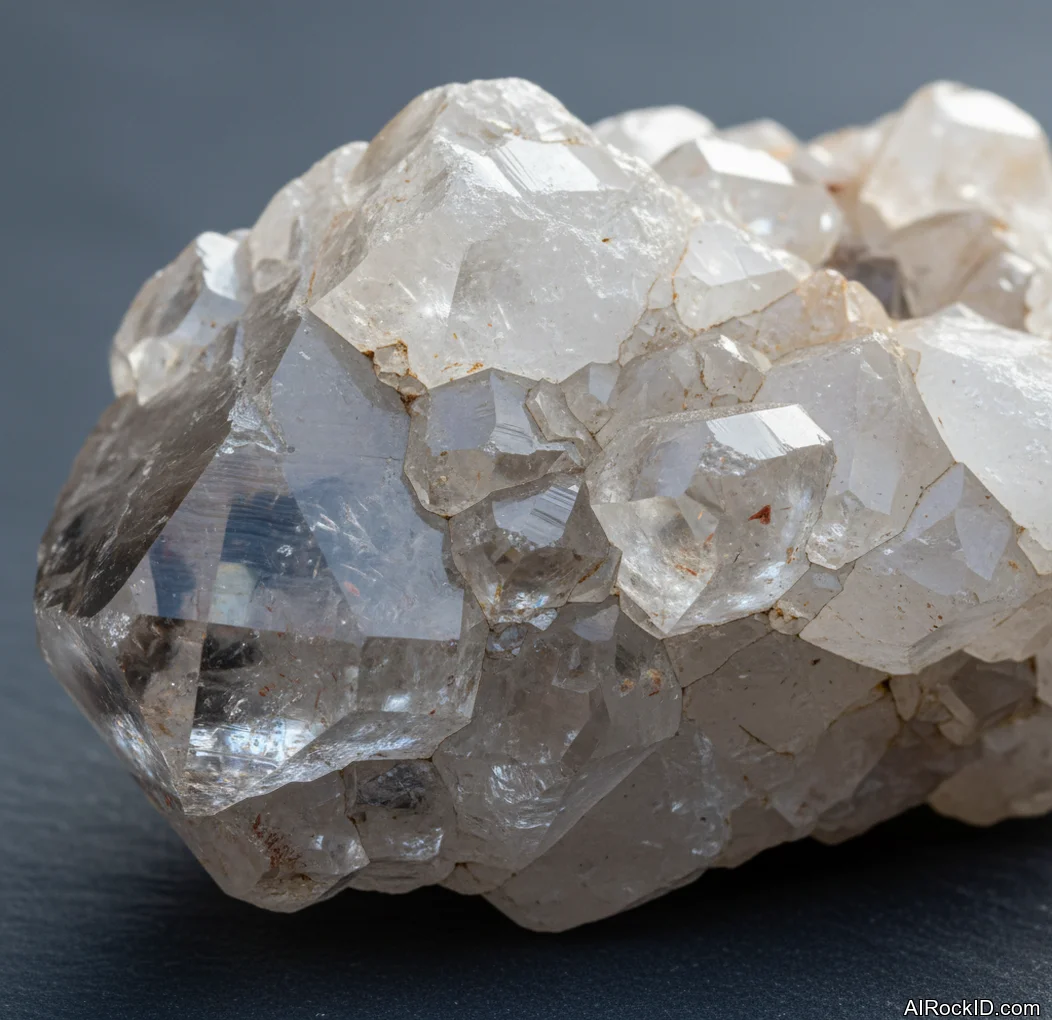
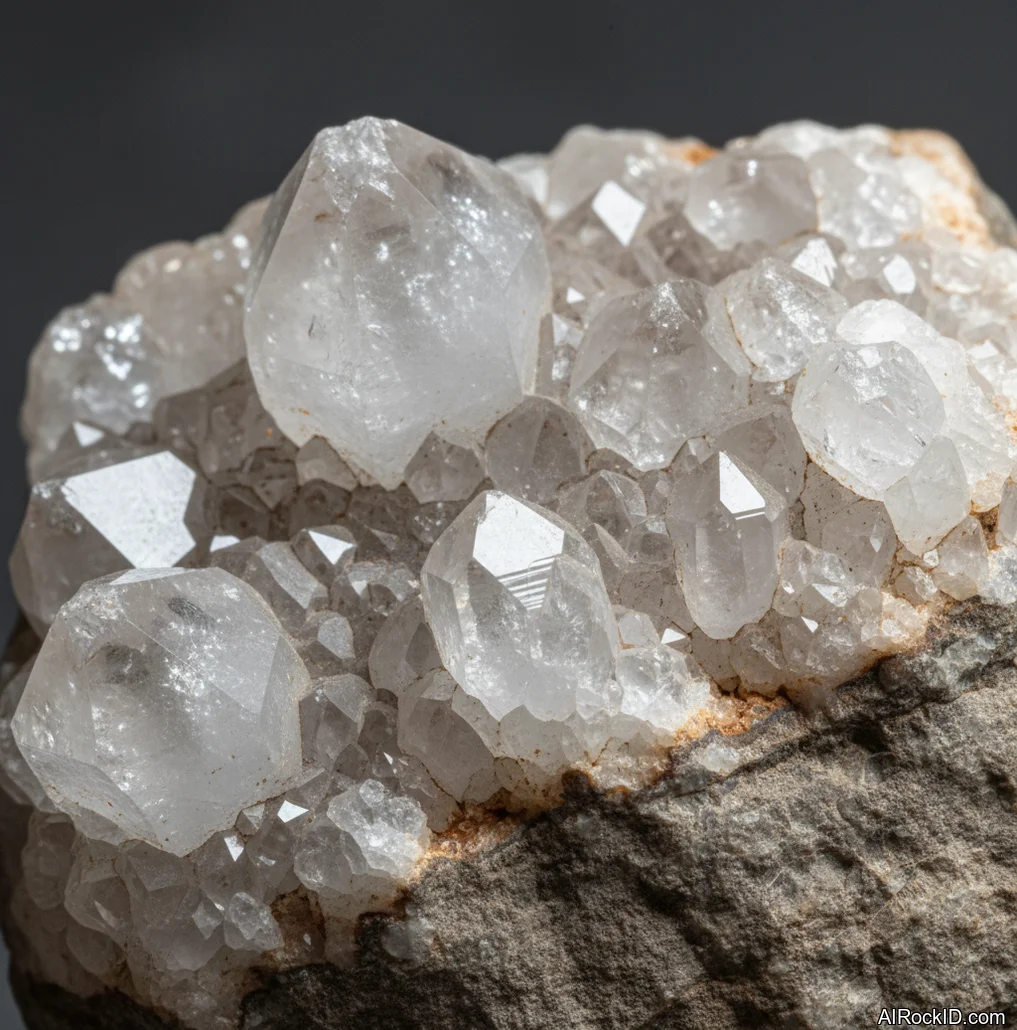
Quick answer: A quartz geode is a rounded or irregular rock nodule with a hollow interior lined by quartz crystals. Its outer shell is usually plain chalcedony, limestone, or volcanic rock, while the inside may show clear, white, gray, smoky, amethyst, or iron-stained quartz points.
AI Rock ID can help compare a quartz geode with similar hollow nodules, dyed specimens, and lookalike crystal clusters from a photo. RockIdentifier.io provides visual identification support, but final confirmation may require checking hardness, crystal habit, weight, and whether the color appears natural or treated.
Good fit
- Collectors who want a durable display specimen with visible crystal growth
- Beginners learning the difference between outer matrix and inner crystal lining
- Buyers comparing natural, dyed, and cut-open geodes
- Classrooms or rock kits that need a common example of mineral-filled cavities
Not a good fit
- Situations where a lightweight decorative item is preferred, since large geodes can be heavy
- Buyers who want a perfectly matched pair, because natural geode halves often differ
- People seeking a rare specimen, since many quartz geodes are widely available
- Handling by small children without supervision, because broken edges can be sharp
Most commonly confused with
- Amethyst Geode: Amethyst geodes have purple quartz caused by iron and natural irradiation, while common quartz geodes are usually clear, white, gray, or lightly stained.
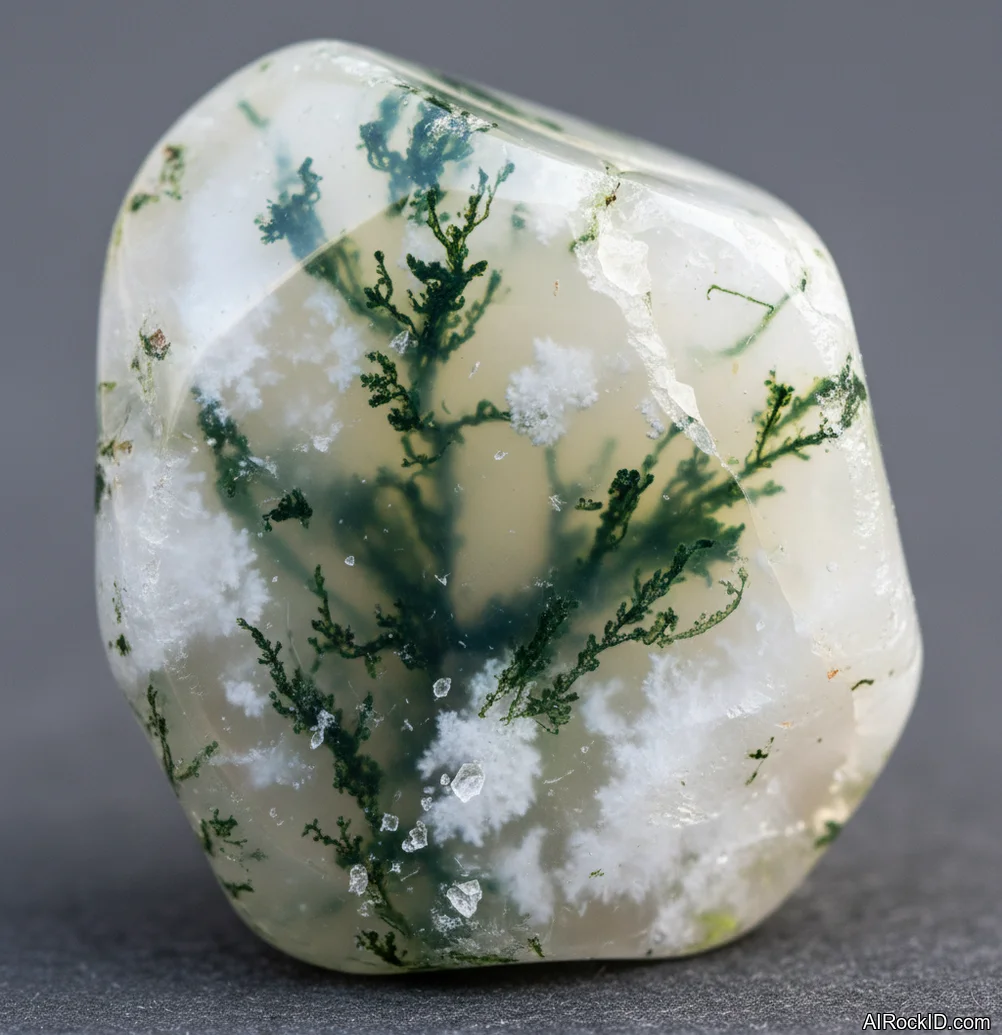
- Agate Geode: Agate geodes show banded chalcedony around or inside the cavity, while quartz geodes are identified mainly by visible quartz crystal points.
- Celestite: Celestite geodes often have pale blue tabular crystals and are much softer than quartz.
- Calcite: Calcite can form crystal-lined cavities but is softer, reacts with acid, and commonly has rhombohedral cleavage.
Quartz Geode Lookalike Comparison
| Specimen | Typical Look | Key Difference | Mohs Hardness |
|---|---|---|---|
| Quartz geode | Hollow cavity lined with clear to white quartz points | Scratches glass and usually has hexagonal crystal tips | 7 |
| Amethyst geode | Purple quartz crystals inside a cavity | Purple color is the main identifying feature | 7 |
| Agate geode | Banded chalcedony with or without a crystal pocket | Banded layers are more obvious than crystal points | 6.5-7 |
| Celestite geode | Pale blue crystals in a geode-like cavity | Softer and more fragile than quartz | 3-3.5 |
| Calcite-lined cavity | White, yellow, orange, or clear crystals in a void | Softer, cleaves easily, and may fizz in acid | 3 |
AI identification confidence
Photo-based identification of a quartz geode is usually moderate to high when the image clearly shows both the rough outer shell and the quartz-lined cavity. Confidence drops when the specimen is dyed, polished, tightly cropped, or photographed under colored lighting.
When AI gets it wrong
- Brightly dyed geodes can be mistaken for naturally colored quartz varieties.
- Close-up photos of only the crystal interior may hide the geode structure and matrix.
- Calcite, celestite, and other crystal-lined cavities can resemble quartz in low-resolution images.
- Polished agate nodules with small druzy pockets may be labeled as quartz geodes without showing enough context.
Final recommendation
Choose a quartz geode by checking for stable halves, visible quartz points, and color that looks consistent with natural mineral staining rather than artificial dye. For identification, combine visual inspection with simple observations such as hardness, crystal shape, and whether the specimen has a true hollow cavity.
How to Tell If a Quartz Geode Is Dyed
Dyed quartz geodes often show very bright blue, green, pink, or purple color that pools in cracks, porous bands, or along the cut rim. Natural quartz geodes are more often clear, white, gray, smoky, pale brown, or iron-stained. A cotton swab lightly dampened with water or alcohol may pick up unstable surface dye, but this test can affect finishes and should be done cautiously on a small hidden area.
Buying Tips for Quartz Geodes
When buying a quartz geode, look for clear photos of the outside, inside, cut edge, and any repaired areas. Check whether the seller describes the specimen as natural, dyed, polished, cracked open, or saw-cut, because these details affect appearance and collectibility. Matched halves, clean crystal pockets, and minimal glue or filler are usually preferred by collectors.
Natural Features Seen in Quartz Geodes
Quartz geodes may contain small broken crystal tips, iron-oxide staining, uneven walls, and areas where crystals did not fully cover the cavity. These features are common in natural specimens and do not automatically indicate damage or poor quality. Saw-cut halves may have a flat rim, while naturally cracked geodes usually have a more irregular edge.
What Is Quartz Geode?
A quartz geode is basically a rounded rock nodule with a hollow pocket inside, and that pocket’s lined with quartz crystals that grew inward. From the outside? It can look like a boring lump. Like a dusty potato you’d kick off the trail without thinking twice. Then you crack it open and suddenly it’s all sparkle and sharp little points.
Grab a typical one and two things jump out fast: it’s heavier than it looks, and the rind feels rough and chalky in your hand. Almost gritty. The crystals inside are the opposite, slick and glossy when you tilt it under the light. The quartz lining might be clear, milky, smoky, or even amethyst if you’re lucky, but most everyday shop pieces land in that white-to-gray range with a glassy glitter that catches track lighting from way across the room.
But here’s what people don’t see coming. A lot of the geodes on the market aren’t “wild” finds at all. They’ve been cut clean on a saw, and sometimes the outside gets a dye bath or a polish job so the interior pops harder under bright lights (you can kind of tell when the color looks a little too loud, right?).
Origin & History
Quartz got pinned down and formally described pretty early in modern mineralogy, but the name itself is older and more practical. It comes from the German “Quarz,” a word miners were using long before anyone was arguing about crystal systems.
The “geode” part goes back even further. It’s from the Greek “geoides,” meaning “earthlike,” which honestly nails it, because a geode really does look like a lumpy little nodule you could mistake for plain old dirt clod at first glance.
People have been cracking geodes open forever because it’s basically nature’s surprise box. In the US, “Keokuk geodes” out of the Midwest got famous with rockhounds in the 1800s and early 1900s, and you still see them sitting on club tables. I’ve bought flats of them at shows where half the fun was sorting through, turning them in your hand, and giving them that light tap with a knuckle (or a rock) to catch that hollow sound that hints there’s a cavity inside.
Where Is Quartz Geode Found?
Quartz geodes show up worldwide, especially in volcanic basalts and some sedimentary limestones where cavities can form and later fill with silica-rich fluids.
Formation
Look at the way the crystals aim toward the middle and the whole thing starts to make sense. A geode begins as an empty pocket, usually a gas bubble in lava (a vesicle) or a void left behind in sedimentary rock. Then, much later, groundwater or hydrothermal fluids carrying dissolved silica sneak in through tiny pathways. Quartz doesn’t hurry. It lays down a lining on the walls first, and only after that do the points grow inward as the chemistry and temperature settle into a slow, steady rhythm.
If you compare it to a single quartz crystal you’d yank from a pocket in a vein, geode quartz usually starts as a drusy “carpet” of tiny crystals, then bigger points form on top if things stay stable for long enough. And sometimes there are bands of chalcedony or agate hugging the inside edge. That’s your hint the silica arrived in separate pulses, not all at once. I’ve cracked geodes where the first layer is that waxy gray chalcedony (almost like candle wax under your thumb), then a thin iron-stained seam, and then clean quartz points that look like someone shook sugar glass into the hollow. Pretty wild, right?
How to Identify Quartz Geode
Color: Most quartz geodes are clear to milky white inside, with occasional smoky gray, honey staining from iron oxides, or purple if amethyst is present. The outer rind is usually tan, gray, or rusty and can look pretty plain.
Luster: The quartz crystals inside have a vitreous (glassy) luster.
Pick up the geode and tilt it under a single light source: real quartz points flash in sharp little facets, not a smooth glitter like glass beads. If you scratch a hidden spot on a crystal with a steel nail, it won’t bite easily, and the quartz will scratch common window glass. The real test is the feel and temperature too: quartz stays cool in your hand longer than resin or plastic “geode decor,” which warms up fast.
Common Look-Alikes
Quartz Geode is sometimes confused with these materials:
- Celestite geode
- Calcite geode
- Dyed quartz geode (bright colors like blue or purple)
- Glass geode (manmade, sold as 'quartz' sometimes)
- Chalcedony nodule
- Agate geode
Market Cautions & Treatments
When AI Can Get This Wrong
AI photo ID mixes up quartz geodes with celestite and calcite geodes a lot, especially if the photo’s blown out or the crystals are stubby. Glass fakes can also slip through because polished rinds and fake 'sparkle' trick the camera. The real test is weight in the hand, and quartz will scratch glass—celestite and calcite won’t.
Properties of Quartz Geode
Physical Properties
| Crystal System | Trigonal |
| Hardness (Mohs) | 7 (Hard (6-7.5)) |
| Density | 2.65 g/cm3 |
| Luster | Vitreous |
| Diaphaneity | Transparent to translucent |
| Fracture | Conchoidal |
| Streak | White |
| Magnetism | Non-magnetic |
| Colors | Colorless, White, Gray, Smoky brown, Purple, Yellow-brown |
Chemical Properties
| Classification | Silicates |
| Formula | SiO2 |
| Elements | Si, O |
| Common Impurities | Fe, Al, Ti, Mn |
Optical Properties
| Refractive Index | 1.544-1.553 |
| Birefringence | 0.009 |
| Pleochroism | None |
| Optical Character | Uniaxial |
Quartz Geode Health & Safety
Quartz geodes are non-toxic, so they’re safe to handle. The real risk is mechanical: those crystal points can be sharp, and if the geode cracks or breaks, you can end up with little chips or jagged edges that’ll nick your skin.
Safety Tips
If you’re cutting or grinding, put on eye protection and a proper respirator that’s actually rated for silica dust. And run a little water while you work to keep the dust from puffing up into the air.
Quartz Geode Value & Price
Price Range
Rough/Tumbled: $10 - $250 per piece
Bigger pieces cost more, same with a clean termination, and it matters if there’s amethyst, smoky quartz, calcite, or agate banding in there. And yeah, most dealers are also judging how neatly it was split and how sparkly the cavity looks when they tilt it under those harsh booth lights.
Durability
Durable — Scratch resistance: Excellent, Toughness: Fair
Quartz handles everyday handling well, but the points can chip if the geode halves knock together or you drop it on tile.
How to Care for Quartz Geode
Use & Storage
Store halves so the crystal faces don’t bang together, like upright in a padded box or with a cloth between them. If it’s a big cathedral-style chunk, set it where it can’t get nudged off a shelf.
Cleaning
1) Rinse with lukewarm water to loosen dust. 2) Use a soft toothbrush with a drop of mild dish soap to scrub between points, then rinse well. 3) Pat dry and let it air-dry fully before putting it back in a cabinet.
Cleanse & Charge
For a simple reset, I just rinse it and let it dry in indirect light. If you use moonlight, keep it out overnight but avoid spots where sprinklers or salty air can leave residue.
Placement
Put it somewhere you’ll actually see the sparkle, like a desk corner or a living room shelf with side lighting. Direct sun won’t hurt clear quartz much, but it can wash out amethyst tones over time.
Caution
Don’t reach for bleach or any harsh acids on mystery geodes. A lot of them have calcite or iron staining, and that stuff can get etched or weirdly discolored fast once chemicals hit it. And when you’re dusting them, watch your fingers. Those tiny little points look harmless until you drag a knuckle across one and realize they’re sharper than you expected.
Works Well With
Quartz Geode Meaning & Healing Properties
A lot of people treat a quartz geode like a “room stone.” It just sits there, quiet, and it shifts the mood of a space more than it changes you in some big, movie-montage way. In my own stash, I grab geodes when I want something steady on the shelf while I’m sorting flats or labeling finds. Background hum. Simple as that.
Thing is, if you actually stare into the inside, you can see why people tie it to clarity and focus. Those little points grab the light, and your eyes kind of stop bouncing around and land. It’s not medicine. I’d never tell anyone to trade a geode for real help. But as a solid object that helps anchor a routine, yeah, it can work. I’ve had one on my desk for years, and when I’m drifting, I’ll literally rotate it a few degrees until the light hits the crystal faces just right (you know that quick flash you get off a clean facet?), and then I go back to whatever I was doing.
But don’t get carried away. A quartz geode won’t “fix” a messy room or a messy head all by itself. What it can do is give you one clean focal point, and that’s real if you actually use it that way. And honestly, some dyed geodes look loud. Like they’re shouting from across the room. So if you’re going for calm, stick to the natural color and a softer sparkle, not the neon stuff.
Common mistakes
- Assuming every bright purple geode is natural amethyst rather than dyed quartz.
- Identifying a specimen from the crystal pocket alone without checking the outer shell.
- Confusing druzy quartz on a flat rock surface with a true hollow geode.
- Using color as the only test, even though quartz geodes vary widely in staining and treatment.
- Expecting both halves of a natural geode to match perfectly in crystal coverage and shape.
Identify Quartz Geode from a photo
Compare Quartz Geode traits, care tips, value clues, and common lookalikes with a clear photo.