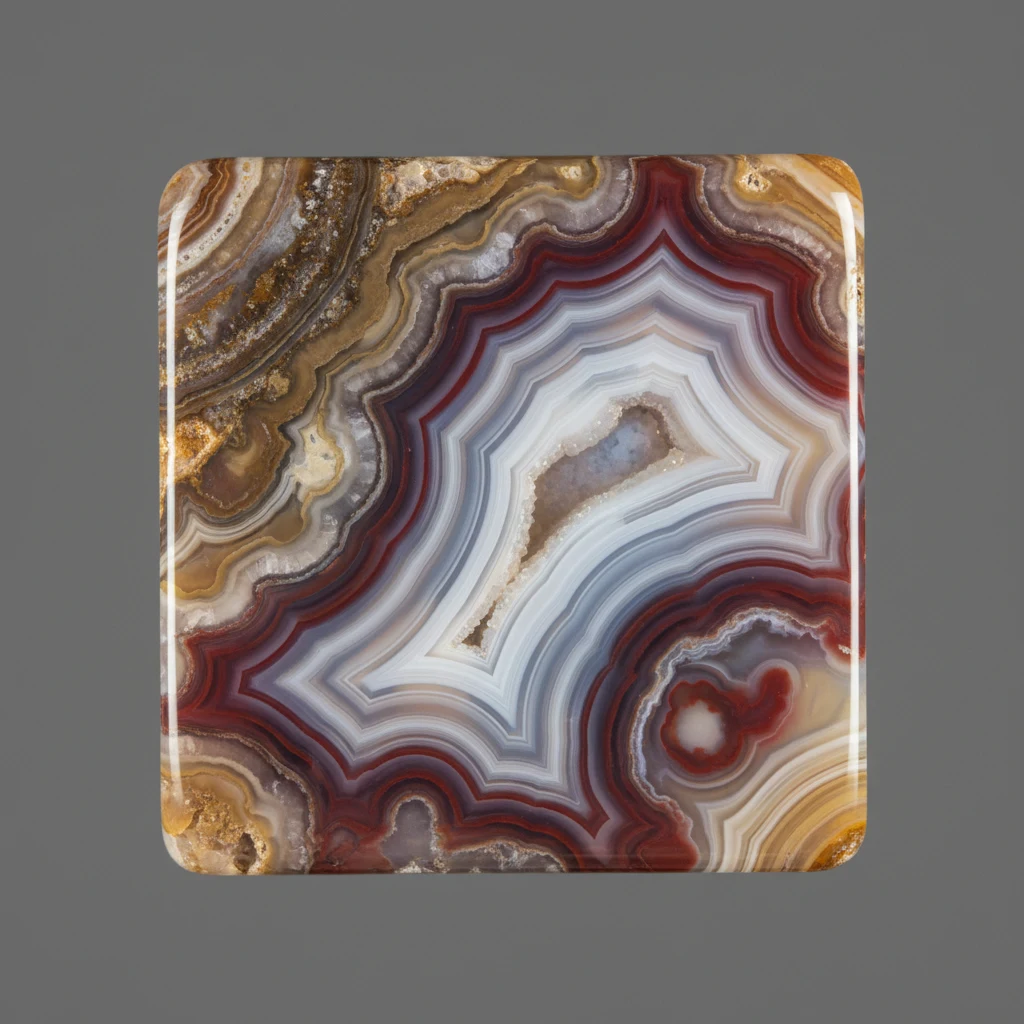
Agate (banded variety)


Quick answer: Banded agate is a layered form of chalcedony, a microcrystalline quartz, recognized by curved, parallel, or irregular bands of contrasting color. It is typically durable enough for jewelry and carvings, but dyed and heat-treated pieces are common in the market.
AI Rock ID can help screen a banded agate photo by checking for chalcedony-like luster, banding style, and visible lookalike clues. RockIdentifier.io should be used as an identification aid rather than a substitute for gemological testing when value, treatment, or origin matters.
Good fit
- Collectors who want a durable, widely available banded chalcedony specimen
- Jewelry buyers looking for a hard stone suitable for beads, cabochons, and pendants
- Beginners learning to recognize natural banding, dye, and common quartz-family materials
- Lapidary hobbyists seeking material that polishes well
Not a good fit
- Buyers who need a rare or high-value gemstone with strict provenance
- Anyone expecting color alone to prove natural origin
- Situations where undisclosed dye or treatment would be unacceptable
Why people search for this
People often search for banded agate to confirm whether a striped stone is natural chalcedony, dyed agate, or another banded material. Identification usually depends on band pattern, translucency, luster, hardness, and any signs of artificial color.
Most commonly confused with
- Onyx: Onyx usually has straighter, more uniform parallel bands, while many agates show curved, irregular, or fortification-style banding.
- Jasper: Jasper is generally opaque, while banded agate often has translucent edges or bands when held to light.
- Carnelian: Carnelian is orange to red chalcedony that may be mostly uniform, while banded agate is identified by visible layered bands.
- Glass: Glass may show bubbles, mold marks, or a very uniform artificial color that differs from natural chalcedony banding.
Banded Agate vs Common Lookalikes
| Material | Typical appearance | Key ID clue | Common issue |
|---|---|---|---|
| Banded agate | Layered chalcedony with curved or irregular bands | Waxy to vitreous luster and Mohs hardness near 7 | May be dyed or heat-treated |
| Onyx | Straight, parallel bands, often black and white | More even banding than typical agate | Many black onyx pieces are dyed |
| Jasper | Opaque patterned quartz-family stone | Little to no translucency at thin edges | Trade names can be inconsistent |
| Glass | Bright color or swirled artificial patterns | Air bubbles or mold seams may be visible | Can imitate agate beads |
| Dyed agate | Very saturated blue, pink, purple, or green bands | Color may concentrate in fractures or porous zones | Treatment may be undisclosed |
AI identification confidence
AI identification confidence is usually moderate to high for clear photos showing banding, luster, and edges, especially when the stone is a typical cabochon or tumbled piece. Confidence drops when the image shows only a close-up of color, a heavily dyed specimen, or a polished bead with no visible translucency or band structure.
When AI gets it wrong
- The photo is taken under colored lighting that exaggerates or changes the apparent band colors.
- The specimen is dyed so strongly that natural band texture is hidden.
- Only one flat polished face is shown, making glass, jasper, onyx, and agate harder to separate.
- The stone is a composite, coated, or resin-filled item sold under an agate trade name.
Final recommendation
For routine collecting or jewelry use, choose banded agate with clear bands, a smooth polish, and seller disclosure about dyeing or treatment. For higher-priced pieces, request origin, treatment information, and additional testing if the purchase depends on authenticity.
How to Spot Dyed Banded Agate
Dyed banded agate often appears in very bright blue, pink, purple, green, or black colors that are uncommon in natural agate. Color may look strongest along fractures, pits, drill holes, or porous bands. Natural agate can be colorful, but a combination of neon color and low price is a reason to ask for treatment disclosure.
Buying Checklist for Banded Agate
Check that the bands are visible, the polish is even, and the stone has no large cracks that affect durability. Ask whether the piece is natural color, dyed, heated, stabilized, or coated. For beads, inspect drill holes because dye concentration, chips, or filler can be easiest to see there.
Photo Tips for Agate Identification
Use daylight or neutral white light and photograph the stone from the front, side, and edge. Include one image with a small flashlight behind a thin edge to show translucency. A scale reference and a close-up of the banding help separate banded agate from jasper, glass, and dyed lookalikes.
What Is Agate (banded variety)?
Agate (banded variety) is a semi-precious variety of quartz, more specifically chalcedony, recognized by distinct layered colors. In the hand, a good piece feels smooth and glossy, with curved bands that seem to wrap through the stone rather than sit on the surface.
Its usual colors include brown, white, red, and blue, often arranged in intricate natural patterns. With Mohs hardness 7, good scratch resistance, good toughness, and stability under normal conditions, banded agate is a durable collector stone as well as a practical material for polished specimens and cut gems.
Origin & History
The name agate comes from the Achates River in Sicily, and banded agate has been used since ancient times. Its long appeal is easy to understand: even a small polished piece can show layered color, waxy-to-vitreous luster, and a clean, glassy feel when turned under light.
Collectors value banded agate for pattern complexity and color saturation, not rarity alone, because it is classed as common and widely available. For locality and specimen-reference checking, many collectors compare agate entries and locality notes on mindat.org.
Where Is Agate (banded variety) Found?
Agate (banded variety) is found in Brazil, India, and Uruguay, especially in volcanic and sedimentary rock formations. Notable localities include Santa Catarina in Brazil, Madhya Pradesh in India, and Artigas in Uruguay.
Formation
Banded agate forms when silica is deposited in layers, often inside gas cavities in volcanic rocks. Over thousands of years, those silica layers build the curved color bands that make the stone recognizable when cut or polished.
Chemically, it is a silicate with the formula SiO2, and common impurities include iron and manganese. Its trigonal crystal system, translucent body, white streak, and conchoidal fracture are consistent with its quartz-family identity; USGS resources are a useful plain-language reference for silica and quartz terminology.
How to Identify Agate (banded variety)
Identify Agate (banded variety) by its smooth, curved bands of color, vitreous to waxy luster, and translucent chalcedony body. Typical colors include browns, whites, reds, and blues, with the layers appearing as natural internal stripes rather than painted surface lines.
A broken edge may show conchoidal fracture, and its white streak and Mohs hardness of 7 support identification. It is non-magnetic, has a density of 2.65 g/cm3, and has refractive index values listed at 1.54 to 1.55, so hardness and banding are often the most practical field checks.
Properties of Agate (banded variety)
Physical Properties
| Crystal System | Trigonal |
| Hardness (Mohs) | 7 (Hard (6-7.5)) |
| Density | 2.65 g/cm3 |
| Luster | Vitreous |
| Diaphaneity | Translucent |
| Fracture | Conchoidal |
| Streak | white |
| Magnetism | Non-magnetic |
| Colors | brown, white, red, blue |
Chemical Properties
| Classification | Silicate |
| Formula | SiO2 |
| Elements | Si, O |
| Common Impurities | Fe, Mn |
Optical Properties
| Refractive Index | 1.54 - 1.55 |
| Birefringence | 0.009 |
| Pleochroism | None |
| Optical Character | Isotropic |
Agate (banded variety) Health & Safety
Banded agate poses no significant health risks.
Agate (banded variety) Value & Price
Price Range
Rough/Tumbled: $5 - $50 per specimen
Cut/Polished: $10 - $100 per carat
Price is influenced by pattern complexity and color saturation.
Durability
Durable — Scratch resistance: Good, Toughness: Good
Banded agate is stable under normal conditions.
How to Care for Agate (banded variety)
Use & Storage
Store in a soft cloth to prevent scratches.
Cleaning
Clean with mild soap and water; avoid harsh chemicals. Rinse thoroughly and dry with a soft cloth.
Cleanse & Charge
To cleanse, place under running water or in sunlight.
Placement
Place in a location where it can be admired and appreciated.
Caution
Avoid prolonged exposure to extreme heat.
Works Well With
Agate (banded variety) Meaning & Healing Properties
In crystal-healing use, Agate (banded variety) is chosen for grounding, stability, emotional balance, and calmness. Practitioners often keep it where it can be seen and handled, using the steady rhythm of its bands as a visual cue for focus, inner peace, and stress relief.
It is associated with the Root and Sacral chakras, the zodiac signs Gemini and Leo, the Earth element, and the planet Earth. It pairs well with rose quartz, clear quartz, and amethyst, and it can be cleaned with mild soap and water, then rinsed thoroughly and dried with a soft cloth.
Identify Agate (banded variety) from a photo
Compare Agate (banded variety) traits, care tips, value clues, and common lookalikes with a clear photo.
Common mistakes
- Assuming every bright-colored banded stone has natural color.
- Calling all black-and-white banded chalcedony onyx without checking band style and trade treatment.
- Ignoring translucency, which can help separate agate from many jaspers.
- Using color alone for identification instead of banding, luster, hardness, and structure.
- Assuming a trade name proves geographic origin or treatment status.