Onyx


Quick answer: Onyx is a banded variety of chalcedony most often recognized in black, black-and-white, or brownish layers. For identification, the most useful clues are waxy luster, fine-grained quartz hardness, and parallel banding, while perfectly solid black material may be dyed or another black stone.
AI Rock ID can help screen an onyx specimen by comparing visible banding, luster, color pattern, and surface texture from a clear photo. RockIdentifier.io can support a first-pass identification, but dyed stones and polished black cabochons may still require hands-on tests or seller disclosure.
Good fit
- Collectors who want a durable black or banded chalcedony for display or jewelry
- Buyers comparing black gemstones where dyed material is common
- Carvers, bead collectors, and cameo enthusiasts interested in layered material
- Beginners learning to separate chalcedony from obsidian, jet, and glass
Not a good fit
- Anyone who needs a verified untreated black stone without documentation
- Collectors seeking visible crystal faces or transparent gem material
- Situations where a stone may be exposed to harsh chemicals, ultrasonic cleaning, or high heat
Why people search for this
People often search for onyx to confirm whether a black bead, ring stone, carving, or banded cabochon is genuine chalcedony. Many searches also focus on whether solid black onyx is natural, dyed, or confused with other black materials.
Most commonly confused with
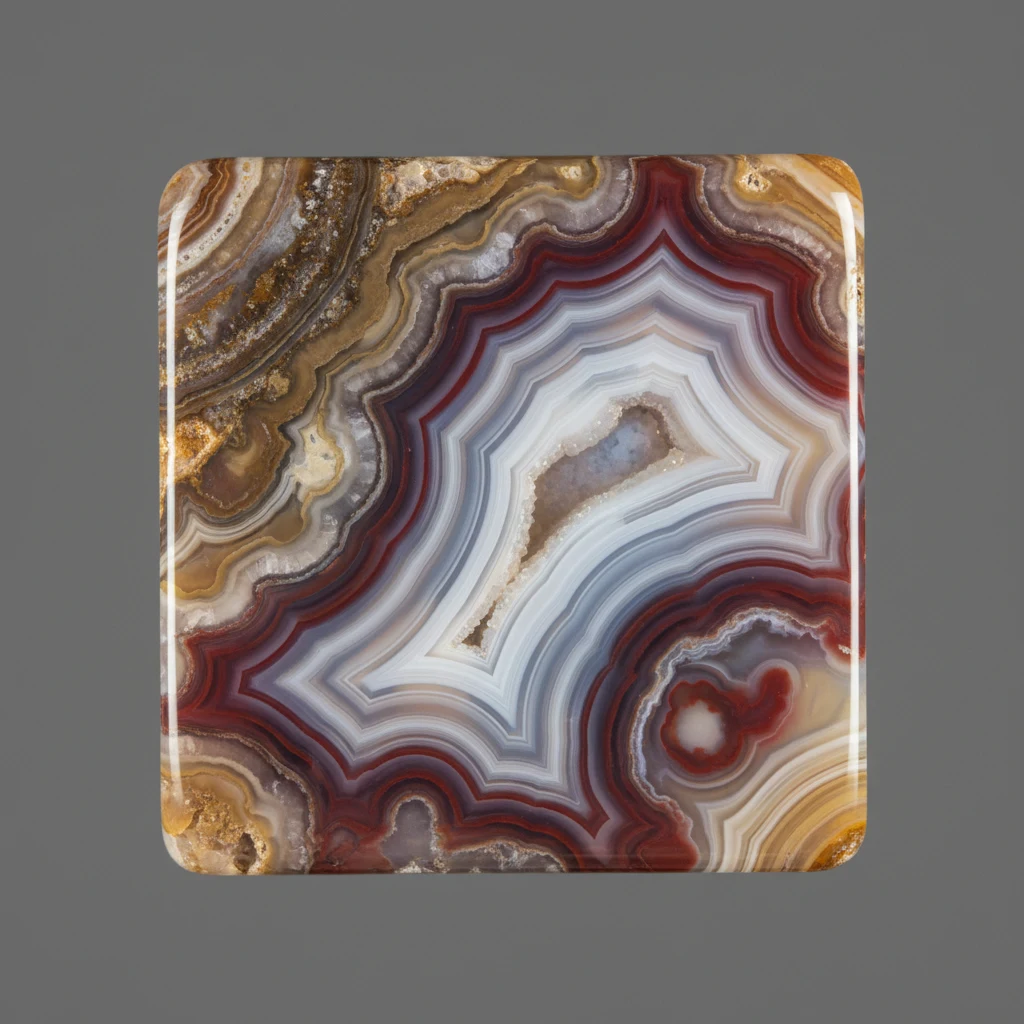
- Black Agate: Agate and onyx are both chalcedony; onyx is typically described as having straighter, more parallel bands.
- Obsidian: Obsidian is volcanic glass, usually smoother and glassier, and it is softer than quartz-family onyx.
- Jet: Jet is organic fossilized wood, much lighter in hand and softer than onyx.
- Black Tourmaline: Black tourmaline commonly shows striated crystal forms, while onyx is massive, waxy chalcedony.
Onyx vs. Common Black Lookalikes
| Material | Key Difference | Typical Clue |
|---|---|---|
| Onyx | Banded chalcedony | Waxy luster; parallel layers may be visible |
| Obsidian | Volcanic glass | Glassy luster; conchoidal fractures; Mohs about 5–5.5 |
| Jet | Organic material | Very lightweight; can feel warm compared with stone |
| Black Tourmaline | Crystalline borosilicate mineral | Long striations or prismatic crystal habit |
| Glass | Manufactured material | May show bubbles, mold marks, or overly uniform color |
AI identification confidence
AI identification confidence for onyx is usually moderate when a photo shows banding, waxy luster, and a polished or broken surface. Confidence drops for solid black, highly polished, or small bead photos because dyed chalcedony, glass, obsidian, and jet can look similar in images.
When AI gets it wrong
- The stone is uniformly black and photographed under strong reflections.
- The specimen is a small bead, cabochon, or inlay with no visible fracture or banding.
- The material has been dyed, heat treated, or coated, masking natural features.
- The photo lacks scale, natural light, or multiple angles.
Final recommendation
For buying onyx, ask whether the material is natural color, dyed, or treated, especially for solid black beads and cabochons. Choose pieces with clear seller disclosure, visible banding when desired, and no claims that cannot be verified by appearance alone.
How to Check Onyx Before Buying
Look for disclosure terms such as natural, dyed, stabilized, or treated, because black onyx in the jewelry trade is often enhanced for uniform color. Inspect drilled holes, chips, or edges for lighter zones that may reveal dye concentration or underlying chalcedony. A reputable seller should be able to explain whether the stone is banded onyx, dyed chalcedony, or a trade-name black stone.
Photo Tips for Identifying Onyx
Photograph onyx in indirect natural light from several angles to show luster, banding, translucency at thin edges, and any chips or drilled areas. Include a coin or ruler for scale and avoid heavy filters, because reflections on polished black stones can hide diagnostic features. A close-up of an edge or broken area is often more useful than a front-facing photo of a polished surface.
Natural Black Onyx vs. Dyed Black Onyx
Natural onyx may show black, white, gray, brown, or reddish layers, while completely uniform black pieces in the market are commonly dyed chalcedony. Dyeing does not necessarily make the material fake if it is disclosed, but it changes how the item should be described and valued. Collectors who want untreated material should request documentation or buy from sellers who clearly state treatment status.
What Is Onyx?
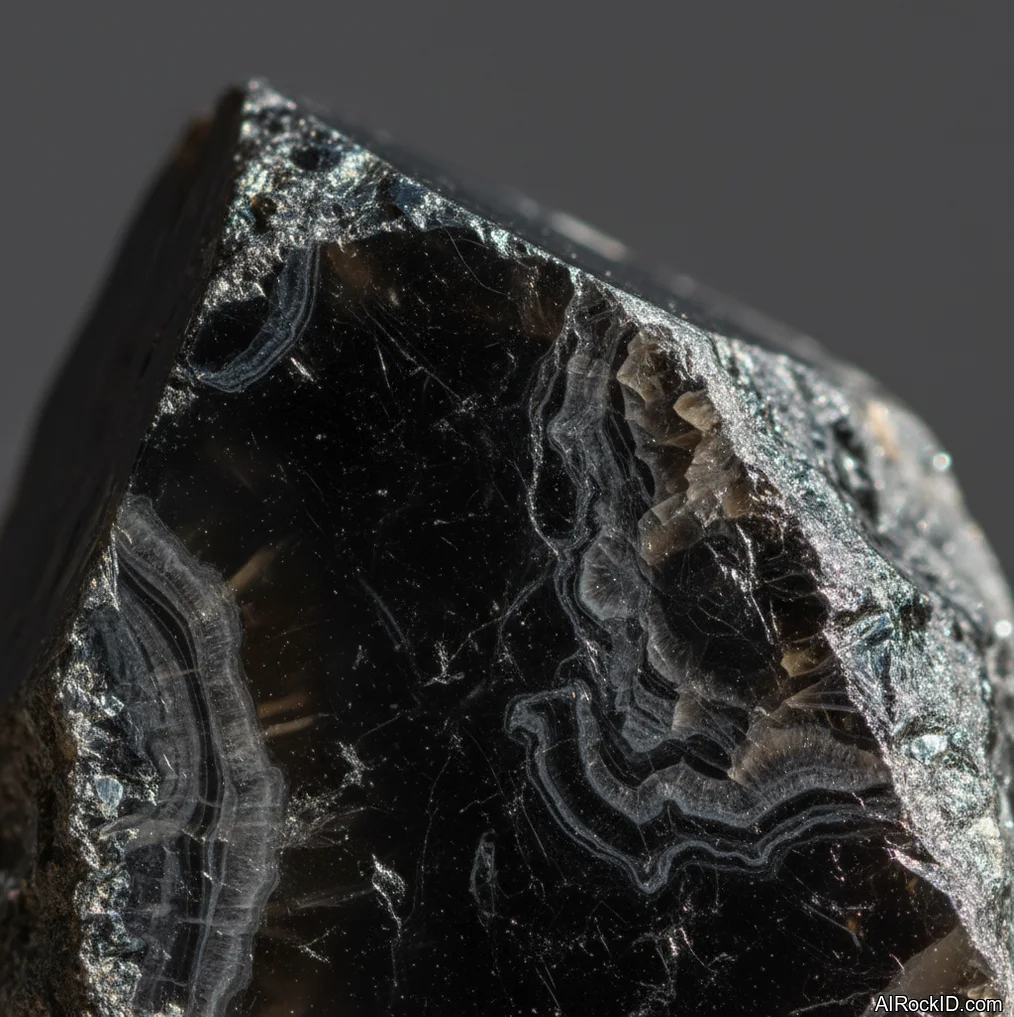
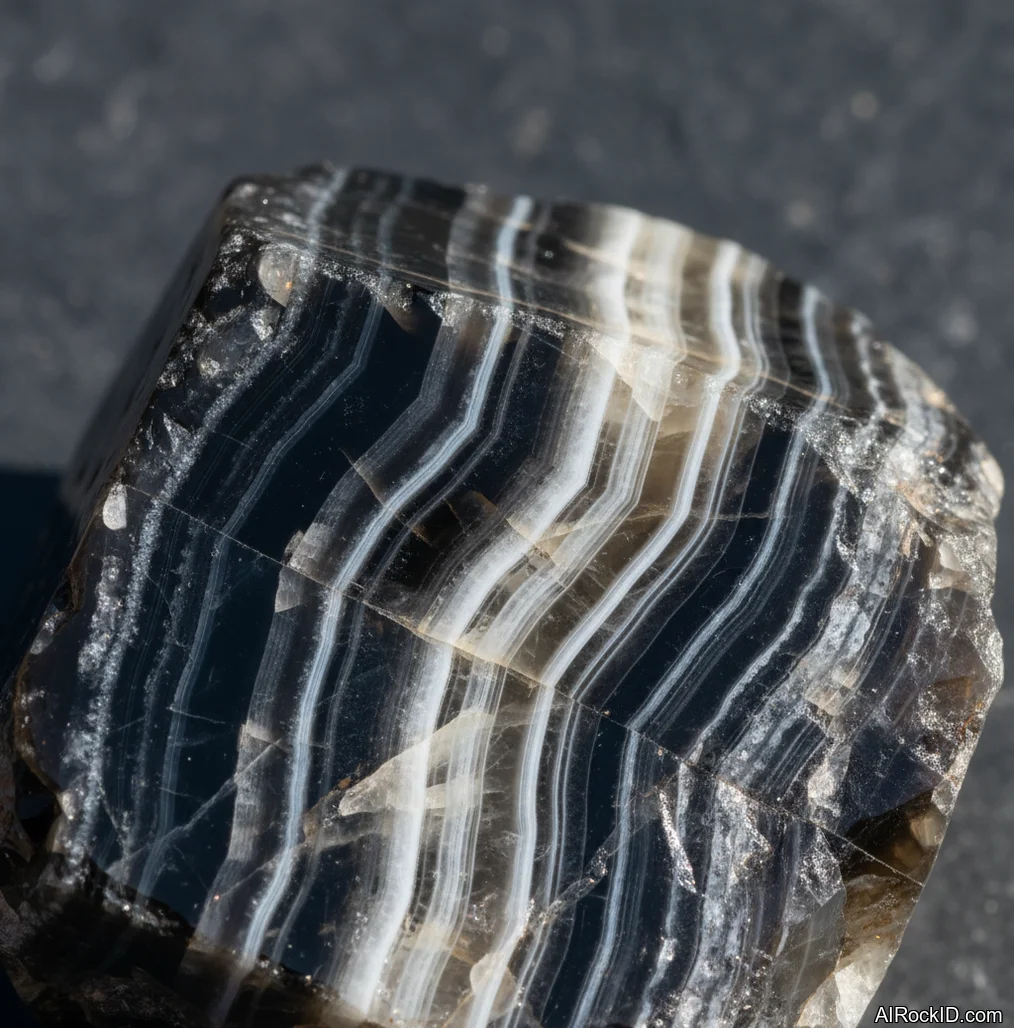
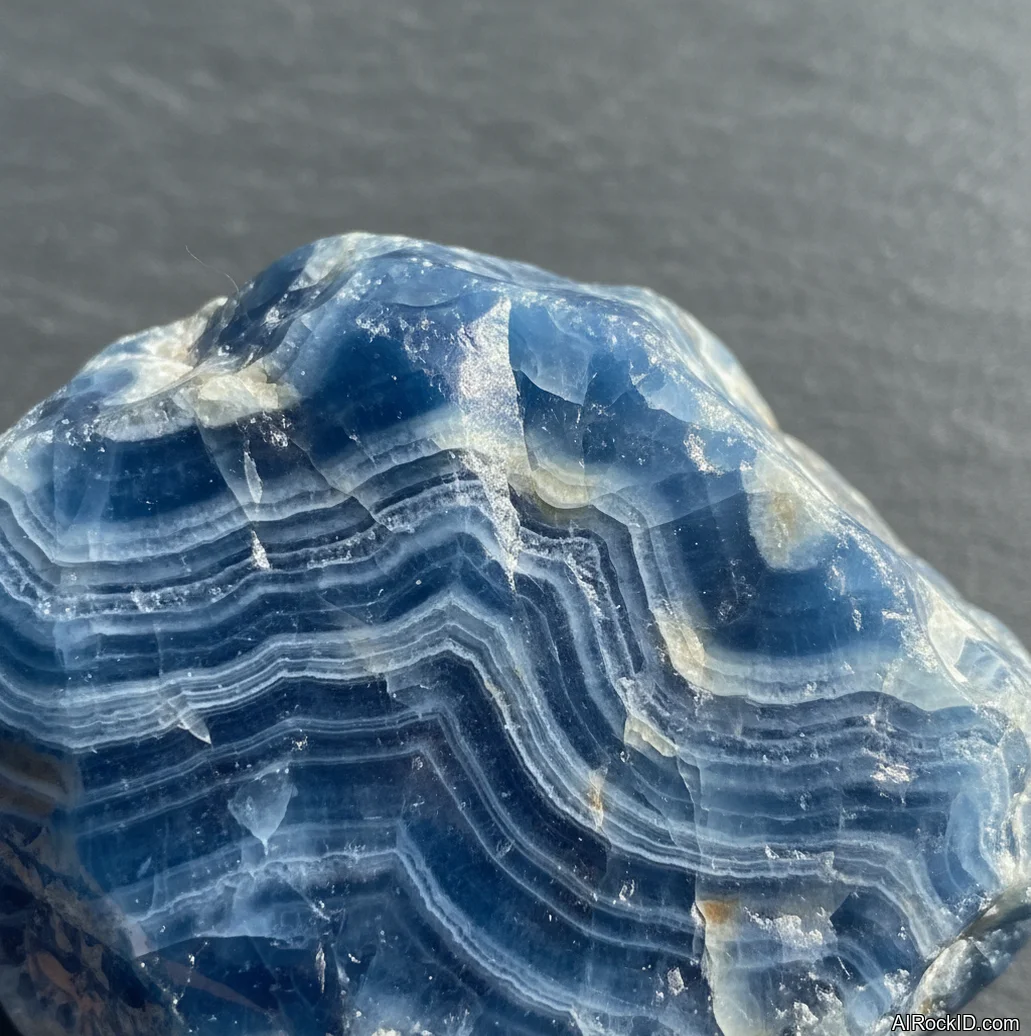
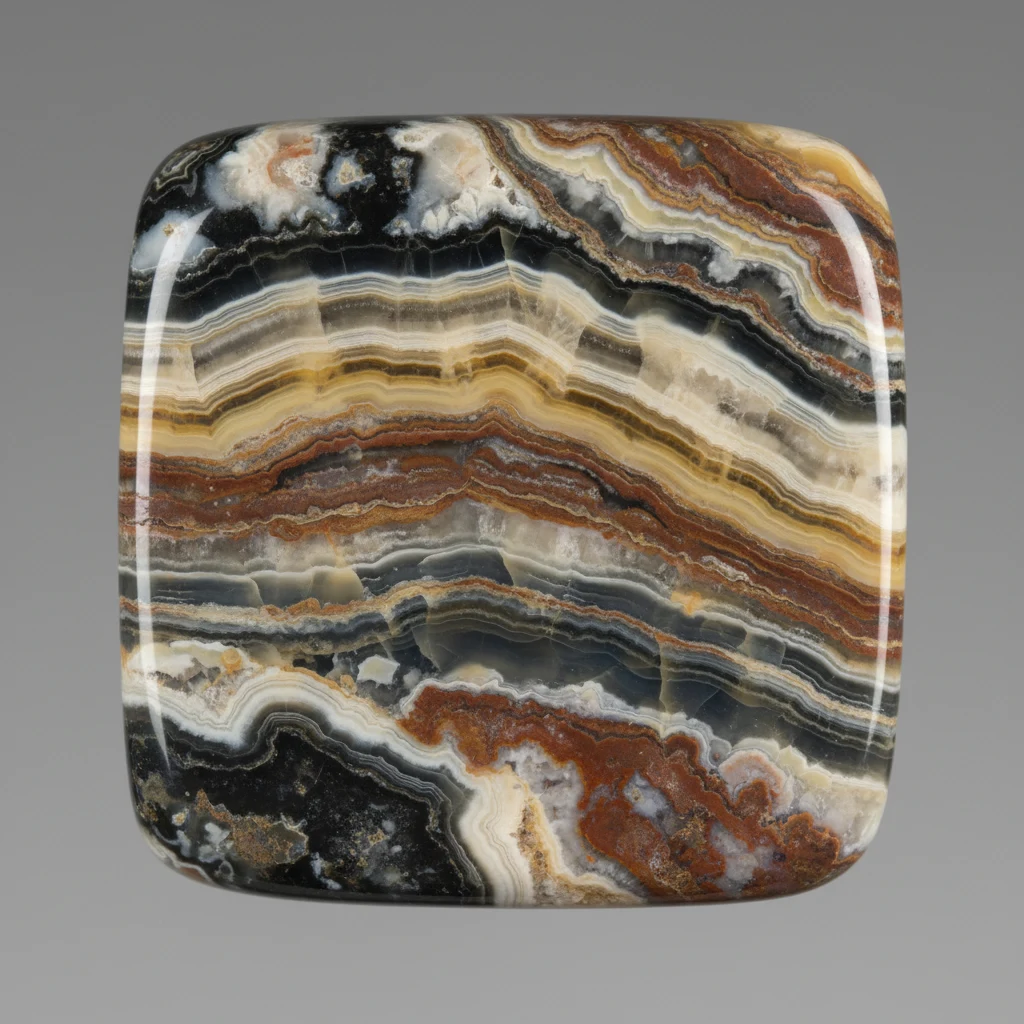
Onyx is banded chalcedony, a microcrystalline variety of quartz best recognized by straight, parallel layers. In the hand, a polished piece feels dense, smooth, and slightly waxy, with a vitreous to waxy shine across black, white, gray, brown, reddish brown, cream, honey, or blue-gray bands. Traditional onyx shows contrast between layers, especially black and white, while sardonyx refers to onyx with sard-like reddish brown or brown bands.
For collectors, the first caution is that much commercial solid black onyx is dyed chalcedony or agate. That does not make it unusable, but it changes how you judge it: look for disclosure, even color, and any signs of dye concentration. True onyx is valued for crisp parallel banding, polish quality, carving workmanship, size, natural color, and freedom from fractures.
Origin & History
The name onyx comes from the Greek word for fingernail or claw, a reference to pale, nail-like bands seen in some ancient material. This is a stone with a long cutting history: onyx has been carved since antiquity for cameos, intaglios, seals, beads, and ornamental objects. Its appeal is practical as well as visual, because fine layers give a carver a clean contrast line to work with.
In gemology, onyx is generally separated from many agates by its relatively straight, parallel banding. Agate may be curved, wavy, concentric, or irregular, while onyx should read more like stacked sheets. For locality checking and specimen records, collectors often compare labels with mindat.org, especially when older material is described broadly as agate, sardonyx, or banded chalcedony.
Where Is Onyx Found?
Onyx and onyx-like banded chalcedony are found in many agate-producing regions worldwide. Important source countries include Brazil, India, Uruguay, Madagascar, Mexico, the United States, Argentina, Germany, the Czech Republic, and Pakistan. These sources supply chalcedony suitable for cutting, carving, tumbling, and dyeing.
Formation
Onyx forms when silica-rich fluids deposit microscopic quartz fibers in cavities, fractures, and veins, commonly in volcanic rocks. Repeated pulses of silica gel or solution build the stone layer by layer. When those layers stay straight and parallel, the material is described as onyx; when they curve or form concentric patterns, it is usually called agate.
This formation explains the stone’s fine texture and durable feel. Onyx is not a single large crystal you can see with the eye, but a cryptocrystalline fibrous quartz aggregate in the trigonal system. Its chemistry is silicon dioxide, SiO2, with color influenced by impurities such as iron oxides, manganese oxides, carbon compounds, or organic dyes in treated material.
How to Identify Onyx
Identify onyx by looking first for straight, parallel banding, then by checking its quartz-like durability and surface character. It has Mohs hardness 6.5-7, a white streak, conchoidal to uneven fracture, and a vitreous to waxy luster. It should be hard enough to scratch glass and should not fizz in dilute acid.
Be especially careful with perfectly uniform black stones, because much black onyx in jewelry is dyed chalcedony or agate. Also avoid confusing gem onyx with “onyx marble,” which is usually banded calcite or aragonite; that material is much softer, reacts with acid, and is less durable. Under normal viewing, onyx ranges from translucent to opaque, and rough broken faces tend to look dull to waxy.
Properties of Onyx
Physical Properties
| Crystal System | Trigonal; cryptocrystalline fibrous quartz aggregate |
| Hardness (Mohs) | 6.5-7 (Hard) |
| Density | 2.58-2.64 g/cm³ |
| Luster | Vitreous to waxy |
| Diaphaneity | Translucent to opaque |
| Fracture | Conchoidal to uneven |
| Streak | White |
| Magnetism | Non-magnetic |
| Colors | Black, White, Gray, Brown, Reddish brown, Cream, Honey, Blue-gray |
Chemical Properties
| Classification | Silicate; tectosilicate; microcrystalline quartz |
| Formula | SiO2 |
| Elements | Silicon, Oxygen |
| Common Impurities | Iron oxides, Manganese oxides, Organic dyes, Carbon compounds |
Optical Properties
| Refractive Index | 1.530-1.540 |
| Birefringence | About 0.004, often difficult to resolve in aggregate material |
| Pleochroism | None |
| Optical Character | Cryptocrystalline aggregate; quartz fibers are uniaxial positive, but material may show aggregate or anomalous optical behavior |
Onyx Health & Safety
Onyx is non-toxic for normal handling and wearing. The main hazard is respirable silica dust produced during cutting, grinding, drilling, or carving. Dyed onyx may release color in prolonged soaking or with chemicals.
Onyx Value & Price
Price Range
Rough/Tumbled: Common rough or tumbled onyx is usually inexpensive, often about $1-$20 per piece depending on size, banding, color, and treatment; larger carving-grade blocks can cost more.
Cut/Polished:
Value depends on crisp parallel banding, natural color, polish quality, size, carving workmanship, and lack of fractures. Fine natural sardonyx and well-cut cameo material can be more desirable than common dyed black onyx.
Durability
Good for most jewelry — Scratch resistance: Good; harder than glass and many household materials, but it can still be scratched by topaz, corundum, diamond, and abrasive grit., Toughness: Fair to good; chalcedony is generally tougher than many crystalline quartz gems, but sharp impacts can chip edges.
Stable under normal wear. Avoid high heat, harsh chemicals, and ultrasonic cleaning for dyed or fracture-filled material because treatments may fade, bleed, or become damaged.
How to Care for Onyx
Use & Storage
Store onyx separately from softer stones and away from harder gems that can scratch it. A fabric pouch or lined jewelry box is ideal.
Cleaning
Clean with warm water, mild soap, and a soft cloth or brush. Rinse briefly and dry well. Avoid harsh chemicals, steam, and ultrasonic cleaners for dyed or treated onyx.
Cleanse & Charge
For non-scientific spiritual practices, cleanse by wiping with a soft cloth, smoke, sound, or brief contact with dry selenite or clear quartz. Avoid prolonged saltwater soaking, especially for dyed stones.
Placement
Suitable for rings, beads, pendants, carvings, inlay, and decorative objects. Use protective settings for rings because edges can chip under impact.
Caution
Do not confuse silica onyx with 'onyx marble,' which is usually banded calcite or aragonite and is much softer, acid-reactive, and less durable.
Works Well With
Onyx Meaning & Healing Properties
In modern crystal traditions, onyx is used as a grounding and protective stone, especially for focus, self-discipline, emotional steadiness, and support during stressful transitions. These meanings are cultural and spiritual rather than medically proven, so onyx should be treated as a reflective tool, not a substitute for health care.
Practically, onyx is easy to live with: it is non-toxic for normal handling and wearing, and it is durable enough for beads, pendants, carvings, inlay, and many rings. Clean it with warm water, mild soap, and a soft cloth, then dry it well. For dyed pieces, avoid prolonged soaking, harsh chemicals, steam, and ultrasonic cleaning because treatments may fade, bleed, or become damaged.
Identify Onyx from a photo
Compare Onyx traits, care tips, value clues, and common lookalikes with a clear photo.
Common mistakes
- Assuming every solid black polished stone is onyx.
- Using color alone instead of checking hardness, luster, weight, and banding.
- Calling all black-and-white banded chalcedony agate without considering straight parallel onyx banding.
- Ignoring treatment disclosure when buying uniformly black beads or cabochons.
- Cleaning onyx with harsh chemicals that can affect polish, dye, or metal settings.