Petoskey Stone


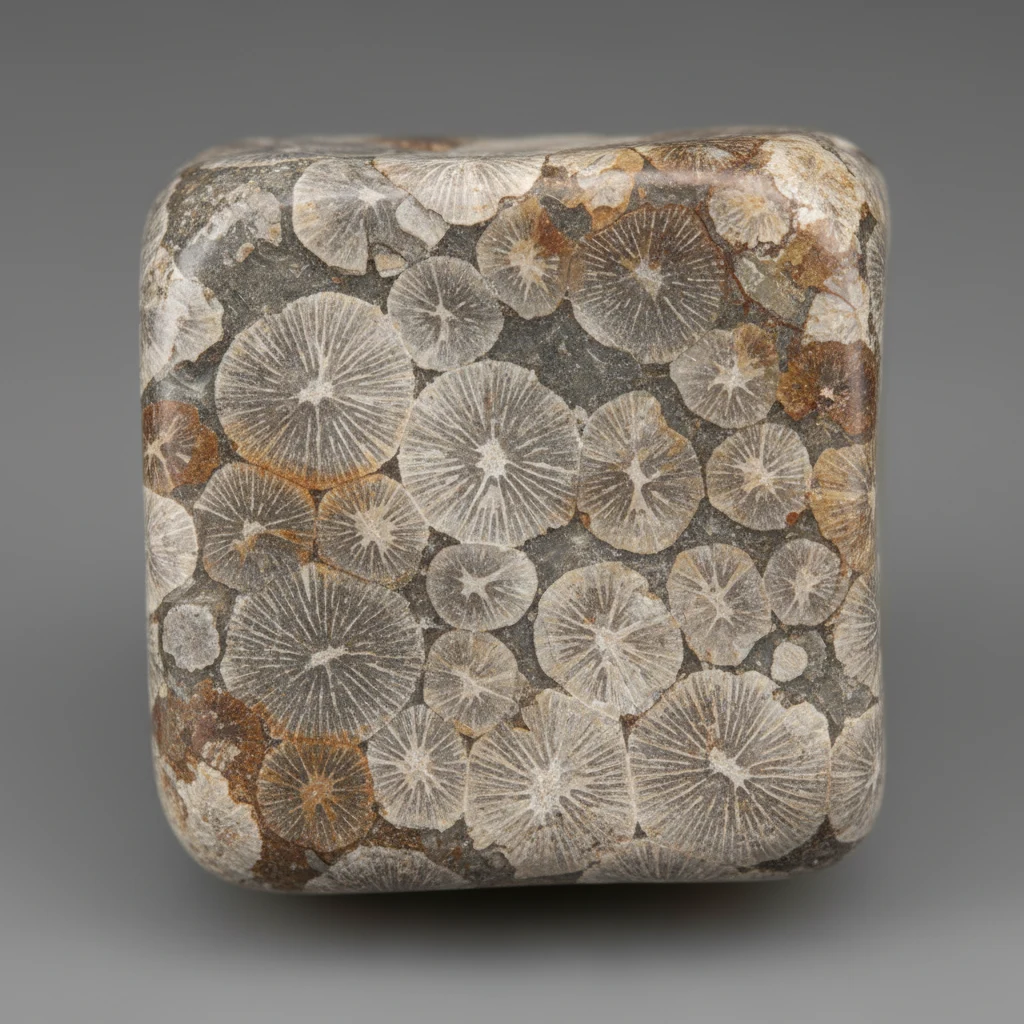
Quick answer: Petoskey Stone is a fossilized colonial coral, most often Hexagonaria percarinata, preserved in calcite-rich limestone. It is best recognized by its gray to brown color and honeycomb-like coral pattern, which becomes clearer when wet or polished.
AI Rock ID can help screen Petoskey Stone photos by checking for the fossil coral cell pattern, color range, and surface texture. RockIdentifier.io provides visual identification support, but uncertain specimens should be verified with locality, hardness, and close-up pattern inspection.
Good fit
- Collectors who like fossils, beach stones, and Great Lakes geology
- Beginners who want a recognizable stone with a clear visual pattern
- Lapidary hobbyists interested in hand-polishing softer fossil material
- People buying souvenirs from Michigan or Lake Michigan-area localities
Not a good fit
- Jewelry that will receive heavy abrasion or frequent impacts
- Collectors seeking rare transparent crystals or faceted gemstones
- Outdoor display in freezing, acidic, or high-wear conditions
Most commonly confused with
- Charlevoix Stone: Usually has smaller, tighter fossil coral patterns than Petoskey Stone.
- Fossiliferous Limestone: May contain shell or coral fragments but often lacks the consistent hexagonal coral-cell pattern.
- Agatized Coral: Typically silicified, harder, and more chalcedony-like than calcite-based Petoskey Stone.
- Septarian Nodule: Shows polygonal crack-fill patterns rather than individual fossil coral corallites.
Petoskey Stone Lookalikes
| Material | Typical Pattern | Key Difference |
|---|---|---|
| Petoskey Stone | Rounded hexagonal coral cells | Calcite-rich fossil coral from Michigan-area Devonian deposits |
| Charlevoix Stone | Smaller coral-cell pattern | Often finer and more compact-looking |
| Fossiliferous Limestone | Mixed shells or fossil fragments | Less uniform honeycomb pattern |
| Agatized Coral | Coral pattern in chalcedony | Harder and more glassy or waxy |
| Septarian Nodule | Crack network or compartments | Pattern is mineral-filled fractures, not coral cells |
AI identification confidence
AI identification is usually moderate to high when a Petoskey Stone photo shows a wet or polished surface with clear coral-cell structure. Confidence drops when the stone is dry, weathered, poorly lit, or photographed from too far away.
When AI gets it wrong
- Dry stones can hide the coral pattern and appear like ordinary gray limestone.
- Small Charlevoix Stone pieces may be mislabeled as Petoskey Stone without scale or close-up detail.
- Polished fossiliferous limestone can show attractive patterns that are not Hexagonaria coral.
- Printed, dyed, or resin souvenir items may imitate the pattern but lack natural fossil texture.
Final recommendation
Choose Petoskey Stone when the goal is a recognizable fossil coral specimen with Great Lakes regional significance. For buying, prioritize visible natural patterning, accurate locality information, and clear disclosure of whether the piece is raw, tumbled, polished, or stabilized.
How to Check Petoskey Stone Authenticity
A genuine Petoskey Stone should show a natural coral pattern made of repeated corallites rather than a printed or painted surface design. The pattern often becomes more visible when the stone is wet, and it should continue through worn edges or small chips rather than sitting only on the surface.
Buying Petoskey Stone Online
Online listings should show close-up photos of the pattern, the full stone, and any polished face. Useful descriptions include whether the stone was found in Michigan, whether it has been sealed or stabilized, and whether it is natural, tumbled, or cut into a cabochon.
Photo Tips for Petoskey Stone Identification
For accurate visual identification, photograph the stone both dry and wet in natural light. Include a close-up of the patterned surface and a scale reference such as a coin or ruler so the coral-cell size can be compared with common lookalikes.
What Is Petoskey Stone?
Petoskey Stone is a fossilized coral rock and a calcite variety, best recognized by its honeycomb-like hexagonal pattern. In hand, it is usually gray, brown, or cream, opaque, and modestly heavy for its size, with a dull to waxy surface that becomes more readable when cleaned or polished.
Collectors value Petoskey Stone for pattern first: the coral structure is the identity of the piece. Its Mohs hardness is 3–4, so it has fair scratch resistance and should be kept away from harder stones in storage. Chemically, it is a carbonate, CaCO3, with calcium, carbon, and oxygen listed as its main elements.
Origin & History
Petoskey Stone is named after Petoskey, Michigan, where it was first described in the 19th century. It is also recognized as a state stone of Michigan, giving it a strong collecting identity beyond ordinary beach stone or fossil material.
In a tray of lake-worn stones, Petoskey Stone stands out once the hexagonal coral cells catch the eye. For locality comparison and specimen research, collectors may consult mindat.org alongside label data, especially when separating Lake Michigan material from broader United States, Canada, or Mexico occurrences.
Where Is Petoskey Stone Found?
Petoskey Stone is most commonly found along the shores of Lake Michigan. Notable Michigan localities include Lake Michigan, Charlevoix, and Holland, where collectors look for gray to brown stones with visible fossil coral patterning.
Formation
Petoskey Stone forms from ancient coral reefs that underwent fossilization. Over millions of years, the original coral structure was replaced by minerals, preserving the distinctive hexagonal cellular pattern that makes the stone recognizable.
That fossil structure is the practical clue: it is not just a gray carbonate rock, but a preserved coral fabric in calcite. The result is an opaque, carbonate stone with a white streak, conchoidal fracture, and a density listed at 2.65 g/cm3.
How to Identify Petoskey Stone
Identify Petoskey Stone by its gray to brown color and distinctive hexagonal fossil coral pattern. The surface may look dull when dry, but the pattern often becomes clearer when the stone is cleaned with mild soap and water or viewed after gentle wetting.
Physical checks support the visual ID: Petoskey Stone is non-magnetic, opaque, has a white streak, and measures Mohs 3–4. It is listed with a hexagonal crystal system, refractive index of 1.65, no pleochroism, no birefringence, and uniaxial optical character.
Properties of Petoskey Stone
Physical Properties
| Crystal System | Hexagonal |
| Hardness (Mohs) | 3-4 (Medium (4-6)) |
| Density | 2.65 g/cm3 |
| Luster | Dull |
| Diaphaneity | Opaque |
| Fracture | Conchoidal |
| Streak | White |
| Magnetism | Non-magnetic |
| Colors | Gray, Brown, Cream |
Chemical Properties
| Classification | Carbonate |
| Formula | CaCO3 |
| Elements | Ca, C, O |
| Common Impurities | Mg, Fe |
Optical Properties
| Refractive Index | 1.65 |
| Birefringence | None |
| Pleochroism | None |
| Optical Character | Uniaxial |
Petoskey Stone Health & Safety
There are no significant health risks associated with handling Petoskey Stone.
Petoskey Stone Value & Price
Price Range
Rough/Tumbled: $10 - $50 per specimen
Cut/Polished: $20 - $100 per carat
Price can be influenced by size, quality, and pattern of the stone.
Durability
Moderate — Scratch resistance: Fair, Toughness: Good
Petoskey Stone is relatively stable but should be protected from harsh chemicals.
How to Care for Petoskey Stone
Use & Storage
Store in a soft pouch or box to avoid scratches.
Cleaning
Clean with mild soap and water using a soft cloth. Avoid acidic cleaners.
Cleanse & Charge
Place in sunlight or moonlight for cleansing.
Placement
Place in a prominent area to showcase its unique patterns.
Caution
Avoid exposing to harsh chemicals.
Works Well With
Petoskey Stone Meaning & Healing Properties
Petoskey Stone is used in crystal healing traditions for grounding, protection, clarity, and emotional healing. Its fossil coral pattern gives it a nature-connected feel in the hand, making it a popular meditation stone for calm focus, inner peace, trust, and self-discovery.
It is associated with the Root and Heart chakras, Cancer and Pisces, the Earth element, and the planet Earth. These meanings are cultural and spiritual rather than medical; Petoskey Stone is not intended for medical use, diagnosis, or treatment.
Identify Petoskey Stone from a photo
Compare Petoskey Stone traits, care tips, value clues, and common lookalikes with a clear photo.
Common mistakes
- Assuming every gray beach stone from Michigan is Petoskey Stone.
- Identifying a dry, unpatterned surface without wetting or cleaning the stone first.
- Confusing Charlevoix Stone with Petoskey Stone solely because both are fossil corals.
- Using vinegar or acidic cleaners, which can react with calcite-rich material.
- Expecting Petoskey Stone to be durable enough for high-wear rings or bracelets.
- Buying souvenir pieces without checking whether the pattern is natural or printed.