Septarian


Quick answer: Septarian is a patterned concretion made mainly of calcite, aragonite, and limestone or clay-rich material. Its brown outer matrix, yellow calcite veins, and gray areas make it popular for polished nodules, slabs, spheres, and display pieces.
AI Rock ID can help compare a septarian photo against common visual matches such as calcite, aragonite, jasper, and fossil-bearing limestone. RockIdentifier.io supports identification by combining image-based clues with observable traits like color zoning, crack-fill patterns, luster, and surface texture.
Good fit
- Collectors who like bold natural patterns in polished nodules or slabs
- Display pieces where brown, yellow, and gray contrast is important
- Beginners learning to recognize concretions and mineral-filled cracks
- Buyers who want a decorative stone with visible calcite vein structure
Not a good fit
- People needing a hard, scratch-resistant stone for daily-wear rings
- Outdoor display where moisture, acids, or freezing conditions may damage the surface
- Buyers expecting every piece to show bright yellow calcite veins
- Anyone seeking a transparent single mineral rather than a mixed rock-like concretion
Most commonly confused with
- Calcite: Calcite may form the yellow vein fill in septarian, but septarian includes matrix material and crack patterns rather than being a single uniform calcite specimen.
- Aragonite: Aragonite can occur in septarian, but standalone aragonite usually lacks the distinctive mud-crack or dragon-scale pattern.
- Jasper: Jasper is typically harder, silica-rich, and more uniform in fracture, while septarian often has softer calcite veins and a concretionary structure.
- Fossiliferous Limestone: Fossiliferous limestone may show shells or fossil fragments, while septarian is recognized by filled shrinkage cracks within a concretion.
Septarian vs. Common Lookalikes
| Stone | Typical Pattern | Key Difference |
|---|---|---|
| Septarian | Brown, yellow, and gray crack-fill network | Concretion with calcite or aragonite-filled shrinkage cracks |
| Calcite | Transparent to opaque masses or rhombs | Usually one main mineral without brown concretion matrix |
| Jasper | Opaque bands, spots, or earthy patterns | Harder silica material; usually not acid-reactive like calcite |
| Fossiliferous limestone | Shells, fossil fragments, or sedimentary texture | Fossil structures are more diagnostic than filled polygonal cracks |
| Aragonite | Fibrous, radiating, or banded forms | May be a component of septarian but lacks the full nodule structure |
AI identification confidence
AI identification confidence for septarian is usually higher when the photo shows polished brown-gray matrix with yellow calcite-filled cracks. Confidence is lower for close-up images of only the yellow vein material, rough weathered nodules, or pieces with unusual coloration.
When AI gets it wrong
- Only a small section of yellow calcite is visible without the surrounding brown or gray matrix
- The specimen is dyed, coated, or heavily polished so natural texture is obscured
- Lighting makes gray limestone areas appear blue, green, or black
- A fossiliferous limestone or jasper slab has a similar earthy pattern but no true septarian crack-fill network
Final recommendation
Choose septarian based on visible crack-fill contrast, stable polish, and accurate disclosure of any resin filling or surface coating. For jewelry, pendants and occasional-wear pieces are more practical than rings because the calcite-rich areas can scratch or react to acids.
How to Identify Real Septarian
Real septarian usually shows a natural network of filled cracks within a rounded or slabbed concretion. Look for yellow to honey calcite veins, brown aragonite or limestone-rich areas, and gray matrix that transitions naturally rather than appearing printed or painted. Small pits, uneven vein thickness, and irregular boundaries are common in genuine pieces.
Buying Tips for Septarian
When buying septarian, check whether the piece is natural, stabilized, resin-filled, dyed, or coated. Polished septarian can contain natural voids, so filled cracks are not always a problem if they are disclosed. Strong contrast, clean polish, stable edges, and an attractive nodule shape often affect desirability more than size alone.
Common Treatments and Enhancements
Septarian is sometimes stabilized with resin to strengthen porous areas or fill open cracks before polishing. Surface coatings may be added to increase shine, and dyed material may show unusually bright or uniform colors. A seller should disclose major stabilization, dye, or repair work, especially for higher-priced display pieces.
What Is Septarian?
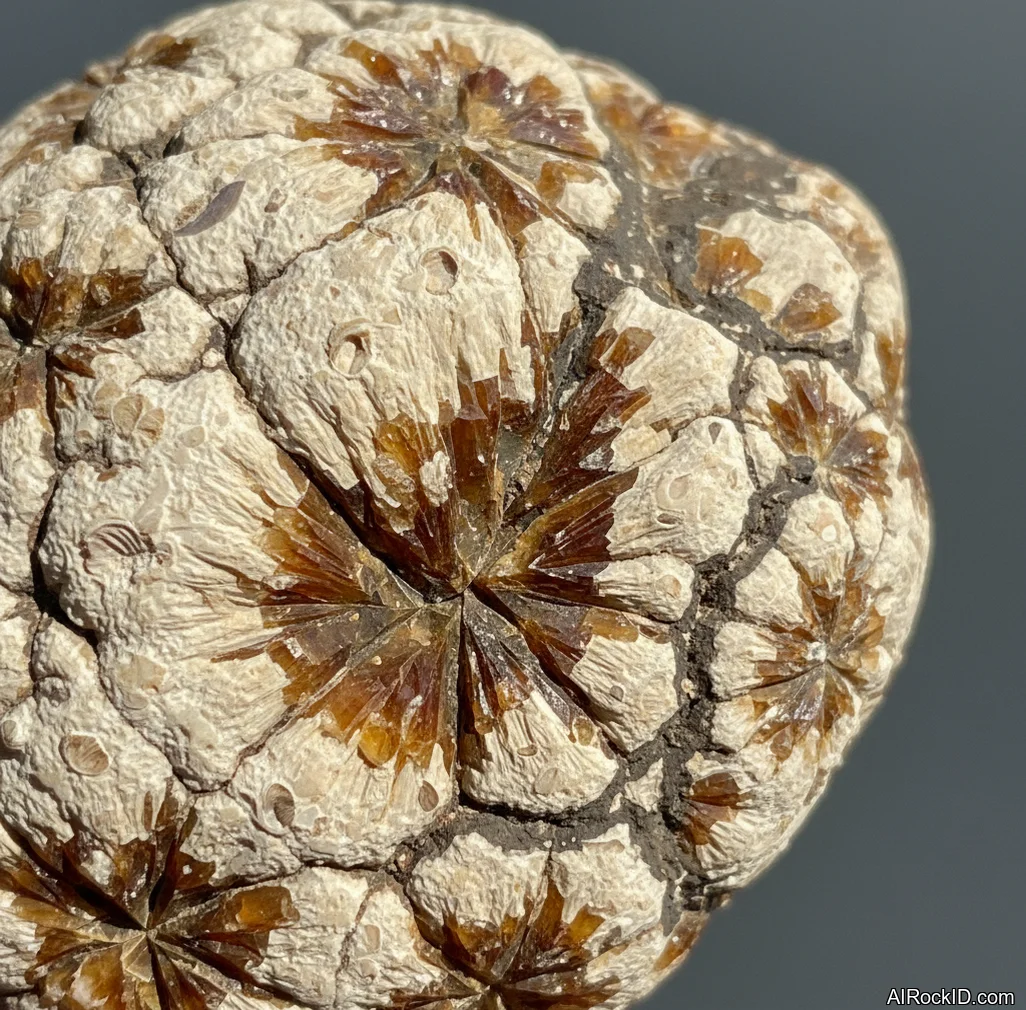
Septarian is a sedimentary concretion made of mudstone or limestone that cracked, then later got filled in with minerals like calcite and aragonite.
Grab a decent nodule and the first thing you clock is the heft. It’s got that dense, no-nonsense weight that sinks into your palm like a river rock, not a pointy crystal you’d set on a shelf. And the pattern? That’s the whole point. Those sharp, angular “turtle shell” cracks with honey-yellow calcite running through them. People see it once and go, “dragon stone.” Hard to argue.
Most of what’s for sale is cut and polished because the outside, raw, can look kind of blah until somebody cracks it open (honestly, who’d guess?). But slice it and you get the brown matrix, cream to gray edges, and those yellow veins that jump out under shop lights. Some pieces even have a little glitter tucked into small pockets where the calcite didn’t quite fill all the way. Pretty satisfying.
Origin & History
“Septarian” comes from the Latin *septum*, meaning partition or fence, which fits because the nodule has those internal cracks that split it up into sections. It isn’t a single mineral species, so in older books you’ll find it filed under concretion descriptions instead of a neat little “first described by” mineral entry.
Collectors were calling these crack-filled nodules “septarian” as a handy label way before the metaphysical market cared. And you’ll see “septaria” used for the crack pattern itself. Dealers also sometimes push “dragon stone” for the wow factor (sounds cooler on a tag, right?), even though that name gets slapped on other materials too.
Where Is Septarian Found?
Septarian nodules turn up in marine sedimentary layers worldwide, especially in Cretaceous and Jurassic-aged shales and limestones. The Madagascar nodules and Utah material are the ones I see most often on dealer tables.
Formation
Most septarian starts off as a plain lump of mud or limey sediment that gets cemented into a concretion while it’s still buried. Then it splits. People still argue about what kicks that off, but shrinkage, dewatering, and pressure changes during burial are the usual suspects.
And those cracks don’t stay empty for long. Later on, fluids work their way through and leave minerals behind in the gaps, usually calcite and/or aragonite, and sometimes there’s a bit of barite in there too. So you can pick up one nodule and see a couple textures right away: a dense brown matrix, that buttery yellow vein fill, plus the occasional tiny cavity that feels gritty if you drag a fingertip across it (you can almost feel the rough little crystals catch).
How to Identify Septarian
Color: Typical septarian shows a brown to gray matrix with cream edges and yellow to amber calcite vein fill. Some pieces lean more gray and tan, especially if the calcite is pale.
Luster: Polished faces range from waxy to vitreous depending on how much calcite vein you’re looking at.
Look closely for polygonal crack networks that cut through a concretion body, not random webbing on the surface. The real test is the cross section: the veins should be mineral fill, not paint sitting in grooves. And if you tap it with a fingernail, the calcite-heavy areas often sound a little “tighter” than the softer matrix, almost like two different stones bonded together.
Common Look-Alikes
Septarian is sometimes confused with these materials:
- Cracked calcite or aragonite chunks sold as "septarian" (especially honey calcite with natural fracture lines)
- Dragon Stone (septarian jasper) from South Africa, which is a different material but gets lumped under the same name online
- Brecciated jasper or brecciated chert with tan cement, especially when it’s cut into eggs and the cracks look “mapped”
- Dyed crackle agate or dyed crackle quartz (artificially fractured then dyed to make dark lines in the cracks)
- Resin or glass "septarian eggs" with painted crack networks (tourist-market decor pieces)
- Turtle jasper / net jasper type patterned rhyolite sold under whatever name moves that week
Market Cautions & Treatments
When AI Can Get This Wrong
At first glance, photos trick AI hard when the crack network is high-contrast, so dyed crackle agate and brecciated jasper get called septarian all the time. The real test is tactile: septarian feels like a heavy mudstone nodule with calcite seams, and a steel pin will bite the calcite fill way easier than it would on agate or jasper. If you’ve got a UV light, some calcite-filled seams will fluoresce, but agate and most jaspers usually won’t.
Properties of Septarian
Physical Properties
| Crystal System | Trigonal |
| Hardness (Mohs) | 3 (Soft (2-4)) |
| Density | 2.6-2.9 g/cm3 |
| Luster | Vitreous |
| Diaphaneity | Opaque |
| Fracture | Uneven |
| Streak | white |
| Magnetism | Non-magnetic |
| Colors | brown, tan, gray, cream, yellow, amber |
Chemical Properties
| Classification | Carbonates (dominantly calcium carbonate) |
| Formula | CaCO3 (dominant; calcite and aragonite) |
| Elements | Ca, C, O |
| Common Impurities | Fe, Mn, Ba, S |
Optical Properties
| Refractive Index | 1.49-1.66 |
| Birefringence | 0.172 |
| Pleochroism | None |
| Optical Character | Uniaxial |
Septarian Health & Safety
Septarian’s usually fine to pick up, hold, and keep on a shelf. But if you’re cutting or grinding it, don’t let it turn into dust and don’t breathe that stuff in. Same rule as with any stone, really.
Safety Tips
If you’re sanding or polishing, keep things wet, crack a window or run a fan for airflow, and wear a real particulate-rated respirator, not just a flimsy dust mask.
Septarian Value & Price
Price Range
Rough/Tumbled: $10 - $250 per piece
Price usually comes down to three things: how crisp the pattern looks, how clean the polish is, and how big the piece is. The ones with clean yellow calcite veins and those tight, even “plates” (the kind you can feel with your fingertip when you tilt it under a light) move quick. But if it’s muddy and the contrast is weak? Those pieces just sit around.
Durability
Moderate — Scratch resistance: Poor, Toughness: Fair
It’s stable in normal room conditions, but the calcite content means it scratches and etches easier than people expect.
How to Care for Septarian
Use & Storage
Store it like you’d store calcite: away from harder stones that can scuff it up. If it’s a polished egg or sphere, a small ring stand keeps it from rolling into trouble.
Cleaning
1) Rinse briefly with lukewarm water and a drop of mild soap. 2) Use a soft toothbrush for grime in the cracks. 3) Rinse again and pat dry; don’t soak it for hours if you’ve got open pockets.
Cleanse & Charge
For non-water methods, I stick to smoke, sound, or a night on a shelf away from direct sun. If you use selenite, set septarian next to it rather than rubbing it.
Placement
On a desk it’s great because you can actually study the pattern up close. I like putting a cut half where side light hits it, since the calcite veins catch the glow.
Caution
Skip acids and acid-based cleaners, vinegar included, because calcite will etch. And don’t just toss it into a bowl with quartz points. Unless you’re cool with random little scratches showing up later (the kind you only notice when the light hits it just right).
Works Well With
Septarian Meaning & Healing Properties
A lot of people who pick up septarian for “energy” stuff are really reacting to the way it looks and feels in your hand. It’s earthy. Solid. And the whole cracked-then-healed thing is right there in the pattern, which hits home for folks who are trying to steady themselves again.
In my own stash, septarian’s one of the stones I grab when I want something steady sitting on the table while I’m sorting other material or slogging through paperwork. When you pick up a polished nodule, it stays cool longer than you’d think, especially if the room’s a little chilly, and it’s got this satisfying heft that settles you down in a plain, physical way. But look, I’m not going to act like it replaces sleep, therapy, or a doctor.
So if you’re using it during meditation, here’s the practical move: use a piece with strong contrast so your eyes have something to lock onto. The issue with a lot of cheaper septarian is the pattern goes kind of muddy, and then it’s just a brown rock with faint lines. Better material has crisp “cells” and veins that look like somebody drew them in with a pen, and that sense of visual order is what people are responding to (even if they don’t say it that way).
Common mistakes
- Assuming every brown-and-yellow polished stone is septarian without checking for a true crack-fill network
- Calling septarian a single mineral, even though it is usually a concretion made of several mineral and rock components
- Using vinegar, lemon juice, or acidic cleaners, which can dull or etch calcite-rich areas
- Expecting rough nodules to show the same high contrast as polished slabs or spheres
- Mistaking resin-filled voids for a fake specimen without considering whether stabilization was disclosed
Identify Septarian from a photo
Compare Septarian traits, care tips, value clues, and common lookalikes with a clear photo.