Bone


Quick answer: Bone is an organic, porous material made mainly of collagen and calcium phosphate minerals, and it may be modern, archaeological, or fossilized. Collectors identify it by its lightweight feel, pore pattern, surface texture, and whether mineral replacement or age-related staining is present.
AI Rock ID can help compare a bone-like specimen against common lookalikes such as ivory, antler, shell, and fossil bone using visible texture and structure. RockIdentifier.io provides specimen information for collectors, but legal status, species origin, and age may require expert or institutional verification.
Good fit
- Collectors comparing organic materials, fossils, and mineral-replaced specimens
- People learning to separate bone from ivory, antler, shell, or plastic imitations
- Educational collections where provenance and ethical sourcing are documented
- Specimens with visible pores, trabecular structure, or mineral staining
Not a good fit
- Buyers who cannot verify legal and ethical sourcing
- Jewelry or carving projects that require high durability and water resistance
- Specimens from protected species, unknown wildlife sources, or restricted archaeological contexts
- Households where fragile porous pieces may be handled frequently
Why people search for this
People often search for bone specimens to determine whether a piece is modern bone, fossil bone, antler, ivory, or a synthetic imitation. Identification matters because value, legality, handling, and conservation needs can differ widely.
Most commonly confused with
- Fossil Bone: Fossil bone is usually heavier or more stone-like when mineralized, while modern bone is lighter and more porous.
- Ivory: Ivory is dense and often shows Schreger lines in elephant material, while bone has small pores and canal-like openings.
- Antler: Antler commonly has a denser outer cortex and a spongy interior, but its growth texture differs from many skeletal bones.
- Shell: Shell is calcium carbonate with layered or nacreous structure, while bone has a fibrous, porous internal pattern.
Bone vs Common Lookalikes
| Material | Typical texture | Key identification clue | Collector caution |
|---|---|---|---|
| Modern bone | Porous, fibrous, lightweight | Visible pores and cancellous structure | May require ethical sourcing proof |
| Fossil bone | Stone-like or mineral-stained | Heavier feel and mineral-filled pores | Local fossil laws may apply |
| Ivory | Dense, smooth, fine-grained | Schreger lines or cross-hatching in some types | Strict wildlife trade restrictions |
| Antler | Dense outside, spongy inside | Growth form and outer cortex pattern | Often confused with carved bone |
| Plastic imitation | Uniform, molded, sometimes glossy | Repeated patterns or seam lines | Low collector value if misrepresented |
AI identification confidence
AI identification is most reliable when the specimen has clear close-up photos of pores, broken edges, surface texture, and scale. Confidence is lower for polished carvings, heavily stained pieces, small fragments, and items that may be ivory or synthetic material.
When AI gets it wrong
- Polished bone, ivory, and plastic can appear similar in photos without visible pores.
- Fossil bone may be mistaken for ordinary rock if mineral replacement obscures original structure.
- Antler fragments can look like bone when only the spongy interior is shown.
- Lighting, stain, glue, or conservation coatings can hide natural texture.
Final recommendation
Treat bone specimens as organic or fossil material rather than ordinary mineral crystals, and prioritize provenance, legality, and condition over appearance alone. For uncertain pieces, compare pore structure under magnification and seek expert review before buying, selling, or exporting.
How to Check Bone Authenticity Before Buying
Ask for clear photos of broken edges, pore structure, scale, and any collection labels before purchasing a bone specimen. Authentic bone usually shows irregular natural porosity rather than repeated molded texture. For carved items, request written information about material, species if known, age, and country of origin.
Legal and Ethical Notes for Bone Specimens
Bone specimens can be subject to wildlife, archaeological, fossil, or import laws depending on species, age, and location. Avoid items from protected species or sellers who cannot provide basic provenance. Museum, university, or local government guidance may be needed for archaeological or vertebrate fossil material.
Photo Tips for Identifying Bone
Use natural light and include a ruler, coin, or caliper for scale. Photograph the outer surface, any broken or cut edge, and close-ups of pores or internal structure. A magnified image of the texture often helps separate bone from ivory, antler, shell, and plastic.
What Is Bone?
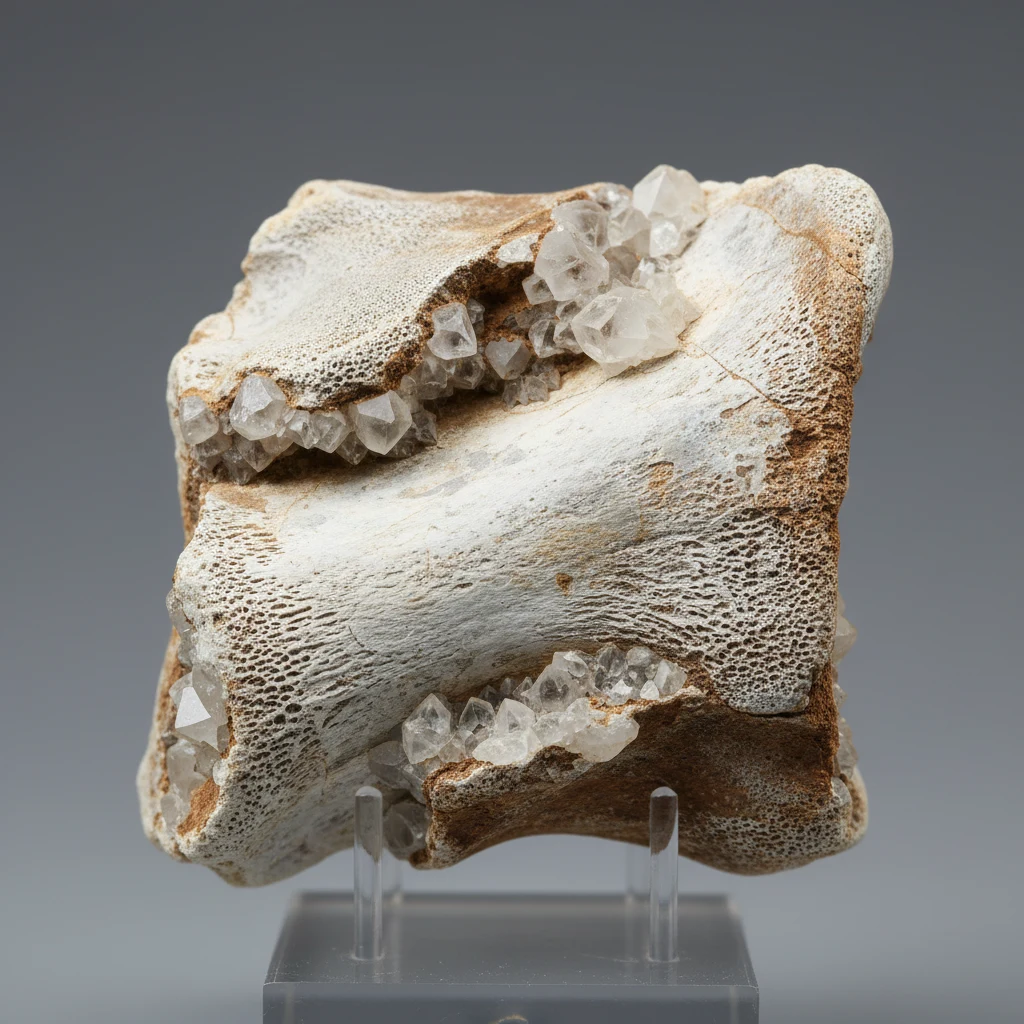
Bone is an organic gem material and a rigid organ that forms the skeleton of vertebrates. In the hand, it is recognized less by sparkle than by structure: dense yet visibly porous, opaque, and usually white, cream, off-white, or brown. Its luster is dull to slightly shiny, and a broken edge may show an uneven fracture rather than a clean crystal face.
For collectors, Bone is a very common material with moderate durability. It has a Mohs hardness of 5-6, fair scratch resistance, good toughness, and a density of 1.8-2.0 g/cm3. It is non-magnetic, amorphous, and has a white streak. Its listed formula is C2H10Ca2O6P, with carbon, hydrogen, calcium, oxygen, and phosphorus.
Origin & History
The word Bone comes from the Old English “ban,” and the material has been known since ancient times. Unlike a mineral crystal grown in a pocket or vein, Bone belongs to the organic class; its collector interest often comes from texture, age, cultural use, and the physical record of vertebrate life.
A labeled Bone specimen should be treated as a locality object as much as a material object. For checking locality names and comparing specimen records, collectors often consult databases such as mindat.org, then return to the piece itself: its weight, pores, color, and dense feel are the practical clues that separate it from many pale look-alikes.
Where Is Bone Found?
Bone is found wherever vertebrate animals exist, which is why its rarity label is very common. The supplied locality list includes the USA, Canada, and China, with noted places such as the Grand Canyon in Arizona, the Great Plains in the USA, and Dongguan in Guangdong, China.
Formation
Bone forms through ossification, a biological process in which cartilage is replaced by mineralized tissue. That origin explains why it does not show a normal crystal habit: the listed crystal system is amorphous, and the surface is more likely to show pores, density changes, and organic structure than geometric faces.
This biological formation also shapes its care profile. Bone is relatively stable, but it can degrade over time, especially if exposed to poor conditions. Store it in a cool, dry place away from direct sunlight, avoid extreme temperatures, and place it where it will not be knocked or chipped.
How to Identify Bone
Identify Bone by its dense, porous structure, opaque body, and white to off-white, cream, or brown color range. It feels lighter than many dense stones but still substantial for its size, with a density of 1.8-2.0 g/cm3. The luster is dull to slightly shiny, and the streak is white.
A practical check is to look for texture before color. Bone can resemble other pale materials at a glance, but its pore pattern, uneven fracture, non-magnetic response, and medium Mohs hardness of 5-6 are useful field clues. Use gloves when handling old specimens, especially if the piece is old or fossilized.
Properties of Bone
Physical Properties
| Crystal System | Amorphous |
| Hardness (Mohs) | 5-6 (Medium (4-6)) |
| Density | 1.8-2.0 g/cm3 |
| Luster | Dull |
| Diaphaneity | Opaque |
| Fracture | Uneven |
| Streak | White |
| Magnetism | Non-magnetic |
| Colors | White, Cream, Brown |
Chemical Properties
| Classification | Organic |
| Formula | C2H10Ca2O6P |
| Elements | C, H, Ca, O, P |
| Common Impurities |
Optical Properties
| Refractive Index | 1.54-1.64 |
| Birefringence | None |
| Pleochroism | None |
| Optical Character | Isotropic |
Bone Health & Safety
Bone is generally safe, but handling old or fossilized bone may pose risks.
Bone Value & Price
Price Range
Rough/Tumbled: $1 - $10 per specimen
Cut/Polished:
Price can vary based on size and quality.
Durability
Moderate — Scratch resistance: Fair, Toughness: Good
Bone is relatively stable but can degrade over time.
How to Care for Bone
Use & Storage
Store in a cool, dry place away from direct sunlight.
Cleaning
Clean bone with a damp cloth and mild soap. Avoid harsh chemicals.
Cleanse & Charge
Use sage smoke or place under moonlight for cleansing.
Placement
Place in a stable area to avoid damage.
Caution
Avoid exposure to extreme temperatures.
Works Well With
Bone Meaning & Healing Properties
In traditional crystal and object work, Bone is associated with grounding, protection, strength, resilience, and support. Its Root chakra link fits the way it feels in practice: not flashy, but steady, structural, and weight-bearing. These meanings are cultural and spiritual associations, not a substitute for medical treatment.
Bone is also connected with Capricorn, Aquarius, Saturn, and the Earth element. For care-based ritual use, cleanse it with sage smoke or place it under moonlight; for physical cleaning, use a damp cloth with mild soap and avoid harsh chemicals. It pairs well with clear quartz, amethyst, and rose quartz.
Identify Bone from a photo
Compare Bone traits, care tips, value clues, and common lookalikes with a clear photo.
Common mistakes
- Assuming every white or cream-colored carved object is bone.
- Calling a specimen fossil bone without checking for mineral replacement or geologic context.
- Ignoring legal restrictions on ivory, protected wildlife, and vertebrate fossils.
- Using hot-pin or destructive tests on collectible or potentially important specimens.
- Cleaning porous bone with bleach, acids, or soaking methods that can damage the material.
- Relying on color alone, since staining, age, soil minerals, and coatings can change appearance.