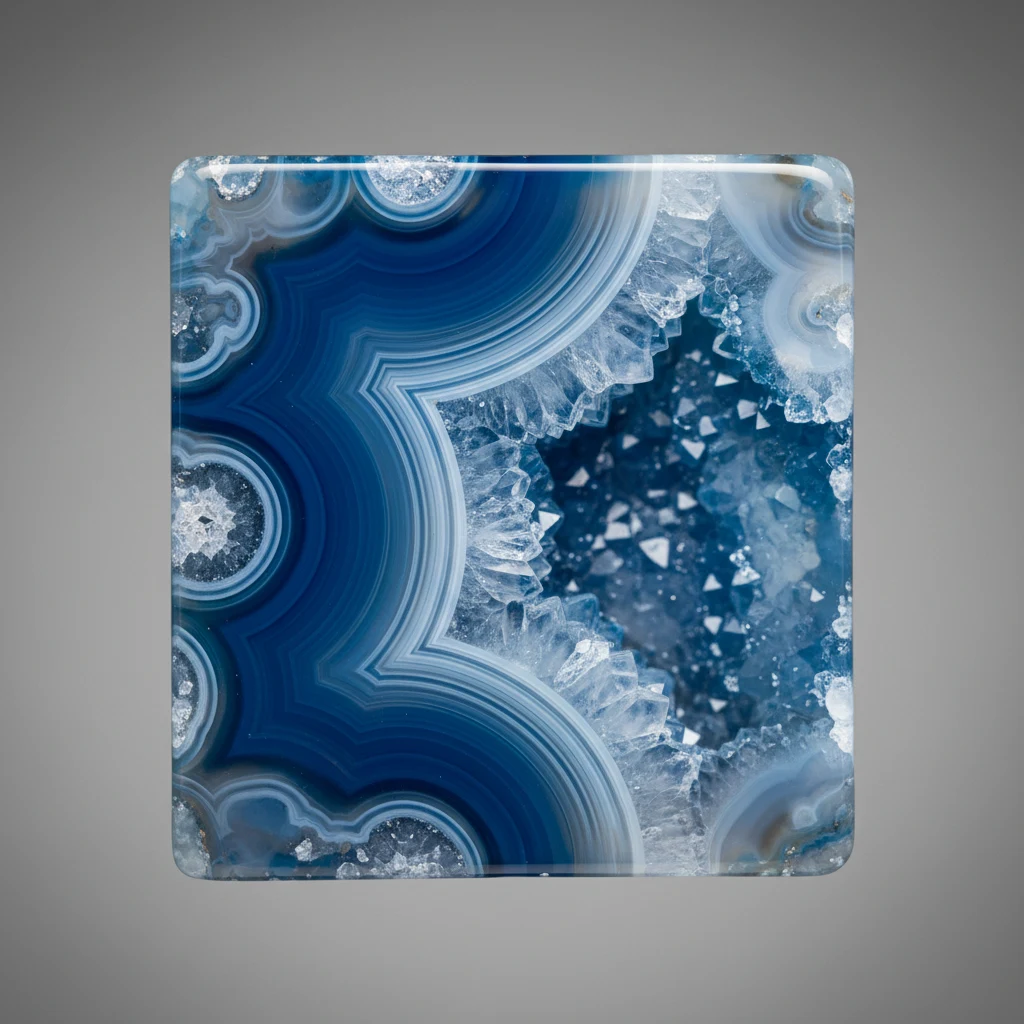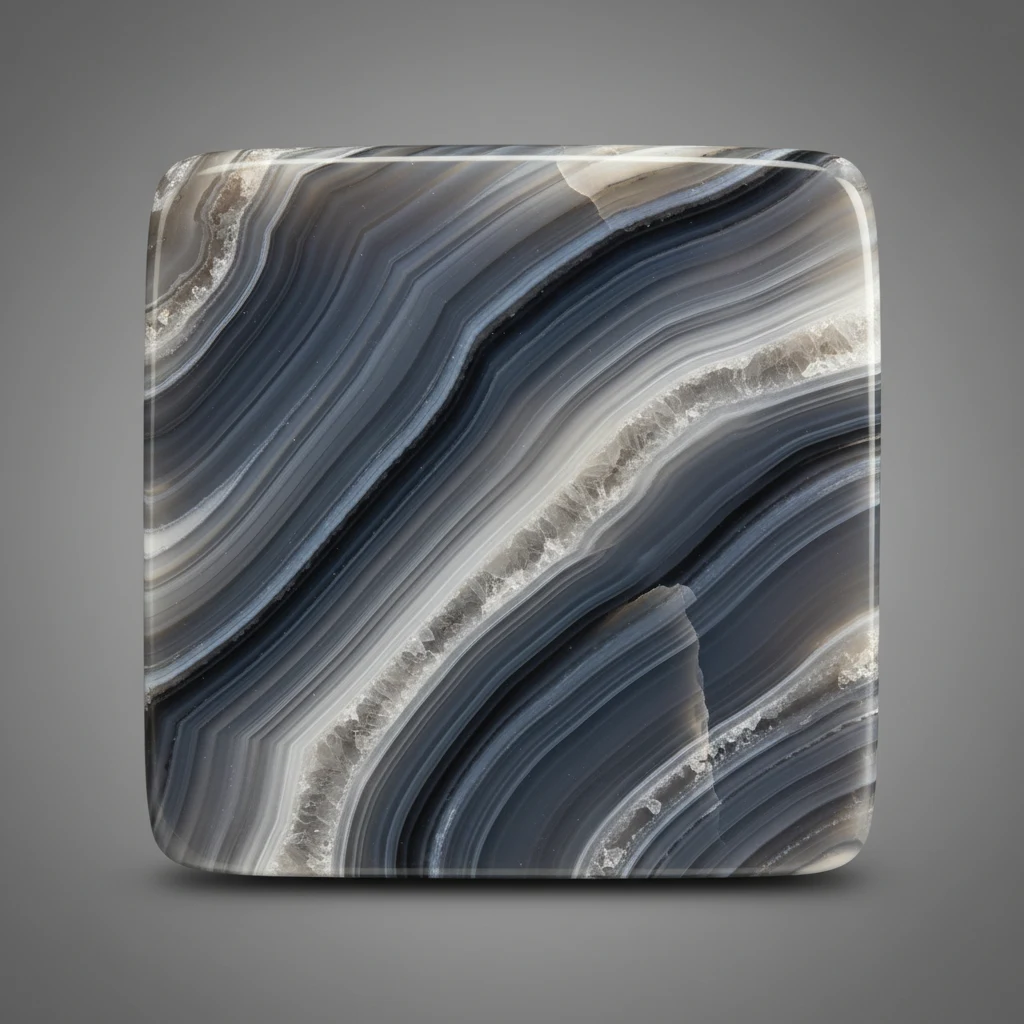
Gray Agate


Quick answer: Gray Agate is a gray to gray-white variety of banded chalcedony, usually identified by its waxy luster, fine-grained texture, and curved or layered banding. It is often used for beads, cabochons, carvings, bookends, and decorative slabs because it is durable and takes a good polish.
AI Rock ID can help compare a photo of Gray Agate against common lookalikes by checking color, banding, translucency, and surface texture. RockIdentifier.io provides visual identification support, but final confirmation may require hardness testing, magnification, or a gemologist when color treatment or imitation is suspected.
Good fit
- Everyday jewelry such as beads, pendants, and cabochons
- Decorative objects, including slices, towers, and bookends
- Collectors who prefer neutral gray, white, and smoky banding
- Beginners learning to recognize chalcedony and agate textures
- Settings that need a durable stone with subtle color
Not a good fit
- Buyers seeking a rare or high-value collector gemstone
- Anyone who wants bright natural color without dye treatment concerns
- Situations requiring a precise species ID from a photo alone
- People looking for a transparent faceted gem appearance
Most commonly confused with
- Botswana Agate: Often shows fine gray, pink, brown, or apricot bands; Gray Agate is a broader color description rather than a locality-based variety.
- Onyx: Onyx has straighter, more parallel bands, while agate usually has curved, irregular, or fortification-style banding.
- Gray Jasper: Jasper is opaque and usually lacks the translucent edges and waxy depth seen in many agates.
- Flint: Flint can be gray chalcedony but typically appears more uniform and may show conchoidal fracture rather than decorative banding.
Gray Agate vs. Common Lookalikes
| Material | Typical Clues | Key Difference |
|---|---|---|
| Gray Agate | Gray-white curved bands, waxy luster, possible translucent edges | Banded chalcedony with subtle layered patterns |
| Onyx | Straight, parallel bands, often black-white or brown-white | Banding is usually flatter and more even |
| Gray Jasper | Opaque gray body, earthy or matte areas, little translucency | Lacks agate-style translucency and fine band depth |
| Flint | Uniform gray, sharp conchoidal breaks, nodular forms | Usually less decorative and less distinctly banded |
| Dyed Agate | Color collects in cracks or pores; unusually uniform gray or black | Color may be treatment-related rather than natural |
AI identification confidence
AI identification confidence for Gray Agate is usually moderate when clear banding, translucency at the edges, and a polished or freshly broken surface are visible. Confidence drops when the stone is opaque, heavily dyed, carved, photographed under colored lighting, or shown without scale.
When AI gets it wrong
- A polished gray stone has no visible banding and could be jasper, flint, or another chalcedony variety.
- The image shows a dyed or enhanced specimen with color that obscures natural banding.
- A carving or bead is photographed too close, making texture and translucency hard to judge.
- The stone is labeled by trade name, locality, or metaphysical name rather than mineral features.
Final recommendation
Choose Gray Agate if you want a durable, neutral-toned chalcedony with visible banding and a polished finish. For authenticity, look for natural-looking gray and white layers, ask whether the stone has been dyed, and compare it with onyx, jasper, and flint before buying.
How to Check Gray Agate Before Buying
Look for fine banding, a waxy to glassy polish, and slight translucency along thin edges or pale bands. Ask sellers whether the stone is natural, dyed, heat-treated, or stabilized, especially for beads and decorative slices. Very uniform dark gray or black color can be natural in some chalcedony, but it is also common in treated agate products.
Natural Gray Agate vs. Dyed Gray Agate
Natural Gray Agate usually has uneven gray, white, smoky, or bluish-gray layers with gradual changes between bands. Dyed agate may show stronger color in fractures, pits, drill holes, or porous bands. Dye treatment is common in agate and is not always a problem, but it should be disclosed for accurate identification and pricing.
Photo Tips for Identifying Gray Agate
Use bright neutral light and include photos of the front, back, edge, and any broken or unpolished area. Place the stone beside a coin or ruler to show scale, and avoid filters that change gray, white, or blue tones. A close-up of the banding is often more useful than a distant photo of the whole object.
What Is Gray Agate?
Gray Agate is a common gray variety of chalcedony, valued for its smooth feel and layered bands in gray, white, and sometimes black. In the hand, a polished piece often feels cool, dense, and glassy-waxy, with the banding giving even a quiet specimen a sense of movement. It is a semi-precious gemstone and is often used in jewelry and decorative items.
Mineralogically, Gray Agate is a silicate with the formula SiO2 and belongs to the trigonal crystal system. Its Mohs hardness is 6.5, with good scratch resistance, fair toughness, and a stable nature in normal handling. It is safe to handle, non-toxic, non-magnetic, and generally durable, though a hard strike can chip it.
Origin & History
Gray Agate belongs to the agate tradition described since ancient times. The name “agate” comes from the Achates River in Sicily, where agate was first discovered in antiquity. That history suits the stone’s look: restrained bands, smooth polish, and a practical durability that made it useful long before modern collecting.
For collectors, Gray Agate is less about rarity and more about pattern, finish, and locality. A clean gray piece with crisp pale banding can be more appealing than a larger but muddy specimen. Locality names and mineral records are commonly checked against mindat.org when documenting agate specimens for a collection.
Where Is Gray Agate Found?
Gray Agate is found in Brazil, India, and the United States. Notable localities listed for this material include Sao Paulo, Brazil; Maharashtra, India; and Montana, USA. In the market, pieces from these broad source areas may appear as rough nodules, polished stones, cut gems, or decorative objects.
Formation
Gray Agate forms when silica is deposited in cavities of volcanic rocks over time. Layer by layer, the silica builds the banded structure that gives agate its recognizable look. In a cut or polished piece, those layers may appear as pale gray, charcoal, white, or softly alternating bands.
This layered growth is the main reason Gray Agate is so tactile and collectible. A broken surface may show conchoidal fracture, while a polished face shows the banding more clearly under light. Its density is listed as 2.60 g/cm3, and its surface luster ranges from vitreous to waxy.
How to Identify Gray Agate
Identify Gray Agate by its gray color, smooth surface, and banded chalcedony appearance. It typically shows shades of gray with white or lighter bands, and some pieces include black. The stone is usually translucent to opaque, so a thin edge may pass light while thicker areas remain cloudy or solid-looking.
A practical check is to examine the luster and fracture. Gray Agate has a vitreous to waxy luster, a white streak, conchoidal fracture, and a Mohs hardness of 6.5. It is non-magnetic, has a refractive index of 1.53 to 1.54, and is listed with no birefringence or pleochroism.
Properties of Gray Agate
Physical Properties
| Crystal System | Trigonal |
| Hardness (Mohs) | 6.5 (Medium (4-6)) |
| Density | 2.60 g/cm3 |
| Luster | Vitreous |
| Diaphaneity | Translucent |
| Fracture | Conchoidal |
| Streak | white |
| Magnetism | Non-magnetic |
| Colors | Gray, White, Black |
Chemical Properties
| Classification | Silicate |
| Formula | SiO2 |
| Elements | Si, O |
| Common Impurities | Fe, Mn |
Optical Properties
| Refractive Index | 1.53 - 1.54 |
| Birefringence | None |
| Pleochroism | None |
| Optical Character | Isotropic |
Gray Agate Health & Safety
Gray Agate poses no significant health risks.
Gray Agate Value & Price
Price Range
Rough/Tumbled: $10 - $50 per specimen
Cut/Polished: $5 - $20 per carat
Price is affected by size, quality, and whether it is polished.
Durability
Durable — Scratch resistance: Good, Toughness: Fair
It is stable but can chip if struck hard.
How to Care for Gray Agate
Use & Storage
Store in a soft pouch to avoid scratches.
Cleaning
Clean with warm soapy water and a soft cloth. Avoid harsh chemicals.
Cleanse & Charge
Cleanse it by placing it under running water or in sunlight.
Placement
Place it in a cool, dry area away from direct sunlight.
Caution
Avoid exposing it to extreme temperatures.
Works Well With
Gray Agate Meaning & Healing Properties
In crystal healing traditions, Gray Agate is believed to promote emotional balance, stability, and grounding. Its quiet gray bands make it a stone many practitioners choose when they want a calm, steadying piece rather than a bright focal crystal. It is associated with the Root Chakra, Earth element, and Mercury.
Gray Agate is used symbolically for grounding, calming energy, stress relief, inner peace, focus, self-discovery, creativity, protection, and insight. It is associated with Gemini and Cancer. For care, clean it with warm soapy water and a soft cloth, avoid harsh chemicals and extreme temperatures, and store it in a soft pouch.
Identify Gray Agate from a photo
Compare Gray Agate traits, care tips, value clues, and common lookalikes with a clear photo.
Common mistakes
- Assuming every gray banded stone is natural Gray Agate without checking for dye.
- Calling all black-and-white banded chalcedony onyx, even when the bands are curved or irregular.
- Identifying opaque gray jasper as agate without looking for translucency at thin edges.
- Using color alone for identification instead of banding, luster, hardness, and texture.
- Expecting every Gray Agate piece to have strong contrast; many natural pieces are subtle.