Botswana Agate


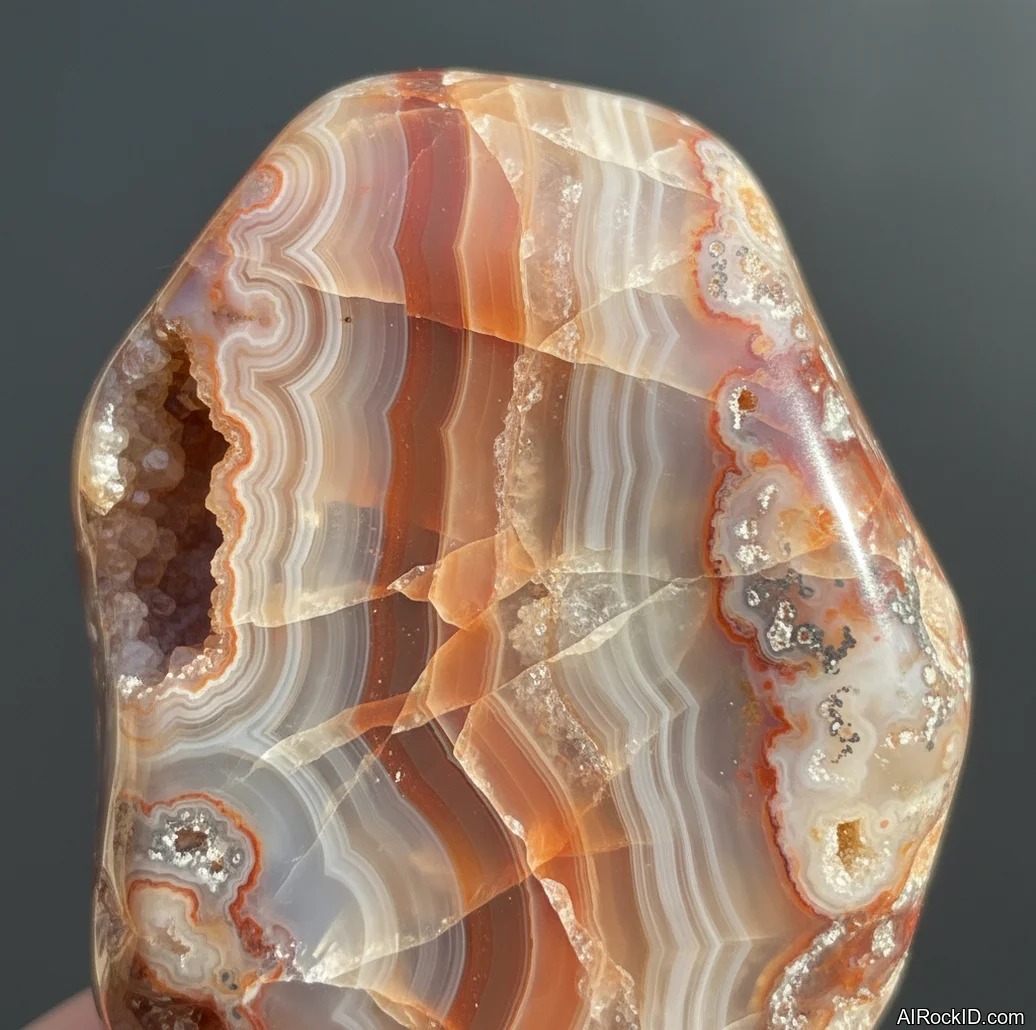
Quick answer: Botswana Agate is a finely banded chalcedony best recognized by soft gray, white, cream, brown, peach, or pinkish stripes. It is usually durable enough for jewelry and carvings, but identification should focus on natural banding, polish quality, and signs of dyeing or imitation.
AI Rock ID can help screen Botswana Agate by comparing visible banding, translucency, and surface texture against known chalcedony patterns. RockIdentifier.io provides visual identification support, but final confirmation may require magnification, hardness checks, or gemological testing.
Good fit
- Collectors who like subtle gray, cream, peach, or pink banded stones
- Jewelry buyers looking for a durable chalcedony with a smooth polish
- Beginners who want a recognizable agate variety with many affordable specimens
- Anyone comparing natural banding against dyed or imitation agates
Not a good fit
- Buyers who want a transparent faceted gemstone with strong sparkle
- Projects requiring a stone with a known single mine or exact locality proof unless documentation is provided
- People expecting metaphysical traditions to replace professional medical advice
Why people search for this
Many searches for Botswana Agate are about distinguishing natural gray-pink banding from dyed agate, sardonyx, or other banded chalcedony. Buyers also look for clues that a cabochon, bead strand, or palm stone is genuinely Botswana-type material rather than a generic trade name.
Most commonly confused with
- Banded Agate: A broad category; Botswana Agate is a specific trade variety known for fine, soft-toned bands.
- Sardonyx: Sardonyx usually shows stronger reddish-brown, black, or white parallel layers.
- Gray Agate: Gray agate may lack the pink, peach, or warm brown tones often associated with Botswana Agate.
- Dyed Agate: Dyed agate can show unnaturally vivid color concentrated in cracks, pits, or porous bands.
Botswana Agate vs Similar Banded Stones
| Stone | Typical Appearance | Key ID Clue | Buying Note |
|---|---|---|---|
| Botswana Agate | Fine gray, white, cream, brown, peach, or pinkish bands | Soft, layered chalcedony bands with a waxy to glassy polish | Ask whether color is natural and whether origin is documented |
| Banded Agate | Any color range with layered bands | General term rather than one specific variety | May be sold honestly without Botswana origin |
| Sardonyx | Reddish-brown, black, orange, or white layers | Stronger contrast and straighter parallel bands | Common in cameos, beads, and cabochons |
| Dyed Agate | Bright blue, purple, hot pink, green, or intense red | Color may pool in fractures or porous zones | Disclose dye treatment before purchase |
| Onyx | Black, white, or sharply layered bands | More uniform color blocks or crisp stripes | Many black onyx pieces are treated chalcedony |
AI identification confidence
AI identification confidence is usually moderate to high when a clear photo shows fine, natural-looking gray to pinkish agate bands. Confidence drops when the stone is a small bead, heavily polished, dyed, poorly lit, or shown without scale and multiple angles.
When AI gets it wrong
- A dyed agate bead may appear natural if the photo hides color pooling in cracks or drill holes.
- Sardonyx and other banded chalcedonies can be mislabeled as Botswana Agate when origin cannot be verified.
- Highly polished cabochons may obscure surface texture and make band patterns look more uniform than they are.
- Photos with warm lighting can exaggerate peach or pink tones and affect visual identification.
Final recommendation
Choose Botswana Agate when you want a durable, finely banded chalcedony with muted gray, cream, peach, or pink tones. For authenticity, prefer sellers who disclose treatments, provide clear close-up photos, and avoid claiming Botswana origin without evidence.
How to Spot Dyed Botswana Agate
Natural Botswana Agate usually has soft, layered colors rather than neon or strongly saturated bands. Dye may concentrate in cracks, pits, bead holes, or porous layers, especially around drilled areas. A loupe can help reveal uneven color buildup that is not visible in a full-size product photo.
Buying Checklist for Botswana Agate
Look for clean band definition, smooth polish, and photos taken in neutral lighting. Ask whether the stone is natural, dyed, heated, stabilized, or sold only as a Botswana-style agate. For higher-priced specimens, locality information and seller transparency are more useful than vague trade descriptions.
Photo Tips for Identifying Botswana Agate
Use bright indirect light and photograph the stone from several angles, including close-ups of banding and any drilled holes or fractures. Place the stone next to a ruler or coin for scale. Avoid strong filters or warm lighting because they can make ordinary gray agate appear pinker or more peach-colored.
What Is Botswana Agate?
Botswana Agate is a banded kind of chalcedony (microcrystalline quartz) that comes out of Botswana. Most of what you run into is smoky gray and white, and then every so often there’s a dusty pink or peach line slipping through. Thin ribbons, stacked up. The banding might be tight like a fingerprint, or it can open up into wide, slow stripes, and it’s one of the few agates where “neutral colors” still hold your attention when you actually look close.
Grab a palm stone and the first thing you notice is the temperature. It stays cool longer than glass. And it has that quartz heft in your hand without feeling clunky or awkward. On a good piece, the polish is slick, almost like a well-worn worry stone, but the bands still show a tiny bit of texture to your eye, especially if you tip it under a bright desk lamp and catch the glare just right.
People see the word agate and expect loud color right away. But Botswana material’s quieter than that. That’s the whole charm, honestly. In a tray full of neon dyed stuff at a show, a real Botswana agate cab just looks calm and straight-up, like it’s not trying to win a contest.
Origin & History
Most dealers use “Botswana agate” as a trade name for banded chalcedony that comes out of Botswana’s volcanic rocks, especially around the Bobonong area in the east. It isn’t a separate mineral species. So you’re not going to find one clean “discovery” moment the way you would with a new element. The name’s basically just geography plus the banded pattern.
Agate itself has an older naming backstory, tied to the Achates (Dirillo) River in Sicily, where people collected banded chalcedony in the ancient world. Botswana agate started showing up more widely in the lapidary world in the 20th century, as Botswana’s stone trade and export pipelines got more organized. And yeah, by the time I was a teenager poking through bargain bins (dusty cardboard flats, little plastic baggies, the odd chipped cabochon rolling around), Botswana agate was already a steady staple at gem shows.
Where Is Botswana Agate Found?
Commercial material is best known from eastern Botswana, where banded chalcedony occurs in volcanic host rocks and gets mined and sorted for lapidary use.
Formation
Look at the banding up close and you’re basically staring at old pulses of fluid that got locked in place. Botswana agate forms when silica-rich groundwater slips through little cavities and hairline fractures in volcanic rock, then drops microcrystalline quartz one layer at a time. Some of those layers are insanely thin. Cut a cabochon, hit it on the wheel, and the bands can end up so tight they almost look printed on.
So what’s with the color shifts? Tiny changes in chemistry and whatever bits get trapped while it’s growing. A touch of iron can push it toward tan or peach. Manganese, plus other trace material, can slide the grays around. But it’s still quartz when you get down to it, which is why it takes a high polish and holds up to everyday handling without much fuss.
How to Identify Botswana Agate
Color: Most Botswana agate shows fine, parallel banding in gray, white, and pale brown, often with soft pink or peach tones. Some pieces have subtle translucence at the edges when you hold them to a strong light.
Luster: Waxy to vitreous when polished.
Pick up a tumbled piece and feel for that cool, glassy-quartz temperature and a smooth, hard polish. The real test is the banding: natural bands aren’t perfectly identical from edge to edge, and they don’t look like dye bleeding into cracks. If the colors are electric purple or hot blue, you’re looking at dyed agate being sold under a fancy label, not Botswana.
Common Look-Alikes
Botswana Agate is sometimes confused with these materials:
- Gray banded agate from Brazil/Uruguay sold as “Botswana” (same quartz family, different source, often wider bands and less of that tight fingerprint striping)
- Fortification agate / “crazy lace” style banded agate in neutral grays (pattern overlap in photos, especially when it’s tumbled)
- Banded calcite/onyx marble sold as “gray onyx” (softer, reacts to acid, banding can look similar at a glance)
- Dyed gray/black agate (color boosted to look like high-contrast Botswana, especially in bracelets and small palm stones)
- Banded glass or resin “agate” (mass-produced stripes, bubbles, and a warmer feel in the hand)
Market Cautions & Treatments
When AI Can Get This Wrong
At first glance, AI tends to call Botswana Agate “banded agate” or even “onyx,” because the gray and white striping looks the same in a cropped, polished photo. Photos also hide the big tell: Botswana’s banding often goes tight and wavy like a fingerprint, not the clean, evenly spaced stripes you see in glass or dyed beads. The real test is physical: Botswana Agate should scratch glass (6.5-7), won’t fizz with a drop of vinegar like banded calcite, and under a 10x loupe you shouldn’t see bubbles or dye concentrated in cracks.
Properties of Botswana Agate
Physical Properties
| Crystal System | Amorphous |
| Hardness (Mohs) | 6.5-7 (Hard (6-7.5)) |
| Density | 2.58-2.64 |
| Luster | Waxy |
| Diaphaneity | Translucent to opaque |
| Fracture | Conchoidal |
| Streak | White |
| Magnetism | Non-magnetic |
| Colors | Gray, White, Brown, Pink, Peach, Tan, Cream |
Chemical Properties
| Classification | Silicates |
| Formula | SiO2 |
| Elements | Si, O |
| Common Impurities | Fe, Mn, Al |
Optical Properties
| Refractive Index | 1.530-1.540 |
| Birefringence | 0.004-0.009 |
| Pleochroism | None |
| Optical Character | Biaxial |
Botswana Agate Health & Safety
Thing is, it’s basically quartz, and it’s safe to handle with bare hands. For everyday use, you don’t need anything special. Just normal care does the job.
Safety Tips
If you’re going to cut or grind it, handle it like any other silica-bearing stone. Keep a steady trickle of water on the cut (you’ll see it turn into that gritty gray slurry) and wear a real respirator, because you do not want to be breathing that fine dust.
Botswana Agate Value & Price
Price Range
Rough/Tumbled: $3 - $25 per tumbled stone or small palm stone
Cut/Polished: $1 - $8 per carat
Tight, crisp banding and a really clean, high polish can jack the price up fast. Large slabs where the pattern stays consistent across the whole face cost more, but that bland gray stuff is everywhere (you see it stacked on racks) and it stays cheap.
Durability
Durable — Scratch resistance: Good, Toughness: Good
Botswana agate is stable in normal wear, but like any quartz it can chip on sharp edges if you smack it on tile.
How to Care for Botswana Agate
Use & Storage
Keep it in a soft pouch or a divided box if it’s polished, because quartz will scratch softer stones sitting next to it. And if you’ve got a slab, store it flat so corners don’t get dinged.
Cleaning
1) Rinse with lukewarm water. 2) Wash with a drop of mild soap and your fingers or a soft brush. 3) Rinse again and dry with a soft cloth.
Cleanse & Charge
If you do energetic cleansing, running water, smoke, or a night on a windowsill all get used by collectors. Just avoid baking it in harsh sun for weeks, since steady heat and UV can dull some finishes over time.
Placement
On a desk it works great as a touch stone because it stays cool and the bands give your eyes something to track. In a display case, angle it so a single light rakes across the surface and the banding pops.
Caution
Don’t run it through an ultrasonic cleaner if it’s got any fractures, vugs, or glued repairs. That vibrating buzz can turn a tiny crack into a bigger problem fast. And skip strong acids or harsh household cleaners too since they can haze a polished surface and leave it looking dull.
Works Well With
Botswana Agate Meaning & Healing Properties
Most people grab Botswana agate when they want steady, not flashy. That’s been true for me too, both selling it and actually carrying a piece around in my pocket. The banding gives your brain something easy to track, and it can settle you down in a very nuts-and-bolts way. Hold one for a minute and you’ll catch yourself rubbing the stripes with your thumb, kind of like worrying the edge of a smooth coin.
In crystal lore, it’s linked to grounding, smoothing out emotions, and gentle support when things are changing. I file that under “helpful ritual,” not “this will solve your life.” So if you’re using it for stress, pair it with something plain and solid like smoky quartz, and stash it somewhere you’ll actually handle it. A stone sitting in a drawer? Doesn’t do much for your day.
But here’s the thing. Botswana agate gets mislabeled all the time, and that throws people off. Dyed banded agate gets pushed as Botswana because the name sells. And if you’re looking for a calmer feel and you end up with some neon-dyed piece, it just doesn’t feel the same in your hand or look the same on the table under normal light. The quiet gray stuff is the whole point.
Common mistakes
- Assuming every gray or pink banded agate is from Botswana
- Treating vivid dyed agate colors as natural Botswana Agate
- Judging authenticity from one product photo without close-ups of bands and drill holes
- Confusing general banded agate with a verified locality-based trade variety
- Overpaying for a common bead strand because it is labeled with an unverified origin
Identify Botswana Agate from a photo
Compare Botswana Agate traits, care tips, value clues, and common lookalikes with a clear photo.