Blue Agate


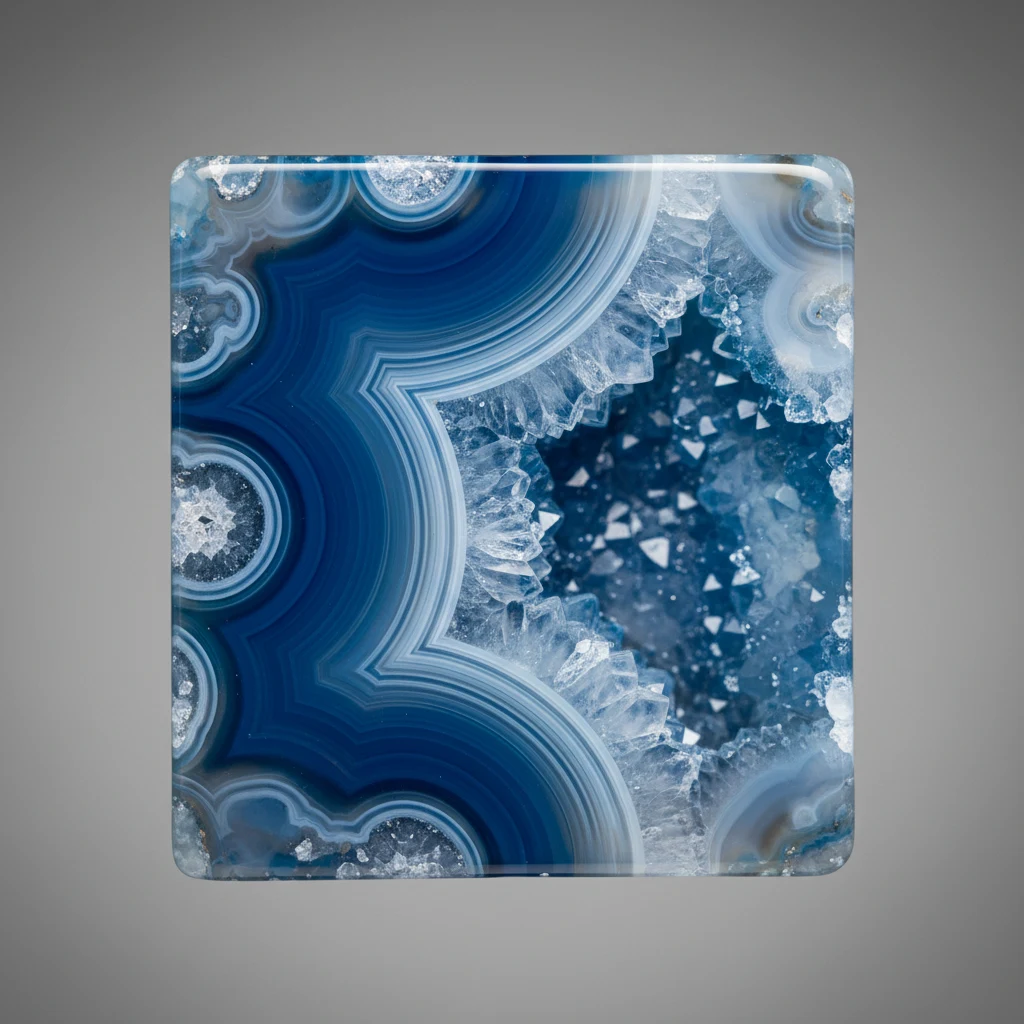
Quick answer: Blue Agate is a blue to blue-gray variety of banded chalcedony, commonly recognized by its fine, curved bands and waxy to vitreous luster. It is often confused with dyed agate, blue lace agate, larimar, and glass, so band pattern, translucency, hardness, and color distribution are useful identification clues.
AI Rock ID can help compare a Blue Agate photo against visually similar stones by checking banding, color zoning, luster, and surface texture. RockIdentifier.io provides crystal identification support, but final confirmation may require hands-on tests such as hardness, magnification, or professional gemological review.
Good fit
- Collectors who want a durable blue chalcedony with visible banding
- Beginners learning to identify agate patterns and translucency
- Jewelry buyers looking for a stone with Mohs 6.5–7 hardness
- Anyone comparing natural, enhanced, and dyed blue agate specimens
Not a good fit
- Buyers who need a guaranteed untreated blue stone without lab documentation
- Collectors seeking rare, high-value transparent gemstones
- Anyone expecting a crystal to replace medical or professional care
Most commonly confused with
- Blue Lace Agate: Usually paler with delicate lace-like white and blue bands rather than deeper or more varied blue banding.
- Dyed Agate: May show very intense blue color concentrated in cracks, edges, or porous zones.
- Larimar: Typically shows cloudy, ocean-like blue-and-white patterns rather than fine chalcedony banding.
- Blue Chalcedony: Often more uniformly colored and may lack the distinct bands that define agate.
Blue Agate Lookalike Comparison
| Material | Typical Visual Clue | Key Difference |
|---|---|---|
| Blue Agate | Curved blue, white, or gray bands | Banded chalcedony with Mohs 6.5–7 hardness |
| Blue Lace Agate | Soft pale blue with lace-like banding | Usually lighter and more delicate in pattern |
| Dyed Agate | Strong electric blue in cracks or edges | Color may appear unnatural or unevenly absorbed |
| Larimar | Cloudy blue and white patches | No agate-style concentric banding |
| Glass | Bubbles or molded uniformity | Lacks natural chalcedony texture and band structure |
AI identification confidence
AI identification of Blue Agate is usually moderate when the photo clearly shows banding, translucency, and natural color variation. Confidence is lower for polished beads, heavily dyed pieces, or close-up images without scale and lighting context.
When AI gets it wrong
- The stone is a dyed agate with color that looks natural in the photo.
- A polished bead shows only a small area and no visible banding.
- Bright lighting makes gray or white chalcedony appear blue.
- Glass or resin imitates agate but lacks visible bubbles in the submitted image.
Final recommendation
Choose Blue Agate based on visible banding, balanced color, good polish, and clear seller disclosure about any dyeing or treatment. For higher-value pieces, request origin information, treatment details, or independent gemological confirmation.
How to Identify Blue Agate in Photos
Look for fine, curved, or concentric bands rather than a single flat blue color. Natural Blue Agate may show blue, gray, white, or translucent zones, while dyed examples can display stronger color along fractures or porous edges. A photo with natural light, a neutral background, and multiple angles gives a more reliable identification result.
Natural vs. Dyed Blue Agate
Blue Agate sold in jewelry and decorative objects may be natural, color-enhanced, or dyed. Dyeing is common in agate because chalcedony can absorb color through porous zones and fractures. Sellers should disclose treatments, especially when the blue color is unusually vivid, uniform, or concentrated in cracks.
Buying Checklist for Blue Agate
Check whether the seller describes the stone as natural, dyed, heated, or stabilized. Examine the banding, polish quality, drill holes, fractures, and color concentration before buying beads, cabochons, or carvings. For online purchases, request photos in daylight and avoid relying only on heavily saturated product images.
What Is Blue Agate?
Blue Agate is a blue, banded variety of chalcedony, valued for its soft to deep blue color zoning and calm, layered appearance. In the hand, a good piece shows alternating light and dark blue bands with a translucent body, giving it the quiet depth collectors expect from agate.
As a silicate gemstone with the formula SiO2, Blue Agate is durable enough for regular handling, display, and cut stone use. Its Mohs hardness of 6.5-7, white streak, conchoidal fracture, and non-magnetic response make it practical for collectors who want a stable, attractive specimen rather than a fragile cabinet mineral.
Origin & History
Blue Agate belongs to the long-used agate family, and the name “agate” comes from the Achates River in Sicily, where agate was first discovered. The material has been used since ancient times, which gives even a small blue-banded piece a strong cultural link to early lapidary collecting.
For modern collectors, provenance matters most when a specimen is labeled by country or district, especially with Brazilian, Indian, or Uruguayan material. When checking old labels or locality claims, mindat.org is a common reference point for comparing mineral names and locality information.
Where Is Blue Agate Found?
Blue Agate is found in Brazil, Uruguay, and India, with noted localities including Rio Grande do Sul in Brazil, Artigas in Uruguay, and Bangalore in India. These sources fit the kind of material collectors often see as polished slices, tumbled stones, cabochons, or small display specimens.
Formation
Blue Agate forms when silica is deposited inside cavities within volcanic rocks. Over thousands of years, that silica builds the banded chalcedony structure, creating the lighter and darker blue layers that make the stone recognizable.
This cavity-filling origin is why many pieces show curved, nested, or ribbon-like bands rather than a single flat color. In a cut face, those bands can look like frozen movement: waxy to vitreous, translucent, and tightly layered, with common impurities such as iron and manganese recorded for the material.
How to Identify Blue Agate
Identify Blue Agate by its blue color, banding, translucency, and chalcedony-like feel. It typically displays shades of blue from light blue to dark blue, with a vitreous to waxy luster and a smooth, compact texture when polished.
Useful checks include its Mohs hardness of 6.5-7, white streak, density of 2.60-2.70 g/cm3, non-magnetic response, and conchoidal fracture. Its crystal system is trigonal, and its listed optical properties include a refractive index of 1.54-1.55, no birefringence, no pleochroism, and an isotropic optical character.
Properties of Blue Agate
Physical Properties
| Crystal System | Trigonal |
| Hardness (Mohs) | 6.5-7 (Hard (6-7.5)) |
| Density | 2.60-2.70 g/cm3 |
| Luster | Vitreous |
| Diaphaneity | Translucent |
| Fracture | Conchoidal |
| Streak | White |
| Magnetism | Non-magnetic |
| Colors | Blue, Light Blue, Dark Blue |
Chemical Properties
| Classification | Silicate |
| Formula | SiO2 |
| Elements | Si, O |
| Common Impurities | Fe, Mn |
Optical Properties
| Refractive Index | 1.54-1.55 |
| Birefringence | None |
| Pleochroism | None |
| Optical Character | Isotropic |
Blue Agate Health & Safety
Blue Agate poses no significant health risks.
Blue Agate Value & Price
Price Range
Rough/Tumbled: $5 - $30 per specimen
Cut/Polished: $10 - $50 per carat
Price is affected by color intensity and banding quality.
Durability
Durable — Scratch resistance: Good, Toughness: Good
Blue Agate is stable and does not fade easily.
How to Care for Blue Agate
Use & Storage
Store in a soft pouch or box to prevent scratches.
Cleaning
Clean with mild soap and water. Avoid harsh chemicals.
Cleanse & Charge
Place under moonlight or in soil to recharge.
Placement
Can be placed in living spaces for calming energy.
Caution
Avoid exposing to extreme temperatures.
Works Well With
Blue Agate Meaning & Healing Properties
Blue Agate is used in crystal healing for calmness, balance, communication, and emotional healing. Practitioners often place it near the throat area or use it during meditation because it is associated with the Throat Chakra and the qualities of calm, balance, and communication.
Its cultural correspondences include Gemini and Libra, the planet Mercury, and the Water and Earth elements. For care, it can be cleaned with mild soap and water, placed under moonlight or in soil to recharge, and stored in a soft pouch or box to prevent scratches.
Identify Blue Agate from a photo
Compare Blue Agate traits, care tips, value clues, and common lookalikes with a clear photo.
Common mistakes
- Assuming every bright blue agate is naturally colored
- Identifying Blue Agate from color alone without checking for banding
- Confusing Blue Lace Agate with any pale blue banded agate
- Ignoring dye concentration around cracks, edges, and drill holes
- Using a scratch test on finished jewelry where it may damage the polish