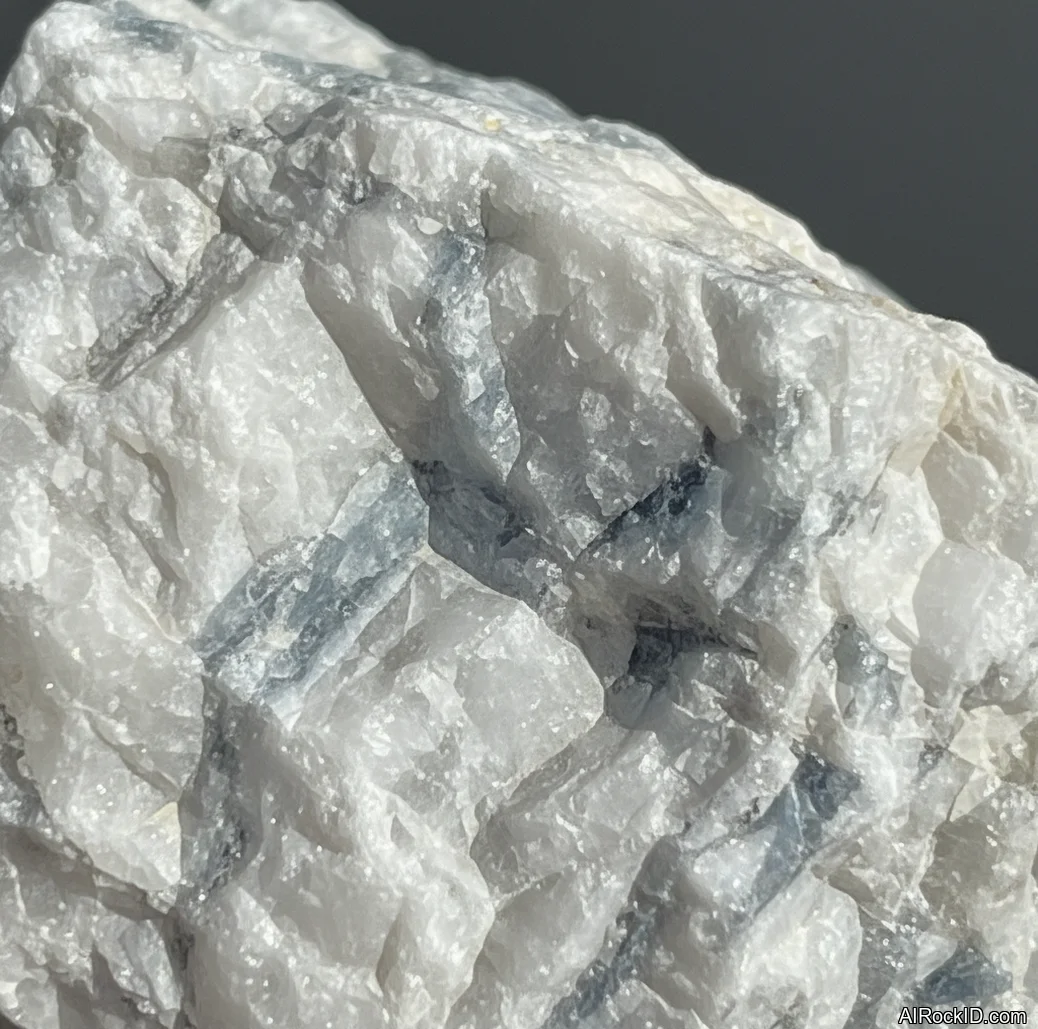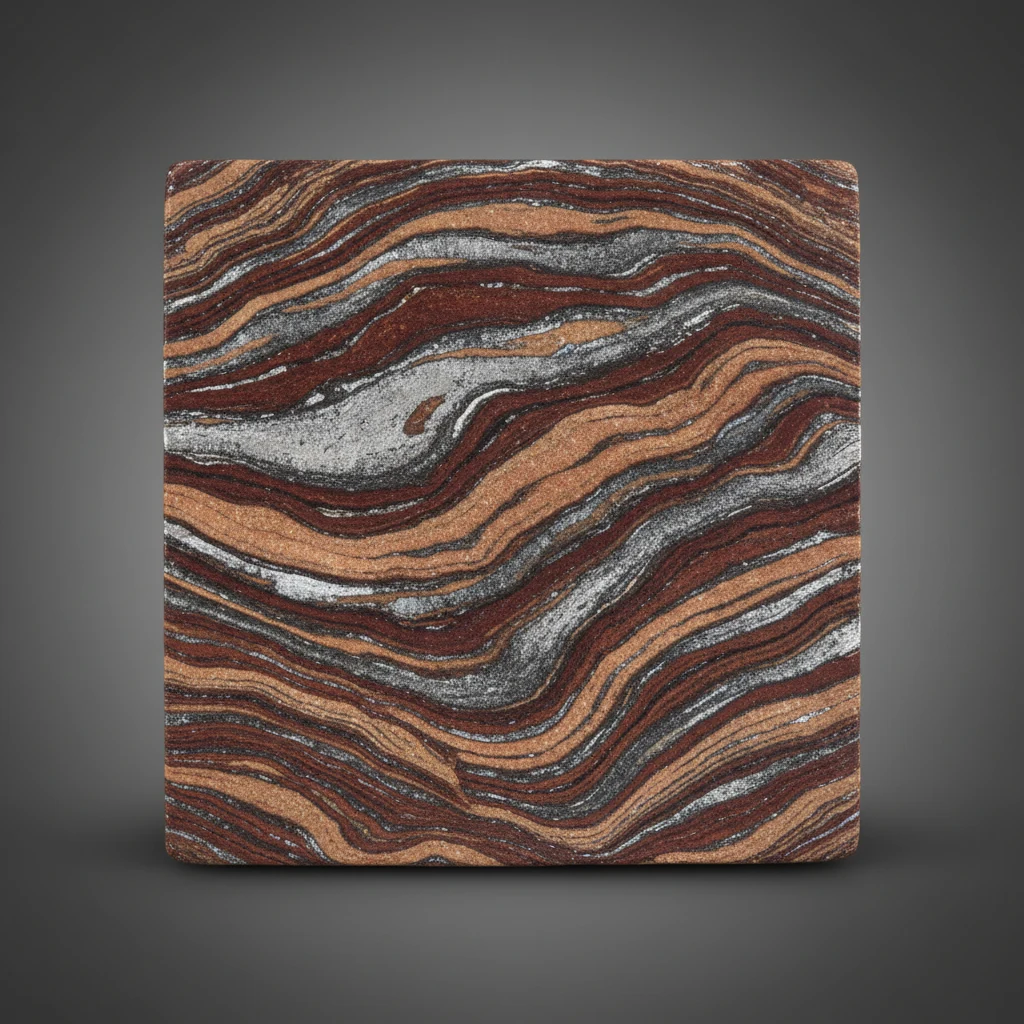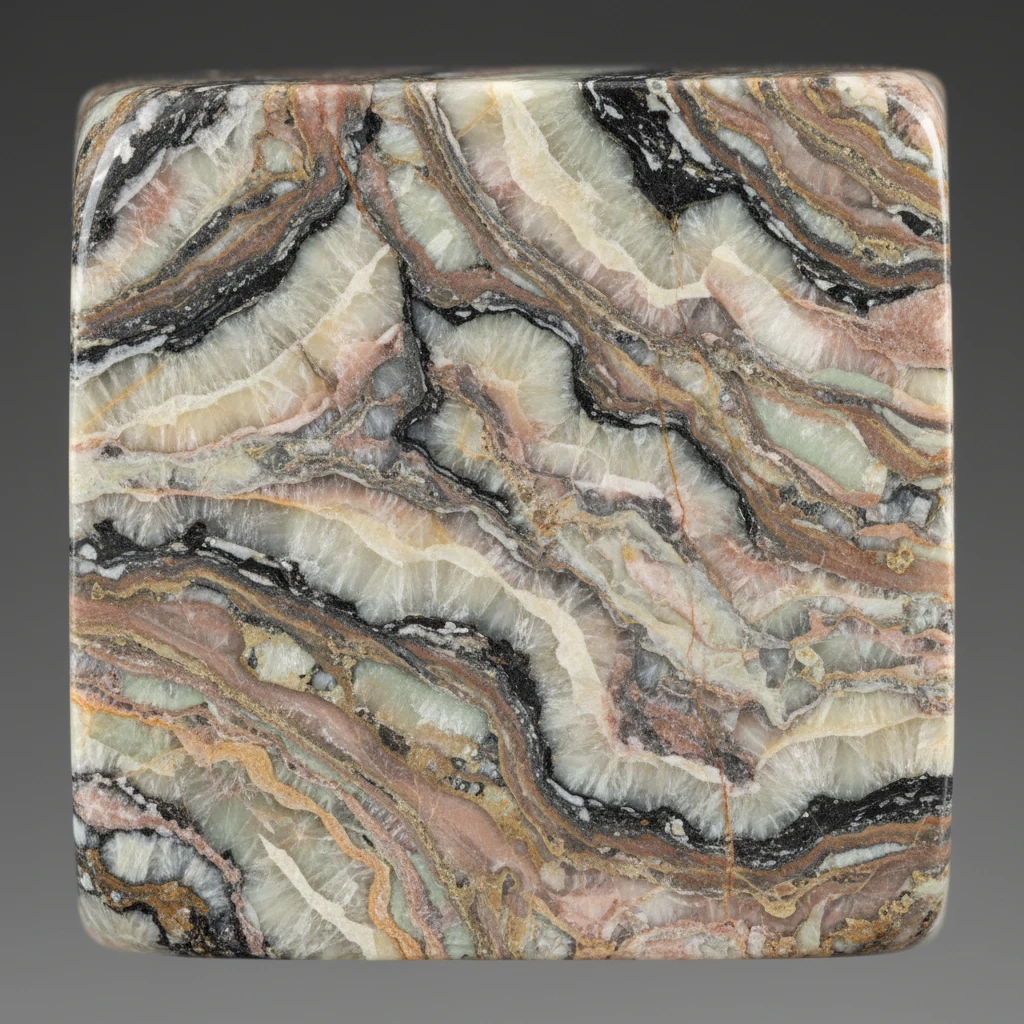
Migmatite


Quick answer: Migmatite is a mixed metamorphic rock that records partial melting, usually showing light-colored leucosome bands with darker metamorphic layers. It is commonly identified by its irregular, swirled, or banded appearance rather than by a single mineral composition.
AI Rock ID can help screen a migmatite photo by looking for mixed light and dark bands, folded textures, and partial-melt patterns. RockIdentifier.io treats migmatite as a rock identification case, so close-up texture, fresh broken surfaces, and location details can improve the result.
Good fit
- Collectors who like visibly banded or swirled metamorphic rocks
- Students learning the transition between metamorphism and partial melting
- Lapidary users seeking patterned material for decorative slabs or cabochons
- Anyone comparing gneiss-like rocks with mixed igneous-looking veins
Not a good fit
- Buyers who want a single-mineral crystal specimen
- Uses requiring a precisely uniform color or pattern
- Identification from one polished surface without any structural context
Most commonly confused with
- Gneiss: Gneiss has strong metamorphic banding but usually lacks the pale, melt-like leucosome patches typical of migmatite.
- Granite: Granite is an igneous rock with interlocking crystals, while migmatite commonly preserves darker metamorphic bands or folded layers.
- Schist: Schist is more platy and mica-rich, often splitting along foliation rather than showing mixed melt bands.
- Amphibolite: Amphibolite is typically dark and hornblende-rich, without the contrasting pale melt segregations seen in many migmatites.
Migmatite vs Similar Rocks
| Rock | Typical Look | Key Difference | Simple Check |
|---|---|---|---|
| Migmatite | Pale melt bands mixed with darker metamorphic layers | Shows partial melting plus preserved foliation | Look for irregular leucosome veins and folded bands |
| Gneiss | Alternating light and dark bands | More consistently banded, less melt-like | Bands are usually straighter and more continuous |
| Granite | Speckled interlocking crystals | Fully igneous texture, little or no foliation | Check for uniform granular texture |
| Schist | Shiny, flaky, strongly foliated surface | Mica-rich and splits more easily | Look for platy mica flakes and cleavage |
| Marble | Soft-looking veined crystalline surface | Carbonate rock, not silicate-dominant | Dilute acid may fizz on calcite-rich marble |
AI identification confidence
AI identification of migmatite is usually moderate when the photo shows both pale leucosome and dark metamorphic bands. Confidence drops when the specimen is polished, tightly cropped, weathered, or visually similar to gneiss or granite.
When AI gets it wrong
- A polished slab hides grain boundaries and makes migmatite look like decorative granite.
- A close-up photo shows only the pale leucosome, causing confusion with granite or quartz-feldspar veins.
- Strong straight banding may be classified as gneiss if melt textures are not visible.
- Weathered surfaces can obscure the contrast between light and dark minerals.
Final recommendation
For practical identification, look for both metamorphic banding and pale, irregular melt-derived material in the same specimen. If buying migmatite, request photos of multiple faces so the mixed texture is visible rather than relying on a single polished surface.
How to Photograph Migmatite for Identification
Use daylight or a neutral light source and photograph both a broad surface and a close-up of the banding. Include a fresh broken face if available, because weathered or polished surfaces can hide the relationship between the pale and dark layers. A scale object helps show whether the light bands are thin veins, broad patches, or large folded zones.
Buying and Authenticity Tips for Migmatite
Migmatite is generally sold as a rock specimen, slab, or decorative stone rather than as a rare crystal. Authentic pieces should show natural variation in banding, veining, or folding instead of a printed or dyed surface pattern. Ask sellers whether the material is natural, stabilized, dyed, or resin-filled, especially for polished display pieces.
Field Clues for Recognizing Migmatite
Migmatite often occurs in high-grade metamorphic terrains where gneiss, schist, amphibolite, or granitic bodies may also be present. Useful field clues include folded dark layers, pale quartz-feldspar-rich bands, and cross-cutting or patchy melt segregations. A single loose stone can be difficult to classify without local geologic context.
What Is Migmatite?
Migmatite is a partially melted high-grade metamorphic rock, often called a mixed rock because it looks both metamorphic and igneous in the hand. A good specimen shows pale granitic-looking quartz-feldspar layers or veins woven through darker biotite-, amphibole-, or garnet-rich bands. Its hardness is variable, typically about Mohs 5–7 depending on the quartz and feldspar content.
In a tray of rocks, migmatite is the one with movement: folded cream, gray, pink, or tan seams cutting through black, brown, or greenish gray layers. It may resemble gneiss invaded by granite, or a slab of natural abstract art. Collectors value pieces where the light leucosome and dark melanosome make bold, readable contrast.
Origin & History
The name migmatite comes from the Greek word “migma,” meaning mixture, a precise description for a rock that combines metamorphic layering with igneous-looking melt. The term was introduced in the early 20th century by Finnish geologist Jakob Sederholm, who studied partially melted Precambrian rocks in Finland.
Migmatite matters because it records deep crustal heat, partial melting, and the transition from solid metamorphic rock toward granite-forming melt. For labeled specimens, collectors often compare locality names and rock descriptions with mindat.org, especially when a piece comes from a shield terrain or old metamorphic belt.
Where Is Migmatite Found?
Migmatite is found worldwide in ancient continental shields, deeply eroded mountain belts, and high-grade metamorphic terrains. Reported countries include Finland, Sweden, Norway, Canada, the United States, the United Kingdom, Brazil, India, Australia, and South Africa.
Formation
Migmatite forms during high-grade regional metamorphism, commonly at amphibolite to granulite facies conditions. Parent rocks such as pelitic schist, gneiss, or quartz-feldspar-rich rocks are heated until part of the rock melts, while other parts remain as a darker residue.
The pale, quartz- and feldspar-rich melt-derived material is called leucosome, and the darker mafic or mica-rich residue is called melanosome. Original or intermediate material may be called mesosome. Folding, shearing, melt injection, and deformation produce the swirled, streaky, vein-like, or net-textured patterns that make migmatite so distinctive.
How to Identify Migmatite
Identify migmatite by looking for a mixed texture rather than a single uniform mineral or a simple banded rock. The best clue is irregular pale quartz-feldspar material occurring as veins, pods, folded bands, or granitic-looking streaks inside darker gneissic layers.
Unlike ordinary granite, migmatite often preserves metamorphic foliation or folded dark bands. Unlike simple gneiss, it contains irregular pale melt segregations that look granitic. A hand lens may show quartz, feldspar, biotite, amphibole, and sometimes garnet; fresh surfaces may be glassy, pearly, micaceous, or dull depending on which minerals dominate.
Properties of Migmatite
Physical Properties
| Crystal System | Not applicable; migmatite is a polymineralic rock |
| Hardness (Mohs) | Variable, typically about 5–7 depending on quartz and feldspar content (Moderate to hard) |
| Density | Approximately 2.6–2.9 g/cm³, varying with mineral composition |
| Luster | Variable: vitreous, pearly, micaceous, or dull |
| Diaphaneity | Opaque as a rock |
| Fracture | Uneven, granular, or splintery along mica-rich foliation |
| Streak | Not diagnostic; powdered material is commonly white, pale gray, or gray |
| Magnetism | Usually non-magnetic, but may be weakly magnetic if magnetite or other iron oxides are present |
| Colors | white, cream, gray, black, pink, tan, brown, greenish gray |
Chemical Properties
| Classification | Silicate-rich polymineralic metamorphic-igneous rock |
| Formula | Variable; commonly dominated by quartz (SiO2), feldspars such as KAlSi3O8-NaAlSi3O8-CaAl2Si2O8, and mica or amphibole minerals |
| Elements | O, Si, Al, K, Na, Ca, Fe, Mg, H |
| Common Impurities | Ti, Mn, Zr, P, S, C |
Optical Properties
| Refractive Index | Not applicable to the rock as a whole; constituent minerals vary, with quartz about 1.544–1.553 and common feldspars about 1.52–1.58 |
| Birefringence | Not applicable as a whole; varies by mineral grains |
| Pleochroism | Not applicable as a whole; biotite and amphibole grains may be pleochroic in thin section |
| Optical Character | Aggregate; individual minerals may be uniaxial or biaxial |
Migmatite Health & Safety
Migmatite is generally safe to handle, but cutting, grinding, drilling, or polishing can create respirable silica-bearing dust from quartz and feldspar. Some samples may also contain minor iron oxides, sulfides, or other accessory minerals.
Migmatite Value & Price
Price Range
Rough/Tumbled: Common field-collected or student specimens are often inexpensive, about $2–$20 USD; larger polished display pieces or decorative slabs with dramatic patterns may sell for much more depending on size and finish.
Cut/Polished:
Value is driven by bold contrast between light leucosome and dark melanosome, attractive folding or swirling, specimen size, polish quality, locality documentation, and whether the piece clearly shows partial-melting textures.
Durability
Generally durable — Scratch resistance: Moderate to good because many migmatites contain abundant quartz and feldspar, but mica-rich layers scratch and flake more easily., Toughness: Variable; massive pieces are tough, while strongly foliated or mica-rich specimens can split along bands.
Stable under normal indoor conditions. Prolonged outdoor weathering can accentuate foliation, loosen mica-rich layers, and stain iron-bearing minerals.
How to Care for Migmatite
Use & Storage
Store as a hand specimen, teaching sample, display stone, bookend, or polished decorative rock. Pad fragile foliated pieces to prevent chipping along mica-rich layers.
Cleaning
Rinse with water and a soft brush. Mild soap is acceptable. Avoid harsh acids or strong chemical cleaners, especially on specimens with carbonate, sulfide, or delicate mica-rich zones.
Cleanse & Charge
For metaphysical use, cleanse gently with smoke, sound, or brief running water, then place in indirect sunlight or moonlight. Avoid saltwater soaking for polished or fractured pieces.
Placement
Display where its banding and swirls catch side lighting. Keep heavy specimens on stable shelves and away from edges.
Caution
Do not use aggressive ultrasonic cleaning on cracked, friable, or mica-rich pieces. Wear protection if cutting or polishing because silica dust is the main practical hazard.
Works Well With
Migmatite Meaning & Healing Properties
In modern crystal-healing traditions, migmatite is used as a stone of integration, transformation, grounding, resilience, and deep time. These meanings come from its appearance: solid dark metamorphic layers visibly blended with pale melt, like a record of pressure, heat, change, and survival. These are cultural and spiritual associations, not scientifically verified effects.
Practitioners commonly connect migmatite with the Root and Third Eye chakras, Capricorn and Scorpio, and the elements Earth and Fire. For a quiet display piece, place it where side light catches the folded bands. Cleanse gently with smoke, sound, or brief running water, and avoid saltwater soaking on polished or fractured pieces.
Identify Migmatite from a photo
Compare Migmatite traits, care tips, value clues, and common lookalikes with a clear photo.
Common mistakes
- Calling any banded rock migmatite without checking for partial-melt textures
- Identifying migmatite from one polished photo with no close-up of the layers
- Assuming all pale veins in dark rock are leucosome rather than quartz or feldspar veins
- Confusing decorative trade names with a geologic identification
- Using color alone instead of texture, banding, and mineral relationships