Granite


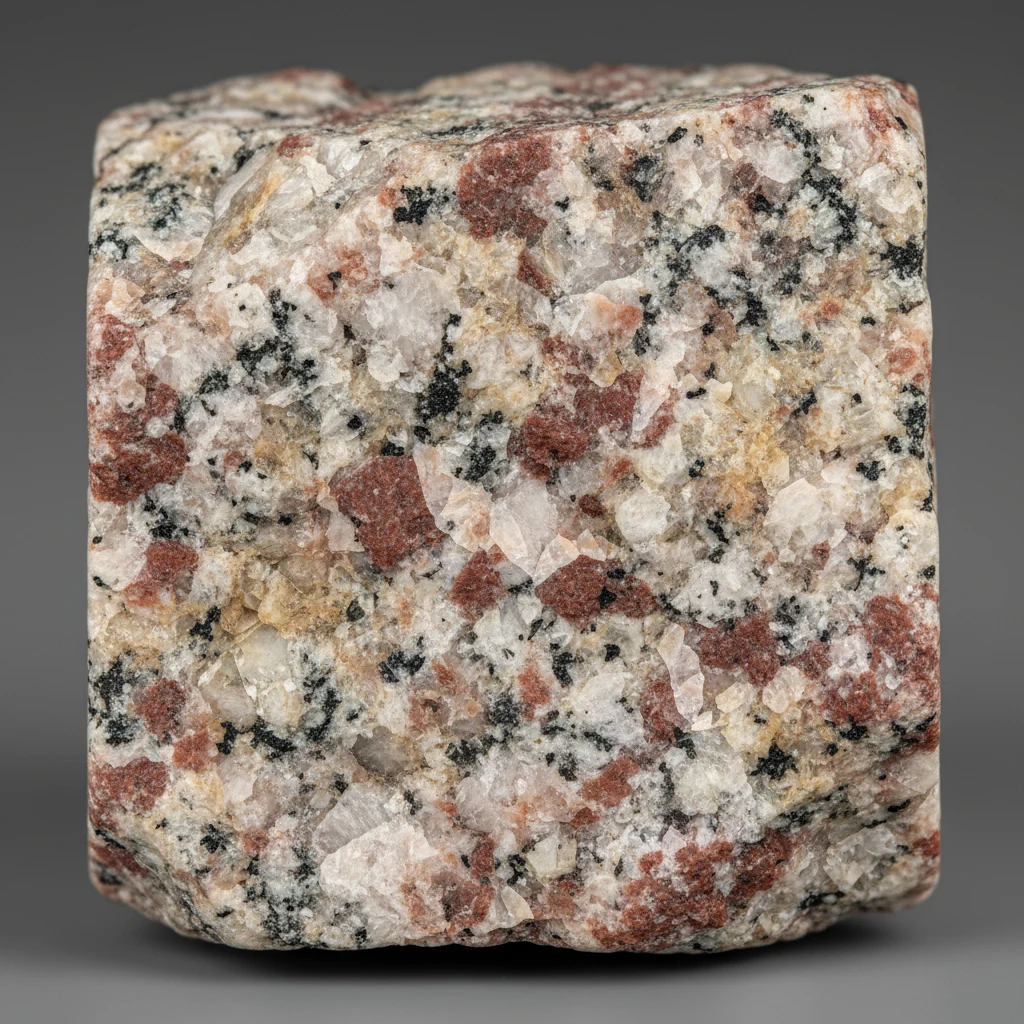
Quick answer: Granite is a coarse-grained igneous rock recognized by its interlocking crystals of quartz, feldspar, and mica or amphibole. Its speckled appearance varies widely, so comparing grain size, mineral mix, and texture is often more useful than relying on color alone.
AI Rock ID can help screen a granite photo by checking for visible quartz, feldspar, mica flakes, and a coarse interlocking texture. RockIdentifier.io can support field identification, but close-up images and basic hardness or streak observations improve reliability.
Good fit
- Learners comparing common igneous rocks by texture and mineral content
- Collectors who want a durable, easy-to-recognize rock specimen
- Homeowners identifying countertop or tile material
- Field users checking whether a speckled rock is granite, gneiss, or diorite
Not a good fit
- Anyone needing precise commercial stone classification without lab or fabricator input
- Users trying to identify granite from a single low-light or polished-surface photo
- Collectors seeking a rare mineral species rather than a rock made of several minerals
Why people search for this
People often search for granite to identify a speckled rock, verify a countertop material, or compare it with similar-looking rocks used in construction and landscaping.
Most commonly confused with
- Gneiss: Gneiss often has banded or striped mineral layers, while granite usually has a more evenly speckled, non-banded texture.
- Diorite: Diorite is typically darker and has less visible quartz than granite.
- Rhyolite: Rhyolite can share granite-like chemistry but is fine-grained or glassy rather than coarse-grained.
- Quartz Monzonite: Quartz monzonite resembles granite but generally contains less quartz by geologic classification.
Granite vs. Common Lookalikes
| Material | Typical Texture | Key Difference |
|---|---|---|
| Granite | Coarse, interlocking, speckled crystals | Visible quartz and feldspar with little to no banding |
| Gneiss | Coarse with bands or foliation | Minerals are often arranged in light and dark layers |
| Diorite | Coarse, salt-and-pepper appearance | Usually darker and lower in quartz |
| Rhyolite | Fine-grained, sometimes porphyritic | Similar chemistry to granite but much smaller crystals |
| Engineered Quartz | Uniform or designed pattern | Manufactured with resin; may show repeated patterning |
AI identification confidence
AI identification of granite is usually stronger when the image shows a fresh broken surface with coarse mineral grains. Confidence drops when the rock is polished, weathered, wet, or photographed from too far away to show quartz and feldspar clearly.
When AI gets it wrong
- A polished countertop may hide natural grain boundaries and resemble engineered stone.
- Banded gneiss can look like granite if only a small, non-banded area is shown.
- Diorite or granodiorite may be misidentified when quartz content is hard to judge from a photo.
- Low-resolution images can make fine-grained rhyolite appear coarser than it is.
Final recommendation
Use multiple clues to identify granite: coarse interlocking crystals, visible quartz and feldspar, and a generally speckled rather than layered pattern. For construction or countertop decisions, confirm the material with a stone supplier, fabricator, or geologist when exact classification matters.
How to Tell Natural Granite from Engineered Stone
Natural granite usually shows irregular mineral grains that vary in size, color, and spacing across the surface. Engineered quartz and other manufactured surfaces may show repeated patterning, resin-rich areas, or a more uniform design. A polished slab label is not always a strict geologic name, because commercial stone names can differ from scientific rock classifications.
Field Clues for Identifying Granite
A hand lens can help reveal quartz as glassy gray to clear grains and feldspar as white, pink, or cream blocky crystals. Granite normally breaks across an interlocking crystal fabric rather than along flat layers. If the rock has strong stripes, folds, or mineral alignment, gneiss or another metamorphic rock may be a better match.
Buying Granite Specimens or Slabs
For specimens, look for cleanly broken surfaces that show the natural grain size and mineral mix. For slabs or tiles, ask whether the name is a trade name or a geologic classification, because stones sold as granite may include related igneous or metamorphic rocks. Photos taken under consistent lighting are more useful than heavily edited images when comparing color and pattern.
What Is Granite?
Granite is a coarse-grained felsic intrusive igneous rock made mainly of quartz, alkali feldspar, and plagioclase. In the hand, it usually feels hard, granular, and substantial, with visible interlocking crystals rather than a smooth single-mineral surface. Most pieces show a light white, gray, pink, tan, cream, or reddish ground scattered with black or dark green specks of mica or amphibole.
Collectors recognize granite by its speckled, crystalline look: glassy gray to clear quartz, cloudy or pearly feldspar, and shiny platy mica or darker amphibole. It is a rock rather than a mineral, so its properties vary with the proportions of its minerals. Overall hardness is approximately Mohs 6–7, density is typically about 2.63–2.75 g/cm³, and solid granite is safe to handle.
Origin & History
The name granite comes from the Latin granum, meaning grain, a direct reference to the visible granular texture seen on broken or polished surfaces. That name fits the material well: even a small hand sample looks like a tight mosaic of quartz, feldspar, and dark accessory minerals locked together.
Granite has been used since antiquity for monuments, building stone, tools, and sculpture because it is hard, durable, and widely available. In geology, granite is a specific quartz- and feldspar-rich intrusive rock; in the building-stone trade, many hard polished rocks are sold as commercial granite even when they are technically diorite, gabbro, gneiss, or other rocks. Reference: mindat.org.
Where Is Granite Found?
Granite is widespread in continental crust, especially in large batholiths, plutons, and ancient cratonic terrains. It is common in mountain belts and exposed intrusive complexes where erosion has removed the rocks that once covered the deep magma body.
Formation
Granite forms when silica-rich magma cools slowly deep underground, giving quartz, feldspar, mica, amphibole, and accessory minerals enough time to grow into visible interlocking crystals. That slow intrusive cooling is why a fresh surface looks coarse and grainy instead of glassy or fine-grained.
Many granites are produced by partial melting and differentiation of continental crustal material, while some involve mantle-derived magmas that later evolve chemically. After crystallization, uplift and erosion can strip away the overlying rock and expose the once-deep intrusion at the surface as a pluton, batholith, or other intrusive body.
How to Identify Granite
Identify granite by looking for a coarse, light-colored, speckled rock with visible interlocking crystals. True granite should show abundant quartz as glassy gray to clear grains, plus feldspar grains that are white, cream, pink, or tan. Dark flecks are commonly mica or amphibole, and pink granite usually contains abundant potassium feldspar.
A field check is simple: granite is hard enough to scratch glass, does not fizz with dilute acid, and usually shows no magnetic attraction except where minor magnetite is present. It should not show strong banding like gneiss, and it is generally lighter and more quartz-rich than diorite or gabbro. Broken surfaces are uneven to granular and may chip across or around individual grains.
Properties of Granite
Physical Properties
| Crystal System | Not applicable as a rock; composed of minerals including trigonal quartz, triclinic plagioclase, monoclinic or triclinic alkali feldspar, and mica or amphibole |
| Hardness (Mohs) | Approximately 6–7 overall, depending on mineral proportions (Hard) |
| Density | Typically about 2.63–2.75 g/cm³ |
| Luster | Overall dull to granular; individual grains vitreous, pearly, or micaceous |
| Diaphaneity | Opaque as a rock; individual quartz or feldspar grains may be translucent in thin pieces |
| Fracture | Uneven to granular; breaks across or around interlocking mineral grains |
| Streak | White to very pale gray when powdered, though streak is not usually diagnostic for rocks |
| Magnetism | Usually non-magnetic to weakly magnetic if magnetite or other iron oxides are present |
| Colors | white, gray, pink, red, tan, cream, black-speckled |
Chemical Properties
| Classification | Felsic intrusive igneous rock; silicate mineral assemblage |
| Formula | Variable; chiefly SiO2 quartz + KAlSi3O8 alkali feldspar + NaAlSi3O8-CaAl2Si2O8 plagioclase, with mica, amphibole, and accessory minerals |
| Elements | oxygen, silicon, aluminum, potassium, sodium, calcium, iron, magnesium, titanium |
| Common Impurities | biotite, muscovite, hornblende, magnetite, zircon, apatite, titanite, tourmaline |
Optical Properties
| Refractive Index | Not applicable to the whole rock; major minerals are approximately quartz 1.544–1.553, feldspars about 1.52–1.58 |
| Birefringence | Not applicable to the whole rock; varies by constituent mineral |
| Pleochroism | Not applicable to the whole rock; dark mica or amphibole grains may be pleochroic in thin section |
| Optical Character | Not applicable as a polymineralic rock; constituent minerals have their own optical characters |
Granite Health & Safety
Solid granite is safe to handle, but cutting, grinding, drilling, or polishing it can release respirable crystalline silica dust, which is hazardous to lungs with repeated or heavy exposure.
Granite Value & Price
Price Range
Rough/Tumbled: Common field specimens are often free to a few dollars; polished hand samples commonly range from about $5–30; decorative slabs and architectural stone vary widely by color, pattern, origin, and finish.
Cut/Polished:
Value depends on color contrast, grain size, polish quality, lack of fractures, quarry source, block size, and whether it is a common construction stone or a distinctive ornamental variety. Scientific specimens may be valued for locality, texture, pegmatitic features, xenoliths, or unusual accessory minerals.
Durability
Very durable — Scratch resistance: Good to excellent; quartz and feldspar make granite harder than steel and able to scratch glass., Toughness: Generally good for a rock, but it can chip along grain boundaries or fracture if struck hard.
Granite is stable in normal indoor and outdoor conditions. Weathering may gradually alter feldspar to clay minerals and oxidize iron-bearing minerals, especially in wet, acidic, or freeze-thaw environments.
How to Care for Granite
Use & Storage
Store hand specimens on a stable shelf or tray; polished pieces can be kept with other hard stones but may scratch softer minerals.
Cleaning
Wash with water, mild soap, and a soft brush. Avoid harsh acids for routine cleaning because feldspar and some accessory minerals may become dulled or etched over time.
Cleanse & Charge
For spiritual use, granite is commonly cleansed with running water, smoke, sound, or moonlight. These practices are cultural and metaphysical rather than geological.
Placement
Granite is suitable for display, landscaping, countertops, monuments, and outdoor placement. Use pads under polished pieces to protect furniture surfaces.
Caution
Avoid dropping heavy pieces, and use caution with sharp broken edges. If cutting or sanding, treat dust as a silica hazard.
Works Well With
Granite Meaning & Healing Properties
In modern crystal-healing traditions, granite is associated with grounding, endurance, steadiness, strength, practicality, protection, and connection to the Earth. These meanings are symbolic and not scientifically verified, but they match the stone’s physical character: heavy in the hand, durable, and visibly built from many locked minerals.
Granite is commonly linked with the Root chakra, the Earth element, and the planets Earth and Saturn. Its associated zodiac signs are Capricorn and Taurus. For spiritual use, it is commonly cleansed with running water, smoke, sound, or moonlight; for physical care, wash specimens with water, mild soap, and a soft brush, and avoid harsh acids for routine cleaning.
Identify Granite from a photo
Compare Granite traits, care tips, value clues, and common lookalikes with a clear photo.
Common mistakes
- Identifying any speckled rock as granite without checking for visible quartz.
- Assuming countertop trade names always match strict geologic names.
- Confusing mineral banding in gneiss with the random speckling of granite.
- Judging granite only by color, even though it can be pink, gray, white, black, or mixed.
- Using a polished surface alone for identification instead of checking a broken or unfinished edge.
Granite FAQ
Related Crystals
Related pages: Pink Granite