Gneiss


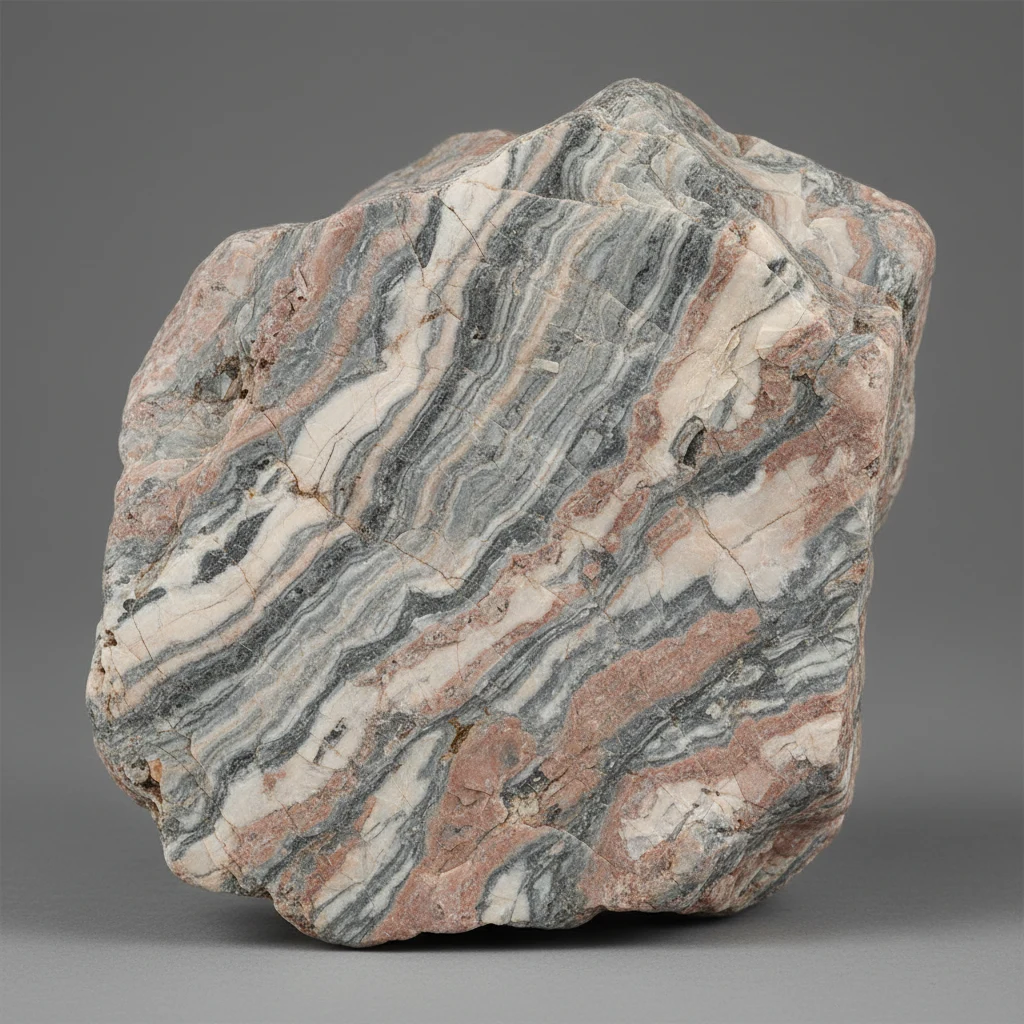
Quick answer: Gneiss is a foliated metamorphic rock recognized by alternating light and dark mineral bands. It is often confused with granite, schist, and migmatite, but its strongest field clue is continuous or wavy banding rather than random speckling or flaky layers.
AI Rock ID can help screen a gneiss photo by checking for banded foliation, coarse mineral grains, and common color contrast. RockIdentifier.io can support visual identification, but a hand specimen, streak, hardness, and local geology are still useful for confirming gneiss.
Good fit
- Collectors who want a common metamorphic rock with clear banding
- Students learning to distinguish foliated from non-foliated rocks
- Landscape or architectural stone buyers who like layered patterns
- Field hobbyists comparing granite, schist, and gneiss outdoors
Not a good fit
- Anyone looking for a rare gemstone specimen
- Collectors who need transparent crystals or faceted material
- Projects requiring a lightweight decorative stone
- Identification based only on color, since gneiss colors vary widely
Why people search for this
People often search for gneiss because its banded appearance can look like granite, schist, or layered sedimentary rock. Correct identification helps with field collecting, geology coursework, landscaping choices, and rock collection labeling.
Most commonly confused with
- Granite: Granite usually has a random interlocking crystal texture, while gneiss shows aligned light and dark bands.
- Schist: Schist is typically more flaky or platy with abundant mica, while gneiss has thicker, more distinct mineral bands.
- Migmatite: Migmatite may show gneiss-like banding but commonly has melted-looking, irregular, vein-like light patches.
- Quartzite: Quartzite is usually more uniform and sugary-looking, while gneiss has contrasting mineral layers.
Gneiss vs Common Lookalikes
| Rock | Key texture | Main field clue | Typical confusion |
|---|---|---|---|
| Gneiss | Coarse, banded foliation | Alternating light and dark mineral bands | Granite or schist |
| Granite | Coarse, non-foliated crystals | Random speckled mineral pattern | Gneiss without obvious banding |
| Schist | Platy or flaky foliation | Shiny mica-rich surfaces split more easily | Fine-banded gneiss |
| Migmatite | Mixed banded and melted textures | Irregular pale veins or swirls | Highly deformed gneiss |
| Quartzite | Hard, sugary or glassy texture | Mostly uniform quartz-rich look | Light-colored gneiss |
AI identification confidence
AI identification of gneiss is usually more reliable when the photo clearly shows coarse alternating bands and a fresh broken surface. Confidence drops when the specimen is weathered, polished, wet, or photographed too close to show the overall layering.
When AI gets it wrong
- A close-up image shows only speckled grains, making gneiss look like granite.
- A mica-rich surface dominates the photo, making gneiss look like schist.
- Weathered surfaces blur the banding and hide the original mineral texture.
- Polished slabs may emphasize decorative patterning instead of natural rock structure.
Best choice summary
Choose gneiss if the goal is a durable banded metamorphic rock for study, display, or decorative stone use. Choose granite for a more uniform speckled igneous look, or schist for a shinier, more flaky metamorphic texture.
Final recommendation
For identification, prioritize texture and banding over color because gneiss can be gray, pink, white, black, brown, or mixed. For buying slabs or specimens, inspect both polished and unpolished areas to confirm that the banding is natural rather than a surface treatment or misleading cut pattern.
How to Identify Gneiss in the Field
Look for coarse, alternating bands of light minerals such as quartz and feldspar and darker minerals such as biotite, hornblende, or other mafic minerals. The bands may be straight, folded, or wavy, but they usually show a directional fabric. A fresh broken edge is often more useful than a weathered outside surface.
Buying and Authenticity Tips for Gneiss
Gneiss is common and is usually sold as a specimen, landscaping stone, countertop slab, or decorative building stone rather than as a rare crystal. Authenticity concerns usually involve mislabeled lookalikes, dyed decorative pieces, or slabs marketed with trade names that do not describe the actual rock type. Ask for the source, view unpolished edges when possible, and compare the stone’s banding with natural metamorphic textures.
Best Photos for Gneiss Identification
Use a photo that shows the full rock face, a close-up of the grain texture, and a fresh broken or chipped surface if available. Include a scale object and take the image in natural light without heavy glare. Wet or polished surfaces can make banding look stronger than it appears on a natural specimen.
What Is Gneiss?
Gneiss is a common, high-grade metamorphic rock recognized by its strong banded texture. In the hand, a good specimen feels solid and durable, with alternating gray, pink, or white layers that look stretched, pressed, and reorganized rather than simply striped on the surface.
Collectors value gneiss less as a flashy gem and more as a readable piece of continental crust history. It is opaque, usually dull to slightly shiny, and hard enough at Mohs 6-7 to resist ordinary scratching well. Its composition is variable, primarily involving SiO2, Al2O3, and other minerals, with Si, O, and Al listed as key elements.
Origin & History
The name gneiss comes from the German word “gneis,” meaning “spark,” and the rock was first described in the 18th century. That old name suits many field pieces: even when the luster is mostly dull, light can catch pale feldspar-rich or quartz-rich bands and give the surface a restrained glint.
As a specimen label, gneiss is most useful when paired with locality and visible banding notes. Documented examples include Germany, Canada, and the USA, with notable localities such as the Baraboo Range in Wisconsin, the Adirondack Mountains in New York, and Napa Valley in California. Locality records can be cross-checked with mineral databases such as mindat.org.
Where Is Gneiss Found?
Gneiss is commonly found in continental crust regions. Important listed countries include Germany, Canada, and the USA, and collector-facing localities include the Baraboo Range of Wisconsin, the Adirondack Mountains of New York, and Napa Valley in California.
Formation
Gneiss forms through high-temperature and high-pressure metamorphic processes. It typically develops when granite or sedimentary rocks are altered deeply enough for minerals and textures to reorganize into the banded, foliated pattern that makes gneiss so recognizable in the field.
In a fresh broken piece, the story is visible as uneven fracture and layered mineral separation rather than a single uniform mass. The rock is generally stable under normal conditions, non-magnetic, opaque, and dense for its size, with a listed density of 2.65-2.75 g/cm3. For broader geologic context on metamorphic rocks and crustal processes, USGS resources are a useful reference.
How to Identify Gneiss
Identify gneiss first by its banding and foliation. The colors are commonly gray, pink, and white, arranged in alternating layers or streaks that look compressed and directional. The surface is usually dull, sometimes slightly shiny, and the streak is white to light gray.
A hardness test can support the identification: gneiss is listed at Mohs 6-7, so it is a hard rock with good scratch resistance. It has no applicable crystal system as a rock, shows uneven fracture, and is non-magnetic. Distinguish it from unbanded rocks by looking for the persistent, rock-wide foliation rather than isolated patches of color.
Properties of Gneiss
Physical Properties
| Crystal System | Not applicable |
| Hardness (Mohs) | 6-7 (Hard (6-7.5)) |
| Density | 2.65-2.75 g/cm3 |
| Luster | Dull |
| Diaphaneity | Opaque |
| Fracture | Uneven |
| Streak | White to light gray |
| Magnetism | Non-magnetic |
| Colors | Gray, Pink, White |
Chemical Properties
| Classification | Tectosilicate |
| Formula | Variable, primarily SiO2, Al2O3, and other minerals |
| Elements | Si, O, Al |
| Common Impurities | Fe, K, Na |
Optical Properties
| Refractive Index | Not applicable |
| Birefringence | None |
| Pleochroism | None |
| Optical Character | Isotropic |
Gneiss Health & Safety
Gneiss poses no significant health risks when handled properly.
Gneiss Value & Price
Price Range
Rough/Tumbled: $10 - $50 per specimen
Cut/Polished:
Price is influenced by color, banding, and locality.
Durability
Durable — Scratch resistance: Good, Toughness: Good
Gneiss is generally stable under normal conditions.
How to Care for Gneiss
Use & Storage
Store in a cool, dry place away from direct sunlight.
Cleaning
Clean with a damp cloth and mild soap. Avoid harsh chemicals.
Cleanse & Charge
Place under moonlight or use sound vibrations for cleansing.
Placement
Position in living spaces to enhance energy flow.
Caution
Avoid exposure to extreme temperatures.
Works Well With
Gneiss Meaning & Healing Properties
In crystal-healing traditions, gneiss is used as a grounding and stability stone, especially for Root chakra work. Its heavy, layered look makes it feel visually anchored: a practical stone for desks, living spaces, or quiet corners where the goal is steadiness, strength, focus, and calm.
Gneiss is associated with Taurus and Capricorn, the Earth element, and the planet Earth. It is traditionally linked with grounding, protection, transformation, emotional healing, insight, self-discovery, and strength. These meanings are cultural and spiritual uses only; gneiss is not a substitute for medical treatment.
Identify Gneiss from a photo
Compare Gneiss traits, care tips, value clues, and common lookalikes with a clear photo.
Common mistakes
- Identifying gneiss by color alone instead of banded texture
- Calling any speckled coarse rock gneiss when it may be granite
- Mistaking mica-rich gneiss for schist without checking whether it splits into thin sheets
- Assuming all banded rocks are sedimentary layers rather than metamorphic foliation
- Relying on a polished slab face without checking an unpolished edge or broken surface