Black Onyx


Quick answer: Black onyx is a black variety of chalcedony, often cut into beads, cabochons, cameos, and signet rings. Much of the uniformly black material sold in jewelry is dyed chalcedony or treated onyx, so authenticity depends on checking color consistency, banding, seller disclosure, and basic gemological properties.
AI Rock ID can help screen a black stone by comparing visible traits such as luster, banding, translucency at thin edges, and surface texture. RockIdentifier.io provides crystal identification support, but final confirmation of black onyx may require gemological testing because dyed chalcedony, glass, and other black materials can look similar in photos.
Good fit
- Buyers who want a durable black chalcedony for beads, cabochons, or carved jewelry
- Collectors comparing natural banded onyx with dyed black chalcedony
- People who prefer a polished black stone with a waxy to vitreous luster
- Jewelry owners checking whether a black stone could be glass, obsidian, jet, or treated chalcedony
Not a good fit
- Anyone needing proof of untreated natural color without a lab report or clear seller disclosure
- Situations where a very light, soft, or warm-to-the-touch black material is expected, such as jet
- Buyers looking for a stone with strong visible crystal faces or metallic luster
Most commonly confused with
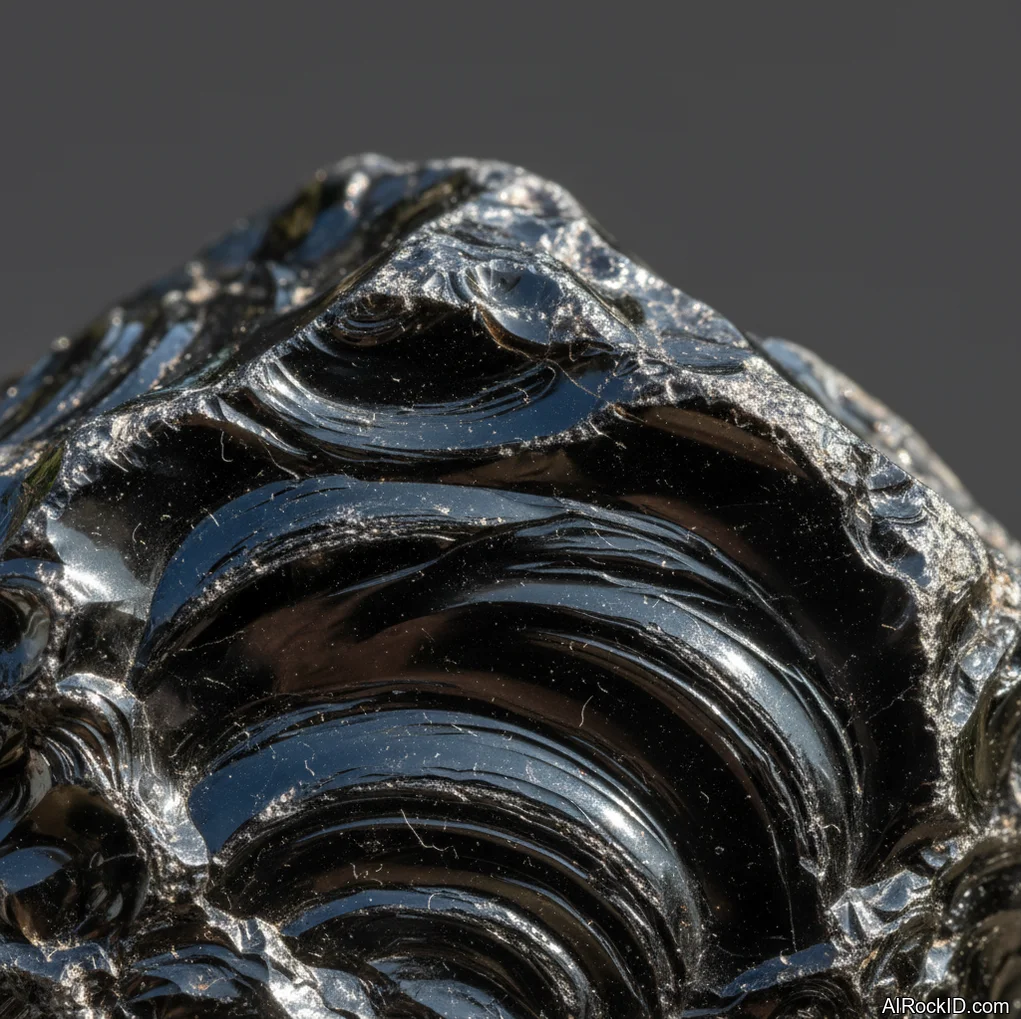
- Obsidian: Volcanic glass with a glassier look and conchoidal fractures; it is usually not banded chalcedony.
- Black Agate: Also chalcedony, but the trade names overlap; black onyx is typically used for parallel-banded or uniformly black chalcedony.
- Jet: Organic material from fossilized wood, much lighter and softer than black onyx.
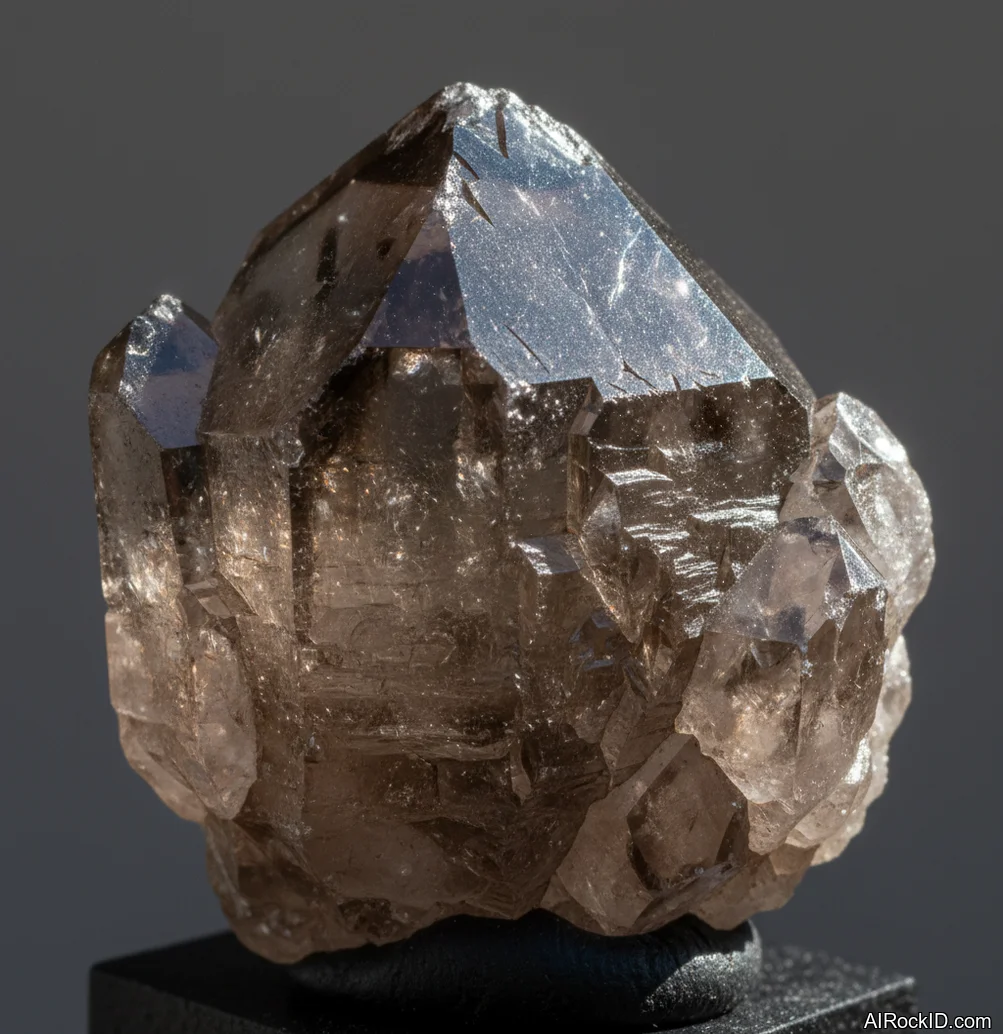
- Black Tourmaline: A borosilicate mineral with striated crystal forms and a different structure from chalcedony.
Black Onyx Lookalike Comparison
| Material | Typical Clue | Key Difference |
|---|---|---|
| Black Onyx | Waxy to vitreous polish; may show subtle banding at edges | Chalcedony quartz with hardness about 6.5–7 |
| Obsidian | Very glassy surface and sharp conchoidal chips | Natural volcanic glass, not microcrystalline quartz |
| Jet | Feels unusually light and can look softer or warmer | Organic and much softer than onyx |
| Black Tourmaline | Long striations or prismatic crystal habit | Different mineral species and often less evenly polished in rough form |
| Dyed Chalcedony | Uniform black color, sometimes concentrated in cracks or drill holes | May still be chalcedony, but color is treatment-related |
AI identification confidence
AI identification of black onyx is usually moderate from clear photos because many black polished stones share similar color and luster. Confidence improves when images show thin edges, drill holes, fractures, banding, scale, and both polished and unpolished surfaces.
When AI gets it wrong
- The stone is uniformly black and highly polished, hiding banding or natural texture.
- Photos are taken under strong reflections that make chalcedony, glass, and obsidian look alike.
- The specimen is a bead or cabochon with no visible fracture, edge translucency, or rough surface.
- The material is dyed chalcedony, which can be visually identical to commercial black onyx.
Final recommendation
For buying black onyx, prioritize clear disclosure about dyeing, stabilization, or other treatments, especially for uniformly black beads and inexpensive jewelry. If natural, untreated color is important, request documentation from a reputable gemological source rather than relying on appearance alone.
How to Check Black Onyx Before Buying
Examine edges, drill holes, and small chips for color concentration that may indicate dye. Ask the seller whether the material is natural-color onyx, dyed chalcedony, or another black stone, and look for consistent terminology on invoices or certificates. Very low prices for perfectly uniform black beads often indicate treated chalcedony rather than rare natural black banding.
Photo Tips for Identifying Black Onyx
Use bright indirect light and include a close-up of any edge, chip, bead hole, or translucent area. A white background can reveal faint brown, gray, or banded zones that are not visible against a dark surface. Include a size reference and avoid heavy filters, because black stones are especially difficult to identify from color alone.
Natural Color vs. Dyed Black Onyx
Commercial black onyx is commonly dyed to create an even black appearance, and this treatment is widely encountered in beads and cabochons. Dyed chalcedony can still be durable and wearable, but it should not be represented as untreated natural-color material. Disclosure matters most when price, collectibility, or natural origin is part of the purchase decision.
What Is Black Onyx?
Black onyx is the black to very dark version of banded chalcedony, which is microcrystalline quartz. Most of the time it’s sold already polished, and it’s often dyed so the color comes out an even, jet-black shade.
Hold a piece for a second and you feel it immediately. Smooth. Cool. And it’s got that dense little heft you expect from quartz family material, even when the stone isn’t very big. Most of what you run into in shops is tumbled or cut as cabochons, and when you put it under a bright light, the surface flashes with a clean, glassy shine, not that fake plastic gleam.
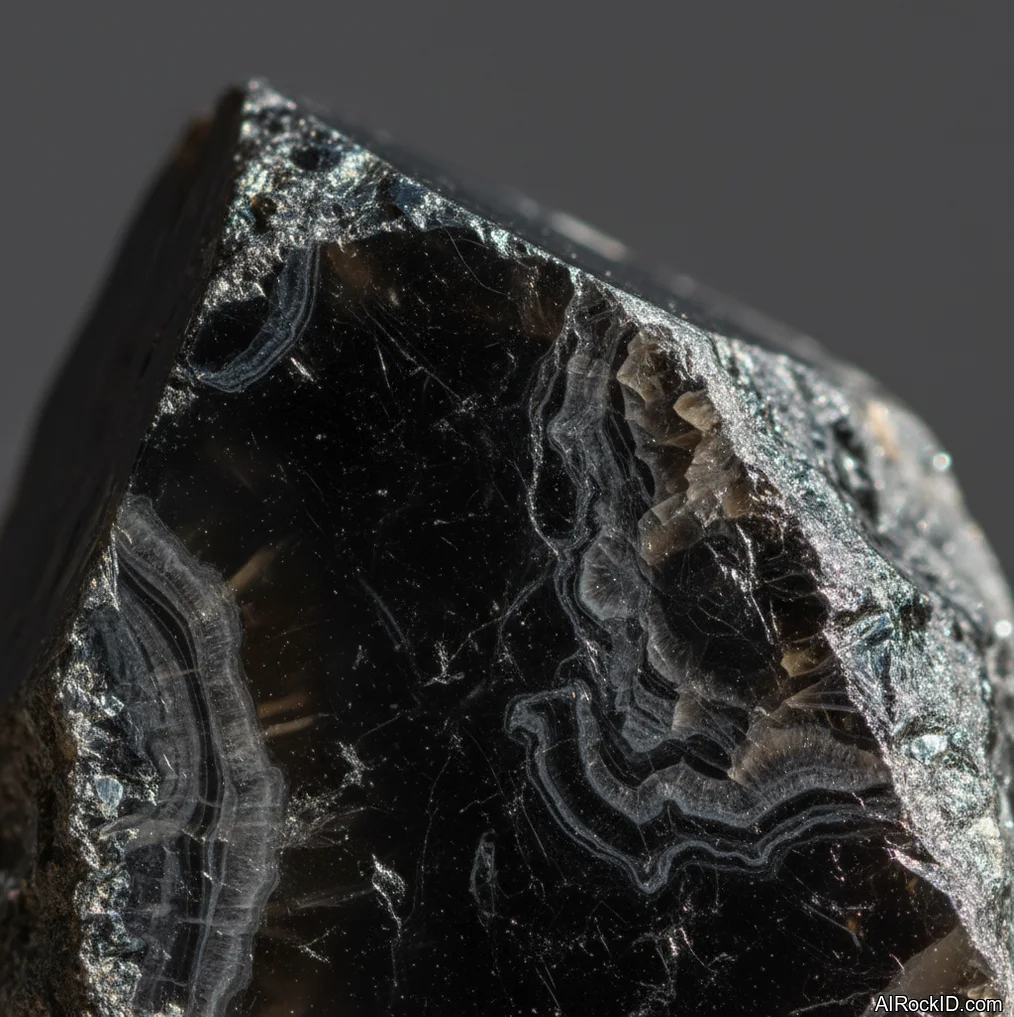
Look, at first it just reads as a plain black stone. But the whole point of onyx is the banding. With real onyx, you can sometimes spot faint, parallel lines if you tilt it under a desk lamp or catch it with side lighting (the kind that skims across the surface). Thing is, the market’s messy: a lot of what gets sold as “black onyx” is actually dyed agate or dyed chalcedony. It’s still quartz, still a real stone, but the color usually comes from a dye bath, not straight from nature.
Origin & History
Onyx as a name has been around forever, lifted straight from the Greek word “onyx,” which means fingernail or claw. Ancient writers were already talking about banded stones used for carving long before modern mineralogy pinned down what chalcedony actually is (or even agreed on the labels).
As a mineral variety, onyx falls under the quartz umbrella, and chalcedony didn’t get its more official, cleaned-up treatment until the 18th and 19th century when mineral classification started tightening up. And in the gem trade, “black onyx” turned into the go-to label for uniformly black cab material, even though truly natural, evenly black banded chalcedony is rarer than the catalogs make it sound. Why? Because a lot of what you see is just dead-even black, no bands showing, like it’s been made to look that way.
Where Is Black Onyx Found?
Black onyx on the market is sourced from major agate and chalcedony producers, especially Brazil and India, plus material from Mexico, Madagascar, Uruguay, and parts of the western United States.
Formation
Most onyx forms the same basic way other agates do. Silica-rich fluids seep through little cavities in volcanic rock, or slip along fractures in other host rock, and they leave behind microcrystalline quartz in layers as they go.
Those layers can be insanely thin. Like, you can stare at it under a lamp and you still won’t pick out individual crystals with your naked eye, you just get bands.
And if you’ve got a cut face in front of you and you tilt it around, you’ll sometimes catch that “stack of paper” look, especially on pieces that aren’t dyed pitch-black. The banding in onyx usually runs more parallel, not the wavy fortification patterns people picture when they think of classic agate slices.
But here’s the catch: that deep black color is often boosted. Dealers will tell you straight if you ask, but a lot of tags won’t say a word about dye.
How to Identify Black Onyx
Color: Usually jet black to very dark gray; natural pieces may show subtle gray or brownish banding under strong side light. Dyed material is often a very uniform black.
Luster: Vitreous to waxy when polished, with a crisp shine on clean surfaces.
Pick up two stones and compare temperature and feel. Real quartz-family material stays cool longer and feels “hard,” while plastic or glass fakes warm up fast and can feel slick in a weird way. If you scratch it with a steel pin, it shouldn’t gouge easily, but it will scratch glass with a sharp edge. The real test is a bright flashlight held right at the edge: some pieces show faint banding or slight translucence at thin spots, while cheap dyed stuff can look dead-black everywhere.
Common Look-Alikes
Black Onyx is sometimes confused with these materials:
- Dyed black agate (banded chalcedony sold as "black onyx" with ink-black color and hidden banding)
- Black obsidian (volcanic glass, usually lighter in the hand and can show flow lines or a glassy edge)
- Jet (organic fossil material, very light for its size and scratches easier than onyx)
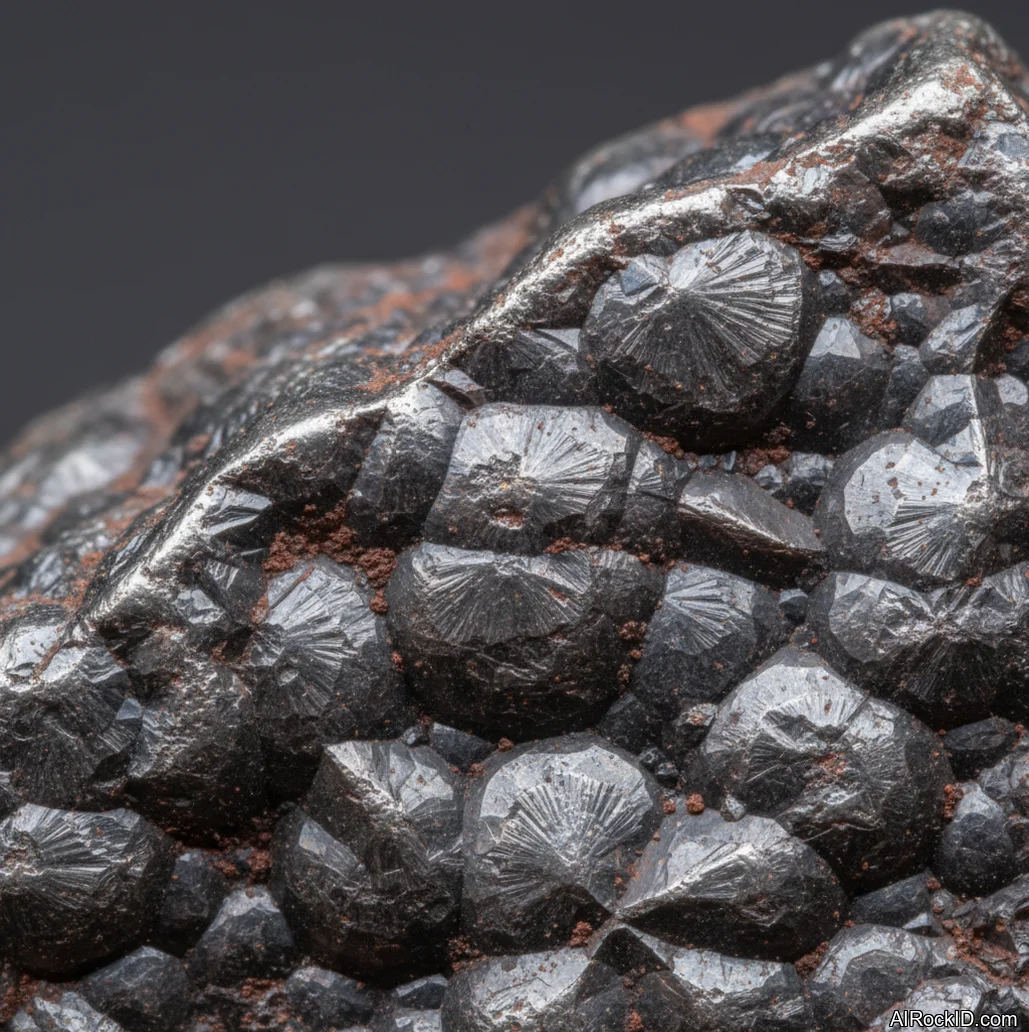
- Hematite (metallic gray-black with a mirror shine and a reddish-brown streak, way heavier feel)
- Black tourmaline (schorl) (striated prismatic pieces, not waxy-smooth chalcedony)
- Black glass or "onyx" glass (uniform black, warmer feel, often shows tiny bubbles under a loupe)
Market Cautions & Treatments
When AI Can Get This Wrong
In photos, AI mixes up polished black onyx with obsidian and black glass constantly, because all three read as shiny black with few surface cues. Banding is the big problem: dyed onyx often hides it, so the camera sees a flat black blob and guesses wrong. The real test is physical: onyx stays cool in the palm longer, won’t show bubbles under magnification, and it’ll scratch glass like other quartz-family material.
Properties of Black Onyx
Physical Properties
| Crystal System | Trigonal |
| Hardness (Mohs) | 6.5-7 (Hard (6-7.5)) |
| Density | 2.58-2.64 |
| Luster | Waxy |
| Diaphaneity | Opaque |
| Fracture | Conchoidal |
| Streak | White |
| Magnetism | Non-magnetic |
| Colors | Black, Dark gray, Black with gray banding |
Chemical Properties
| Classification | Silicates |
| Formula | SiO2 |
| Elements | Si, O |
| Common Impurities | Fe, Mn, C |
Optical Properties
| Refractive Index | 1.530-1.543 |
| Birefringence | 0.004 |
| Pleochroism | None |
| Optical Character | Uniaxial |
Black Onyx Health & Safety
Black onyx (chalcedony quartz) is usually fine to handle, and it can get wet without any trouble. The real, everyday risk is mechanical: drop it on tile or concrete and those crisp edges, especially at sharp corners, can chip.
Safety Tips
If you have to cut it or grind it, handle it the same way you’d handle anything with silica. Keep the dust out of your lungs. Use water to knock the dust down, and wear the right respirator (not just a paper mask).
Black Onyx Value & Price
Price Range
Rough/Tumbled: $2 - $25 per tumbled stone
Cut/Polished: $1 - $10 per carat
Price can jump around a lot, and it usually boils down to cut quality, size, and whether you’re seeing clean, parallel banding or just that flat, uniform dye-black look. And yeah, you’ll pay more for carvings and matched pairs than you will for loose tumbles.
Durability
Durable — Scratch resistance: Good, Toughness: Good
It’s stable in normal wear, but polished surfaces can pick up a dull haze if they bang around with harder stones in a pocket.
How to Care for Black Onyx
Use & Storage
Store it in a soft pouch or a divided box slot so the polish doesn’t get scuffed by harder or grit-covered pieces. And don’t toss it in a bowl with loose quartz points unless you want little frosty scratches.
Cleaning
1) Rinse with lukewarm water and a drop of mild soap. 2) Use a soft toothbrush to clean around settings or drill holes. 3) Rinse well and dry with a microfiber cloth.
Cleanse & Charge
If you do energetic cleansing, simple is fine: rinse and dry, or leave it on a shelf overnight away from electronics. Avoid salt soaks if the piece is set in metal or has glued fittings.
Placement
On a desk, it looks great under a lamp because the polish throws back clean highlights. In a pocket, it holds up well, but edges on carved pieces can chip if you carry keys.
Caution
Skip harsh cleaners and don’t toss set jewelry into an ultrasonic machine. If the stone’s dyed, letting it sit in solvents or other strong chemicals for a long time can slowly mess with the surface color (it might not show up right away, but it adds up).
Works Well With
Black Onyx Meaning & Healing Properties
Compared to the flashier stuff, black onyx is what I see people grab when they want something quiet. No sparkle. No fireworks. Just a smooth, dark stone that sits there and doesn’t ask for attention.
In your hand it feels steady. Cool at first, then it warms up slow. And the surface has that slick, almost glassy feel that makes you want to keep rubbing your thumb over it without thinking. If you’re the kind of person who calms down by holding something and zoning in on a sensation, that simple physical steadiness can be grounding.
Most people link black onyx with boundaries, protection, and staying level-headed. That makes sense to me. It looks like it “absorbs” light, and since it isn’t throwing off rainbows or glitter, it’s easy to treat it like a plain focus stone during breath work or meditation. But, same note I always tack on (because it matters): none of this replaces medical care, and it won’t fix anxiety on its own. Tool, not cure. That’s the deal.
The sticky part with black onyx in the metaphysical market is the whole dye conversation. Some folks feel off about using a dyed stone for spiritual work. I’ve handled plenty of natural pieces and dyed ones, and honestly? Half the time what people are responding to is the texture, the weight, and their own baggage or comfort with the color black, not a lab report. So if you want to keep it strictly natural, look for pieces where the “black” fades into smoky grays at the edges, or where you can catch those parallel bands when you tilt it under a light. (You usually see it when the reflection slides across the surface.)
Common mistakes
- Assuming every uniformly black polished stone is black onyx.
- Treating dyed chalcedony as automatically fake; it may be real chalcedony with treated color.
- Using color alone to separate black onyx from obsidian, glass, jet, or black tourmaline.
- Ignoring bead holes and fractures, where dye concentration may be easier to see.
- Expecting strong banding in every black onyx item, since many commercial pieces look uniformly black.
Identify Black Onyx from a photo
Compare Black Onyx traits, care tips, value clues, and common lookalikes with a clear photo.