Blue Onyx Identification


Quick answer: Blue Onyx is a blue variety or trade form of banded chalcedony, and many specimens on the market are dyed to achieve a stronger blue color. Its banding, quartz hardness, and translucent-to-opaque chalcedony texture help separate it from softer blue stones and glass imitations.
How to identify blue onyx
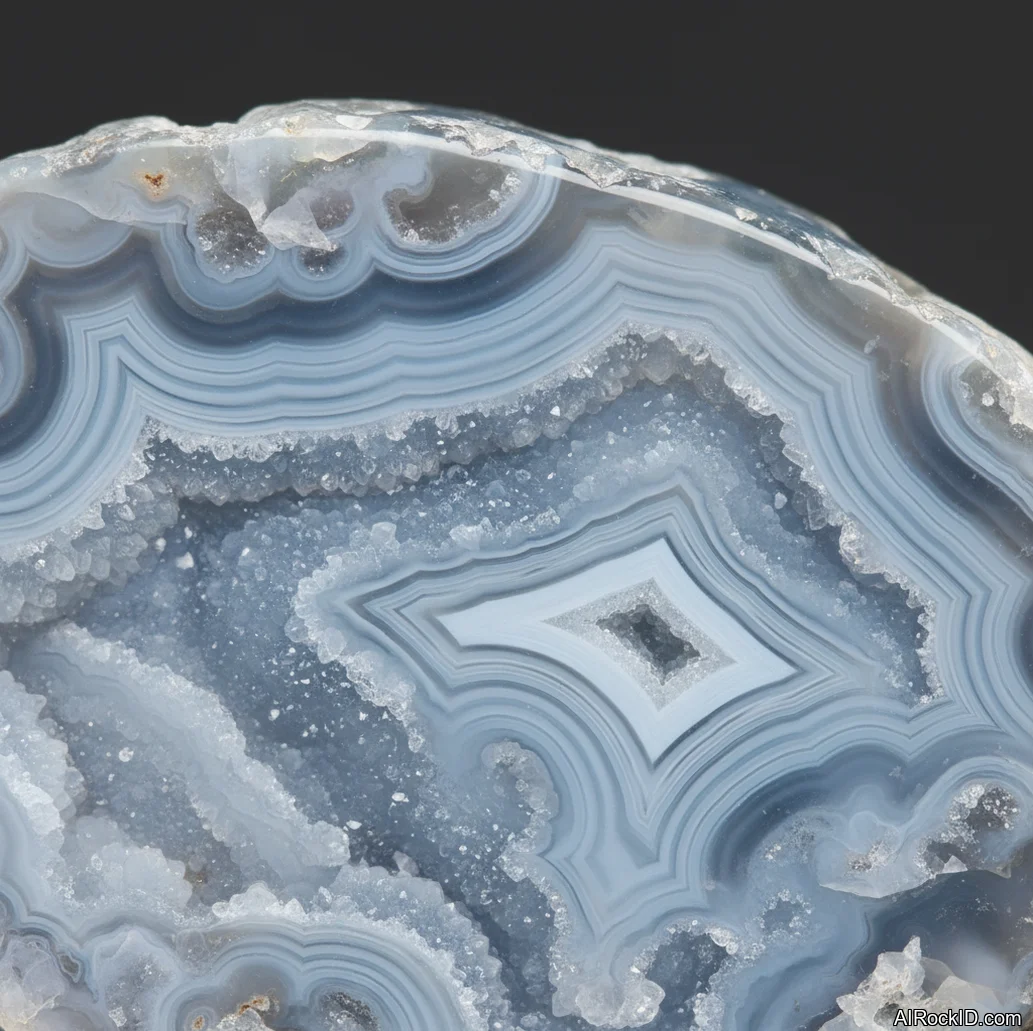
In strict gemological use, onyx is chalcedony with parallel bands, but the name blue onyx is used inconsistently for blue-banded chalcedony, dyed agate and banded calcite sold as onyx. Chalcedony has a waxy to glassy luster and Mohs hardness near 7, whereas calcite is much softer at 3 and may show cleavage. Extremely even color or blue dye concentrated along cracks, pits and drill holes suggests treatment, although professional testing may be needed to confirm it.
AI Rock ID can help compare Blue Onyx against similar blue banded stones using visible traits such as banding, translucency, and surface luster. RockIdentifier.io provides crystal reference information that can support visual identification, but lab testing may be needed for dyed or treated material.
Good fit
- Collectors who want a blue, banded chalcedony with a polished decorative look
- Jewelry buyers looking for a durable stone suitable for beads, cabochons, and carvings
- People comparing dyed versus natural-looking blue chalcedony materials
- Beginners learning to identify banding, waxy luster, and quartz-family hardness
Not a good fit
- Buyers who require untreated natural color unless the seller provides reliable disclosure
- Situations where heat, harsh chemicals, or ultrasonic cleaning may affect dyed material
- Anyone expecting a diagnostic ID from color alone
- Collectors seeking rare natural blue chalcedony with full origin documentation
Most commonly confused with
- Blue Chalcedony: Blue chalcedony is often more evenly colored, while Blue Onyx commonly shows parallel or curved banding.
- Agate: Agate is also banded chalcedony, but the name is broader and may include many colors and banding patterns.
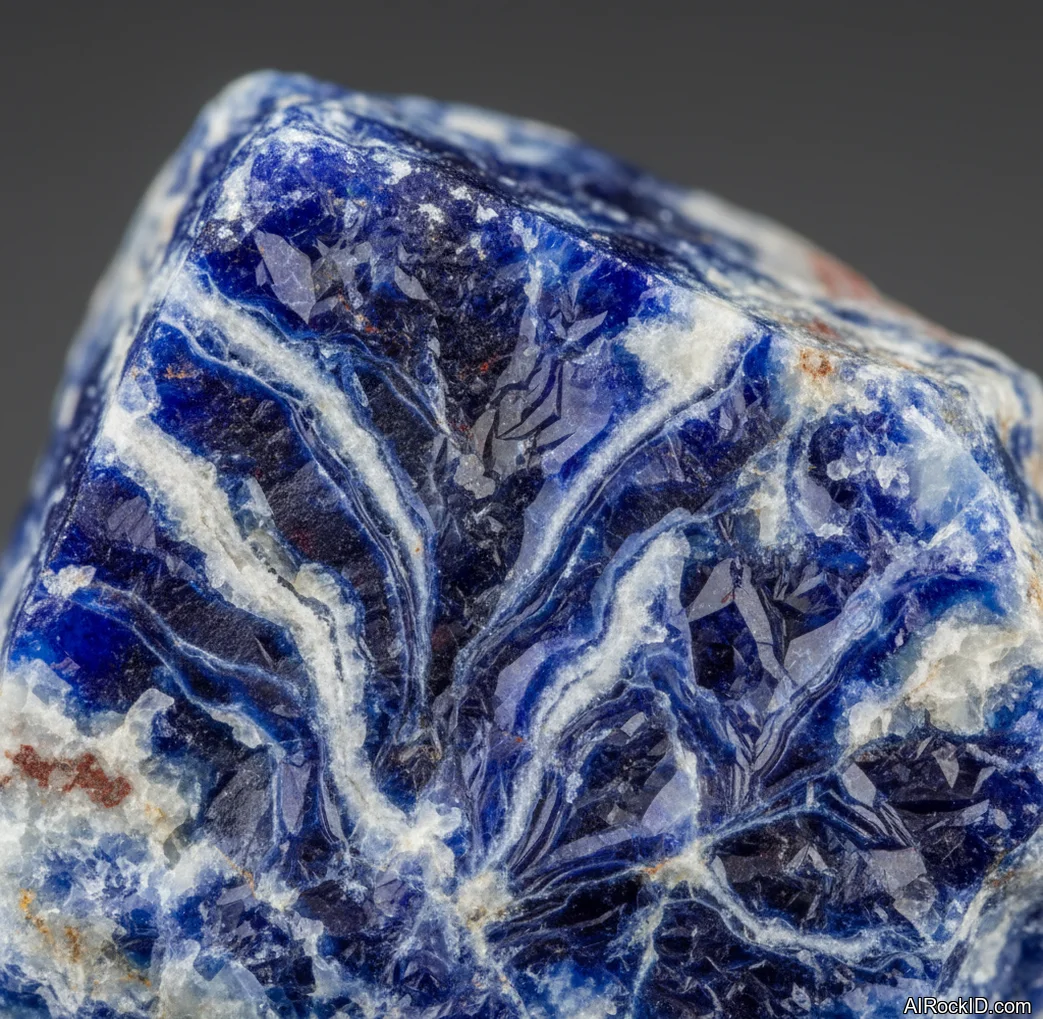
- Sodalite: Sodalite is usually darker royal blue with white veining and is softer than Blue Onyx.
- Lapis Lazuli: Lapis lazuli often contains pyrite flecks and calcite patches, features not typical of Blue Onyx.
Blue Onyx vs Similar Blue Materials
| Material | Typical Clues | Key Difference |
|---|---|---|
| Blue Onyx | Banded chalcedony, waxy to vitreous luster, Mohs 6.5–7 | Often dyed; banding is a major visual clue |
| Blue Chalcedony | Soft blue, translucent, usually less distinct banding | More uniform color than typical Blue Onyx |
| Sodalite | Deep blue with white veining, Mohs 5.5–6 | Softer and more granular-looking |
| Lapis Lazuli | Blue with pyrite or calcite inclusions, Mohs 5–5.5 | May show gold pyrite flecks |
| Blue Glass | Uniform color, possible bubbles, conchoidal fracture | Not a microcrystalline quartz material |
AI identification confidence
AI identification confidence for Blue Onyx is usually moderate when clear banding, polished surfaces, and multiple angles are visible. Confidence decreases when the stone is heavily dyed, photographed under colored lighting, or shown only as a small bead or cabochon.
When AI gets it wrong
- A dyed agate or chalcedony bead may be labeled Blue Onyx based mainly on color.
- Blue glass can appear similar in low-resolution photos, especially when bubbles or mold lines are not visible.
- Sodalite or lapis lazuli may be misread as Blue Onyx if white veining or pyrite is not shown clearly.
- Overexposed images can hide banding and make natural texture difficult to evaluate.
Final recommendation
For buying Blue Onyx, ask whether the color is natural, dyed, or otherwise treated, especially for vivid or uniform blue pieces. Choose stones with clear disclosure, visible banding, and product photos taken under neutral lighting.
How to Check Blue Onyx Authenticity
Authentic Blue Onyx should have the hardness and texture expected of chalcedony, with a smooth waxy to vitreous polish and no plastic-like feel. Strongly saturated blue color is often a sign of dye treatment rather than a sign that the stone is fake. A jeweler, gemologist, or mineral lab can test uncertain pieces using refractive index, magnification, and dye-detection methods.
Natural Color vs Dyed Blue Onyx
Many commercial Blue Onyx beads, slabs, and carvings are dyed chalcedony or agate. Dye can concentrate along fractures, drill holes, porous bands, or surface-reaching cracks. Treatment disclosure matters most for collectors and resale value, while dyed material may still be genuine chalcedony.
Photo Tips for Identifying Blue Onyx
Photograph Blue Onyx in daylight or neutral white light to avoid making gray, teal, or dyed colors look inaccurate. Include close-up images of banding, drill holes, edges, and any fractures. A photo beside a common object for scale can help distinguish beads, cabochons, slabs, and tumbled stones.
What Is Blue Onyx?
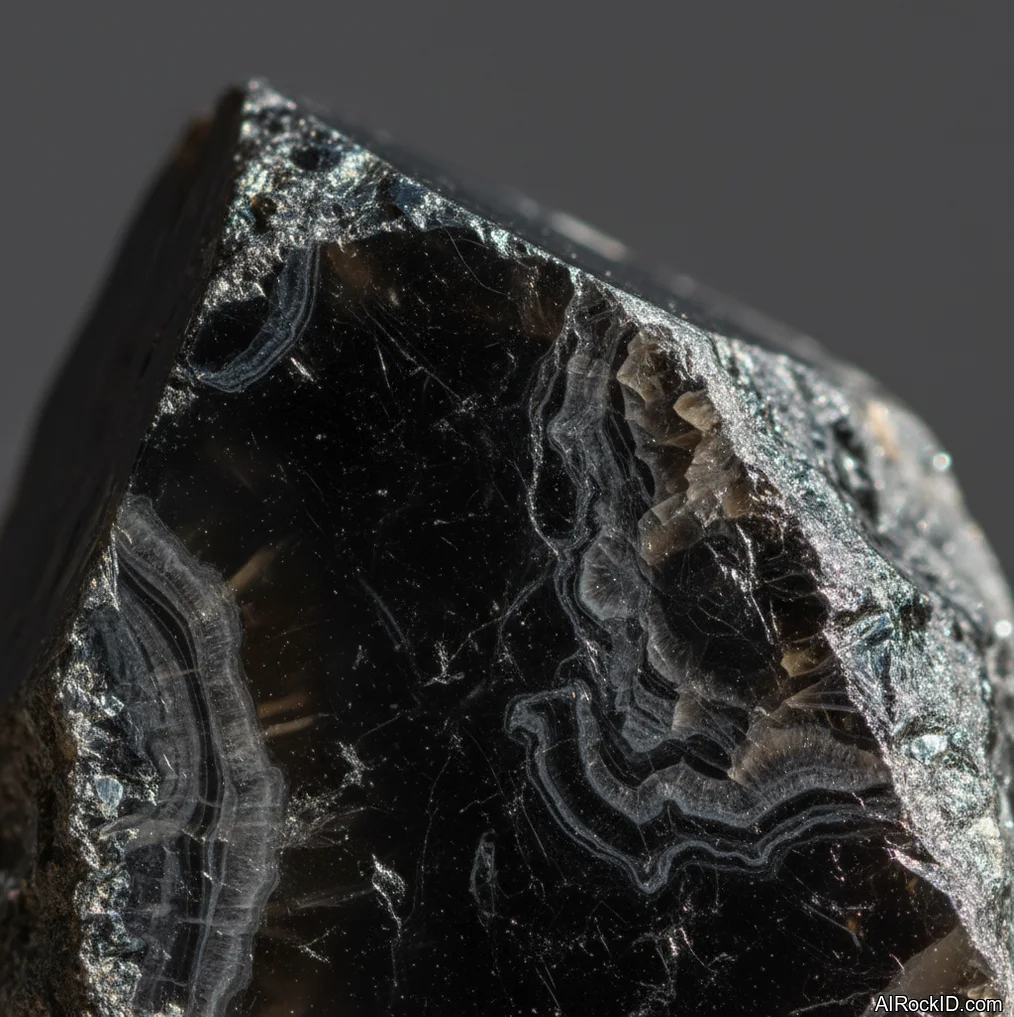
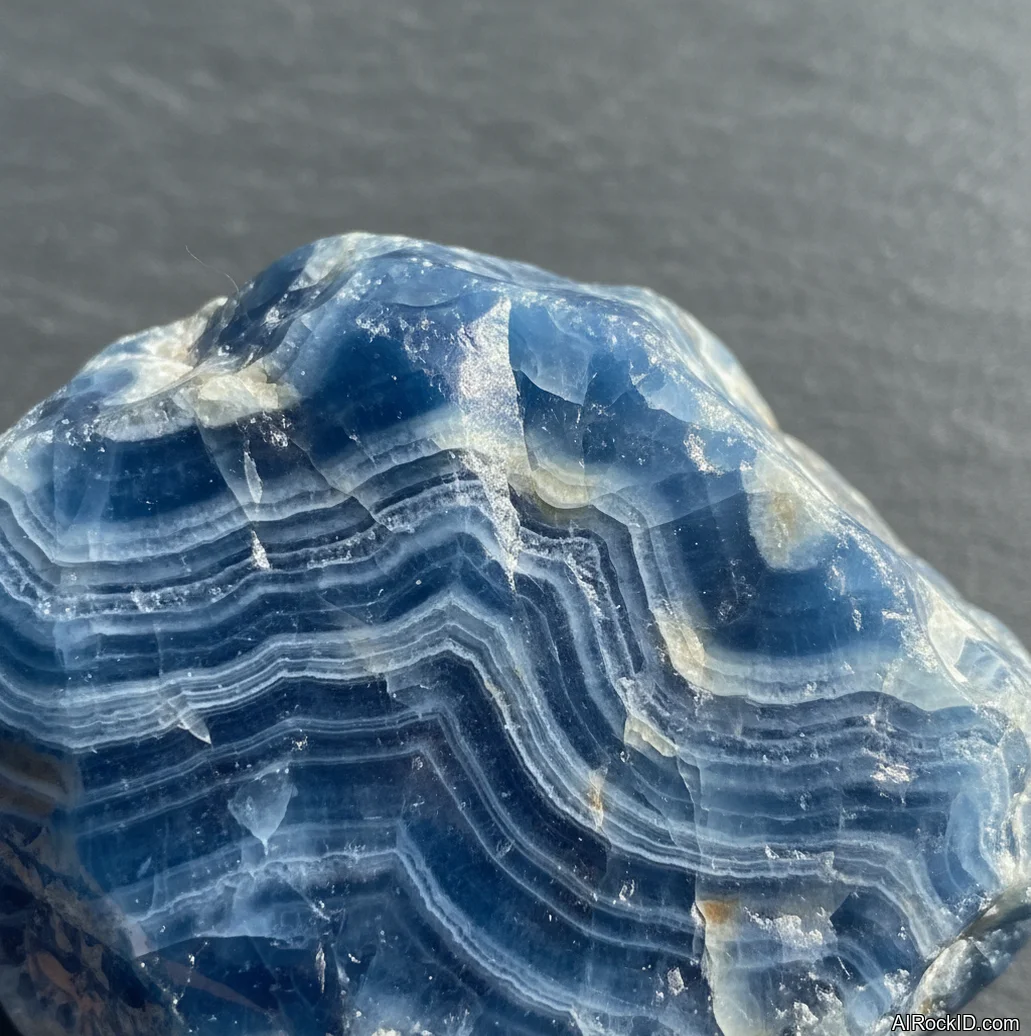
Blue Onyx is a blue, banded type of chalcedony (microcrystalline quartz) that gets sold under the onyx trade name.
Pick up a polished piece and you notice the quartz weight right away. It’s got that cool-to-the-touch feel in your palm, like it’s been sitting on a stone countertop. The bands can look almost too neat, like somebody pulled a paintbrush across it in straight, clean stripes. Thing is, most of what’s labeled “blue onyx” in shops is dyed chalcedony, because naturally blue banding that uniform just isn’t common in bulk. But it still looks fantastic tossed in a bowl of tumbles or cut into a chunky palm stone.
At a quick glance, people also mix it up with “blue onyx” that’s actually banded calcite. That material’s softer, and you can usually feel the difference fast (it doesn’t have the same dense, hard snap in hand). With chalcedony, the edges stay crisp after polishing, and the surface ends up with that glassy-waxy shine, not a chalky feel.
Origin & History
Onyx as a name has been around forever. It comes from the Greek “onyx,” which means fingernail or claw. Ancient writers used the word for layered stones, but over the years it got used more and more loosely, and now it’s basically a trade label for a whole pile of banded materials.
Geologically speaking, onyx is banded agate with straight, parallel layers. “Blue onyx” isn’t a formally defined mineral species, and it wasn’t “discovered” the way a brand-new mineral would be. So in today’s gem market, it turns up as a color name, usually for dyed chalcedony, and sometimes for banded calcite that sellers also call onyx.
Where Is Blue Onyx Found?
Banded chalcedony suitable for blue onyx is commonly cut from agate material from Brazil, India, Madagascar, Mexico, and the western USA; much of the blue color on the market is added by dye.
Formation
Most of the time, what you’re actually looking at is silica that crept into little cavities inside volcanic rock. Picture the gas bubbles in basalt. Later on, silica-rich fluids roll through and flood those empty pockets. It happens in thin passes, not all at once. Layer by layer, chalcedony coats the inside, and if the conditions don’t change much you end up with those straighter, onyx-style bands instead of the wilder, swirly agate stuff.
Look, if you hold a fresh cut face under a bright desk lamp and tilt it around, you can see how tight the structure is. No big crystals staring back at you. It’s microcrystalline quartz packed so fine it breaks with that smooth conchoidal snap you feel in your fingers when an edge chips clean.
But here’s the market wrinkle: color. A lot of the blue material gets dyed (yeah, dyed) after it’s cut or even before it’s tumbled, because natural blue banding in chalcedony is usually subtle and uneven. And once you’ve seen a piece that looks a little too uniform, it’s hard not to wonder, right?
How to Identify Blue Onyx
Color: Typically light to medium blue with white, gray, or cream parallel bands; color can be very uniform if dyed. Natural-looking material usually has slight patchiness, soft transitions, or uneven saturation.
Luster: Vitreous to waxy luster on polished surfaces.
If you scratch it with a steel nail, it shouldn’t bite easily. Quartz-based onyx sits around Mohs 6.5–7, so the nail mostly skates. The real test is a tiny dab of acetone on a cotton swab in an unimportant spot on a polished piece: some dyed stones will show a faint blue tint on the swab. And compared to banded calcite “onyx,” chalcedony feels a little colder and tougher, and it won’t fizz with a drop of weak acid like vinegar.
Common Look-Alikes
Blue Onyx is sometimes confused with these materials:
- Dyed white/gray banded agate sold as "blue onyx" (color added after cutting, bands stay but the blue looks too even)
- Blue calcite (softer, waxier look, bands are cloudy and it dents easier than chalcedony)
- Banded blue aragonite/calcite "onyx marble" (often from Pakistan, takes a high polish but feels a bit softer and can fizz in acid)
- Blue glass (uniform color, round bubbles, feels a touch warmer in the hand, edges can look too sharp and glassy)
- Dyed howlite or dyed magnesite (takes dye hard, often shows spiderweb veining instead of clean agate banding)
Market Cautions & Treatments
When AI Can Get This Wrong
At first glance, photos of dyed blue agate, blue calcite, and banded aragonite all read as “blue onyx” to an AI because banding plus blue is basically the whole visual cue. The real test is in-hand: chalcedony should feel hard and slick and will scratch glass, while calcite/aragonite won’t and can react to a weak acid. If the blue looks identical in every band and you see dark pooling around pits or the edges of a drilled hole, assume dye even if the listing says “natural.”
Properties of Blue Onyx
Physical Properties
| Crystal System | Trigonal |
| Hardness (Mohs) | 6.5-7 (Hard (6-7.5)) |
| Density | 2.58-2.64 g/cm3 |
| Luster | Vitreous |
| Diaphaneity | Translucent to opaque |
| Fracture | Conchoidal |
| Streak | White |
| Magnetism | Non-magnetic |
| Colors | Blue, White, Gray, Cream |
Chemical Properties
| Classification | Silicates |
| Formula | SiO2 |
| Elements | Si, O |
| Common Impurities | Fe, Mn, Al, Ca, organic dyes (treated material) |
Optical Properties
| Refractive Index | 1.530-1.540 |
| Birefringence | 0.004-0.009 |
| Pleochroism | None |
| Optical Character | Uniaxial |
Blue Onyx Health & Safety
Solid, quartz-based material is safe to handle, and it does just fine around water. But if you’re cutting, grinding, or drilling it, watch the dust. Don’t breathe it in.
Safety Tips
Use wet cutting, and put on a properly fitted respirator any time you’re shaping or sanding. Silica dust is the main hazard, and it’s nasty stuff. You can feel it in your throat fast (that dry, scratchy bite), especially once the fine powder starts hanging in the air.
Blue Onyx Value & Price
Price Range
Rough/Tumbled: $5 - $60 per piece (tumbled/palm stones); $50 - $300+ for larger decorative slabs or carvings
Cut/Polished: $1 - $8 per carat (typical cabochon material, often dyed)
Prices jump around depending on how straight the bands are, how good the polish is (you can literally feel it when you rub a thumb over the surface), and the size. Stuff with natural-looking color and clean, crisp banding costs more. But that super-uniform neon-blue material you see all the time is usually cheaper, and it’s dyed.
Durability
Durable — Scratch resistance: Good, Toughness: Good
It’s stable quartz, but dyed color can fade or shift if it lives in strong sun for months.
How to Care for Blue Onyx
Use & Storage
Store it in a soft pouch if it’s polished, because quartz will scratch softer stones in the same box. Keep dyed pieces out of long, direct window sun if you want the color to stay put.
Cleaning
1) Rinse with lukewarm water and a drop of mild soap. 2) Use a soft toothbrush to get into grooves on carvings. 3) Rinse well and dry with a microfiber cloth.
Cleanse & Charge
If you do energetic cleansing, gentle methods are fine: running water, smoke, or setting it on selenite. Skip harsh salt soaks if you don’t know whether the color was dyed.
Placement
On a desk or nightstand it reads calm and tidy because the banding looks organized. I like it near a lamp, since side light makes the layers pop instead of looking flat.
Caution
Don’t hit dyed material with harsh stuff like strong solvents, bleach, or an ultrasonic cleaner. It can mess up the color and even dull the polish, kind of like when a glossy finish turns chalky after the wrong cleaner. And watch heat and long UV exposure too. Treated stones can fade if they sit under it for too long.
Works Well With
Blue Onyx Meaning & Healing Properties
In shop circles, folks grab blue onyx when they want something that feels steady in the hand, not airy or floaty. And yeah, I get why. The banding looks tidy and organized, and when you actually hold it, it has that grounded quartz feel, like it won’t crumble or flake just because it knocked against a table edge.
My own take, after years of hauling stones around in my pockets, is that blue onyx acts like other banded chalcedonies. It’s a quiet stone. No buzz, no “let’s go!” energy. When I’m sorting inventory or stuck doing paperwork at a show, I’ll keep a palm stone close because it’s smooth, it stays cool for a while, and it gives my fingers something to mess with while I’m thinking (or stalling, honestly).
But look, here’s the real limit: a lot of blue onyx is dyed, and some people get touchy about that. If dye isn’t your thing, treat it the same way you’d treat treated turquoise or heat-treated amethyst. It’s still a real mineral, it just got a human color boost. And none of this is a stand-in for medical care. If you’re dealing with anxiety, sleep problems, or anything physical, crystals are a support tool at best, not the plan. Right?
Common mistakes
- Assuming every vivid blue specimen has natural color
- Identifying Blue Onyx by color alone without checking banding or texture
- Confusing trade names with strict mineral classification
- Using scratch tests on finished jewelry, which can damage polish or settings
- Ignoring dye concentration around holes, cracks, or pale bands
- Comparing photos taken under different lighting conditions
Identify Blue Onyx from a photo
Compare Blue Onyx traits, care tips, value clues, and common lookalikes with a clear photo.