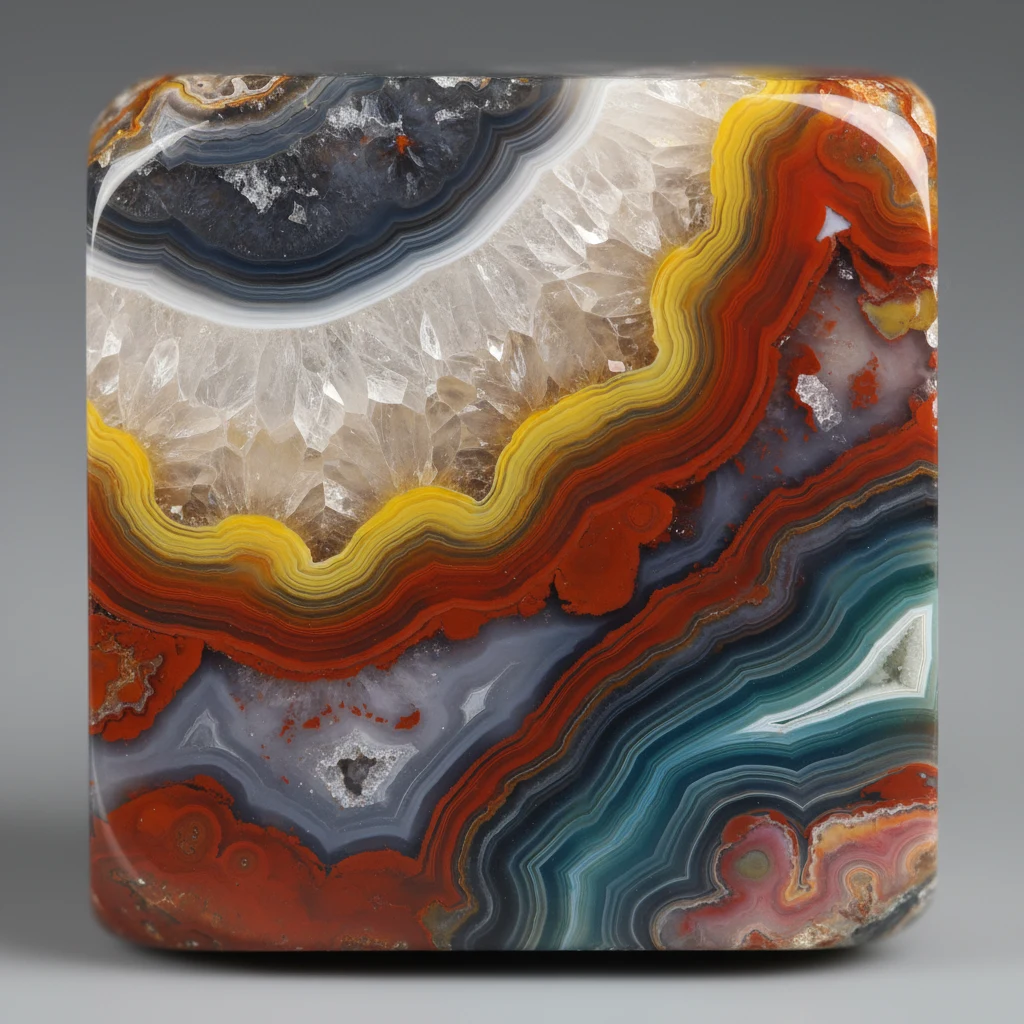
Agate


Quick answer: Agate is a durable, banded variety of chalcedony, a microcrystalline form of quartz. Its layered patterns, wide color range, and frequent use in polished slices, beads, cabochons, and geodes make it a common target for identification and authenticity checks.
AI Rock ID can help compare an agate specimen against visual features such as banding, translucency, luster, and fracture style. RockIdentifier.io provides crystal and rock information for visual identification, care context, and comparison with similar materials.
Good fit
- Collectors who like patterned stones with visible bands, mossy inclusions, or fortification-like outlines
- Jewelry buyers looking for a relatively hard quartz-family material for beads, cabochons, or pendants
- Beginners who want a common mineral with many recognizable varieties
- People comparing dyed, natural, and heat-treated stones before buying
- Lapidary hobbyists interested in slices, tumbling rough, carvings, and small decorative objects
Not a good fit
- Anyone who needs a gemstone that can be identified by color alone
- Buyers seeking rare transparent gems with strong brilliance and faceted sparkle
- Collectors who avoid commonly dyed or enhanced material
- Situations where exact locality or treatment history cannot be checked but is important to the purchase
Most commonly confused with
- Jasper: Jasper is usually opaque, while many agates show translucency at thin edges or in banded zones.
- Onyx: Onyx typically has straighter, more parallel bands, while agate bands are often curved, irregular, or concentric.
- Carnelian: Carnelian is orange to red chalcedony and may be mostly uniform, while agate is identified by distinct banding.
- Opal: Opal is softer and may show play-of-color or a more resinous look, while agate is quartz-based and harder.
Agate Lookalike Comparison
| Material | Typical Clue | Key Difference |
|---|---|---|
| Agate | Curved, concentric, or irregular bands; waxy to vitreous luster | Banded chalcedony with Mohs 6.5-7 |
| Jasper | Opaque, earthy or patterned appearance | Usually lacks the translucent banding typical of agate |
| Onyx | Straight, parallel black, white, or brown bands | Banding is usually more even and linear |
| Carnelian | Orange to red chalcedony, often semi-translucent | May lack strong banding |
| Opal | Softer, sometimes with play-of-color | Not quartz; generally lower hardness |
AI identification confidence
AI identification of agate is often strongest when the photo clearly shows banding, translucency at thin edges, and a polished or freshly broken surface. Confidence is lower for dyed stones, opaque pieces, tumbled pebbles, or specimens with minimal visible banding.
When AI gets it wrong
- A single-color tumbled stone may be chalcedony, carnelian, jasper, or dyed quartz-family material rather than agate.
- Strong artificial colors can obscure natural banding and make dyed chalcedony look like a rare agate variety.
- Low-light photos may hide translucency, causing agate to be confused with jasper or other opaque stones.
- Close-up images without scale can make glass, resin, or polished stone imitations harder to separate visually.
How to Check if Agate Is Real
Real agate should feel like a dense quartz-family stone, show a waxy to vitreous polish, and resist scratching from a steel knife more than softer imitations. Look for natural banding that continues through the stone rather than surface-only patterns. Very bright blue, pink, purple, or green colors are often dyed, which can still be real agate but should be disclosed by the seller.
Natural, Dyed, and Treated Agate
Agate is commonly dyed because chalcedony can absorb color through microscopic pores and fractures. Dyed agate may show concentrated color in cracks, along band edges, or near drill holes. Heat treatment can also deepen red, orange, and brown tones in iron-bearing chalcedony, especially in carnelian-like material.
Buying Tips for Agate
When buying agate, check whether the listing states natural color, dyed, heated, or stabilized. For slices and geodes, inspect photos for cracks, glued repairs, filled cavities, and uneven polish. For beads and carvings, compare the color inside drill holes or chips because dyed material may look more intense in porous areas.
What Is Agate?
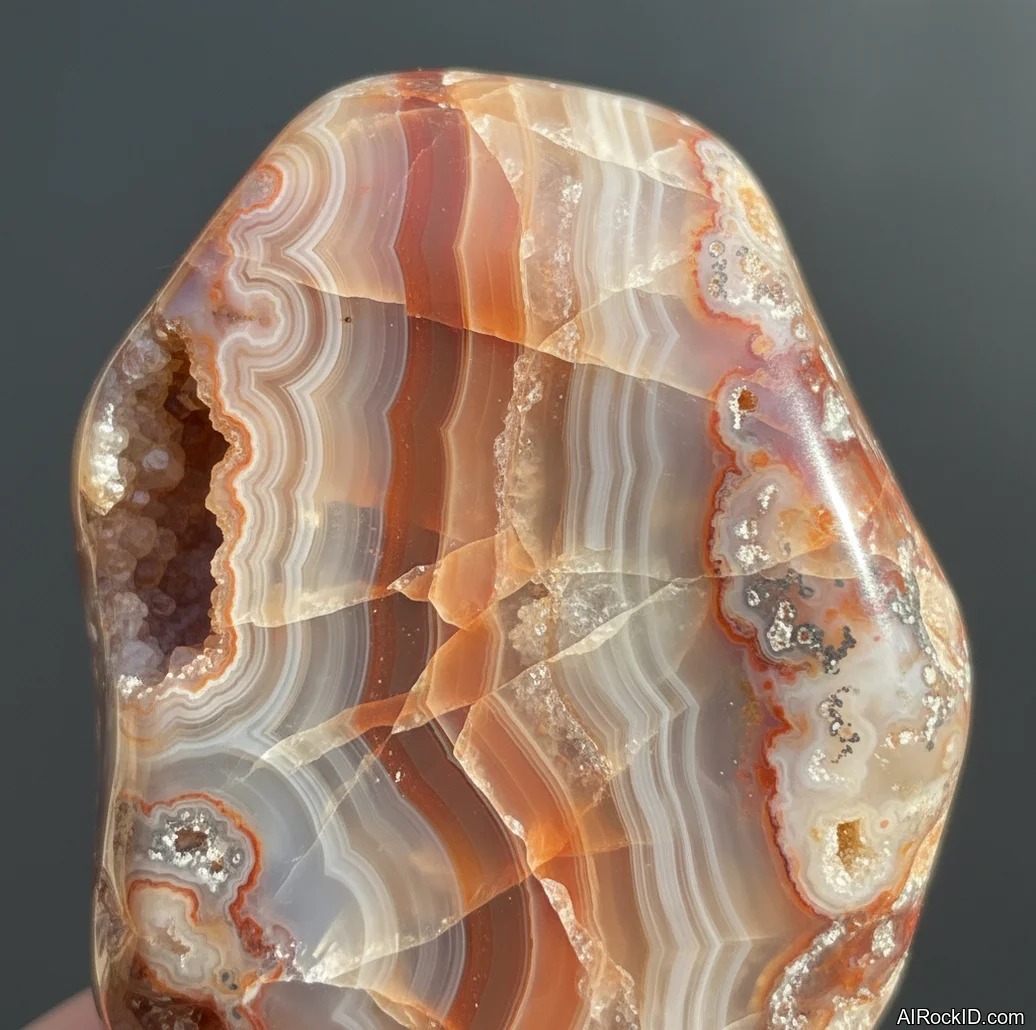
Agate is banded chalcedony, a microcrystalline variety of quartz made mainly of silicon dioxide, SiO2. In the hand, a good piece feels dense, smooth, and cool, with a waxy to vitreous polish and tight bands that may curve, stack, or form fortification patterns. It is translucent to opaque, and thin edges often glow softly when held to light.
Collectors prize agate because it is common enough to study widely but varied enough to stay interesting for a lifetime. White, gray, brown, red, orange, yellow, black, blue, green, and pink pieces all occur, though very bright neon colors are commonly dyed. With Mohs hardness 6.5-7, no true cleavage, and conchoidal fracture, agate is durable for jewelry, carvings, slabs, bookends, and educational collections.
Origin & History
Agate’s name comes from the Achates River in Sicily, now generally identified with the Dirillo River, where agates were collected in antiquity. Ancient Greek writers, including Theophrastus, described the stone, and its long record of use includes seals, beads, cameos, bowls, and decorative objects.
That history still shows in the way agate is handled today: cut, polished, sliced, carved, and studied for its bands. A collector’s label matters, especially for named varieties and regional material; locality references are commonly checked against mineral databases such as mindat.org. The stone’s appeal is both practical and visual: hard enough for everyday objects, yet patterned like a frozen record of growth.
Where Is Agate Found?
Agate is found worldwide, especially in volcanic and sedimentary environments. Major commercial sources include Brazil and Uruguay, with notable material from Rio Grande do Sul, Brazil, and the Artigas Department, Uruguay. These sources are especially important for nodules, slabs, and decorative agate.
Formation
Agate forms when silica-rich fluids enter cavities, fractures, or vesicles in host rocks, especially volcanic rocks such as basalt and rhyolite. Layer by layer, silica deposits on the cavity walls as chalcedony and microcrystalline quartz, building the banded structure that makes agate recognizable.
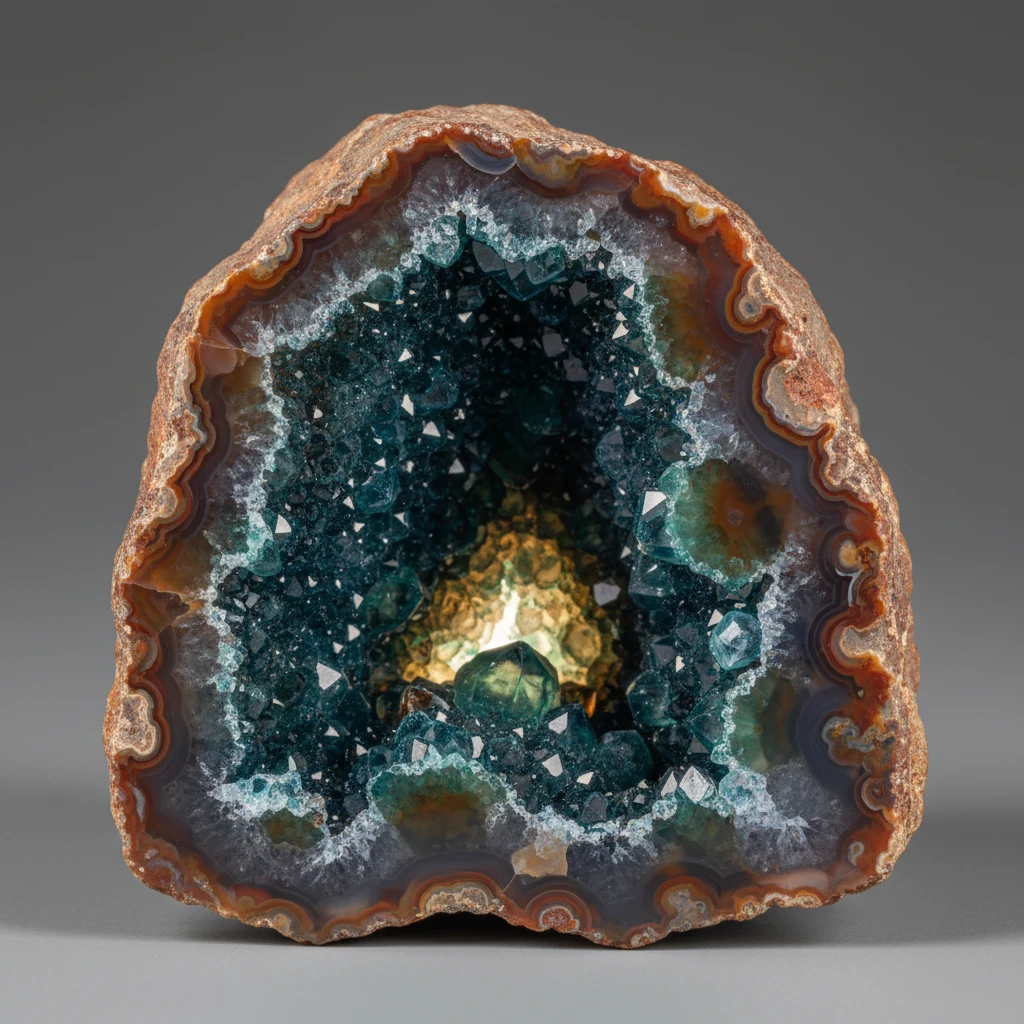
Changes in chemistry, impurities, oxidation state, and growth conditions create different colors and banding styles. Iron oxides, manganese oxides, aluminum, calcium, titanium, and organic inclusions may all contribute to color or pattern. Some agates later remain hollow in the center and become lined with quartz or amethyst crystals, forming agate geodes.
How to Identify Agate
Identify agate by looking for fine chalcedony banding, waxy to vitreous luster, conchoidal fracture, and hardness close to quartz. It should scratch glass and resist scratching by a steel knife. Natural broken surfaces may look dull to waxy, while polished faces show the bands with much more depth.
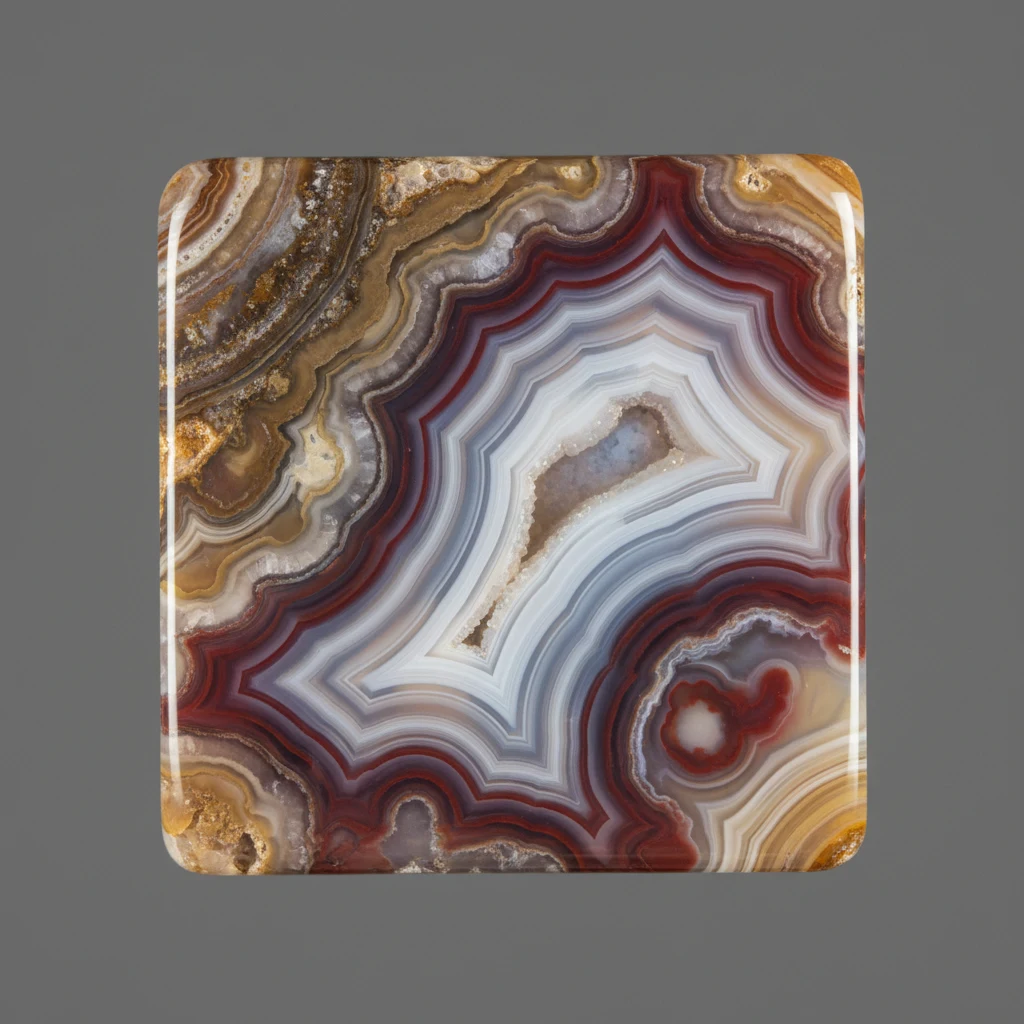
Color alone is not enough. Natural agate commonly shows subtle zoning in white, gray, brown, red, orange, yellow, black, or blue, with curved, concentric, eye-like, mossy, plume-like, or fortification patterns. Very intense blue, pink, purple, green, or black color concentrated along cracks, pores, or band edges is a useful warning sign for dyed agate.
Properties of Agate
Physical Properties
| Crystal System | Trigonal; cryptocrystalline aggregate of quartz with minor moganite commonly present |
| Hardness (Mohs) | 6.5-7 on the Mohs scale (Hard) |
| Density | Approximately 2.58-2.64 g/cm³ |
| Luster | Waxy to vitreous |
| Diaphaneity | Translucent to opaque |
| Fracture | Conchoidal to uneven; no true cleavage |
| Streak | White |
| Magnetism | Non-magnetic |
| Colors | White, Gray, Brown, Red, Orange, Yellow, Black, Blue, Green, Pink |
Chemical Properties
| Classification | Silicate; tectosilicate; microcrystalline silica |
| Formula | SiO2 |
| Elements | Silicon, Oxygen |
| Common Impurities | Iron oxides, Manganese oxides, Aluminum, Calcium, Titanium, Organic inclusions |
Optical Properties
| Refractive Index | Approximately 1.530-1.540 |
| Birefringence | Low, about 0.004; often difficult to resolve in cryptocrystalline aggregates |
| Pleochroism | None |
| Optical Character | Uniaxial positive for quartz crystallites; aggregate behavior in chalcedony |
Agate Health & Safety
Intact agate is safe to handle and is not chemically toxic. Cutting, grinding, drilling, or polishing agate can produce respirable crystalline silica dust, which is hazardous if inhaled.
Agate Value & Price
Price Range
Rough/Tumbled: Common rough agate is often inexpensive, from about $1-$10 per pound for ordinary material; attractive nodules, slabs, and named localities commonly range from $10-$100+, while exceptional large, scenic, plume, lace, or collector-grade pieces can sell for hundreds of dollars or more.
Cut/Polished:
Value depends on banding quality, color contrast, translucency, pattern, size, locality, polish, absence of cracks, and whether the color is natural or dyed. Rare named varieties and highly scenic patterns are more collectible than ordinary gray or brown agate.
Durability
Good — Scratch resistance: Good for jewelry and carvings because it is close to quartz in hardness and resists everyday scratches better than softer stones., Toughness: Generally good due to its compact microcrystalline texture, though thin slabs, geodes, and fractured pieces can break if dropped.
Stable under normal display, storage, and wear conditions. Prolonged strong sunlight may fade some dyed agates, and sudden temperature changes can worsen existing fractures.
How to Care for Agate
Use & Storage
Store agate separately from softer stones to avoid scratching them. Keep polished pieces in a pouch, tray, or lined box if used in jewelry.
Cleaning
Clean with warm water, mild soap, and a soft brush or cloth. Rinse well and dry completely. Avoid harsh acids, bleach, and abrasive cleaners.
Cleanse & Charge
If used in spiritual practices, agate is commonly cleansed with water, smoke, sound, or moonlight. Avoid long sun exposure for dyed stones because color may fade.
Placement
Suitable for display, jewelry, desk stones, bookends, carvings, and educational collections. Keep fragile geodes or thin slabs on stable stands.
Caution
Many vivid blue, pink, purple, green, or black agates on the market are dyed. Dye does not make them fake, but it should be disclosed for collecting and valuation.
Works Well With
Agate Meaning & Healing Properties
In modern crystal healing traditions, agate is associated with grounding, emotional steadiness, patience, balance, and protection. These meanings are cultural and spiritual rather than scientifically proven, but many practitioners like agate because its physical look supports the symbolism: slow bands, steady weight, and a calm, layered surface.
Agate is commonly linked with the Root, Sacral, and Heart chakras, and with Gemini, Virgo, and Capricorn. For spiritual care, people often cleanse it with water, smoke, sound, or moonlight. If the stone is dyed, avoid long sun exposure because color may fade; for ordinary cleaning, warm water, mild soap, and a soft brush or cloth are enough.
Identify Agate from a photo
Compare Agate traits, care tips, value clues, and common lookalikes with a clear photo.
Common mistakes
- Assuming every brightly colored agate is naturally colored without checking for dye disclosure
- Calling all opaque patterned chalcedony agate when some pieces are more accurately jasper
- Identifying agate by color only instead of looking for banding and quartz-family hardness
- Mistaking straight-banded onyx for typical curved or fortification agate
- Overvaluing common dyed slices or beads because the color looks unusual
- Using metaphysical names as proof of mineral identity or locality
Agate FAQ
Related Crystals
Related pages: Brown Agate · Dzi Bead