Bismuth


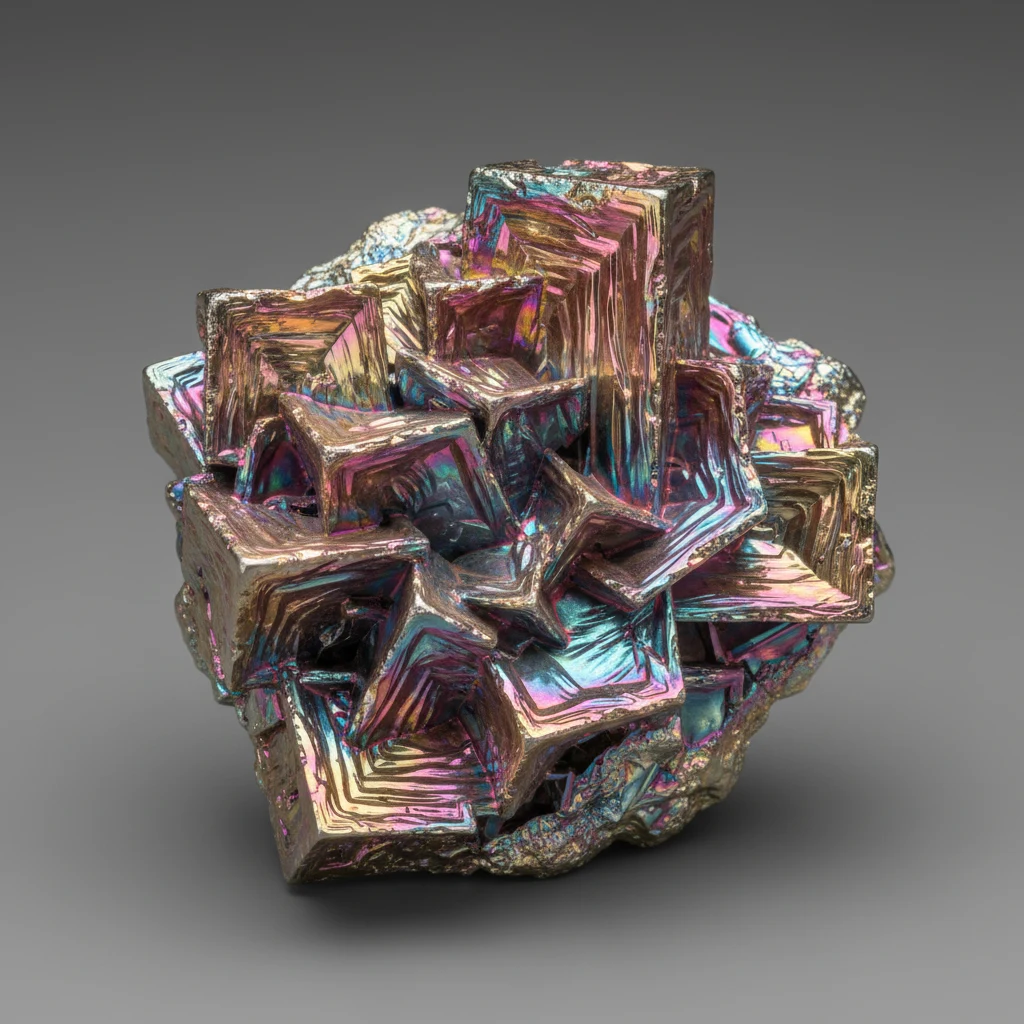
Quick answer: Bismuth is a brittle, low-melting metal often sold as lab-grown hopper crystals with iridescent oxide colors. Natural bismuth is usually silver-white to pinkish and massive or granular, while the rainbow stair-step specimens are typically crystallized by controlled cooling.
AI Rock ID can help compare bismuth’s metallic luster, stepped crystal habit, and rainbow oxidation with visually similar minerals. RockIdentifier.io provides identification support, but density, hardness, and specimen history are still useful for confirming bismuth.
Good fit
- Collectors who want a metallic specimen with geometric stair-step crystal forms
- Beginners who want a distinctive mineral that is easy to recognize visually
- Display collections where bright iridescent color is the main appeal
- People comparing natural bismuth nuggets with lab-grown bismuth crystals
Not a good fit
- Jewelry that needs strong scratch resistance or impact durability
- High-heat display areas, candles, or settings near open flames
- Collectors seeking only untouched natural crystal formations
- Specimens that will be handled frequently by children without supervision
Most commonly confused with
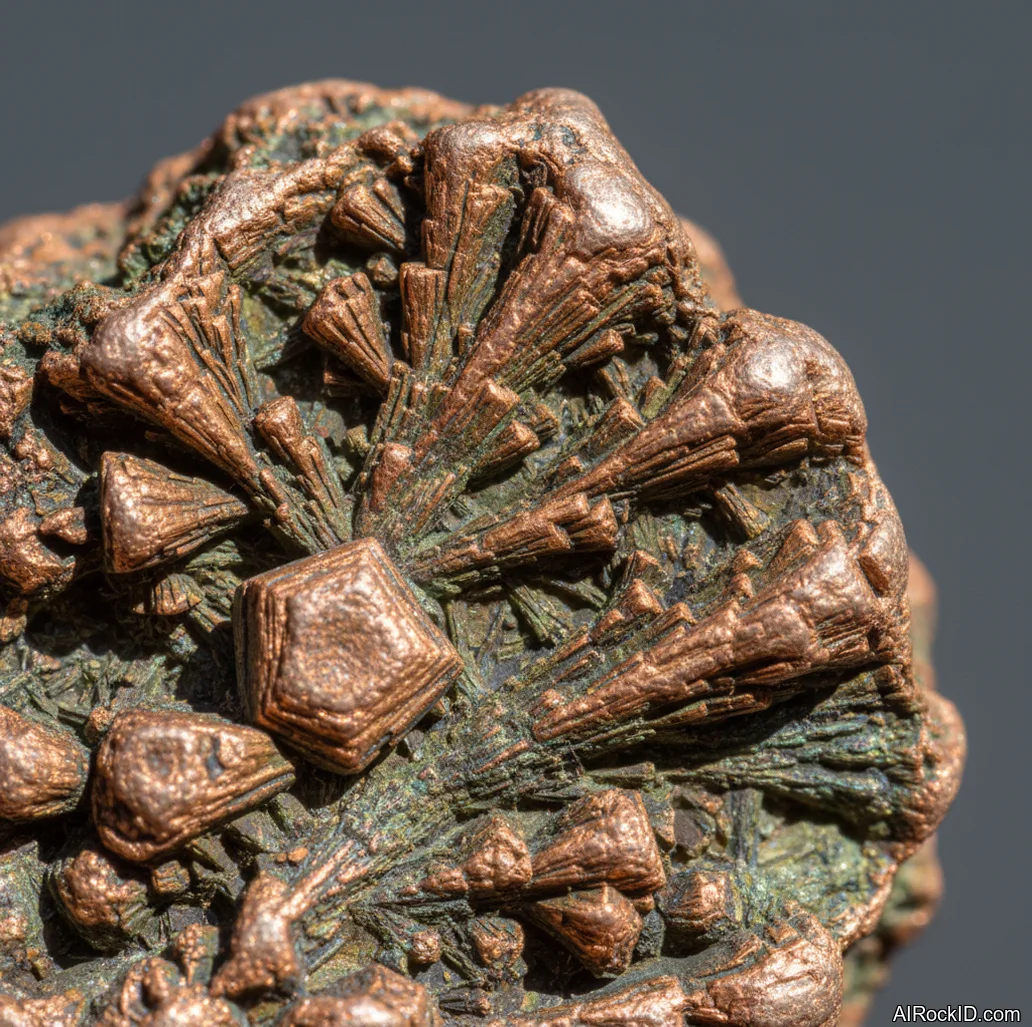
- Bornite: Bornite can show peacock-like tarnish, but it usually has a coppery base color and does not form bismuth’s square hopper steps.
- Chalcopyrite: Acid-treated chalcopyrite may look rainbow colored, but its brassy base and uneven crystal surfaces differ from bismuth’s metallic stair-step habit.
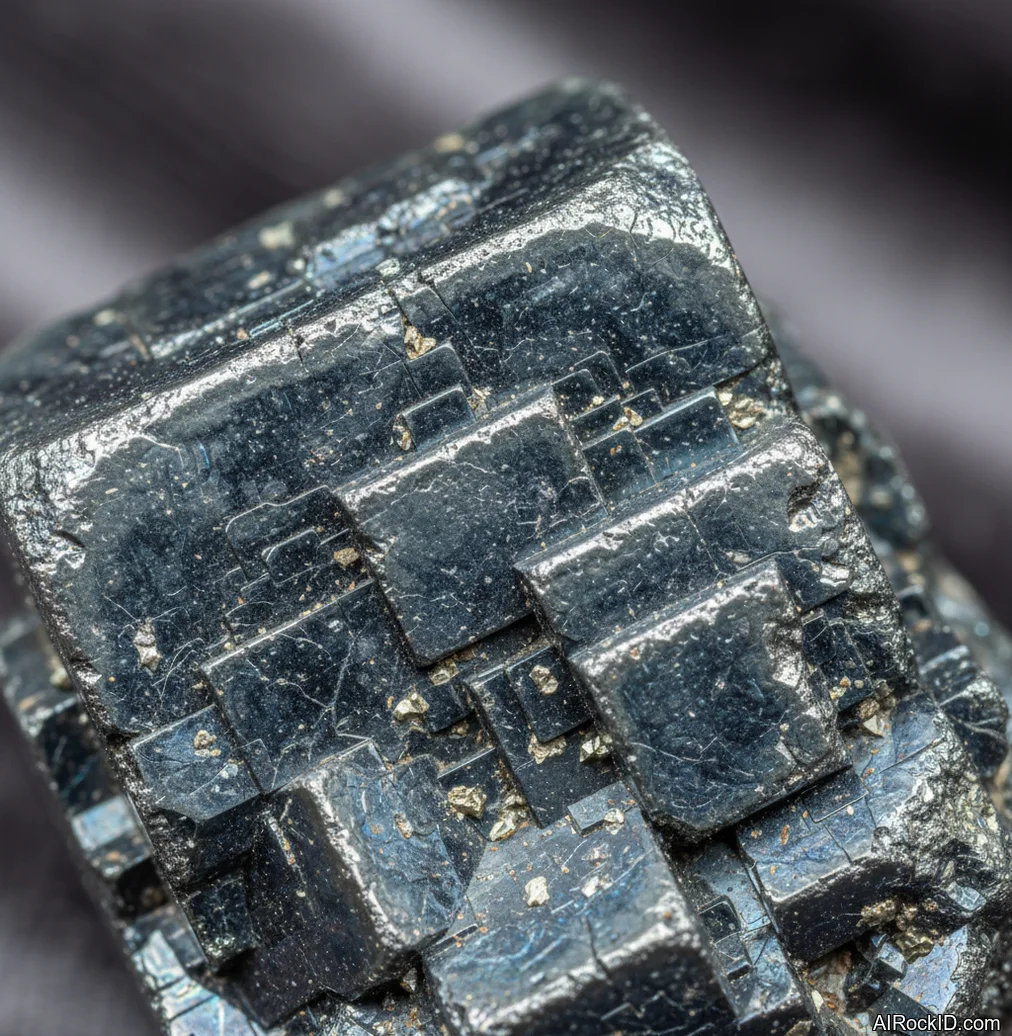
- Galena: Galena is lead-gray with cubic cleavage and high density, but it lacks the stable rainbow oxide coating typical of display bismuth.
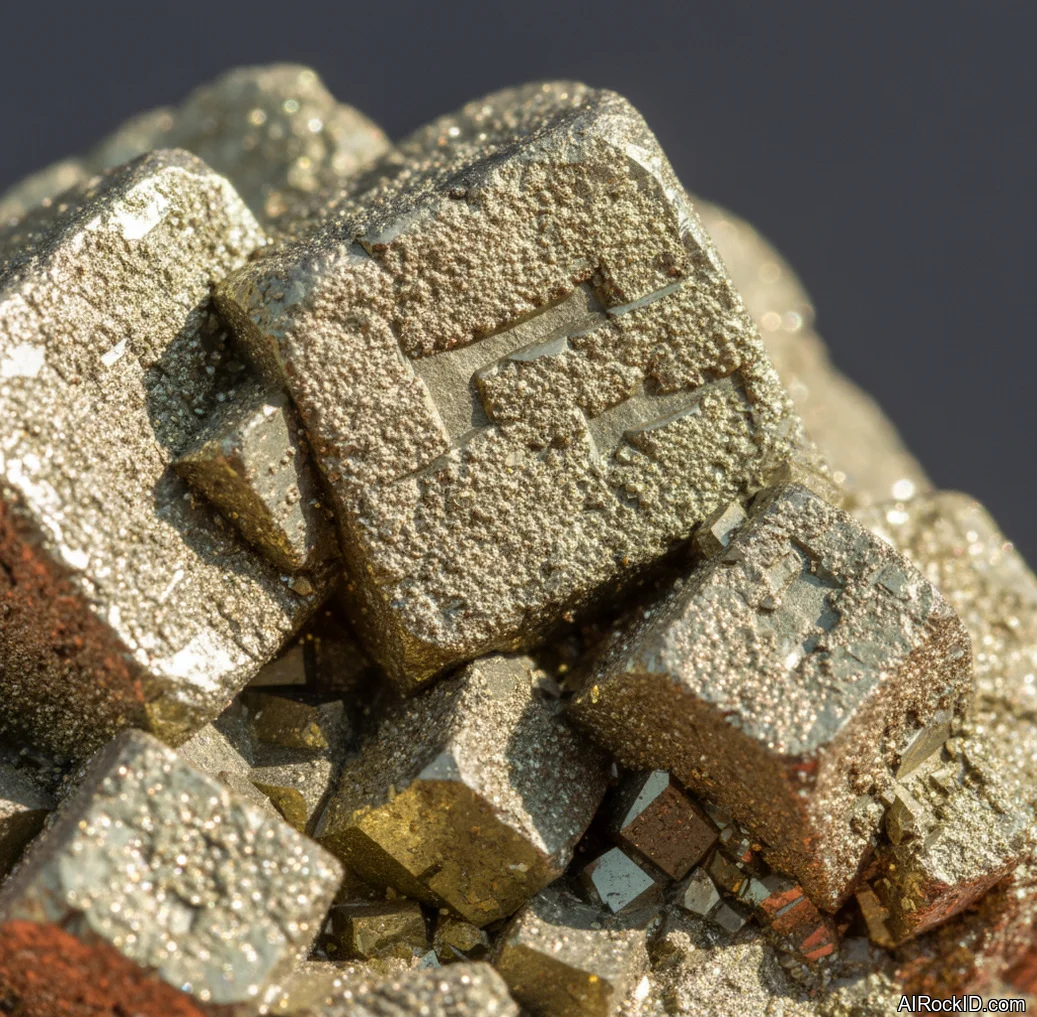
- Pyrite: Pyrite is harder and brass-yellow, with cubic or pyritohedral crystals rather than hollow hopper growth.
Bismuth vs. Common Lookalikes
| Material | Typical Look | Key Difference |
|---|---|---|
| Bismuth | Rainbow oxide on metallic stair-step crystals | Low hardness and low melting point |
| Bornite | Blue-purple tarnish over coppery mineral | Usually massive or uneven, not square hopper crystals |
| Chalcopyrite | Brassy metallic mineral, sometimes treated rainbow | Harder and more yellow-brassy underneath |
| Galena | Silver-gray cubes or cleavage pieces | Lead-gray color without bright oxide stair steps |
| Pyrite | Brass-yellow cubes or clusters | Much harder and not heat-sensitive like bismuth |
AI identification confidence
AI identification is often strong for rainbow lab-grown bismuth because the stair-step hopper form and metallic iridescence are visually distinctive. Confidence is lower for natural bismuth ore, small broken pieces, or specimens photographed under colored lighting.
When AI gets it wrong
- Peacock ore or treated chalcopyrite may be mistaken for bismuth because both can show rainbow surface colors.
- Close-up photos without scale can hide bismuth’s softness, density, and crystal habit.
- Overexposed lighting may make galena, hematite, or pyrite appear more colorful than they are.
- Natural bismuth fragments without hopper crystals may look like other silver-gray metallic minerals.
Final recommendation
Choose bismuth if you want a display specimen with metallic color, geometric crystal form, and easy visual recognition. For durability, frequent handling, or jewelry use, a harder mineral such as quartz, pyrite, or hematite may be more practical.
Natural vs. Lab-Grown Bismuth
Most bright rainbow bismuth crystals sold to collectors are lab-grown from melted bismuth metal. Natural bismuth usually appears as silvery-white, pinkish, or gray metallic masses, grains, or irregular crystals in ore deposits. Lab-grown bismuth is still real bismuth, but it is not the same as a naturally formed crystal specimen.
How to Spot Treated or Misrepresented Bismuth
A seller should clearly state whether a specimen is lab-grown, natural, or a natural ore piece. Bright stair-step rainbow crystals are usually grown after extraction and melting, not mined in that exact form. Be cautious of listings that describe common lab-grown pieces as rare natural crystals without locality or provenance.
Photography Tips for Bismuth Identification
Photograph bismuth in indirect white light to show its true metallic luster and oxide colors. Include a coin or ruler for scale, and capture both the stepped crystal face and any broken or unoxidized areas. Avoid using colored LEDs or heavy filters, which can make bismuth look like peacock ore or treated chalcopyrite.
What Is Bismuth?
Bismuth is a brittle metallic element, formula Bi, best recognized by its rainbow oxidation and stair-step crystal habit. In the hand, it feels dense for its size, with a bright metallic luster and opaque silver body beneath surface colors of pink, blue, yellow, and silver. Its Mohs hardness is 2.5-3, so it is much softer than quartz and should be handled as a display specimen rather than a daily-carry stone.
Collectors value Bismuth because it looks engineered by nature: geometric ledges, angular terraces, and shifting iridescent color. It is classed as a common mineral specimen, but attractive pieces still vary in appeal by crystal size and color quality. Under normal conditions it is stable, though it can oxidize, so dry storage and gentle cleaning are part of good care.
Origin & History
The name Bismuth comes from the German word “Wismut,” and the material was first described in the 15th century. That long record suits the specimen itself: it is not a transparent gem, but a heavy, metallic element with a distinctive presence on a collector’s shelf. Its visual signature is the colorful oxidation skin that forms over a metallic surface.
In practical collecting notes, Bismuth is treated as both a chemical element and a mineral specimen, with Bi as its formula. Locality and occurrence records can be checked against mineral references such as mindat.org, especially when comparing named deposits in Germany, Mexico, and the USA. For buyers, the most useful history is often visual: strong stair-step growth and clean iridescence make a piece more memorable.
Where Is Bismuth Found?
Bismuth is found in Germany, Mexico, and the USA, with noted localities including Sierra de Cruces in Mexico, the Himalaya Mine in California, USA, and Bismuth deposits in Germany. It is often associated with hydrothermal veins and is also obtained as a byproduct of mining other metals. That means a collector may see Bismuth offered as a standalone specimen even when the broader mining context involved other metallic ores.
Formation
Bismuth forms by cooling and crystallization from molten metal, and it can also form through hydrothermal processes. The collector’s stair-step crystals reflect that orderly crystallization: terraces stack into angular, geometric forms rather than rounded gem shapes. Its trigonal crystal system underlies the structured look, while the surface oxidation supplies the vivid color play.
In hydrothermal settings, Bismuth occurs in veins, and it may be recovered as a byproduct of mining other metals. USGS is a useful plain-text reference point for broader metal and mining context, while the specimen-level features remain tactile and visual: dense feel, metallic shine, opaque body, and colored oxidation. Because Bismuth has a low melting point, keep specimens away from extreme heat.
How to Identify Bismuth
Identify Bismuth by its metallic luster, opaque body, colorful oxidation, and unique stair-step crystal habit. Fresh or less oxidized areas may show a silver tone, while exposed surfaces can display pink, blue, and yellow. The streak is silver-white, and the specimen feels notably heavy because its density is 9.78 g/cm3.
Bismuth is very soft compared with many display minerals, with a Mohs hardness of 2.5-3, and it has conchoidal fracture. It is non-magnetic, and its optical entries are unlike transparent gems: refractive index, birefringence, and pleochroism are listed as none, with isotropic optical character. For field-style sorting, the quickest checks are weight, metallic luster, silver-white streak, and stepped iridescent form.
Properties of Bismuth
Physical Properties
| Crystal System | Trigonal |
| Hardness (Mohs) | 2.5-3 (Very Soft (1-2)) |
| Density | 9.78 g/cm3 |
| Luster | Metallic |
| Diaphaneity | Opaque |
| Fracture | Conchoidal |
| Streak | Silver-white |
| Magnetism | Non-magnetic |
| Colors | Pink, Blue, Yellow, Silver |
Chemical Properties
| Classification | Element |
| Formula | Bi |
| Elements | Bi |
| Common Impurities |
Optical Properties
| Refractive Index | None |
| Birefringence | None |
| Pleochroism | None |
| Optical Character | Isotropic |
Bismuth Health & Safety
Bismuth is generally considered safe and non-toxic.
Bismuth Value & Price
Price Range
Rough/Tumbled: $5 - $20 per specimen
Cut/Polished:
Price is influenced by crystal size and color quality.
Durability
Moderate — Scratch resistance: Fair, Toughness: Fair
Bismuth is stable under normal conditions but can oxidize.
How to Care for Bismuth
Use & Storage
Store in a dry place to prevent oxidation.
Cleaning
Clean with a soft cloth and mild soap solution. Avoid abrasive cleaners.
Cleanse & Charge
Use water or sound cleansing techniques.
Placement
Place in a location where it can receive natural light.
Caution
Avoid exposure to extreme heat to prevent melting.
Works Well With
Bismuth Meaning & Healing Properties
In crystal-healing practice, Bismuth is believed to promote calm, grounding, transformation, and emotional healing. It is associated with the Root and Heart chakras, the zodiac signs Aquarius and Pisces, the planet Venus, and the Earth element. These meanings are cultural and spiritual associations, not a substitute for medical treatment.
For use, place Bismuth where it can receive natural light, or pair it with quartz, amethyst, or selenite. It is generally considered safe and non-toxic, safe to handle, and safe in water, but the specimen still deserves gentle care. Clean it with a soft cloth and mild soap solution, avoid abrasive cleaners, store it dry to reduce oxidation, and keep it away from extreme heat.
Identify Bismuth from a photo
Compare Bismuth traits, care tips, value clues, and common lookalikes with a clear photo.
Common mistakes
- Assuming every rainbow bismuth crystal is naturally formed in the ground
- Confusing peacock ore or treated chalcopyrite with bismuth based only on color
- Using hot water, flame, or high-heat display lights near bismuth specimens
- Cleaning bismuth with abrasives that can scratch its soft metallic surface
- Expecting bismuth to be suitable for rings or daily-wear jewelry
- Judging authenticity only by iridescence instead of crystal habit, seller disclosure, and material properties