Chalcopyrite


Quick answer: Chalcopyrite is a brass-yellow copper iron sulfide that can tarnish to iridescent colors. It is often confused with pyrite, bornite, and gold, but its greenish-black streak and softer hardness help separate it from common lookalikes.
AI Rock ID can help compare chalcopyrite against visually similar metallic minerals using color, luster, crystal form, and streak clues. RockIdentifier.io supports mineral identification with image-based suggestions, but hands-on checks such as streak and hardness are still useful for chalcopyrite.
Good fit
- Collectors who want a common copper ore mineral with a metallic brass-yellow look
- Beginners learning the difference between chalcopyrite, pyrite, bornite, and gold
- Specimen buyers who like natural tarnish and iridescent surface colors
- Educational collections focused on sulfide minerals or ore minerals
Not a good fit
- Jewelry that needs daily-wear durability, because chalcopyrite is relatively soft
- Aquariums, terrariums, or water-based displays, because sulfide minerals can alter in moisture
- Buyers seeking native gold, since chalcopyrite only resembles gold in color
Most commonly confused with
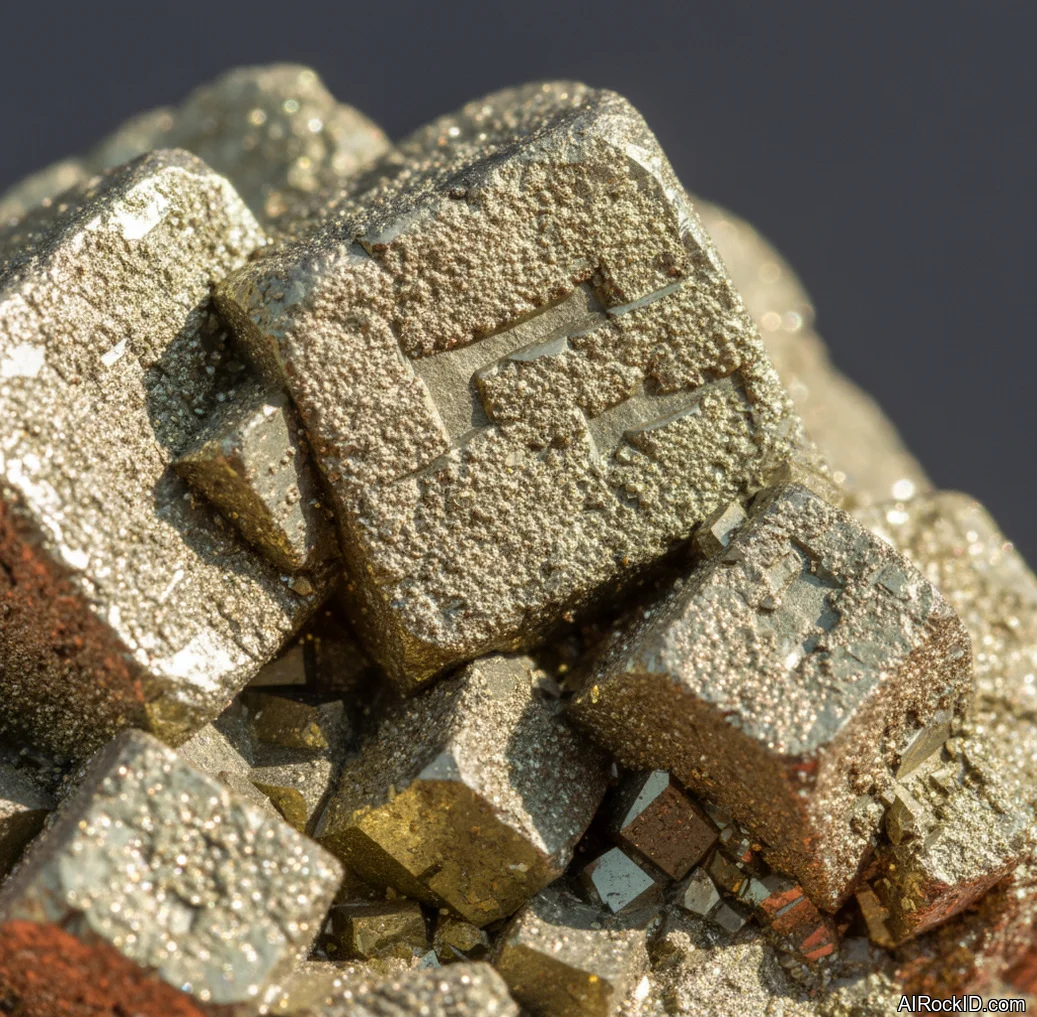
- Pyrite: Pyrite is harder, usually paler brassy yellow, and often forms cubic crystals; chalcopyrite is softer and has a greenish-black streak.
- Bornite: Bornite often shows stronger purple-blue tarnish and is commonly called peacock ore; chalcopyrite is usually more brass-yellow when fresh.
- Gold: Gold is much denser, malleable, and leaves a yellow streak; chalcopyrite is brittle and leaves a greenish-black streak.
- Marcasite: Marcasite is typically paler and more silvery-brassy, while chalcopyrite tends to look warmer yellow-brass.
Chalcopyrite vs Common Lookalikes
| Mineral | Key Visual Clue | Simple Check | Typical Streak |
|---|---|---|---|
| Chalcopyrite | Brass-yellow metallic color, sometimes iridescent tarnish | Scratches more easily than pyrite | Greenish-black |
| Pyrite | Paler brassy color, common cubes or pyritohedrons | Harder than chalcopyrite | Greenish-black to brownish-black |
| Bornite | Purple, blue, or rainbow tarnish often dominates | Fresh surfaces may appear coppery-bronze | Grayish-black |
| Gold | Rich yellow metallic color without tarnish | Malleable and very dense | Yellow |
| Marcasite | Pale brassy to silvery metallic surfaces | Often occurs in radiating or cockscomb forms | Dark gray to black |
AI identification confidence
AI identification confidence for chalcopyrite is usually higher when the image shows metallic luster, brass-yellow color, tarnish, and the surrounding matrix. Confidence drops when the specimen is heavily iridescent, poorly lit, weathered, or photographed without scale.
When AI gets it wrong
- Rainbow-tarnished chalcopyrite may be labeled as bornite or generic peacock ore.
- Bright brassy pieces may be confused with pyrite if crystal shape and hardness are not visible.
- Small gold-colored grains in quartz can be mistaken for native gold without density or streak testing.
- Artificially treated specimens may not match the natural color patterns expected for chalcopyrite.
Final recommendation
Choose chalcopyrite when you want a recognizable copper ore mineral with a metallic brass-yellow appearance and possible iridescent tarnish. For authenticity, compare streak, hardness, and seller labeling, especially when a specimen is marketed as peacock ore or gold-like material.
How to Check Chalcopyrite Authenticity
A real chalcopyrite specimen should show metallic luster, a brass-yellow to golden color on fresh surfaces, and a greenish-black streak. It should be softer than pyrite and brittle rather than malleable like gold. If a specimen is labeled as peacock ore, ask whether it is natural bornite, natural tarnished chalcopyrite, or acid-treated chalcopyrite.
Buying Tips for Chalcopyrite Specimens
Look for clear photos in natural light, accurate locality information, and honest disclosure of any artificial treatment. Natural chalcopyrite may have tarnish, but extremely vivid rainbow colors can indicate surface alteration or treatment. Avoid paying gold-like prices for chalcopyrite, since it is a common copper ore mineral rather than native gold.
Natural Tarnish vs Treated Peacock Ore
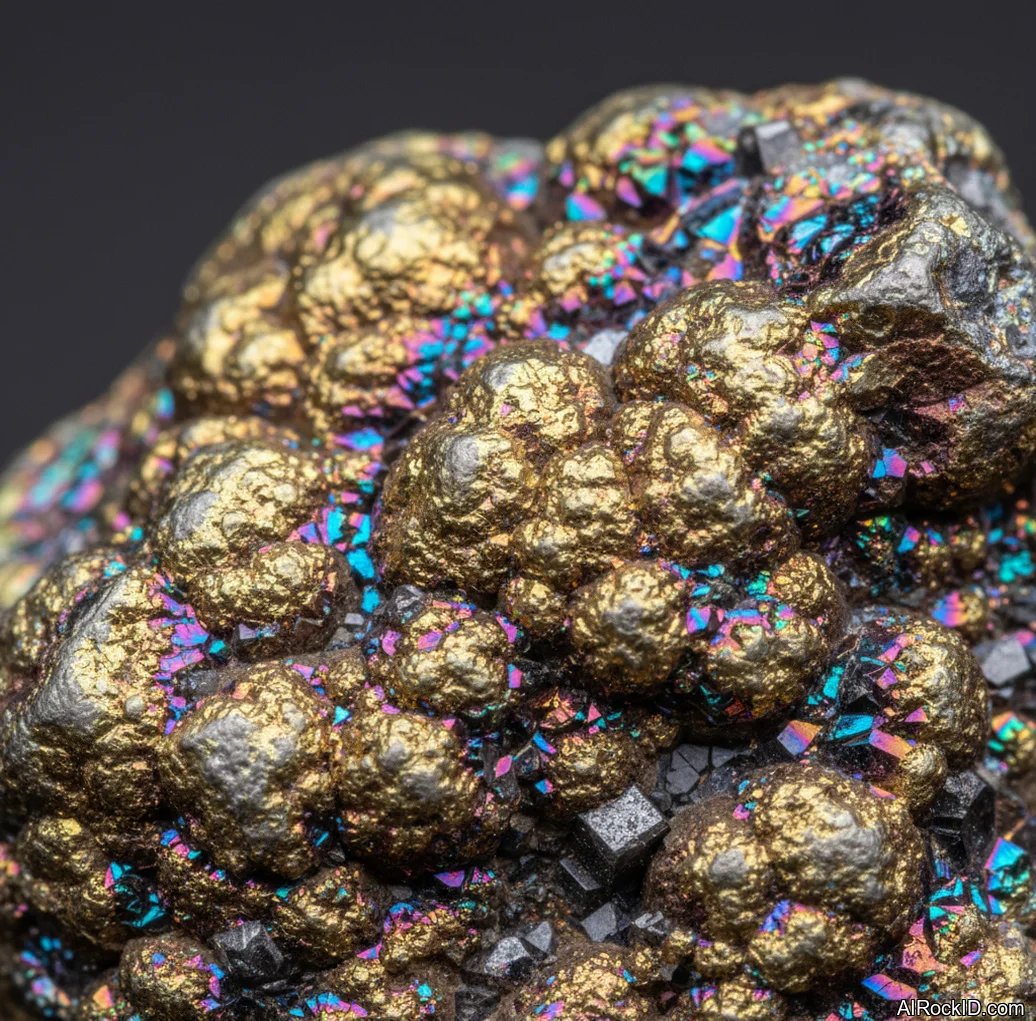
Chalcopyrite can naturally develop iridescent tarnish, but many brightly colored peacock ore specimens are chemically treated to intensify rainbow colors. Treated surfaces may show unusually uniform purple, blue, or magenta colors across broken areas. Natural tarnish is often more uneven and may appear only on exposed surfaces.
What Is Chalcopyrite?
Chalcopyrite is a copper iron sulfide mineral with the formula CuFeS2, and it’s got that brassy, metallic look people recognize right away.
Grab a chunk and the first thing that hits you is the heft. It just sits heavy in your palm. The skin of it feels slick, almost like a coin that’s been rattling around in someone’s pocket for years. Fresh breaks can read way more yellow-gold than you’d expect, but most pieces you see out in the wild have that rainbow tarnish from oxidation, especially the ones that have been passed around at shows for years and years.
People confuse it with pyrite all the time. But chalcopyrite usually comes off a bit softer, kind of “buttery” in color, and the crystal faces don’t kick the light back as sharply. And if you’ve ever tried keeping a shiny one shiny, you already know the annoying part: it wants to dull and get little spots unless you store it dry and stop rubbing it all the time (harder than it sounds, right?).
Origin & History
Most collectors point to Johann Friedrich Henckel in 1725 as the first solid, formal description, when he split it out as its own species from the grab-bag of “pyrites” that all sort of looked the same in the old mining books.
The name’s straight from Greek: chalkos (copper) and pyrites (striking fire), basically “copper pyrite.” And yeah, that phrasing tracks when you’ve got a brassy sulfide in your hand (heavy for its size, leaves that dull greenish-black smudge on your fingers) and you’re squinting at a mine dump trying to decide which “pyrite” is actually carrying copper.
Where Is Chalcopyrite Found?
Chalcopyrite shows up in copper districts worldwide, from massive porphyry copper systems to old-school hydrothermal veins. You’ll see it both in active mining regions and in classic European localities where collectors still hunt old dumps.
Formation
Raw chunks from copper mines are the go-to source, mostly because chalcopyrite is one of the major primary copper ores. It shows up in hydrothermal veins, skarns, and porphyry copper deposits, usually hanging out with quartz, pyrite, sphalerite, galena, plus a whole crowd of other sulfides.
Look, if you’ve ever had a vein specimen in your hands and turned it under a lamp, you’ll spot it parked right next to pyrite in the same little pocket, or smeared through the host rock as brassy blebs. And up in the oxidized zone near the surface, it can change into bornite, covellite, malachite, or azurite. So yeah, some pieces end up looking like a tiny color parade, but the loud blues and greens are almost always the alteration products, not the chalcopyrite itself.
How to Identify Chalcopyrite
Color: Brass-yellow to golden, often with iridescent purple, blue, and green tarnish on exposed surfaces. Fresh breaks can look more yellow than the weathered outside.
Luster: Metallic, with a softer flash than pyrite.
If you scratch it with a steel nail, it’ll usually mark more easily than pyrite, and the streak on unglazed porcelain comes out greenish-black. Pick up two similar-sized pieces of pyrite and chalcopyrite and compare the heft and the color in shade, chalcopyrite tends to read warmer and a bit darker. The problem with “peacock ore” labels is that a lot of that rainbow stuff is actually bornite, so check the base color where it’s freshly chipped.
Common Look-Alikes
Chalcopyrite is sometimes confused with these materials:
- Bornite (Peacock Ore)
- Pyrite
- Brass-coated glass
- Dyed quartz with metallic paint
- Gold (inexperienced buyers sometimes confuse raw nuggets)
- Marcasite
Market Cautions & Treatments
When AI Can Get This Wrong
AI image systems get tripped up by the rainbow tarnish, often confusing chalcopyrite with bornite. Photos flatten the metallic luster and make it hard to judge weight or streak. In-person, the streak test tells you fast—chalcopyrite gives a dark green-black streak, while bornite's is more grayish-black.
Properties of Chalcopyrite
Physical Properties
| Crystal System | Tetragonal |
| Hardness (Mohs) | 3.5-4 (Soft (2-4)) |
| Density | 4.1-4.3 g/cm3 |
| Luster | Metallic |
| Diaphaneity | Opaque |
| Fracture | Uneven |
| Streak | greenish-black |
| Magnetism | Non-magnetic |
| Colors | brass-yellow, golden-yellow, iridescent purple, iridescent blue, iridescent green |
Chemical Properties
| Classification | Sulfides |
| Formula | CuFeS2 |
| Elements | Cu, Fe, S |
| Common Impurities | Ag, Zn, As, Se |
Optical Properties
| Refractive Index | 2.65-2.67 |
| Birefringence | None |
| Pleochroism | None |
| Optical Character | Isotropic |
Chalcopyrite Health & Safety
Handling is usually no big deal. But the second you start cutting, grinding, or dry-brushing it, you can kick up that super-fine dust that hangs in the air and ends up in your lungs. Not great. And water? It can push tarnish along faster, and if it sits on the surface (especially in little pits or scratches), it can help the surface break down over time.
Safety Tips
Don’t soak it, and skip the ultrasonic cleaner entirely. If you absolutely have to mess with the material, keep it wet while you work, crack a window or run real ventilation, and wear a proper respirator (not just a paper dust mask).
Chalcopyrite Value & Price
Price Range
Rough/Tumbled: $5 - $150 per specimen
Price has a lot more to do with crystal shape and whatever minerals are sitting with it than with sheer size. Clean tetragonal crystals perched on a dark matrix can cost a lot more than crumbly, massive ore, even if the ore is bigger in your hand and leaves that gritty dust on your fingers. And tarnish is a weird one: sometimes it helps if it throws off a rainbow sheen, but it can also drag the value down if it turns into that flat, dull brown. Depends on the piece, honestly.
Durability
Nondurable — Scratch resistance: Fair, Toughness: Poor
It can tarnish and stain with humidity and skin oils, and it chips easier than it looks for something metallic.
How to Care for Chalcopyrite
Use & Storage
Store it dry, ideally in a box or a cabinet away from bathroom humidity. If it’s a showy rainbow piece, keep it from rubbing against harder minerals that’ll scuff the metallic skin.
Cleaning
1) Blow off grit with a bulb blower or soft brush. 2) Wipe lightly with a dry microfiber cloth; don’t scrub. 3) If needed, do a very quick rinse in distilled water, pat dry immediately, and let it air out fully before storing.
Cleanse & Charge
For metaphysical use, stick to smoke, sound, or placing it on a dry bed of quartz. Avoid salt water and long water rinses because sulfides don’t love that treatment.
Placement
I keep chalcopyrite on a shelf where I can see the color shift, but not in direct window sun where heat cycling and humidity swings are worse. A glass display case helps a lot if your place runs humid.
Caution
Don’t soak chalcopyrite. Don’t pack it in salt. And don’t hit it with harsh acids or metal polish unless you’re genuinely okay with the surface being changed for good. Wash your hands after you’ve handled it (that faint metallic smell can stick). And keep any chips or sharp little fragments out of reach of kids and pets.
Works Well With
Chalcopyrite Meaning & Healing Properties
Next to a lot of those sparkly desk stones, chalcopyrite feels like it came from a job site. It’s ore. And that’s probably why people tie it to motivation, problem-solving, and getting unstuck. When I’ve carried a little chunk, it didn’t make me “zen.” It made me feel switched on, like my brain wanted to sort the pile, start a list, and hit the hardest task first. Why procrastinate when you’re already in go-mode?
But look, here’s the collector reality: most chalcopyrite out there is soft, kind of crumbly, and it tarnishes fast. So if you want something you can fidget with all day, this isn’t it. I’ve literally seen someone rub the rainbow sheen down to a dull, brassy patch just from thumb-polishing it over a weekend (the edges get that gritty, powdery feel too). So, if you’re using it for personal practice, treat it like a “look at it, set an intention, put it back” piece. Not a pocket stone.
In crystal shop terms, chalcopyrite usually gets filed under confidence and that upbeat shove of momentum, especially when it has the peacock-colored shine. Just keep it as supportive symbolism, not anything medical. If you’ve got real health issues going on, this is decoration and ritual. Not treatment.
Common mistakes
- Calling every rainbow-colored specimen bornite, even when it may be treated chalcopyrite.
- Assuming chalcopyrite is gold because it has a metallic yellow color.
- Using color alone for identification instead of checking streak and hardness.
- Buying vivid peacock ore without asking whether the color is natural or treated.
- Cleaning chalcopyrite aggressively, which can damage tarnish and surface texture.
Identify Chalcopyrite from a photo
Compare Chalcopyrite traits, care tips, value clues, and common lookalikes with a clear photo.