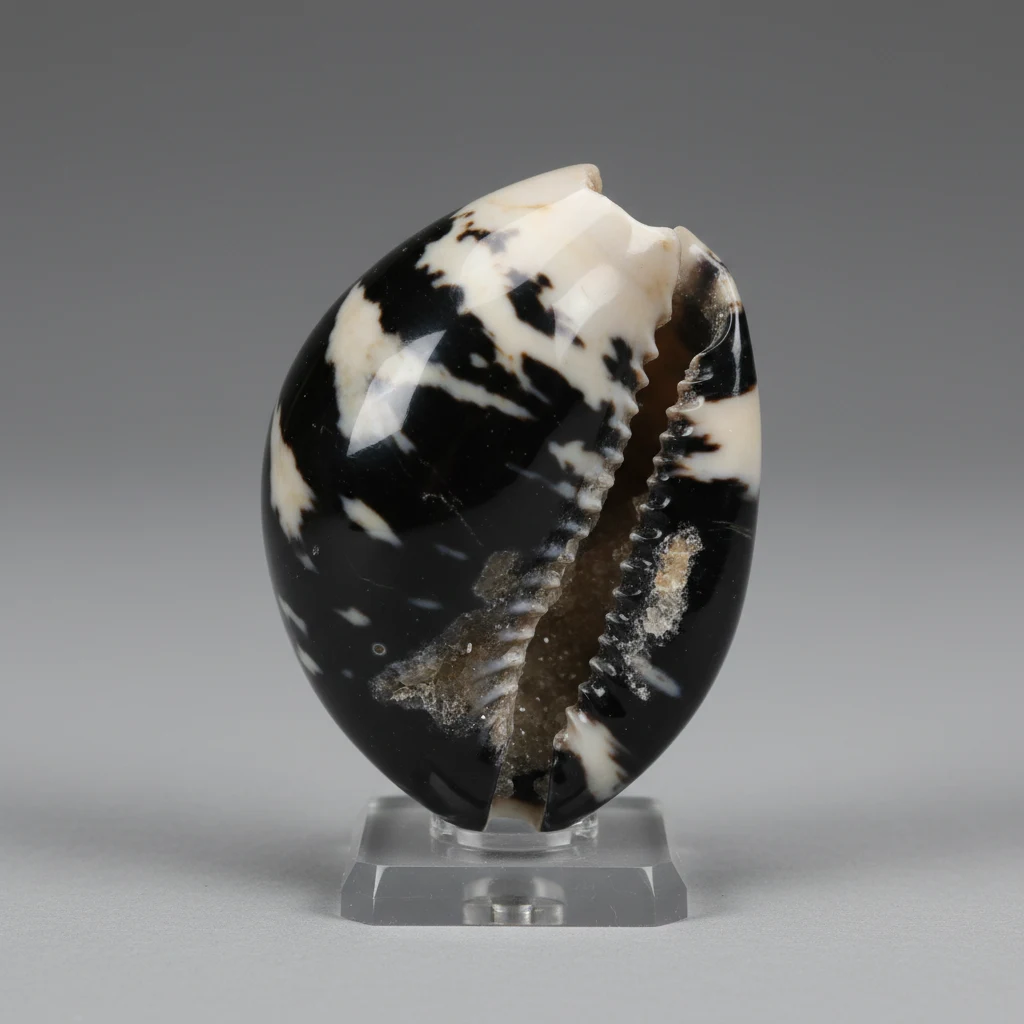
Black and White Cowrie Shell


Quick answer: Black and White Cowrie Shell is an organic calcium carbonate shell recognized by its glossy surface, rounded form, and contrasting dark-and-light pattern. It is softer than most gemstones, so identification should focus on shell structure, weight, surface gloss, and signs of natural growth rather than crystal cleavage.
AI Rock ID can help screen a Black and White Cowrie Shell by comparing its shape, color pattern, aperture, and surface texture against similar shells and imitations. RockIdentifier.io provides reference information for checking whether a specimen is likely a natural cowrie shell, a dyed shell, or a shell-like substitute.
Good fit
- Collectors who want a natural organic specimen rather than a mineral crystal
- Jewelry makers looking for lightweight black-and-white shell accents
- Beginners learning to identify shell materials by shape, aperture, and surface pattern
- Decorative collections with tropical marine or beach-related themes
Not a good fit
- Rings or bracelets that will receive heavy abrasion
- Collectors seeking a hard mineral with crystal faces
- Use in water, acids, ultrasonic cleaners, or harsh cleaning solutions
- Buyers who need verified species-level shell identification without expert confirmation
Most commonly confused with
- Tiger Cowrie Shell: Tiger cowrie usually has tan to brown spotting rather than a high-contrast black-and-white pattern.
- Conch Shell: Conch shells are usually larger, spiral-form shells with a flared lip rather than a small, smooth cowrie shape.
- Mother of Pearl: Mother of pearl is an iridescent nacre layer, while cowrie shell is a whole shell with an arched back and narrow toothed opening.
- Dyed Shell: Dyed shells may show color concentrated in cracks, drill holes, or worn edges instead of natural patterning through the surface.
Black and White Cowrie Shell vs Common Lookalikes
| Specimen | Key ID Clue | Common Difference |
|---|---|---|
| Black and White Cowrie Shell | Glossy arched shell with narrow toothed aperture | Natural pattern follows shell surface and growth features |
| Tiger Cowrie Shell | Rounded cowrie form with brown or tan spotting | Warmer spotted pattern, usually not stark black and white |
| Mother of Pearl | Flat or curved nacre pieces with iridescence | Lacks the complete cowrie shape and toothed opening |
| Dyed Shell | Color may collect in pits, cracks, or drilled areas | Pattern can look stained, uneven, or surface-applied |
| Plastic Imitation | May show mold lines or repeated printed pattern | Often feels very light and lacks natural shell microtexture |
AI identification confidence
AI identification is usually more reliable when the photo shows the top, underside aperture, side profile, and scale of the shell. Confidence is lower for polished, drilled, dyed, or heavily worn pieces because surface treatment can hide natural cowrie features.
When AI gets it wrong
- Only the patterned top is photographed and the toothed underside is not visible
- The shell has been dyed, lacquered, or coated with resin
- The specimen is a carved or molded imitation with a cowrie-like outline
- Lighting glare on the glossy surface obscures color boundaries and texture
Final recommendation
Choose Black and White Cowrie Shell if you want a lightweight organic specimen with a natural marine origin and a bold contrast pattern. For durability in daily-wear jewelry, select protected settings and avoid pieces with cracks, chalky surfaces, or suspiciously uniform printed markings.
How to Spot a Real Black and White Cowrie Shell
A real cowrie shell should show a smooth domed back, a narrow underside opening, and small tooth-like ridges along the aperture. Natural pieces often have slight asymmetry, minor wear, or subtle growth-related variation. Printed or molded imitations may show repeated patterns, seam lines, or color that sits only on the surface.
Buying Tips for Black and White Cowrie Shell
Ask whether the shell is natural, dyed, polished, drilled, or coated before buying. Check drill holes and edges for color changes that may reveal dye or paint. For jewelry, choose shells without cracks around holes because the material is relatively soft and can chip under tension.
Ethical and Legal Sourcing Notes
Cowrie shells are marine animal shells, so sourcing can matter for conservation and local regulations. Buyers should prefer legally collected, recycled, vintage, or responsibly sourced shells when possible. Restrictions may vary by region, especially for protected marine species or shells collected from sensitive habitats.
What Is Black and White Cowrie Shell?
Black and White Cowrie Shell is a common organic gem: a marine gastropod shell valued for its smooth feel, high-gloss surface, and sharp black-and-white patterning. In the hand, it reads more like polished natural enamel than a rock specimen, with an opaque body, vitreous luster, and a characteristic cowrie form that makes it easy to recognize.
Mineralogically, this shell is calcium carbonate, CaCO3, with a listed Mohs hardness of 3-4 and a density of 2.5 g/cm3. It is non-magnetic, amorphous in crystal system, and may show a white streak. Collectors choose specimens for size, clean pattern contrast, and surface quality, while handling them with moderate care because rough treatment or extreme conditions can damage the shell.
Origin & History
The name cowrie comes from the Sanskrit word kauri, and Black and White Cowrie Shell belongs to a long tradition of shells used as ornament and currency. Its value is not only decorative; the polished, patterned surface has made cowries recognizable objects in personal adornment, collection trays, and ritual settings since ancient times.
For collectors, the historical appeal sits right beside the tactile appeal: a good specimen is glossy, compact, and instantly identifiable by its black and white contrast. When documenting a shell collection, note that it is an organic gem rather than a mineral crystal, even though its material is calcium carbonate. Reference: mindat.org.
Where Is Black and White Cowrie Shell Found?
Black and White Cowrie Shell is commonly found in tropical and subtropical marine environments. Reported countries include India, Sri Lanka, and Indonesia, with notable localities including the Andaman Islands in India, Seychelles, and Madagascar.
Formation
Black and White Cowrie Shell forms as a mollusk secretes calcium carbonate to build a hard outer shell. That secreted CaCO3 becomes the smooth, protective structure collectors handle, with the glossy surface and patterned black-and-white coloration developing as part of the shell rather than from cutting or polishing alone.
These shells grow in marine environments, often on coral reefs. The resulting material is organic in origin but calcium-carbonate in composition, with listed optical properties of refractive index 1.53, no birefringence, no pleochroism, and isotropic optical character.
How to Identify Black and White Cowrie Shell
Identify Black and White Cowrie Shell by its glossy vitreous luster, smooth texture, and striking black-and-white pattern. The shape is also important: a true cowrie has a characteristic form, and the aperture is a key identification feature when separating it from other polished shells or shell fragments.
On the bench, expect an opaque organic gem with a white streak, Mohs hardness of 3-4, conchoidal fracture, and no magnetism. It should feel smooth rather than gritty, but it should not be tested harshly; avoid abrasive materials, rough handling, and harsh chemicals because the shell has only moderate durability.
Properties of Black and White Cowrie Shell
Physical Properties
| Crystal System | Amorphous |
| Hardness (Mohs) | 3-4 (Medium (4-6)) |
| Density | 2.5 g/cm3 |
| Luster | Vitreous |
| Diaphaneity | Opaque |
| Fracture | Conchoidal |
| Streak | White |
| Magnetism | Non-magnetic |
| Colors | Black, White |
Chemical Properties
| Classification | Calcium carbonate |
| Formula | CaCO3 |
| Elements | Ca, C, O |
| Common Impurities |
Optical Properties
| Refractive Index | 1.53 |
| Birefringence | None |
| Pleochroism | None |
| Optical Character | Isotropic |
Black and White Cowrie Shell Health & Safety
There are no significant health risks associated with handling this shell.
Black and White Cowrie Shell Value & Price
Price Range
Rough/Tumbled: $5 - $20 per specimen
Cut/Polished:
Price varies based on size and pattern quality.
Durability
Moderate — Scratch resistance: Fair, Toughness: Good
It can be damaged by rough handling or extreme conditions.
How to Care for Black and White Cowrie Shell
Use & Storage
Store in a cool, dry place to prevent damage.
Cleaning
Clean with mild soap and water, then rinse and dry thoroughly. Avoid abrasive materials.
Cleanse & Charge
Place in sunlight or moonlight for cleansing.
Placement
It can be displayed in a collection or used in jewelry.
Caution
Avoid exposing to harsh chemicals.
Works Well With
Black and White Cowrie Shell Meaning & Healing Properties
Black and White Cowrie Shell is traditionally associated with protection, prosperity, beauty, and abundance. In metaphysical use, it is linked with the Root and Sacral chakras, the zodiac signs Cancer and Pisces, the planets Moon and Venus, and the Water element.
Practitioners often treat it as a talismanic shell rather than a crystal point: it can sit in a collection, be carried, or be used in jewelry. For care and energetic cleansing, clean the shell with mild soap and water, rinse and dry it thoroughly, and place it in sunlight or moonlight; avoid abrasive cleaners and harsh chemicals.
Identify Black and White Cowrie Shell from a photo
Compare Black and White Cowrie Shell traits, care tips, value clues, and common lookalikes with a clear photo.
Common mistakes
- Calling Black and White Cowrie Shell a mineral crystal instead of an organic shell material
- Assuming every black-and-white shell pattern is natural without checking for dye or printed coating
- Using vinegar or acidic cleaners, which can react with calcium carbonate shell
- Identifying the shell from the top pattern only and ignoring the underside aperture
- Wearing drilled shells in high-impact jewelry without checking for cracks around the hole