Mother of Pearl


Quick answer: Mother of pearl is nacre, the iridescent inner shell layer produced by certain mollusks. It is softer than many gemstones, so identification often relies on its layered shell structure, pearly luster, and gentle play of color rather than hardness alone.
AI Rock ID can help compare a mother of pearl specimen with common lookalikes such as plastic, glass, dyed shell, and pearl. RockIdentifier.io provides visual reference and identification support, but final confirmation may require close inspection of layers, surface texture, and setting details.
Good fit
- Collectors who want an organic gem material with natural iridescence
- Jewelry buyers comparing shell inlay, buttons, beads, or carved pieces
- Beginners learning to separate nacre from plastic or glass imitations
- People who prefer lightweight, low-luster materials over harder faceted stones
Not a good fit
- Rings or bracelets that will be exposed to frequent abrasion
- Ultrasonic or steam cleaning routines
- Collectors needing a mineral specimen, because mother of pearl is organic shell material
Most commonly confused with
- Pearl: Pearl is a rounded nacre object formed inside a mollusk, while mother of pearl is the nacreous shell layer.
- Abalone Shell: Abalone often shows stronger blue, green, and violet color patches, while many mother of pearl pieces are cream, white, silver, or pale pastel.
- Opal: Opal is a silica mineraloid with play-of-color, while mother of pearl has a layered shell structure and pearly sheen.
- Plastic Imitation: Plastic imitations may look overly uniform, feel warmer and lighter, and lack natural layered nacre edges.
Mother of Pearl vs Common Lookalikes
| Material | Typical Appearance | Key Difference | Mohs Hardness |
|---|---|---|---|
| Mother of Pearl | Pearly, layered, often white to cream with soft iridescence | Natural nacre lining from mollusk shell | 3.5–4.5 |
| Pearl | Rounded bead-like form with nacre luster | Forms as a pearl rather than a flat shell layer | 2.5–4.5 |
| Abalone Shell | Bright blue, green, purple, or rainbow patches | Usually more vivid and patchy in color | 3–4 |
| Opal | Color flashes within a silica body | No shell layering; different mineral composition | 5.5–6.5 |
| Plastic Imitation | Uniform pearly coating or printed pattern | May lack depth, layering, and natural edge structure | Varies |
AI identification confidence
AI identification is usually more reliable when the photo shows the surface luster, edge layering, and scale of the specimen. Confidence may be lower for polished inlay, dyed shell, coated plastic, or photos with strong glare.
When AI gets it wrong
- A flat shell inlay is photographed without visible edges or layering
- The specimen is dyed, bleached, resin-coated, or sealed under a clear finish
- Lighting creates rainbow glare that resembles opal or coated glass
- A plastic imitation has a printed or molded nacre-like pattern
Final recommendation
Choose mother of pearl when you want a lightweight organic gem material with soft iridescence and visible shell character. For everyday wear, select protected settings and avoid pieces advertised with vague terms if the material, treatment, or shell source is not disclosed.
How to Tell Real Mother of Pearl from Imitation
Real mother of pearl usually shows subtle depth, fine growth lines, and slight variation in color across the surface. Edges or drilled holes may reveal layered shell structure. Plastic imitations can appear too uniform or may show a printed pattern, while glass imitations often feel harder and cooler.
Buying Tips for Mother of Pearl Jewelry
Look for smooth surfaces, secure inlay, and minimal cracking or lifting around edges. Ask whether the piece is natural, dyed, bleached, stabilized, or coated, especially for strongly colored material. In vintage jewelry, inspect the setting for gaps where moisture or adhesives may have weakened the shell.
Common Treatments and Enhancements
Mother of pearl may be bleached to create a whiter appearance or dyed to produce black, pink, blue, green, or other colors. Some pieces are coated with resin or lacquer to improve shine and durability. Treatments are common, but they should be disclosed when they affect appearance, value, or care.
What Is Mother of Pearl?
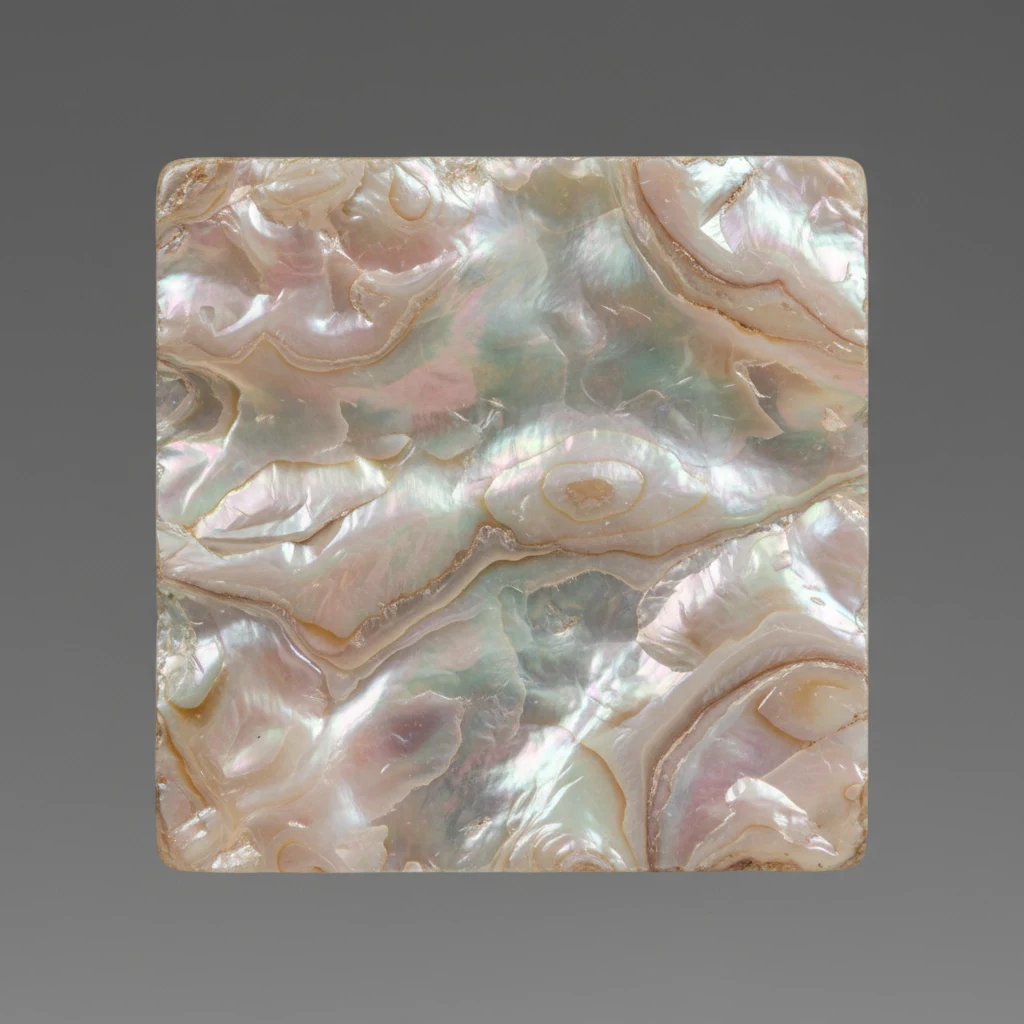
Mother of Pearl is the iridescent inner layer of some mollusk shells, valued as a common organic gem with a smooth, layered glow. In hand, it feels more shell-like than stone: cool at first touch, softly lustrous, and shifting from white into pink or green as the light moves across the surface.
It is a biogenic calcium carbonate material listed with the formula CaCO3, and its structure is described as amorphous. With a Mohs hardness of 3.5-4.5, Mother of Pearl has fair scratch resistance, good toughness, and a pearly luster, but it should still be handled carefully because rough use can mark or damage the surface.
Origin & History
Mother of Pearl has been used since ancient times, and its name is tied to the French word “nacre.” The name suits the material well: it is not a single crystal you look through, but a built-up inner shell layer that catches light in soft, watery flashes.
Collectors often approach Mother of Pearl as both a natural specimen and a decorative gem material. For mineral and locality cross-checking, mindat.org is a useful plain-text reference, especially when comparing shell-derived calcium carbonate materials with named mineral entries and reported sources.
Where Is Mother of Pearl Found?
Mother of Pearl is most commonly found in tropical and subtropical waters. Reported countries include China, Japan, and the USA, with notable localities including the South China Sea in China, the Gulf of California in Mexico, and Baja California in Mexico.
Formation
Mother of Pearl forms when mollusks secrete layers of aragonite and conchiolin along the inside of the shell. Those repeated layers create the familiar nacreous look: a stacked, reflective surface that can flash white, pink, or green depending on the viewing angle.
This layered growth is why Mother of Pearl looks different from a broken mineral crystal. Its fracture is listed as conchoidal, its streak is white, and its diaphaneity is translucent, but its most practical field clue is still the pearly, shifting sheen produced by those shell-built layers.
How to Identify Mother of Pearl
Identify Mother of Pearl by its smooth texture, pearly luster, and iridescent sheen that changes color as the light angle changes. Typical colors include white, pink, and green, often blending softly rather than appearing as hard, sharply bounded crystal zones.
Its physical profile helps confirm the ID: Mohs hardness 3.5-4.5, density 2.7-2.9 g/cm3, non-magnetic behavior, white streak, and translucent diaphaneity. Optical data include refractive index 1.53-1.66, no birefringence, no pleochroism, and isotropic optical character.
Properties of Mother of Pearl
Physical Properties
| Crystal System | Amorphous |
| Hardness (Mohs) | 3.5-4.5 (Soft (2-4)) |
| Density | 2.7-2.9 g/cm3 |
| Luster | Pearly |
| Diaphaneity | Translucent |
| Fracture | Conchoidal |
| Streak | White |
| Magnetism | Non-magnetic |
| Colors | White, Pink, Green |
Chemical Properties
| Classification | Biogenic material |
| Formula | CaCO3 |
| Elements | Ca, C, O |
| Common Impurities | Fe, Mg |
Optical Properties
| Refractive Index | 1.53-1.66 |
| Birefringence | None |
| Pleochroism | None |
| Optical Character | Isotropic |
Mother of Pearl Health & Safety
There are no significant health risks when handling Mother of Pearl.
Mother of Pearl Value & Price
Price Range
Rough/Tumbled: $10 - $50 per specimen
Cut/Polished: $20 - $100 per carat
Price is influenced by color, quality, and size.
Durability
Moderate — Scratch resistance: Fair, Toughness: Good
It can be prone to scratching and damage with rough handling.
How to Care for Mother of Pearl
Use & Storage
Store in a soft cloth to prevent scratches.
Cleaning
Clean with mild soap and water; avoid harsh chemicals. Dry thoroughly after cleaning.
Cleanse & Charge
Place under moonlight or use sound to cleanse.
Placement
Keep away from direct sunlight to prevent fading.
Caution
Handle with care to avoid scratches.
Works Well With
Mother of Pearl Meaning & Healing Properties
In crystal healing traditions, Mother of Pearl is believed to support emotional healing, calm, protection, and a nurturing sense of inner peace. It is associated with the Heart chakra, the Moon, the Water and Earth elements, and zodiac signs Cancer and Libra.
Use it as a gentle, reflective stone rather than a hard-wearing pocket crystal. It is safe to handle and safe in water, but it can scratch, so clean it with mild soap and water, dry it thoroughly, keep it away from direct sunlight, and store it in a soft cloth.
Identify Mother of Pearl from a photo
Compare Mother of Pearl traits, care tips, value clues, and common lookalikes with a clear photo.
Common mistakes
- Calling every nacreous shell piece a pearl instead of mother of pearl
- Assuming strong rainbow color always means opal
- Using hardness tests on finished jewelry and damaging the surface
- Cleaning mother of pearl with acids, abrasives, steam, or ultrasonic machines
- Assuming dyed shell is fake rather than treated natural shell
- Ignoring lifted inlay edges, cracks, or adhesive damage before buying