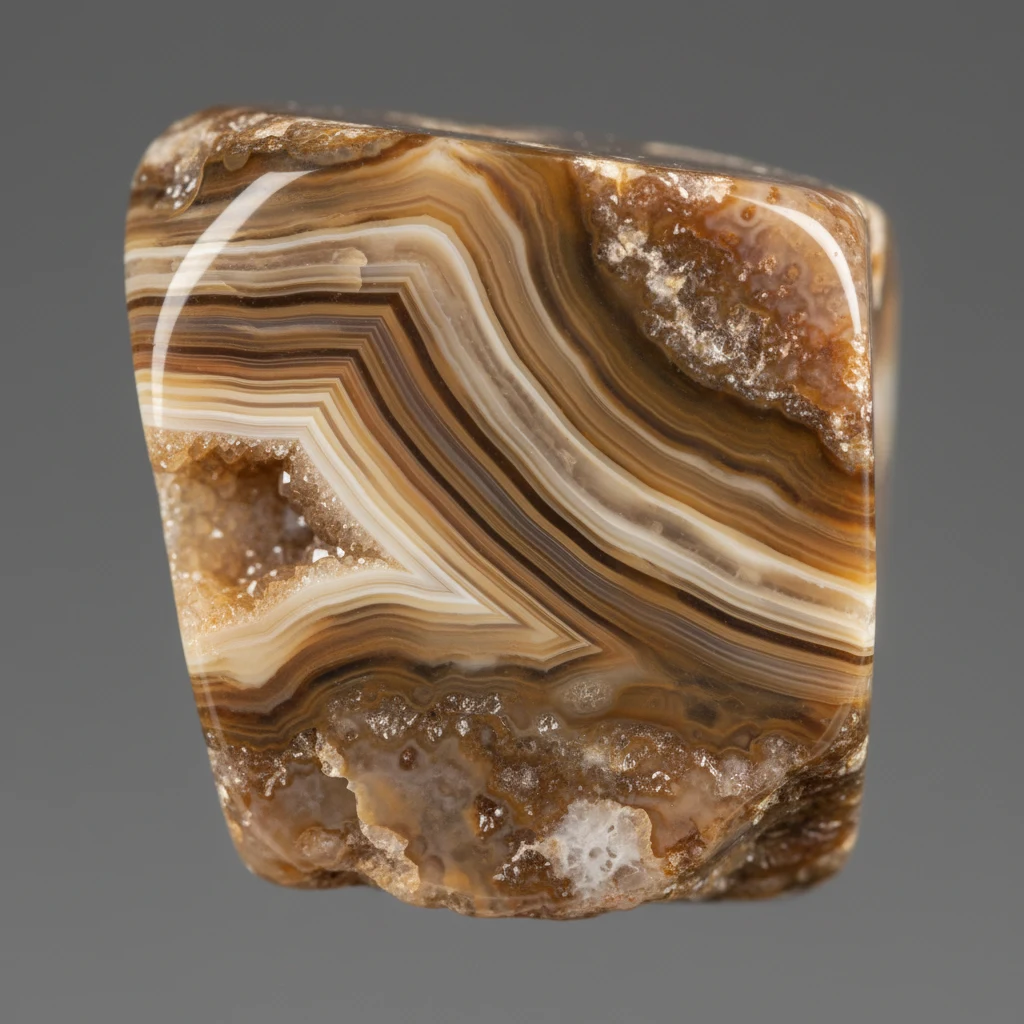
Brown Agate


Quick answer: Brown Agate is a brown to tan variety of banded chalcedony, often showing white, cream, gray, or translucent layers. It is commonly cut into cabochons, beads, slices, and polished display pieces because its banding can be visually distinct and durable.
AI Rock ID can help compare a Brown Agate photo against common chalcedony, jasper, onyx, and dyed agate patterns. RockIdentifier.io provides visual identification support, but close inspection of banding, translucency, and dye indicators is still useful for confident identification.
Good fit
- Collectors who like visible banding in earth-tone colors
- Jewelry wearers who want a durable quartz-family stone for beads or cabochons
- Beginners learning to distinguish chalcedony, jasper, and agate
- Decor buyers looking for polished slices, bookends, or small display stones
Not a good fit
- Anyone needing a professionally verified gemstone appraisal from photos alone
- Buyers who want only untreated material unless the seller clearly discloses treatment
- Collectors seeking high transparency or faceted brilliance rather than banded texture
Most commonly confused with
- Jasper: Jasper is usually opaque and lacks the translucent banding typical of many agates.
- Onyx: Onyx has straighter, more parallel bands and is often black, white, or evenly dyed.
- Carnelian: Carnelian is orange to reddish chalcedony and usually shows warmer, less brown-dominant color.
- Tiger's Eye: Tiger's Eye has a silky chatoyancy, while Brown Agate typically shows fixed bands or cloudy layers.
Brown Agate Lookalike Comparison
| Stone | Typical Appearance | Key Difference |
|---|---|---|
| Brown Agate | Brown, tan, cream, or white banded chalcedony | Often partly translucent with curved or layered bands |
| Jasper | Opaque earthy red, brown, yellow, or green stone | Usually no translucent banding |
| Onyx | Straight parallel bands, often black and white | Bands are more uniform and may be dyed |
| Tiger's Eye | Golden to brown silky sheen | Shows moving chatoyancy under light |
| Petrified Wood | Wood-grain or bark-like pattern | Texture often follows fossilized plant structure |
AI identification confidence
AI identification is often moderately reliable for Brown Agate when the photo clearly shows banding, translucency at the edges, and natural color variation. Confidence is lower for polished beads, dark slabs, dyed pieces, or photos taken under warm indoor lighting.
When AI gets it wrong
- The stone is opaque, making agate and jasper difficult to separate visually.
- The piece has been dyed brown, black, orange, or red, which can mask natural banding.
- The photo shows only a small bead or cabochon without edges or layered structure.
- Strong reflections on polished surfaces hide banding and translucency.
Final recommendation
Choose Brown Agate when you want a durable, banded chalcedony with neutral brown tones and visible natural patterning. For authenticity, look for clear photos, treatment disclosure, and banding that continues through the stone rather than appearing only as surface color.
How to Identify Natural Brown Agate
Natural Brown Agate usually shows layered bands, cloudy zones, or translucent edges when held near a light source. Color may range from light tan to deep brown, often with cream, gray, or white layers. Uniform color without internal patterning can indicate jasper, glass, or dyed chalcedony rather than naturally patterned agate.
Brown Agate Buying and Authenticity Tips
Ask sellers whether a Brown Agate piece is natural, dyed, heat-treated, or stabilized, especially for beads and very saturated colors. Natural-looking pieces often have uneven bands, small inclusions, and color variation rather than perfectly uniform brown. A low price is common for many agates and does not automatically mean the stone is fake.
Photo Tips for Better Brown Agate Identification
Photograph Brown Agate in indirect daylight on a neutral background, and include close-ups of bands, edges, and any broken or unpolished surface. A second photo with light passing through the edge can help show chalcedony translucency. Avoid heavy filters or warm lighting because they can make gray, red, or orange stones appear brown.
What Is Brown Agate?
Brown Agate is a brown-and-white banded variety of chalcedony, valued for its smooth feel, layered look, and durable nature. In hand, a good piece often feels rounded and solid, with tan, brown, and pale bands that move across the surface like stacked ribbons. It is a semi-precious gemstone and is considered common, which makes it approachable for new collectors.
Mineralogically, Brown Agate is a silicate with the formula SiO2. It belongs to the trigonal crystal system, has a Mohs hardness of 6.5-7, and is typically translucent with a vitreous to waxy surface. Its white streak, conchoidal fracture, non-magnetic response, and density of 2.60-2.65 g/cm3 help separate it from softer brown stones.
Origin & History
Brown Agate takes its broader agate name from the Achates River in Sicily, where agate was first described in ancient times. Brown varieties have long been used for decorative purposes, especially where the banding gives a carved, polished, or tumbled piece visual movement without needing a bright color.
For a collector, the historical appeal is easy to understand: Brown Agate looks finished even before it is highly worked, because the pattern is already built into the stone. Its identity as banded chalcedony can be cross-checked with general mineral references such as mindat.org when comparing agate varieties and chalcedony descriptions.
Where Is Brown Agate Found?
Brown Agate is found in Brazil, India, and the United States. Notable localities listed for this material include Sergipe, Brazil; Madhya Pradesh, India; and Montana, USA. It is mostly associated with volcanic and sedimentary rocks, so field pieces may appear as rounded nodules or patterned fragments rather than obvious crystals.
Formation
Brown Agate forms when silica is deposited over time inside cavities in volcanic rocks. The banded appearance develops as layers of silica accumulate in varying colors, producing the brown, tan, white, and lighter zones seen in polished or broken pieces. Those repeating layers are the main visual clue that the stone is agate rather than plain chalcedony.
The specimen’s smooth texture and conchoidal fracture reflect its silica-rich nature. Iron and manganese are listed as common impurities, and these can be associated with the brown-toned appearance. In practice, the best pieces show clear layer boundaries, a stable surface, and enough translucency for light to catch the bands along edges or thin areas.
How to Identify Brown Agate
Identify Brown Agate by looking first for banding: brown, tan, and white or lighter layers are the key feature. The stone usually has a smooth, rounded look, with a vitreous to waxy luster that feels polished even on many naturally worn surfaces. It is translucent rather than fully opaque in favorable thin edges.
A hardness test can help confirm it, since Brown Agate is 6.5-7 on the Mohs scale and has good scratch resistance. It is non-magnetic, leaves a white streak, and breaks with a conchoidal fracture. If a brown stone lacks distinct layers, feels unusually soft, or shows a different streak, it should be checked against other brown minerals.
Properties of Brown Agate
Physical Properties
| Crystal System | Trigonal |
| Hardness (Mohs) | 6.5-7 (Hard (6-7.5)) |
| Density | 2.60-2.65 g/cm3 |
| Luster | Vitreous |
| Diaphaneity | Translucent |
| Fracture | Conchoidal |
| Streak | white |
| Magnetism | Non-magnetic |
| Colors | Brown, White, Tan |
Chemical Properties
| Classification | Silicate |
| Formula | SiO2 |
| Elements | Si, O |
| Common Impurities | Fe, Mn |
Optical Properties
| Refractive Index | 1.53-1.54 |
| Birefringence | None |
| Pleochroism | None |
| Optical Character | Isotropic |
Brown Agate Health & Safety
Brown Agate poses no significant health risks.
Brown Agate Value & Price
Price Range
Rough/Tumbled: $5 - $30 per specimen
Cut/Polished: $10 - $50 per carat
Price is affected by size, color intensity, and pattern uniqueness.
Durability
Durable — Scratch resistance: Good, Toughness: Good
Brown Agate is stable and does not react to water.
How to Care for Brown Agate
Use & Storage
Store in a soft pouch to avoid scratches.
Cleaning
Clean with mild soap and water. Avoid harsh chemicals.
Cleanse & Charge
Place in sunlight or moonlight for cleansing.
Placement
Can be placed in living spaces for decoration.
Caution
Avoid prolonged exposure to extreme heat.
Works Well With
Brown Agate Meaning & Healing Properties
In traditional crystal use, Brown Agate is associated with grounding, stability, protection, emotional healing, and balance. Its earthy brown and tan bands suit Root Chakra work, where practitioners often choose stones that feel steady, weighty, and visually calming. These meanings are cultural and spiritual associations, not medical claims.
Brown Agate is also linked with Leo and Virgo, the Earth element, and the planet Earth in the supplied tradition. For daily practice, it can be kept in a living space for decoration, held during meditation, or paired with amethyst, rose quartz, or clear quartz. Clean it with mild soap and water, and avoid harsh chemicals or prolonged extreme heat.
Identify Brown Agate from a photo
Compare Brown Agate traits, care tips, value clues, and common lookalikes with a clear photo.
Common mistakes
- Assuming every brown opaque stone is Brown Agate instead of checking for translucency or banding
- Mistaking dyed onyx or dyed agate for naturally brown material
- Relying only on bead color, since small beads may not show diagnostic banding
- Calling any wood-grain pattern Brown Agate when it may be Petrified Wood
- Using metaphysical labels as proof of geological identity