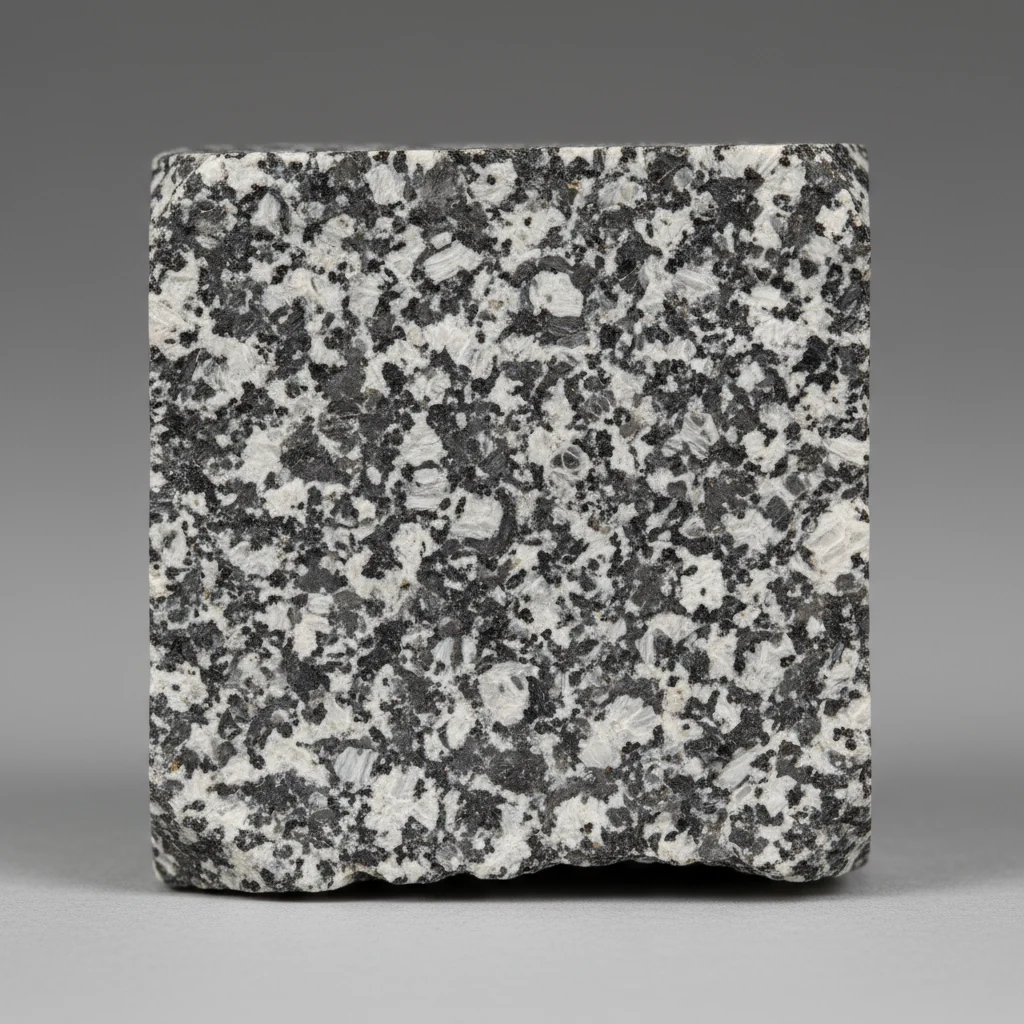
Diorite


Quick answer: Diorite is a coarse-grained intrusive igneous rock with a salt-and-pepper look caused mainly by light plagioclase feldspar and darker amphibole or pyroxene minerals. It is often confused with granite, gabbro, and andesite, but its intermediate composition and visible speckled texture help separate it from those rocks.
AI Rock ID can help screen a suspected diorite sample by checking visible grain size, color balance, and speckled mineral pattern from a clear photo. RockIdentifier.io provides identification support, but final confirmation may require a hand lens, streak test, hardness check, or local geologic context.
Good fit
- Collectors who want a durable, common igneous rock with visible mineral grains
- Students comparing intrusive and extrusive igneous rocks
- People identifying gray speckled stones in landscaping, masonry, or field settings
- Anyone learning the differences between granite, gabbro, and diorite
Not a good fit
- Buyers seeking a transparent or facetable gemstone
- Collectors who prefer brightly colored or rare mineral specimens
- Situations where exact mineral percentages are required without lab testing
Most commonly confused with
- Granite: Granite usually contains visible quartz and more potassium feldspar, often giving it a lighter or pinker appearance.
- Gabbro: Gabbro is typically darker and richer in pyroxene and calcium-rich plagioclase than diorite.
- Andesite: Andesite has a similar intermediate composition but is fine-grained or porphyritic because it cools at or near the surface.
- Syenite: Syenite is usually richer in alkali feldspar and contains little to no quartz, often lacking diorite’s balanced salt-and-pepper pattern.
Diorite vs Common Lookalikes
| Rock | Typical texture | Key difference | Common color |
|---|---|---|---|
| Diorite | Coarse-grained | Plagioclase-rich with mixed light and dark minerals | Gray, black, white speckled |
| Granite | Coarse-grained | Usually has visible quartz and potassium feldspar | Light gray, pink, white, black |
| Gabbro | Coarse-grained | More mafic and usually darker overall | Dark gray to black |
| Andesite | Fine-grained to porphyritic | Volcanic equivalent with smaller crystals | Gray to dark gray |
| Syenite | Coarse-grained | More alkali feldspar and typically little quartz | Gray, pinkish, reddish |
AI identification confidence
AI identification of diorite is usually more confident when the photo shows fresh, coarse grains and a balanced mix of light plagioclase and dark mafic minerals. Confidence drops when the surface is weathered, polished, wet, covered in lichen, or photographed under colored lighting.
When AI gets it wrong
- A polished countertop or tile may hide diagnostic grain boundaries and make granite or gabbro look like diorite.
- Weathered diorite can appear brownish or dull, obscuring the original black-and-white speckling.
- Fine-grained andesite may be mislabeled as diorite if the image lacks scale.
- Strong shadows or glare can make dark minerals look more abundant than they are.
Final recommendation
For casual identification, look for a coarse, interlocking texture with gray-white plagioclase and black amphibole or pyroxene, plus little to no obvious glassy quartz. For buying or labeling a specimen, compare it with granite and gabbro and ask for locality or geologic context when available.
How to Check Diorite Authenticity
Authentic diorite should show interlocking mineral grains rather than a printed, painted, or resin-like pattern. A fresh broken surface often reveals clearer salt-and-pepper crystals than a weathered exterior. For commercial stone pieces, the trade name may not match the strict geologic name, so ask whether the material was identified petrographically or sold under a decorative stone label.
Field Clues for Identifying Diorite
Diorite commonly feels hard and dense, with individual mineral grains visible without magnification. It usually lacks the abundant glassy quartz seen in many granites and is not as uniformly dark as many gabbros. A hand lens can help confirm that the light minerals are feldspar grains rather than quartz-rich patches.
Buying Diorite Specimens
Diorite is generally bought as a teaching rock, display specimen, building stone, or carved object rather than as a gemstone. Useful listing details include specimen size, locality, whether the surface is natural or polished, and whether the name is a geologic identification or a commercial stone name.
What Is Diorite?
Diorite is a coarse-grained igneous rock made mainly of plagioclase feldspar, biotite, and hornblende. In the hand, it usually reads as a gray, black, and white speckled stone, with individual mineral grains visible rather than glassy or fine. Most pieces are light to dark gray, though some can show greenish or bluish tones.
For collectors, diorite is appreciated more as a durable rock specimen than as a transparent gemstone. It is opaque, non-magnetic, and hard at Mohs 6-7, with a density of 2.6-2.9 g/cm3. Its surface is typically dull to slightly glossy, and a fresh break tends to show an uneven fracture.
Origin & History
The name diorite comes from the Greek word “diorusis,” meaning “to distinguish.” It was first described in 1796, and the name suits the rock well: a good specimen is recognized by contrast, with pale feldspar grains broken up by darker biotite and hornblende.
In collection work, diorite labels are often tied to volcanic-region geology and older European or American localities. When checking a specimen label, compare the stated locality with reliable locality databases such as mindat.org, especially for names like Catania in Sicily, Saxony in Germany, or California in the USA.
Where Is Diorite Found?
Diorite is common and is found in volcanic regions. Reported countries include Italy, Germany, and the USA, with notable localities including Catania, Sicily; Saxony, Germany; and California, USA.
Formation
Diorite forms from the slow crystallization of magma beneath the Earth’s surface. That slow cooling is why a typical piece feels and looks granular: the minerals had time to grow into a coarse-grained texture rather than forming a glassy surface.
Chemically, diorite is classed as a plutonic rock, with listed feldspar chemistry in the NaAlSi3O8-CaAl2Si2O8 range and elements including silicon, aluminum, sodium, and calcium. Common impurities include iron and magnesium, which fit the darker speckled minerals seen in many hand specimens.
How to Identify Diorite
Identify diorite by its coarse texture, speckled appearance, and gray color range. A typical specimen is opaque, dull to slightly glossy, and visibly granular, with black, white, and gray components rather than a uniform surface.
Useful checks include hardness, streak, and magnetism. Diorite has a Mohs hardness of 6-7, a white streak, and is non-magnetic. It is also noted as harder than granite in the supplied identification notes, so it should feel like a tough, durable rock rather than a soft or crumbly specimen.
Properties of Diorite
Physical Properties
| Crystal System | Igneous |
| Hardness (Mohs) | 6-7 (Hard (6-7.5)) |
| Density | 2.6-2.9 g/cm3 |
| Luster | Dull |
| Diaphaneity | Opaque |
| Fracture | Uneven |
| Streak | White |
| Magnetism | Non-magnetic |
| Colors | Gray, Black, White |
Chemical Properties
| Classification | Plutonic rock |
| Formula | NaAlSi3O8 - CaAl2Si2O8 |
| Elements | Si, Al, Na, Ca |
| Common Impurities | Fe, Mg |
Optical Properties
| Refractive Index | Not applicable |
| Birefringence | None |
| Pleochroism | None |
| Optical Character | Isotropic |
Diorite Health & Safety
There are no significant health risks associated with diorite.
Diorite Value & Price
Price Range
Rough/Tumbled: $10 - $50 per specimen
Cut/Polished:
Price is influenced by size, color, and locality.
Durability
Very Durable — Scratch resistance: Excellent, Toughness: Good
Diorite is stable under normal environmental conditions.
How to Care for Diorite
Use & Storage
Store in a cool, dry place away from direct sunlight.
Cleaning
Clean with a damp cloth and mild soap if necessary. Avoid harsh chemicals.
Cleanse & Charge
Place under running water or in sunlight for a few hours.
Placement
Display in a stable area to prevent chipping.
Caution
Handle with care to avoid dropping.
Works Well With
Diorite Meaning & Healing Properties
In crystal-healing practice, diorite is used as a grounding stone associated with strength, stability, and resilience. Its heavy, speckled, rock-like presence suits Root chakra work, especially when the goal is steadiness, focus, protection, or a calmer emotional baseline.
Diorite is linked with Taurus and Capricorn, the Earth element, and the planet Earth. It is believed to support grounding, inner peace, courage, emotional healing, and self-discovery, but it is not a substitute for medical treatment. Pair it with quartz, amethyst, or obsidian when building a practical grounding set.
Identify Diorite from a photo
Compare Diorite traits, care tips, value clues, and common lookalikes with a clear photo.
Common mistakes
- Assuming every gray speckled rock is granite
- Identifying diorite from color alone without checking grain size
- Calling fine-grained andesite diorite without considering cooling texture
- Overlooking the lack of obvious quartz as an identification clue
- Trusting decorative stone trade names as exact geologic labels
- Photographing a wet or polished surface and expecting reliable mineral recognition