Amazonite


Quick answer: Amazonite is a green to blue-green variety of microcline feldspar, often recognized by its blocky cleavage, pale streaks, and vitreous to pearly luster. It is commonly cut into beads, cabochons, carvings, and display specimens, but it can be confused with dyed stones, turquoise-colored minerals, and other feldspars.
AI Rock ID can help compare an amazonite photo against similar green and blue-green minerals by analyzing color, texture, cleavage, and visible inclusions. RockIdentifier.io provides crystal and mineral information to support visual identification, but lab testing may still be needed for high-value or treated specimens.
Good fit
- Collectors who like blue-green feldspar specimens with visible cleavage or graphic patterns
- Jewelry wearers who prefer beads, pendants, or cabochons over faceted stones
- Beginners learning to distinguish feldspar from turquoise, jade, and dyed materials
- Buyers looking for an affordable decorative stone in soft green to teal shades
Not a good fit
- Rings or daily-wear jewelry exposed to frequent knocks and abrasion
- Anyone needing a stone that can tolerate acids, ultrasonic cleaning, or harsh cleaners
- Buyers who want a transparent, highly brilliant faceted gem
- Specimens sold with exaggerated rarity or healing claims and no identification details
Most commonly confused with
- Turquoise: Turquoise is usually more waxy to dull, often porous, and commonly shows brown or black matrix rather than feldspar cleavage.
- Chrysocolla: Chrysocolla is typically softer, more earthy or botryoidal, and lacks the blocky feldspar cleavage seen in amazonite.
- Jade: Jade is tougher, denser-feeling, and usually has a smoother, more compact texture without amazonite’s pale feldspar streaking.
- Aventurine: Green aventurine is quartz-based and may show sparkly mica flecks, while amazonite is feldspar with cleavage and a different fracture behavior.
Amazonite vs. Common Lookalikes
| Material | Typical Visual Clue | Key Difference |
|---|---|---|
| Amazonite | Blue-green to green feldspar with pale streaks or blocky cleavage | Mohs 6–6.5; vitreous to pearly luster |
| Turquoise | Opaque blue to green with matrix or webbing | Softer, more porous, and usually waxier |
| Chrysocolla | Bright blue-green masses, often mixed with other copper minerals | Usually softer and less feldspar-like in cleavage |
| Green aventurine | Green quartz with possible glittery mica specks | Harder quartz material with no feldspar cleavage |
| Dyed howlite | Blue-green color with gray veining or dye in cracks | Color may look concentrated or artificial |
AI identification confidence
AI identification of amazonite is usually more reliable when the image shows natural surfaces, cleavage planes, and multiple angles in neutral lighting. Confidence drops when the stone is polished, heavily color-enhanced, photographed under saturated lighting, or shown only as small beads.
When AI gets it wrong
- Polished cabochons hide cleavage and can resemble turquoise, chrysocolla, or dyed howlite.
- Strong blue lighting or photo filters can make pale feldspar look more saturated than it is.
- Small beads may not show enough surface texture for reliable separation from dyed or stabilized materials.
- Mixed rocks containing quartz, smoky quartz, or other feldspars may be labeled as pure amazonite.
Final recommendation
Choose amazonite when you want an opaque blue-green feldspar with visible natural texture rather than a high-brilliance transparent gem. For purchases, favor sellers who provide untreated or treatment-disclosed material, clear photos in daylight, and origin or mineral identification when available.
How to Check Amazonite Authenticity
Authentic amazonite commonly shows slight color zoning, pale streaks, and feldspar cleavage rather than perfectly even color. Be cautious with very bright, uniform blue-green beads, especially if color collects in cracks or drill holes. A simple visual check cannot prove authenticity, but magnification, hardness comparison by a qualified person, and disclosure from the seller can reduce risk.
Amazonite Treatments and Enhancements
Amazonite may be sold natural, polished, waxed, or stabilized depending on the material and intended use. Dyed substitutes can be marketed with amazonite-like colors, so treatment disclosure is important for jewelry and strand purchases. Buyers should ask whether the stone is natural amazonite, stabilized amazonite, or another material dyed to resemble it.
Buying Amazonite Beads and Specimens
For beads, inspect drill holes and strand consistency because dyed or lower-grade material may show concentrated color at openings. For specimens, look for recognizable feldspar cleavage, associated smoky quartz or albite when present, and stable surfaces without heavy crumbling. Large pieces with strong blue-green color, attractive patterning, and minimal fractures generally command more attention from collectors.
What Is Amazonite?
Amazonite is a blue-green variety of microcline feldspar, and it gets that color mostly from trace lead plus structural defects in the crystal lattice.
Pick up a palm stone and the first thing you’ll notice is how it stays weirdly cool in your hand, even after you’ve been holding it for a minute. Good amazonite has this watery, lagoon look. Usually you’ll see white streaks or those blocky patches of albite running through it like little clouds. And if you tilt a polished face under shop lights, you can sometimes catch a soft, satiny flash from tiny internal planes. Not glittery sparkle. More like a muted sheen that sort of appears, then slips away.
Most of what’s for sale is tumbled stuff or cut into beads, but the collector pieces are those blocky microcline crystals and the granite chunks where the green sits right next to smoky quartz or cleavelandite. But here’s the friction: photos lie. Sellers crank the saturation, and real amazonite rarely looks neon in normal light. If it’s screaming teal with no white at all? I slow down and start asking questions (because, come on).
Origin & History
The name “amazonite” gets pinned on the Amazon River region, even though the classic stuff doesn’t actually come out of the Amazon basin. Weird, right? But the mistake stuck because early European collectors and traders loved a romantic place-name, and the green stones moving through trade were easy to mash into one category.
On the mineral side, it’s microcline, a potassium feldspar, and it shows that cross-hatched “tartan” twinning that feldspar nerds hunt for under magnification (once you see it, you can’t unsee it). People started describing it as a feldspar variety in the 18th and 19th century when mineralogy got more systematic. But folks were using similar green feldspar way earlier than that for carvings and beads. The modern story, though, is mostly pegmatites: big, slow-grown crystals, lots of feldspar, and that just-right mix of chemistry that lets the green color show up.
Where Is Amazonite Found?
Most amazonite comes from granite pegmatites, with famous collector material from Colorado (Pikes Peak) and Russia, plus lots of lapidary rough from Brazil and Madagascar.
Formation
Raw pegmatite pieces can look almost silly in your hand. Big, blocky, heavy. That happens because pegmatites form late as granitic magma cools down, when the last bit of melt is packed with water and the elements that let crystals grow huge and slow.
Feldspar is one of the main builders there, so microcline turns up as these massive chunks, sometimes in the green amazonite variety (the kind that can leave a faint chalky smear on your fingers if there’s any weathered surface).
Amazonite’s origin is pretty down-to-earth compared to a lot of crystal shop stuff: granites, veins, pockets, plus that messy mix of quartz, feldspar, and mica. In the Pikes Peak area, you’ll see it sitting with smoky quartz, and sometimes alongside those sharp black schorl tourmalines. The color’s the tricky bit, though. It’s tied to trace lead and radiation-related defects, so two pegmatites can look the same on paper but give you totally different greens once you’ve actually got the pieces in hand.
How to Identify Amazonite
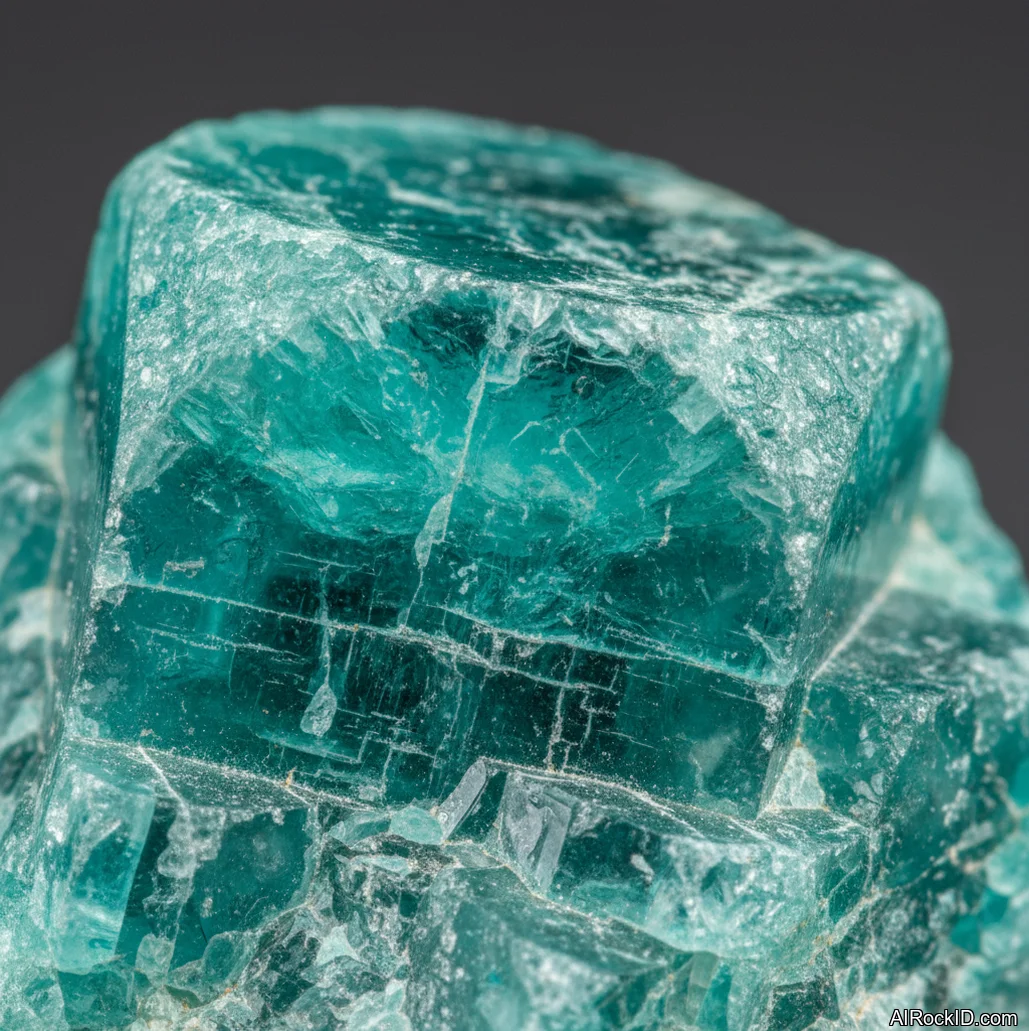
Color: Amazonite ranges from pale green to blue-green, often with white streaks or patches from intergrown albite and perthitic texture.
Luster: Polished surfaces look vitreous to slightly pearly on cleavage faces.
Look closely for the blocky feldspar look and the way it breaks: it wants to cleave in two directions at close to right angles, so chips often have flat, step-like faces. The real test is hardness and feel. If you scratch it with a steel knife, it usually won’t take an easy gouge, but it also won’t laugh off quartz. And in beads, I watch for dyed lookalikes: color pooled in pits and drill holes is a dead giveaway.
Common Look-Alikes
Amazonite is sometimes confused with these materials:
- Dyed chalcedony (often sold as 'blue quartz' or 'turquoise quartz')
- Dyed or glass fakes (sometimes called 'Amazonite glass')
- Turquoise (especially stabilized or reconstituted material)
- Variscite (can be similar, but usually greener and softer)
- Microcline feldspar without blue-green color (sometimes misrepresented as low-grade amazonite)
- Serpentine (rare, but some green varieties get passed off as amazonite)
Market Cautions & Treatments
When AI Can Get This Wrong
AI photo ID tools often confuse amazonite with dyed quartz, glass, or even turquoise—especially when the photo's overexposed or the stone's highly polished. Real amazonite will scratch glass (hardness above 6), while dyed quartz or glass won't. Look for white streaks and a blocky, almost grid-like pattern—AI doesn't always catch that, but your eyes and a loupe can.
Properties of Amazonite
Physical Properties
| Crystal System | Triclinic |
| Hardness (Mohs) | 6-6.5 (Hard (6-7.5)) |
| Density | 2.55-2.63 g/cm3 |
| Luster | Vitreous |
| Diaphaneity | Translucent to opaque |
| Fracture | Uneven |
| Streak | White |
| Magnetism | Non-magnetic |
| Colors | blue-green, green, turquoise-green, pale green, green with white streaks |
Chemical Properties
| Classification | Silicates |
| Formula | KAlSi3O8 |
| Elements | K, Al, Si, O |
| Common Impurities | Pb, Rb, Cs, Na, Fe |
Optical Properties
| Refractive Index | 1.518-1.526 |
| Birefringence | 0.008 |
| Pleochroism | Weak |
| Optical Character | Biaxial |
Amazonite Health & Safety
Handling and rinsing amazonite is usually pretty low-risk. But if you’re grinding or sawing it, don’t breathe in the dust, since that fine, gritty powder can float up fast (especially when the piece gets warm and starts shedding more).
Safety Tips
Use water and keep the air moving when you’re cutting or sanding (a fan and an open window help). And for lapidary work, put on a properly fitted respirator that actually seals to your face, not one that leaks around the nose.
Amazonite Value & Price
Price Range
Rough/Tumbled: $5 - $60 per piece (tumbled/hand-size rough); $80 - $600+ for display specimens
Cut/Polished: $2 - $20 per carat
Prices jump around depending on the color (the bluer it is, the more you usually pay), how clean the material looks once it’s in your hand, and whether it has that nice white patterning or shows up as a sharp, damage-free crystal with crisp edges and no chips.
Durability
Moderate — Scratch resistance: Good, Toughness: Fair
It holds up fine for normal wear, but cleavage means it can chip if you knock it against harder stones or drop it on tile.
How to Care for Amazonite
Use & Storage
Store it in a pouch or a divided box slot so quartz and topaz don’t scuff it up. If you’ve got a cleavage-heavy chunk, don’t let it bang around in a bowl of mixed stones.
Cleaning
1) Rinse with lukewarm water and a drop of mild soap. 2) Use a soft toothbrush to clean around pits and white feldspar seams. 3) Rinse well and pat dry; skip steamers and harsh cleaners.
Cleanse & Charge
If you do energy-style care, a quick rinse and a dry wipe works, or set it on a windowsill for gentle light. Don’t bake it in full sun all week if you want the color to stay looking calm and even.
Placement
On a desk it looks great under indirect light, where the blue-green reads softer and the white streaks show. I like it near other feldspars so you can compare textures side by side.
Caution
Thing is, cleavage means it’ll chip pretty easily. So don’t drop it, and don’t put it in an ultrasonic cleaner (those little vibrations can be rough). And when you stash it in a jewelry box, keep it away from harder stones, because they’ll knock into it and leave little nicks.
Works Well With
Amazonite Meaning & Healing Properties
Grab amazonite when you want something that feels steady and cool in your hand, not all buzzy and jangly. In my own little pile, it’s the one I go for when my brain starts doing that frantic tab-switching thing and I can’t land on a thought. The polished stuff gets that slick, almost glassy feel under your thumb, but it doesn’t feel slippery emotionally, if that makes any sense. It’s more like a deep breath you can actually hold onto.
People link amazonite with honest communication and calming those anxious mental loops, and yeah, I get it. That blue-green color sits right in that in-between zone of “heart” and “throat” symbolism in modern crystal culture, so it shows up a lot when people are trying to speak clearly without coming in hot. But look, I’ll say the obvious part out loud: none of this is medical care. If you’ve got real anxiety or sleep issues, treat the stone like a comfort object, not a prescription.
Most dealers will tell you it’s calming, and sure, that can be true. But thing is, I’ve watched it hit the opposite way for some people. If you’re already restless, the brighter, bluer pieces can feel a little too stimulating, especially sitting in a bright room. I’ve had better luck with the softer green material with lots of white in it, the kind that looks like sea glass with foam (you know the type?). That’s the one that makes the room feel quieter.
Common mistakes
- Assuming every blue-green opaque stone is amazonite without checking texture, cleavage, or seller disclosure
- Confusing dyed howlite or magnesite beads with natural amazonite
- Using harsh cleaners or ultrasonic machines on fractured or treated amazonite jewelry
- Expecting amazonite to be as tough as jade because both can appear green and opaque
- Judging value only by color while ignoring fractures, polish quality, treatment, and workmanship
Identify Amazonite from a photo
Compare Amazonite traits, care tips, value clues, and common lookalikes with a clear photo.