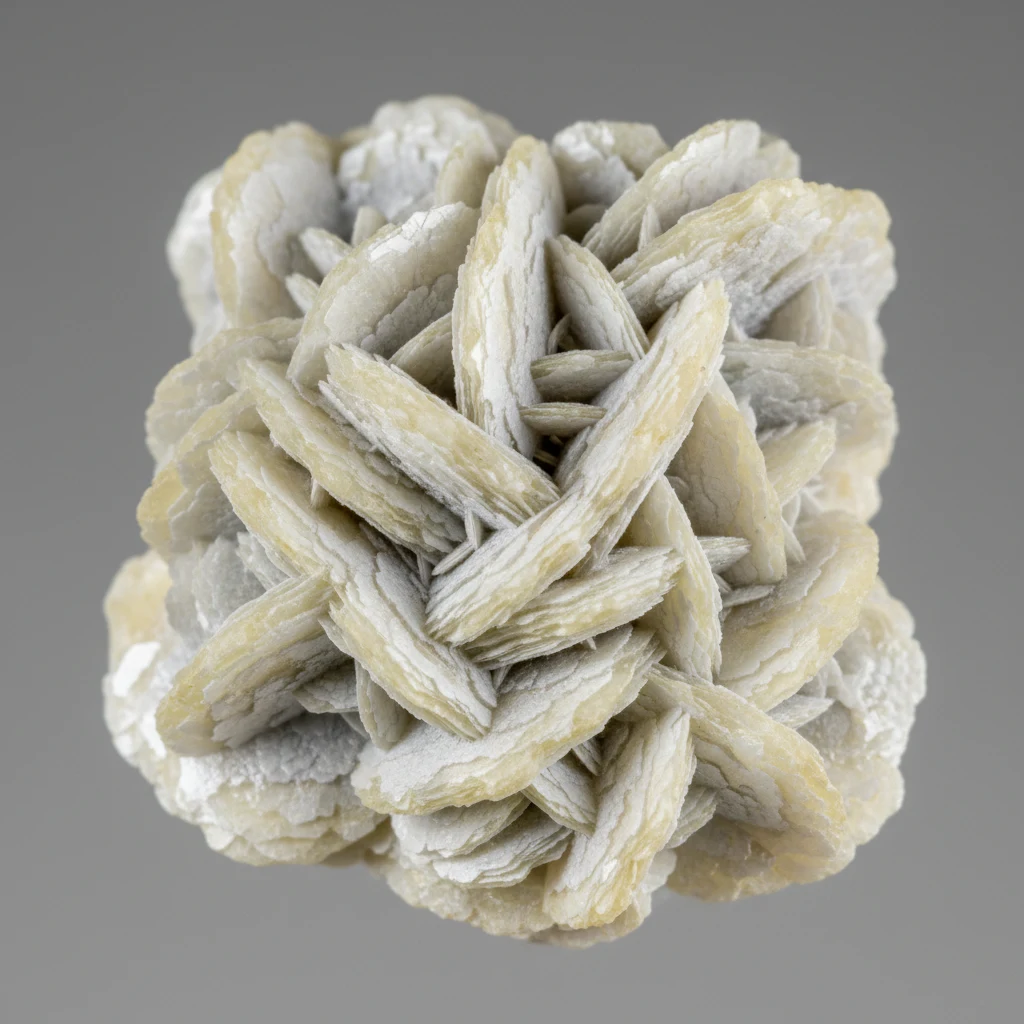
Kaolinite


Quick answer: Kaolinite is a soft, usually white clay mineral that commonly forms from the weathering of feldspar-rich rocks. Its fine, earthy texture and very low hardness help separate it from harder white minerals such as quartz, calcite, and feldspar.
AI Rock ID can help screen a kaolinite sample by comparing color, texture, luster, and visible form against common clay minerals and white lookalikes. RockIdentifier.io should be used with simple field observations, such as hardness, streak, and whether the specimen feels powdery or plastic when damp.
Good fit
- Collectors who want a common clay mineral with an important geologic and industrial role
- Students learning feldspar weathering, clay formation, and sedimentary processes
- People identifying soft, white to cream earthy material in soils, saprolite, or altered rock
- Reference collections that include clay minerals, alteration minerals, or industrial minerals
Not a good fit
- Jewelry use, because kaolinite is too soft and crumbly for normal wear
- Collectors seeking glassy crystals or durable display specimens
- Situations where inhalable dust cannot be controlled
- Identification based on color alone, since many minerals can appear white or pale
Most commonly confused with
- Calcite: Calcite is harder than kaolinite, commonly shows cleavage, and reacts with dilute acid.
- Quartz: Quartz is much harder, glassy to waxy, and will scratch glass, unlike kaolinite.
- Gypsum: Gypsum is also soft but often forms clearer crystals or fibrous masses and is less claylike.
- Talc: Talc has a greasy or soapy feel, while kaolinite is usually more earthy or powdery.
Kaolinite vs. Common White Lookalikes
| Mineral | Typical Feel or Texture | Quick Difference |
|---|---|---|
| Kaolinite | Earthy, powdery, or claylike | Very soft; may become plastic when damp |
| Calcite | Smooth to crystalline | Fizzes with dilute acid |
| Quartz | Hard, glassy, or waxy | Scratches glass easily |
| Gypsum | Soft, sometimes silky or fibrous | Can be scratched by a fingernail but is less claylike |
| Talc | Greasy or soapy | Feels slicker than kaolinite |
AI identification confidence
AI identification of kaolinite is usually moderate when the sample shows a white to cream color, dull luster, and earthy clay texture. Confidence is lower for close-up photos of white powder, mixed soils, or massive altered rock because several pale minerals can look similar in images.
When AI gets it wrong
- The photo shows only a white powder with no scale, texture, or surrounding rock context
- The specimen is a mixture of clay, quartz, feldspar, and iron staining rather than a single mineral
- Lighting overexposes the sample and hides surface texture
- The mineral is identified from color alone without hardness, acid reaction, or feel
Final recommendation
For a likely kaolinite specimen, combine visual identification with simple checks such as softness, earthy texture, and lack of glassy luster. If the sample may be used industrially, scientifically, or around dust exposure, confirm the identification with appropriate mineral testing rather than relying on appearance alone.
How to Identify Kaolinite in the Field
Kaolinite commonly appears as white, cream, gray, or slightly stained earthy material in weathered rocks, clay deposits, and altered feldspar-rich zones. A simple field clue is its softness: it can often be scratched easily and may feel powdery or claylike. When damp, kaolinite-rich material may become plastic, but field identification should still be treated as tentative because clay deposits are often mixtures.
Buying and Authenticity Tips
Kaolinite is common and usually inexpensive, so unusually high prices should be supported by clear provenance, unusual form, or association with another collectible mineral. Many specimens sold as kaolinite are kaolin-rich clay, altered feldspar, or mixed clay rather than pure kaolinite. For educational or reference use, request locality information and avoid listings that rely only on vague terms such as white clay or cleansing clay.
Geologic Occurrence
Kaolinite forms mainly through chemical weathering or hydrothermal alteration of aluminum-rich silicate minerals, especially feldspars. It is common in kaolin deposits, tropical to subtropical weathering profiles, sedimentary clay layers, and altered granitic or volcanic rocks. Iron oxides, quartz, mica, and feldspar remnants are frequent associates in natural material.
What Is Kaolinite?
Kaolinite is a common, very soft clay mineral best known for its white color and fine, powdery feel. In hand, it is not a sparkling display mineral; it reads as earthy, dull, and quiet, often white to pale yellow or gray, with a white streak and opaque body.
Collectors value kaolinite for texture, origin, and purity rather than brilliance. Its Mohs hardness is only 2-2.5, so it scratches easily, feels fragile, and should be handled more like compacted clay than a durable gemstone. Chemically, it is listed as Al2Si2O5(OH)4 and may contain iron or titanium impurities.
Origin & History
Kaolinite takes its name from Kaoling, a hill in Jiangxi, China, where the mineral was first identified in the 17th century. That origin gives the mineral a strong historical anchor: the name itself points back to a specific Chinese locality rather than to a color or trade term.
For collectors, that makes locality labels especially meaningful. A specimen marked Kaoling, Jiangxi, China carries direct name-history interest, while material from Brazil or the United States is usually appreciated for purity, texture, and deposit context. For locality checking and mineral references, mindat.org is a useful plain-text reference.
Where Is Kaolinite Found?
Kaolinite is found in China, Brazil, and the United States, and it is most commonly associated with weathered granite and sedimentary deposits. Notable listed localities include Kaoling in Jiangxi, China; Pernambuco, Brazil; and Georgia, USA.
Formation
Kaolinite forms through the hydrolysis of feldspar under acidic conditions. In plain collector terms, it is a weathering product: feldspar breaks down, and the result can be a soft, white to pale clay mineral with low density and a powdery surface.
This formation explains why kaolinite is so often linked with weathered granite and sedimentary deposits. Its earthy fracture, dull luster, and plastic behavior when wet all fit a mineral formed by alteration rather than by sharp, glassy crystal growth. USGS is a useful plain-text reference for broader geologic context.
How to Identify Kaolinite
Kaolinite is identified by its softness, pale color, earthy luster, and plasticity when wet. Look for a white, pale yellow, or gray material with a dull surface, white streak, opaque appearance, earthy fracture, and a fine powdery feel under careful handling.
Its Mohs hardness of 2-2.5 is a key practical clue: it has poor scratch resistance and poor toughness. It is non-magnetic, low in density for a hand specimen at 2.16-2.63 g/cm3, and belongs to the monoclinic crystal system. Avoid aggressive tests, because moisture and handling can break it down.
Properties of Kaolinite
Physical Properties
| Crystal System | Monoclinic |
| Hardness (Mohs) | 2-2.5 (Very Soft (1-2)) |
| Density | 2.16-2.63 g/cm3 |
| Luster | Dull |
| Diaphaneity | Opaque |
| Fracture | Earthy |
| Streak | White |
| Magnetism | Non-magnetic |
| Colors | White, Pale Yellow, Gray |
Chemical Properties
| Classification | Tectosilicate |
| Formula | Al2Si2O5(OH)4 |
| Elements | Al, Si, O |
| Common Impurities | Fe, Ti |
Optical Properties
| Refractive Index | 1.56-1.62 |
| Birefringence | None |
| Pleochroism | None |
| Optical Character | Biaxial |
Kaolinite Health & Safety
Inhalation of dust may cause respiratory issues.
Kaolinite Value & Price
Price Range
Rough/Tumbled: $1 - $10 per specimen
Cut/Polished:
Price may vary based on purity and location of origin.
Durability
Fragile — Scratch resistance: Poor, Toughness: Poor
Kaolinite is sensitive to moisture and can break down when wet.
How to Care for Kaolinite
Use & Storage
Store in a cool, dry place away from direct sunlight.
Cleaning
Gently wipe with a damp cloth. Avoid harsh chemicals.
Cleanse & Charge
Cleanse with water and charge in sunlight or moonlight.
Placement
Place in a location that promotes calmness and clarity.
Caution
Keep away from extreme humidity to avoid degradation.
Works Well With
Kaolinite Meaning & Healing Properties
Kaolinite is used metaphysically as a calming, grounding, and nurturing stone, especially for emotional balance and mental clarity. Its soft, clay-like presence suits quiet placement rather than jewelry wear, and it is commonly associated with the Root chakra, Earth element, and the signs Taurus and Virgo.
As a healing stone, kaolinite should be treated as supportive symbolism, not medical treatment. It may be cleansed with water and charged in sunlight or moonlight, but because it is moisture-sensitive and fragile, brief gentle care is better than soaking. Store it cool, dry, and away from harsh chemicals or extreme humidity.
Identify Kaolinite from a photo
Compare Kaolinite traits, care tips, value clues, and common lookalikes with a clear photo.
Common mistakes
- Calling any white clay kaolinite without checking texture, geologic setting, or mineral mixture
- Assuming a powdery white mineral is safe to inhale because it is natural
- Confusing kaolinite with calcite without testing for acid reaction
- Expecting kaolinite to behave like a durable crystal in jewelry or pocket carry
- Using color as the main identification feature for pale clay minerals
- Assuming industrial kaolin clay and a mineral specimen have the same purity or composition