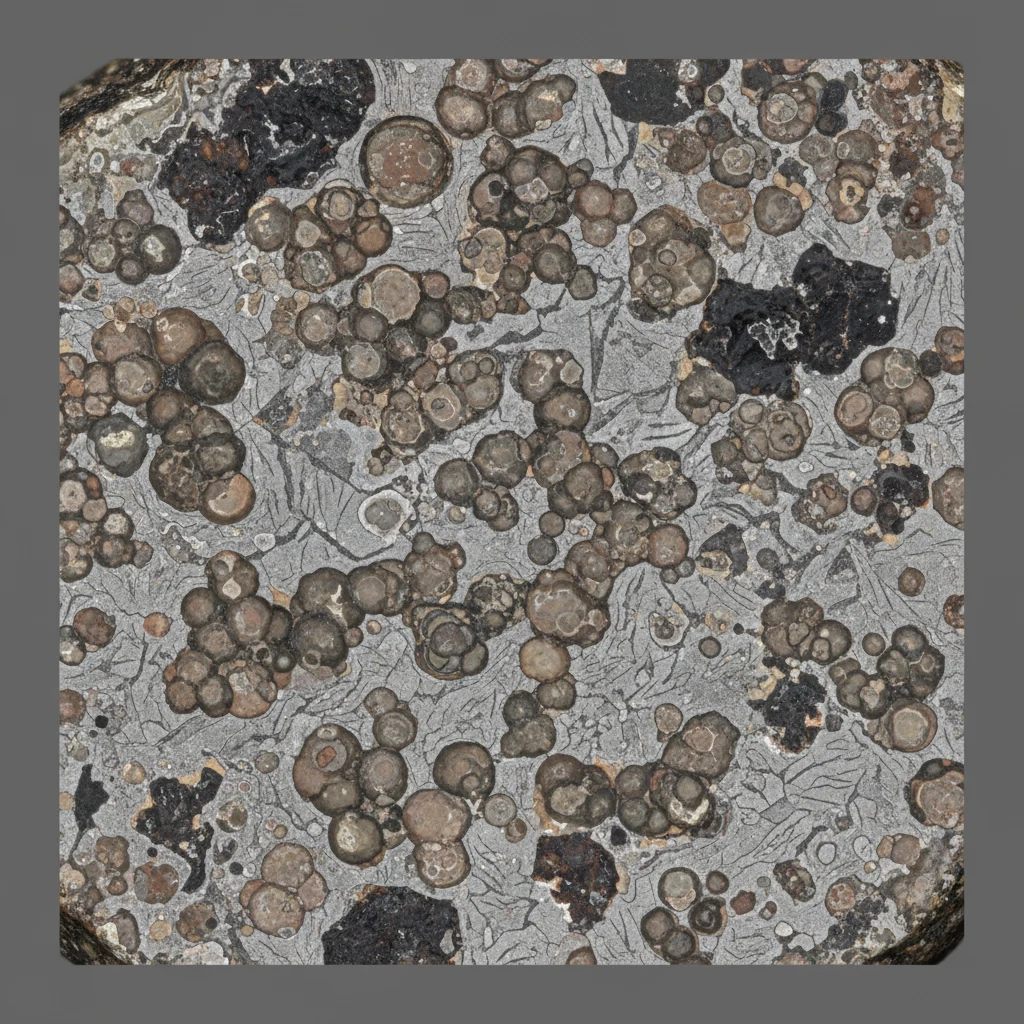
Meteorite (likely a type of chondrite)


Quick answer: A likely chondrite meteorite is a stony meteorite that may show small rounded chondrules, metal flecks, and a dark fusion crust. Identification is not certain from appearance alone because slag, basalt, hematite, and other dark rocks are commonly mistaken for meteorites.
AI Rock ID can help screen a suspected chondrite by checking visible traits such as fusion crust, texture, color, and possible metal grains. RockIdentifier.io should be used as a first-pass identification aid, not as a substitute for laboratory testing, magnetic susceptibility testing, or classification by a qualified meteoritics lab.
Good fit
- Collectors who want a stony meteorite candidate with visible chondrules or metal flecks
- Users comparing an outdoor find against common meteorite lookalikes
- Beginners learning the difference between meteorites, slag, basalt, and iron-rich rocks
- Educational collections focused on planetary science and asteroid material
Not a good fit
- Anyone needing a guaranteed meteorite ID from photos alone
- Jewelry use where rust, brittleness, or unknown composition could be a problem
- Buyers unwilling to request provenance, classification details, or seller documentation
- People seeking medical or protective effects from a stone
Why people search for this
People often search for chondrite meteorites after finding a dense dark stone with a black crust, magnetic response, or unusual rounded grains. Many searches are driven by the need to separate genuine meteorites from industrial slag and ordinary terrestrial rocks.
Most commonly confused with
- Basalt: Basalt can be dark and fine-grained, but it usually lacks a true fusion crust and visible metallic iron-nickel grains.
- Hematite: Hematite is dense and may be weakly magnetic, but it commonly leaves a reddish-brown streak unlike most chondrites.
- Magnetite: Magnetite is strongly magnetic and black, but it is an Earth mineral rather than a stony meteorite with chondrules.
- Obsidian: Obsidian has a glassy volcanic texture and conchoidal fracture, not granular chondrules with metal grains.
Chondrite Meteorite vs Common Lookalikes
| Material | Typical clue | Key difference from chondrite |
|---|---|---|
| Chondrite meteorite | Dark fusion crust, chondrules, possible metal flecks | May contain rounded chondrules and iron-nickel grains |
| Basalt | Dark volcanic rock | Usually lacks fusion crust and metallic iron-nickel flecks |
| Hematite | Heavy with reddish-brown streak | Red-brown streak is not typical for chondrites |
| Magnetite | Strongly magnetic black mineral | Crystalline oxide mineral, not a chondrule-bearing stony meteorite |
| Slag | Bubbly or glassy industrial material | Vesicles and foamy texture suggest human-made waste |
AI identification confidence
AI identification for a likely chondrite is moderate at best because many dark, dense, magnetic-looking rocks share similar visual traits. Confidence improves when photos show fresh broken surfaces, possible chondrules, a thin fusion crust, scale, streak test results, and magnet response.
When AI gets it wrong
- The specimen is photographed only from the outside and the interior texture is not visible
- A slag piece has a dark melted surface that resembles fusion crust
- Iron-rich terrestrial rocks appear dense or magnetic in photos
- Weathering, dirt, or varnish hides chondrules and metal grains
Final recommendation
For a suspected chondrite, use photo ID and simple observations only as screening steps. A verified meteorite purchase or formal identification should rely on provenance, classification information, and testing by a reputable source.
How to Check a Suspected Chondrite Before Buying
Ask for clear photos of both the exterior and a cut or broken interior surface. A credible listing should describe weight, size, location or provenance when available, and whether the specimen has been classified or paired with a known meteorite. Be cautious with vague claims such as “magnetic space rock” without supporting details.
Authentication Clues for Chondrite Meteorites
Useful clues include a thin dark fusion crust, rounded chondrules in the interior, scattered metal grains, and a density that feels heavier than many ordinary stones of similar size. A file mark or cut face may reveal light-gray to dark-gray matrix with tiny metallic specks. Laboratory confirmation may include thin section petrography, nickel testing, or formal meteoritical classification.
Photo Tips for Better Meteorite Identification
Photograph the specimen in daylight with a ruler or coin for scale. Include close-ups of the crust, any broken or cut surface, and areas that show rounded grains or metal flecks. Add notes about streak color, magnet reaction, weight, and whether the rock was found near roads, railways, industrial sites, or volcanic terrain.
What Is Meteorite (likely a type of chondrite)?
Meteorite (likely a type of chondrite) is a stony meteorite rock known for small, rounded particles called chondrules. In the hand, a typical piece feels dense for its size, opaque, and earthy rather than glassy, with gray, brown, or black tones and a dull to waxy surface.
As a collector specimen, chondrite is valued less for sparkle and more for story: it is material that formed in space from early solar-system matter. Its listed hardness is Mohs 5-7, with an uneven fracture, white to light gray streak, weak magnetism, and a variable composition primarily involving SiO2, FeO, and MgO.
Origin & History
The name chondrite comes from the Greek word “chondros,” meaning grain, a direct reference to the rounded chondrules visible within many specimens. Chondrites were first described in the early 19th century, and today they remain one of the most recognizable stony meteorite types for study and collecting.
In a tray, a chondrite may look modest beside bright crystals, but its appeal is scientific and cultural: it is a remnant of early solar-system material that reached Earth. For locality comparison and meteorite record checking, collectors commonly consult databases such as mindat.org alongside specimen documentation.
Where Is Meteorite (likely a type of chondrite) Found?
Meteorite (likely a type of chondrite) is found worldwide after meteorite falls, with reported countries including the USA, Russia, and Australia. Notable localities listed for chondrite-related specimens include Allende in Chihuahua, Mexico; Murchison in Victoria, Australia; and Sikhote-Alin, Russia.
Formation
Chondrites form from solar nebula materials that cooled and solidified in space. They are remnants from the early solar system, so their appeal is not just mineralogical but cosmic: a small, dark, granular stone can represent material older than ordinary Earth rocks in a collection context.
Their composition is variable, but the provided chemistry is primarily SiO2, FeO, and MgO, with silicon, iron, and magnesium listed as elements and calcium and aluminum as common impurities. This lithometeoritic rock is amorphous in crystal system, opaque, and typically shows dull luster rather than crystal faces.
How to Identify Meteorite (likely a type of chondrite)
Identify Meteorite (likely a type of chondrite) by looking for chondrules within the matrix and checking the exterior for a fusion crust. Fresh-looking pieces may show gray, brown, or black color, dull to waxy luster, an uneven fracture, and a white to light gray streak.
A chondrite can be weakly magnetic, with density listed at 3.0-3.9 g/cm3 and hardness at Mohs 5-7. In practical terms, do not rely on color alone: many dark rocks mimic meteorites, so the best field clues are rounded internal grains, an outer crust, specimen weight, and reliable provenance.
Properties of Meteorite (likely a type of chondrite)
Physical Properties
| Crystal System | Amorphous |
| Hardness (Mohs) | 5-7 (Medium (4-6)) |
| Density | 3.0-3.9 g/cm3 |
| Luster | Dull |
| Diaphaneity | Opaque |
| Fracture | Uneven |
| Streak | White to light gray |
| Magnetism | Weakly Magnetic |
| Colors | Gray, Brown, Black |
Chemical Properties
| Classification | Lithometeoritic |
| Formula | Variable; primarily SiO2, FeO, MgO |
| Elements | Si, Fe, Mg |
| Common Impurities | Ca, Al |
Optical Properties
| Refractive Index | Not applicable |
| Birefringence | None |
| Pleochroism | None |
| Optical Character | Isotropic |
Meteorite (likely a type of chondrite) Health & Safety
Chondrites pose no significant health risks.
Meteorite (likely a type of chondrite) Value & Price
Price Range
Rough/Tumbled: $50 - $500 per specimen
Cut/Polished:
Price is influenced by size, type, and historical significance.
Durability
Moderate — Scratch resistance: Fair, Toughness: Good
Chondrites are stable under normal conditions but can be affected by moisture.
How to Care for Meteorite (likely a type of chondrite)
Use & Storage
Store in a dry, cool place.
Cleaning
Gently wipe with a dry cloth to remove dust. Avoid water to prevent moisture damage.
Cleanse & Charge
Place under moonlight for a few hours.
Placement
Best displayed in a glass case to avoid dust accumulation.
Caution
Avoid exposing to extreme temperatures.
Works Well With
Meteorite (likely a type of chondrite) Meaning & Healing Properties
In crystal healing traditions, Meteorite (likely a type of chondrite) is believed to support grounding, protection, and awareness. Its Root chakra association fits the way collectors often experience it: as a compact, weighty stone that feels anchoring, quiet, and connected to Earth despite its space-born origin.
It is linked with Taurus and Virgo, the planet Earth, and the Earth element. For care, store it in a dry, cool place, display it in a glass case to limit dust, and gently wipe it with a dry cloth; although it is listed as safe in water, avoiding moisture helps prevent damage.
Identify Meteorite (likely a type of chondrite) from a photo
Compare Meteorite (likely a type of chondrite) traits, care tips, value clues, and common lookalikes with a clear photo.
Common mistakes
- Assuming any magnetic rock is a meteorite
- Mistaking bubbles or holes in slag for meteorite surface texture
- Calling a black coating fusion crust without checking if it is thin and continuous
- Ignoring a red-brown streak, which often points to hematite or iron oxides
- Buying unclassified specimens without provenance or clear interior photos
- Cleaning or polishing a suspected meteorite before documenting its original surface
Meteorite (likely a type of chondrite) FAQ
Related Crystals
Related pages: Pallasite Meteorite