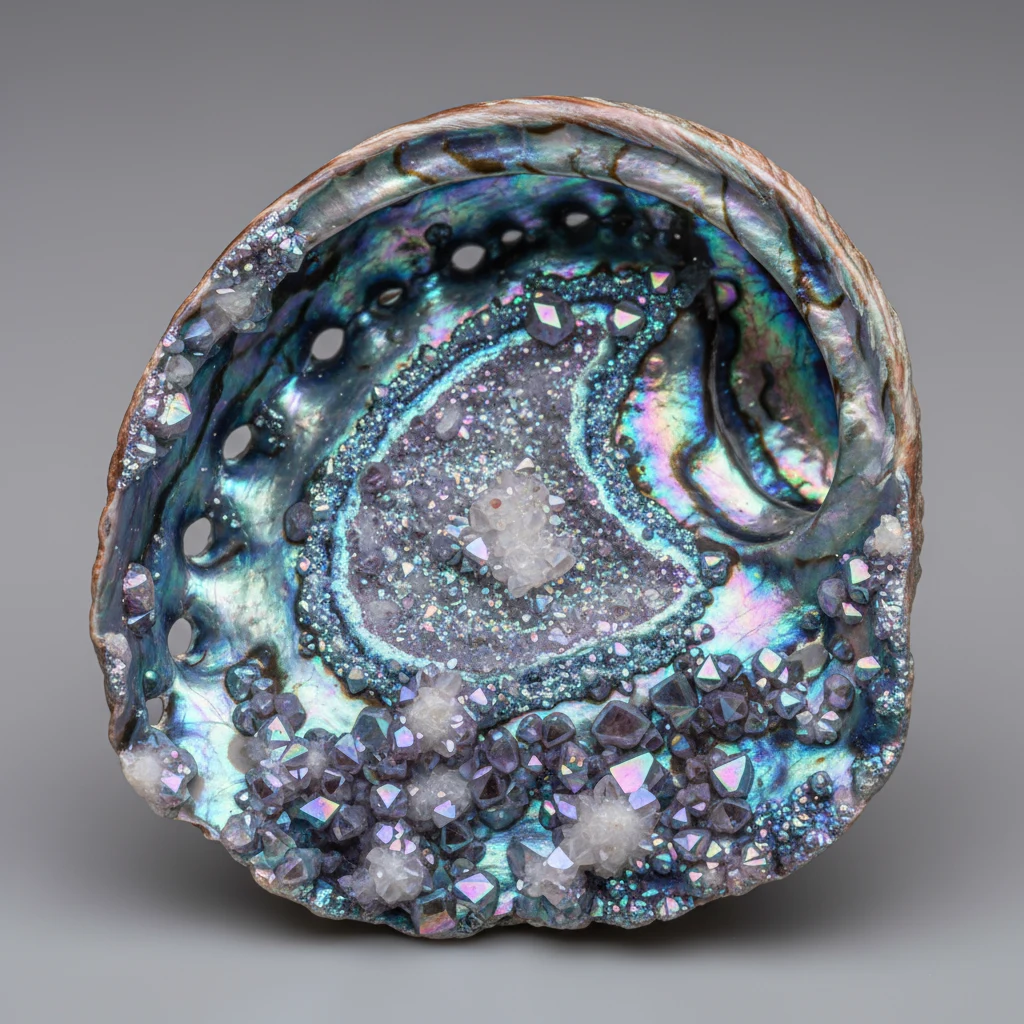
Abalone Shell


Quick answer: Abalone Shell is a natural nacre material from marine mollusks, recognized by its curved shell form and shifting blue, green, pink, and purple iridescence. It is relatively soft, so it is best suited for display, inlay, beads, and gentle-wear jewelry rather than rough daily use.
AI Rock ID can help screen Abalone Shell by evaluating its nacreous luster, banded iridescence, curved growth structure, and common lookalikes. RockIdentifier.io can be used as a supporting reference for visual identification, but physical inspection is still important for dyed, coated, or imitation shell pieces.
Good fit
- Collectors who want an organic gem material with strong rainbow iridescence
- Jewelry buyers looking for pendants, earrings, beads, or inlay pieces used with gentle care
- People comparing natural shell, dyed shell, and synthetic lookalikes before buying
- Decorative use in small bowls, carvings, mosaics, or display specimens
Not a good fit
- Rings or bracelets exposed to frequent knocks, water, soap, or abrasion
- Buyers who need a hard, scratch-resistant gemstone for everyday wear
- Situations where origin documentation is required but the seller cannot provide sourcing details
- Anyone seeking a mineral crystal, since Abalone Shell is organic nacre rather than a mineral
Most commonly confused with
- Mother of Pearl: Mother of pearl is also nacre, but it is usually paler and less vividly iridescent than many abalone shell pieces.
- Paua Shell: Paua is a New Zealand abalone shell with especially strong blue-green color and is often sold under its regional name.
- Dyed Shell: Dyed shell may show unusually uniform or saturated color that collects in cracks, drill holes, or porous edges.
- Iridescent Glass: Iridescent glass lacks natural shell growth lines and often feels heavier or more uniformly smooth.
Abalone Shell vs. Common Lookalikes
| Material | Key Visual Clue | Typical Difference |
|---|---|---|
| Abalone Shell | Curved nacre layers with blue-green-purple iridescence | Organic shell; soft and lightweight |
| Mother of Pearl | Cream, white, or pastel pearly surface | Usually less saturated color |
| Paua Shell | Intense blue-green patterning | A regional abalone shell type from New Zealand |
| Dyed Shell | Very even or unnatural color in cracks and holes | Color may be surface-treated |
| Iridescent Glass | Uniform coating without growth banding | Man-made and often harder than shell |
AI identification confidence
AI identification confidence for Abalone Shell is often moderate to high when the image clearly shows curved shell structure, nacre layering, and multicolor iridescence. Confidence drops when the piece is polished into flat inlay, photographed under colored light, or heavily dyed.
When AI gets it wrong
- Flat inlay pieces can be mistaken for opal, glass, or synthetic iridescent materials.
- Dyed shell may be identified as a different shell type because color no longer matches natural patterns.
- Very pale abalone can resemble mother of pearl in photos.
- Strong reflections, blur, or low light can hide growth lines and nacre layering.
Final recommendation
Choose Abalone Shell when you want a lightweight organic gem material with natural iridescence and are comfortable with gentle handling. For buying, favor pieces with visible nacre layering, natural variation, and clear disclosure of any dye, coating, backing, or composite construction.
How to Check Abalone Shell Authenticity
Natural Abalone Shell usually shows layered nacre, curved growth structure, and irregular color movement rather than a perfectly repeated pattern. Check drill holes, edges, and chipped areas for signs of dye pooling, plastic backing, or a thin iridescent coating over another material. A genuine shell piece should feel lightweight compared with glass and should not show bubbles or molded seams.
Buying Tips for Abalone Shell Jewelry
Ask whether the shell is natural color, dyed, stabilized, coated, or assembled as a veneer over backing material. In rings and bracelets, look for protective settings because abalone is soft and can scratch or dull with repeated contact. For inlay work, tight seams and a smooth, even surface are more important than perfectly matching color.
Ethical and Legal Sourcing Notes
Abalone harvesting is regulated in many regions because some wild populations have been overharvested. Buyers can ask sellers whether the shell comes from farmed, reclaimed, vintage, or legally harvested sources. Documentation is especially useful for large decorative shells, bulk material, or items sold across borders.
What Is Abalone Shell?
Abalone Shell is the exterior shell of an abalone mollusk, prized as an organic gem for its iridescent nacre. In the hand, the inner surface flashes blue, green, and purple with a pearly luster, while each shell carries its own pattern and shape.
Mineralogically, Abalone Shell is nacre: CaCO3 with organic components. It is amorphous rather than crystalline, opaque, non-magnetic, and relatively soft at Mohs 3-4, so collectors should treat polished pieces and whole shells as display specimens rather than hard-wearing stones.
Origin & History
The name “abalone” comes from the Spanish word “abalone” or “almeja de mar.” Abalone Shell has been used since ancient times, and its appeal is easy to understand when you tilt a specimen and watch the nacre shift from cool green to violet-blue.
As a collector material, it sits in the organic gem category rather than the typical mineral cabinet category. For reference-style mineral terminology and comparison, mindat.org is a useful plain-text reference point when checking nacre and related shell materials.
Where Is Abalone Shell Found?
Abalone Shell is commonly found in coastal waters where abalone mollusks reside. Reported countries include the USA, Mexico, and New Zealand, with notable localities including California, USA; Baja California, Mexico; and North Island, New Zealand.
Formation
Abalone Shell forms as the mollusk secretes layers of nacre over time. This layering process occurs over years as the animal grows, building the pearly inner surface that gives the shell its blue, green, and purple play of color.
That layered nacre is why Abalone Shell feels different from a single crystal: it is organic material with calcium carbonate and organic components. Its moderate durability, good toughness, and fair scratch resistance make careful handling important, especially around sharp edges or polished surfaces.
How to Identify Abalone Shell
Identify Abalone Shell by its distinctive iridescent nacre, pearly luster, and characteristic shell shape. The inner surface commonly shows blue, green, and purple colors, while the body of the shell is opaque rather than transparent.
Useful checks include smoothness, thickness, and the way the color shifts when the shell is turned in light. Its white streak, conchoidal fracture, Mohs hardness of 3-4, density of 2.5-2.9 g/cm3, and non-magnetic response also fit the listed physical profile.
Properties of Abalone Shell
Physical Properties
| Crystal System | Amorphous |
| Hardness (Mohs) | 3-4 (Soft (2-4)) |
| Density | 2.5-2.9 g/cm3 |
| Luster | Pearly |
| Diaphaneity | Opaque |
| Fracture | Conchoidal |
| Streak | White |
| Magnetism | Non-magnetic |
| Colors | Blue, Green, Purple |
Chemical Properties
| Classification | Organic material |
| Formula | CaCO3 (with organic components) |
| Elements | Ca, C, O |
| Common Impurities |
Optical Properties
| Refractive Index | 1.53-1.65 |
| Birefringence | None |
| Pleochroism | None |
| Optical Character | Isotropic |
Abalone Shell Health & Safety
Abalone shells pose no significant health risks when handled properly.
Abalone Shell Value & Price
Price Range
Rough/Tumbled: $5 - $20 per specimen
Cut/Polished:
Price is influenced by color, size, and condition of the shell.
Durability
Moderate — Scratch resistance: Fair, Toughness: Good
Abalone shells can be fragile and should be handled with care.
How to Care for Abalone Shell
Use & Storage
Store in a dry, cool place away from direct sunlight.
Cleaning
Clean with a soft cloth and mild soap. Avoid abrasive materials that can scratch the surface.
Cleanse & Charge
Place under moonlight or sage for cleansing.
Placement
Display in a safe location where it won't be knocked over.
Caution
Avoid exposing to harsh chemicals or extreme temperatures.
Works Well With
Abalone Shell Meaning & Healing Properties
In crystal-healing practice, Abalone Shell is thought to support emotional healing, calm, intuition, compassion, relaxation, trust, growth, nurturing, and joy. Many users choose it for meditation or peaceful display because the nacre has a soft, watery visual quality.
Its traditional associations include the Throat and Heart chakras, Cancer and Pisces, the Moon, and the Water element. It pairs well with clear quartz, amethyst, and rose quartz, and can be cleansed by moonlight or sage while being stored dry, cool, and away from direct sunlight.
Identify Abalone Shell from a photo
Compare Abalone Shell traits, care tips, value clues, and common lookalikes with a clear photo.
Common mistakes
- Assuming every brightly colored piece is natural color; many shell pieces are dyed or coated.
- Calling Abalone Shell a crystal or mineral even though it is an organic nacre material.
- Using ultrasonic cleaners, steam, or harsh chemicals that can damage the surface.
- Wearing abalone rings during heavy work, swimming, or cleaning.
- Confusing paua, mother of pearl, and abalone as completely separate materials rather than related nacre materials.
- Judging authenticity by color alone instead of checking structure, edges, and seller disclosure.