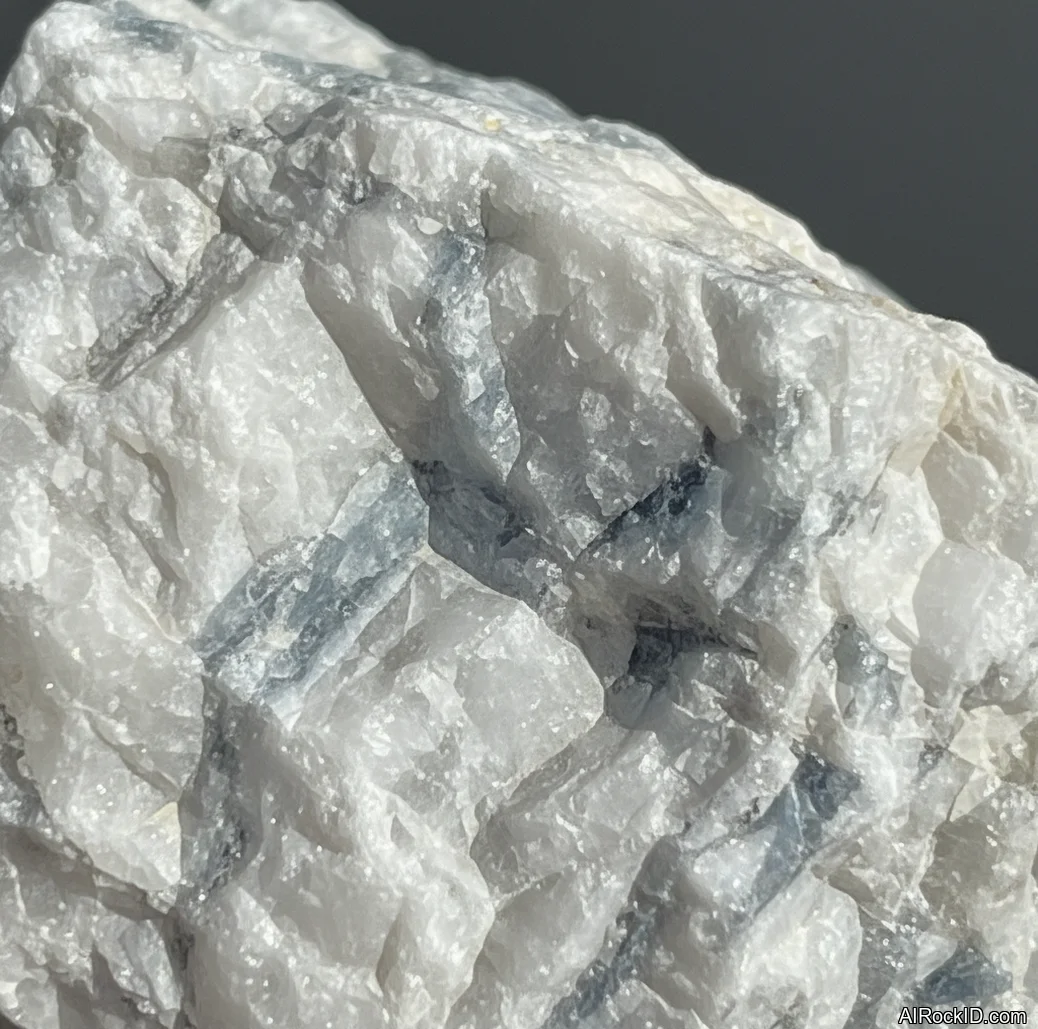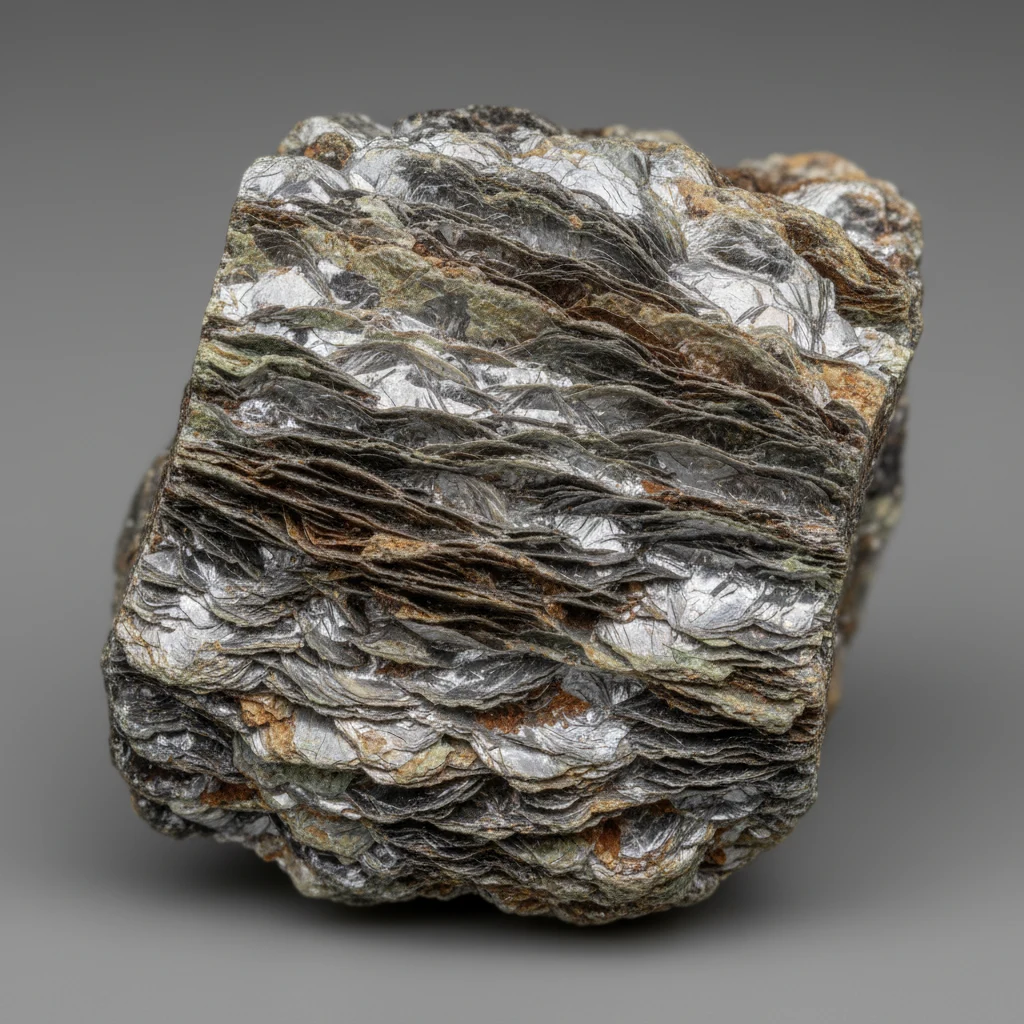
Phyllite


Quick answer: Phyllite is a fine-grained foliated metamorphic rock between slate and schist in metamorphic grade. It is usually recognized by its silky or satiny sheen, wavy cleavage surfaces, and gray, greenish, brown, or black color.
AI Rock ID can help compare a suspected phyllite sample against visually similar foliated rocks using color, texture, luster, and layering cues. RockIdentifier.io presents phyllite as a metamorphic rock rather than a single mineral species, so identification should consider overall rock texture and mineral mix.
Good fit
- Collectors learning the slate-to-schist metamorphic sequence
- Students comparing foliated metamorphic rock textures
- Decorative stone users who like subtle silvery or satin surfaces
- Field observers identifying low- to medium-grade metamorphic rocks
Not a good fit
- Anyone needing a transparent faceted gemstone
- Projects requiring a very hard, scratch-resistant stone
- Identification based only on color, since phyllite has several common colors
- Outdoor use where splitting, weathering, or moisture absorption is a concern
Most commonly confused with
- Slate: Slate is usually duller, flatter, and lower grade, with smoother planar cleavage rather than a silky wavy sheen.
- Schist: Schist is coarser grained and commonly shows visible mica flakes, while phyllite has a finer silky luster.
- Mica: Mica is a mineral with elastic flakes, while phyllite is a rock that may contain fine mica minerals.
- Shale: Shale is sedimentary and often breaks into dull earthy layers, while phyllite has been metamorphosed and develops a phyllitic sheen.
Phyllite vs. Similar Foliated Rocks
| Rock | Typical Texture | Key Difference |
|---|---|---|
| Phyllite | Fine-grained, wavy foliation, silky sheen | Intermediate between slate and schist |
| Slate | Very fine-grained, flat cleavage, dull to slight sheen | Lower metamorphic grade and less silky surface |
| Schist | Medium to coarse foliation with visible mica | Higher grade with larger mineral grains |
| Shale | Fine sedimentary layers, dull earthy surface | Not metamorphosed and lacks phyllitic luster |
| Gneiss | Coarse light-dark banding | Higher grade with compositional bands |
AI identification confidence
AI identification of phyllite is usually moderate when photos clearly show the silky sheen, wavy foliation, and broken edge. Confidence drops when the sample is wet, polished, dusty, or photographed without scale because slate, schist, and shale can appear similar in a single image.
When AI gets it wrong
- A close-up photo hides grain size, making schist look like phyllite.
- Wet slate may appear shinier than it is and resemble phyllite.
- Weathered phyllite can lose its silky surface and be mistaken for shale.
- Polished decorative stone may obscure natural foliation and cleavage.
Final recommendation
For the most reliable identification, examine both the surface sheen and the broken edge rather than relying on color alone. A hand lens, scratch test, and comparison with slate and schist samples can help confirm whether the rock fits phyllite.
How to Identify Phyllite in the Field
Look for thin, foliated layers that are slightly wavy rather than perfectly flat. Fresh surfaces often show a silky, silvery, or satiny luster caused by very fine mica minerals. Phyllite commonly splits along foliation but is not usually as perfectly flat as roofing slate.
Buying and Authenticity Notes
Phyllite is usually sold as a specimen, landscaping stone, tile, or educational rock sample rather than as a rare gemstone. Authenticity concerns are generally about correct labeling, since slate, schist, and dark shale may be sold under similar names. Ask for locality, natural surface photos, and whether the piece has been sealed, polished, or dyed.
Phyllite in the Metamorphic Sequence
Phyllite forms after slate and before schist as shale or mudstone is altered by heat, pressure, and directed stress. Its fine mica growth gives it more sheen than slate, but the grains are typically too small to identify individually without magnification. This position makes phyllite useful for teaching progressive metamorphism.
What Is Phyllite?
Phyllite is a low-grade foliated metamorphic rock known for its silky, satiny sheen, called phyllitic luster. In hand, it feels layered and slightly slick along the foliation, with a soft shine that catches angled light more strongly than ordinary slate.
Geologically, phyllite sits between slate and schist in the metamorphic sequence: shale or mudstone becomes slate, then phyllite, then schist as heat and pressure increase. Its mica and chlorite flakes are usually too tiny to see clearly, so the rock looks fine grained rather than sparkly.
Origin & History
The name phyllite comes from the Greek word “phyllon,” meaning leaf, a fitting reference to its leafy, sheet-like foliation. Collectors often notice this in broken pieces: the rock tends to part along thin surfaces, but those surfaces are wavy and lustrous rather than perfectly flat.
Geologists use the term for rocks that have been metamorphosed beyond slate but not enough to form the visible mica flakes typical of schist. It is common in ancient mountain belts where shale, mudstone, or tuff was compressed and recrystallized; locality notes can be cross-checked with mindat.org when labeling specimens.
Where Is Phyllite Found?
Phyllite is found worldwide in regional metamorphic belts, especially where former shale, mudstone, siltstone, or volcanic ash layers were buried and deformed during mountain building. It is a common rock rather than a rare gemstone material.
Formation
Phyllite forms by low- to lower-medium-grade regional metamorphism of clay-rich sedimentary rocks such as shale and mudstone, and less commonly fine volcanic rocks. Heat, directed pressure, and chemically active fluids recrystallize clay minerals into very small flakes of muscovite, sericite, chlorite, and sometimes biotite.
Quartz and feldspar remain as fine granular components while the platy minerals align into foliation. Small wrinkles and crenulations give many specimens their crinkled, satiny surfaces, so a fresh slab can look almost brushed or satin-polished even when it is completely natural.
How to Identify Phyllite
Identify phyllite by its fine grain, wavy foliation, and silky to pearly luster on cleavage surfaces. Common colors include gray, silver-gray, greenish gray, dark gray, brownish gray, black, and weathered tan or rusty brown where iron oxides are present.
In the hand, phyllite is shinier and more crinkled than slate, but it lacks the obvious mica flakes of schist. It is opaque, approximately 2.5-4 on the Mohs scale, and may split into slabs, though thin pieces can flake or break along the foliation.
Properties of Phyllite
Physical Properties
| Crystal System | Not applicable; phyllite is a foliated metamorphic rock composed of microscopic mineral aggregates |
| Hardness (Mohs) | Approximately 2.5-4 on Mohs, variable with quartz, mica, and chlorite content (Soft to moderately hard) |
| Density | Approximately 2.6-2.8 g/cm3 |
| Luster | Silky, satiny, pearly to dull on broken surfaces |
| Diaphaneity | Opaque |
| Fracture | Uneven to splintery across foliation; tends to split along foliated or slaty cleavage planes |
| Streak | White to light gray, but streak is not usually diagnostic for rocks |
| Magnetism | Usually non-magnetic; may be weakly magnetic if it contains magnetite or iron-rich minerals |
| Colors | gray, silver-gray, greenish gray, dark gray, black, brown, tan |
Chemical Properties
| Classification | Metamorphic silicate rock; mixture dominated by quartz, mica, chlorite, feldspar, and clay-derived phyllosilicates |
| Formula | Variable rock composition; commonly contains SiO2-rich quartz plus mica/chlorite such as KAl2(AlSi3O10)(OH)2 and chlorite-group minerals |
| Elements | O, Si, Al, K, Mg, Fe, Na, Ca, H |
| Common Impurities | carbonaceous matter, iron oxides, pyrite, graphite, carbonate minerals, feldspar |
Optical Properties
| Refractive Index | Not applicable as a rock; constituent minerals commonly include quartz around 1.544-1.553 and micas/chlorite with variable indices |
| Birefringence | Not applicable for the rock as a whole; mica and chlorite grains are birefringent in thin section |
| Pleochroism | Not applicable for hand specimens; chlorite and biotite may show pleochroism in thin section |
| Optical Character | Aggregate; individual mineral grains may be uniaxial or biaxial depending on species |
Phyllite Health & Safety
Phyllite is safe to handle as a solid rock, but cutting, grinding, drilling, or crushing can produce respirable mineral dust, including silica-bearing dust from quartz. Some phyllite may contain minor pyrite or other accessory minerals, so avoid ingesting dust or using it in drinking-water applications.
Phyllite Value & Price
Price Range
Rough/Tumbled: Common field specimens are usually inexpensive, often about $1-$10 for small rough pieces and $10-$40 for larger educational or decorative slabs; specialty landscaping stone is priced by weight or pallet rather than specimen value.
Cut/Polished:
Value depends on attractive silky sheen, strong foliation, unusual green or silver color, structural features such as crenulations, locality documentation, size, and suitability as a teaching specimen. Phyllite is generally not a gemstone material and is valued mainly for education, geology collections, landscaping, or decorative stone.
Durability
Moderate — Scratch resistance: Variable; mica- and chlorite-rich surfaces scratch easily, while quartz-rich layers resist scratching better., Toughness: Fair to poor along foliation because it can split or flake; better across massive, compact pieces.
Stable under normal indoor conditions, but thin slabs may delaminate if repeatedly soaked, frozen, or handled roughly. Iron-bearing specimens may develop rusty staining when exposed to moisture.
How to Care for Phyllite
Use & Storage
Store phyllite specimens dry and supported, especially thin slabs that may split along foliation. Wrap delicate pieces to prevent flaking and abrasion of the silky surface.
Cleaning
Clean with a soft brush and water if needed. Avoid aggressive scrubbing, ultrasonic cleaners, and acidic cleaners, especially if the rock contains carbonates, pyrite, or rusty weathered zones.
Cleanse & Charge
For non-scientific or metaphysical use, cleanse gently with smoke, sound, or brief dry methods rather than prolonged soaking. If placed in moonlight or sunlight, avoid locations where temperature changes or moisture could cause flaking.
Placement
Best used as an educational hand specimen, display rock, or decorative natural stone. Place it where its satiny foliation can be viewed under angled light.
Caution
Do not tumble thin or highly foliated pieces expecting a durable polish; phyllite may break, shed flakes, or polish unevenly. Avoid using dusty fragments in aquariums or drinking-water containers.
Works Well With
Phyllite Meaning & Healing Properties
In modern crystal-healing traditions, phyllite is interpreted as a stone of gradual transformation, patience, grounding, adaptability, and steady growth. These meanings come from its place in the metamorphic sequence, where it represents rock changed by pressure but not yet transformed into schist.
These associations are cultural and spiritual, not scientifically proven effects. For symbolic use, many people place phyllite near the Root or Heart chakra, keep it dry and supported, and cleanse it gently with smoke, sound, or brief dry methods rather than prolonged soaking.
Identify Phyllite from a photo
Compare Phyllite traits, care tips, value clues, and common lookalikes with a clear photo.
Common mistakes
- Identifying phyllite by gray color alone instead of checking foliation and luster.
- Calling any shiny layered rock mica, even when it is a rock made of multiple minerals.
- Mistaking flat, dull slate for phyllite without looking for a wavy silky surface.
- Assuming visible large mica flakes are normal for phyllite; that texture more often indicates schist.
- Testing only a polished face, which may hide natural cleavage and grain texture.
- Using hardness alone, since mixed mineral content can make scratch results variable.