Slate


Quick answer: Slate is a fine-grained metamorphic rock best recognized by its flat, sheet-like cleavage and muted gray, black, green, purple, or reddish tones. It is commonly confused with shale, phyllite, and schist, but slate is harder and more compact than shale and less shiny or visibly crystalline than higher-grade metamorphic rocks.
AI Rock ID can help screen a suspected slate sample by checking visual clues such as foliation, grain size, color, and how it breaks into thin slabs. RockIdentifier.io provides identification support, but a hands-on check of cleavage, hardness, and texture is important for separating slate from similar rocks.
Good fit
- Identifying a flat, layered gray, black, green, or purple rock
- Comparing roofing, tile, landscaping, or classroom specimens
- Learning the difference between shale and metamorphic slate
- Checking whether a rock has slaty cleavage rather than random fractures
Not a good fit
- Confirming gemstone quality or transparent crystal identity
- Determining exact quarry origin without geological context
- Testing asbestos or other contaminants without a qualified lab
Most commonly confused with
- Shale: Shale is sedimentary, usually softer, and may crumble or split along bedding rather than showing true slaty cleavage.
- Phyllite: Phyllite has a silky sheen and slightly wavy foliation, while slate is duller and finer grained.
- Schist: Schist has visible mica flakes or larger crystals, unlike the very fine, compact texture of slate.
- Basalt: Basalt is an igneous rock that is typically massive and does not split into thin, even sheets.
Slate vs. Common Lookalikes
| Rock | Key Texture | How It Breaks | Typical Clue |
|---|---|---|---|
| Slate | Very fine grained, dull to slightly satin | Splits into thin flat sheets | Compact metamorphic rock with slaty cleavage |
| Shale | Fine grained, often earthy | Splits along sedimentary layers; may crumble | Usually softer and less durable than slate |
| Phyllite | Fine grained with silky sheen | Splits into wavy sheets | More lustrous than slate |
| Schist | Visible mica or crystals | Breaks along coarse foliation | Sparkly or flaky surface |
| Basalt | Dense, dark, non-foliated | Fractures irregularly | No sheet-like cleavage |
AI identification confidence
AI identification of slate is often moderately reliable when the photo clearly shows flat cleavage, fine grain, and overall color. Confidence drops when the sample is wet, polished, dusty, painted, or shown without an edge view that reveals how it splits.
When AI gets it wrong
- A shale sample is photographed as a thin slab and appears more durable than it is.
- Phyllite is mistaken for slate because its silky sheen is not visible in the lighting.
- A dark basalt or fine-grained igneous rock is photographed from only one flat surface.
- A manufactured slate tile or composite material is presented without a broken edge.
Final recommendation
For practical identification, examine a fresh edge and look for fine, parallel cleavage planes rather than visible crystals or crumbly bedding. If the rock is part of a building material, consider origin, backing, sealants, and possible modern composites before labeling it natural slate.
How to Tell Natural Slate from Manufactured Slate
Natural slate usually shows subtle mineral variation, fine cleavage layers, and irregularities along a broken edge. Manufactured or composite slate may have a uniform color, molded texture, resin backing, repeated patterning, or a smoother engineered edge. A loupe can help reveal whether the surface is natural mineral grain or a cast, coated, or printed finish.
Buying Slate Specimens and Tiles
When buying slate, check whether the item is sold as a natural rock specimen, roofing slate, floor tile, craft piece, or composite product. Natural slate varies in thickness, color, and edge texture, while calibrated tiles are cut to more consistent dimensions. For architectural use, ask about freeze-thaw rating, slip resistance, sealing requirements, and source information.
Field Clues for Slate Identification
Slate commonly occurs in areas where shale or mudstone has been altered by low-grade metamorphism. In the field, look for thin, planar cleavage that may cut across original sedimentary bedding. A fresh break is often more useful than a weathered surface because weathering can hide grain size, color, and cleavage quality.
What Is Slate?
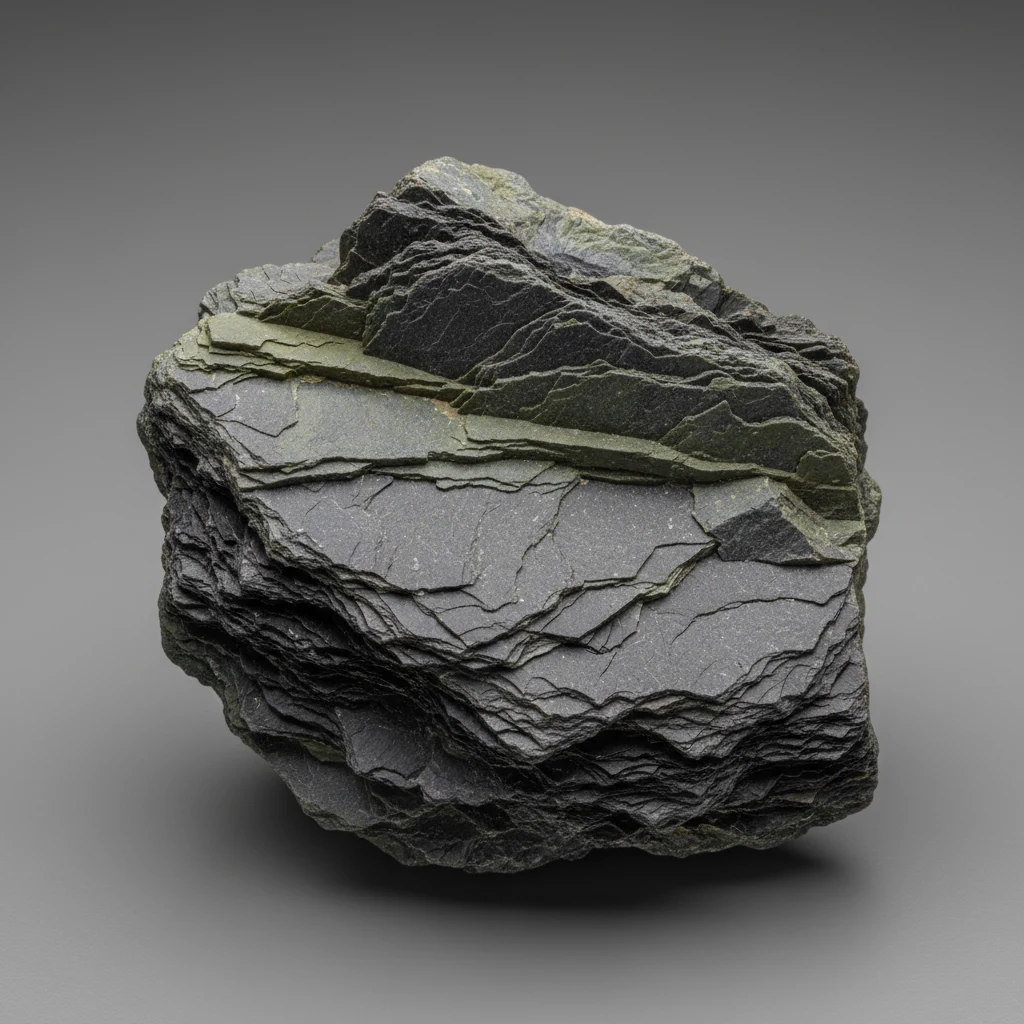
Slate is a fine-grained metamorphic rock known for splitting into thin, flat layers. In the hand, it feels compact and plate-like rather than sparkly or granular, with a typically dull surface that may turn slightly glossy across fresh, flat faces.
Most specimens are grey, green, or black, though slate can also appear red. Collectors value it less for rarity and more for its clean foliation, durability, and recognizable structure. Its Mohs hardness is 3-5, with fair scratch resistance, good toughness, and moderate durability overall.
Origin & History
The name slate comes from the Old French word “esclate,” meaning “to split.” That name fits the rock exactly: a good piece separates into flat sheets, giving it the crisp layered look that makes slate easy to recognize among metamorphic rocks.
Slate was first described in the early 19th century and remains a common, widely available rock type. For locality checking, collectors often compare place names such as Slate Valley, North Wales, and Hubei Province with entries on mindat.org, especially when documenting a labeled specimen.
Where Is Slate Found?
Slate is found in regions with metamorphic rock formations. Reported countries include the United States, the United Kingdom, and China, with notable localities including Slate Valley in Vermont, North Wales in the UK, and Hubei Province in China.
Formation
Slate forms when shale undergoes metamorphism under heat and pressure. That process produces foliation, the internal alignment that lets slate split into thin, flat layers rather than breaking randomly like many massive rocks.
This formation history explains the way slate behaves in the hand: broad planes, compact grain, and a sheet-like structure. Its listed chemical classification is phyllosilicate, with formula Al2Si4O10(OH)2 and common impurities including Fe and Ti.
How to Identify Slate
Identify slate by its fine grain, flat layered structure, and ability to split along smooth planes. Typical colors include grey, green, red, and black, and the surface is usually dull to slightly glossy, opaque, and non-magnetic.
A scratch test can help confirm its Mohs hardness range of 3-5. Slate has a light grey streak, density of 2.7-2.8 g/cm3, conchoidal fracture, and an orthorhombic listed crystal system; in practice, the layered, flat texture is the quickest field clue.
Properties of Slate
Physical Properties
| Crystal System | Orthorhombic |
| Hardness (Mohs) | 3-5 (Medium (4-6)) |
| Density | 2.7-2.8 g/cm3 |
| Luster | Dull |
| Diaphaneity | Opaque |
| Fracture | Conchoidal |
| Streak | Light grey |
| Magnetism | Non-magnetic |
| Colors | Grey, Green, Black |
Chemical Properties
| Classification | Phyllosilicate |
| Formula | Al2Si4O10(OH)2 |
| Elements | Si, Al, O |
| Common Impurities | Fe, Ti |
Optical Properties
| Refractive Index | Not applicable |
| Birefringence | None |
| Pleochroism | None |
| Optical Character | Isotropic |
Slate Health & Safety
Slate poses no significant health risks.
Slate Value & Price
Price Range
Rough/Tumbled: $5 - $30 per specimen
Cut/Polished:
Price is influenced by color, texture, and local availability.
Durability
Moderate — Scratch resistance: Fair, Toughness: Good
Slate is stable under normal conditions but can chip or crack with impact.
How to Care for Slate
Use & Storage
Store in a cool, dry place away from direct sunlight.
Cleaning
Clean with a damp cloth and mild soap if necessary. Avoid harsh chemicals.
Cleanse & Charge
Leave in sunlight for a few hours to cleanse and recharge.
Placement
Place in areas where you seek grounding energy.
Caution
Avoid dropping as it can chip or crack.
Works Well With
Slate Meaning & Healing Properties
In crystal healing traditions, slate is used for stability, grounding, and mental clarity. Its calm, heavy, sheet-like presence makes it a practical stone for placement in areas where you want a steadier atmosphere, though it is not a substitute for medical treatment.
Slate is associated with the Root and Third Eye chakras, Capricorn and Aquarius, the planet Saturn, and the Earth element. It pairs well with quartz, amethyst, and sodalite, and it can be cleansed by leaving it in sunlight for a few hours.
Identify Slate from a photo
Compare Slate traits, care tips, value clues, and common lookalikes with a clear photo.
Common mistakes
- Calling any flat gray rock slate without checking for true slaty cleavage.
- Confusing shale bedding with metamorphic cleavage.
- Assuming all black slate is the same material or from the same quarry.
- Identifying polished tile from the top surface only instead of inspecting an edge.
- Using color alone to separate slate from phyllite, schist, basalt, or shale.